
On the evening of 19 September 2026, the yen slipped into the 158 range against the dollar, and Bank of Japan officials picked up the phone. Governor Kazuo Ueda had just finished a press conference. Japan’s five-day Silver Week holiday, running 19-23 September, was hours away, ready to drain liquidity from the market.
For anyone holding yen exposure, that combination is worth understanding. A BoJ rate check is never publicly announced, leaves no official record when it happens, and yet it can move currency markets in minutes. If you trade or invest in yen pairs and you treat the phrase as background noise, you are operating blind at exactly the moments volatility runs highest.
Here is what a rate check actually signals, how it fits inside Japan’s wider intervention machinery, and why a holiday calendar deserves a permanent place in any yen trader’s toolkit. You will finish knowing how to read the signal when it surfaces in a headline, and, just as importantly, where that reading can quietly go wrong.
What a BoJ rate check actually is (and what it is not)
You spot it first as a line in a news feed: “BoJ conducts rate check.” Prices twitch. The yen firms. Something has happened, but nothing has officially been announced.
A rate check is a phone call. Officials from the Bank of Japan or the Ministry of Finance contact banks and major dealers and ask a simple question: at what exchange rates are foreign-exchange transactions currently being executed? On paper it looks like data gathering. In practice, the market treats it as something else entirely.
The act of asking is the message. Traders read the call as a probe conducted before possible intervention, not a passive inquiry, which is why CNBC characterises rate checks as a move usually seen as a precursor to intervention.
A rate check is “a move usually seen as a precursor to intervention.” (CNBC)
Three features define it:
- Informal phone contact with banks and dealers, not a formal notice
- No public announcement at the time it occurs
- No real-time official record confirming it happened
The signal, in other words, reaches you through reported sightings and bank dealer networks rather than any statement from Tokyo. That absence of an official record is not ambiguity. It is the design. The informal, deniable nature of the call is precisely what lets authorities signal readiness without committing to a single move.
The September episode fits the template. According to Financial News, BoJ officials contacted banks after the yen fell into the 158 range, following the Ueda press conference and ahead of the Silver Week holiday. MUFG analyst Michael Wan characterised an earlier rate check as elevating intervention risk, with the pair subsequently retreating from its post-meeting high to below the 157 level.
If you see “BoJ rate check” and file it under routine market commentary, you have misread the signal. Understanding the procedural reality behind the phrase is the difference between a calibrated response and a reactive one.
When big ASX news breaks, our subscribers know first
How rate checks fit inside Japan’s broader FX intervention framework
A rate check does not exist on its own. It sits on a ladder, and each rung is built to achieve an effect without necessarily forcing authorities to climb to the next one.
Japan’s defence of the yen runs across three layers. First come verbal warnings from Ministry of Finance officials. Then rate checks, a procedural escalation that raises the perceived stakes. Finally, actual foreign-exchange operations, the terminal step Tokyo has deployed only at genuinely critical moments.
There is a clear division of labour behind this. The Ministry of Finance authorises and funds any actual intervention. The Bank of Japan executes the rate checks and carries out market operations on the ministry’s behalf.
The rhetoric keeps the ladder live. Finance Minister Satsuki Katayama has repeatedly said Tokyo “will respond appropriately at any time as needed.” On 4 September 2026, currency diplomat Atsushi Mimura told Reuters he remained “on alert” and that Tokyo stood ready to intervene against excessive yen declines.
The August 2026 coordinated yen intervention illustrated a structural escalation beyond anything the rate-check ladder alone could signal: the US Treasury sold euro reserves rather than dollars to avoid flooding its own bond market, a design choice that reveals how deeply the two governments had assessed systemic spillover risk before acting.
| Tool | Who deploys it | Typical market effect |
|---|---|---|
| Verbal warning | MoF officials | Dampens momentum |
| Rate check | BoJ, on MoF’s behalf | Signals readiness to act |
| Actual FX operation | MoF funded, BoJ executed | Direct price impact |
What makes the lower rungs credible is the threat sitting at the top. That threat has a documented price tag.
The scale of Japan’s intervention firepower
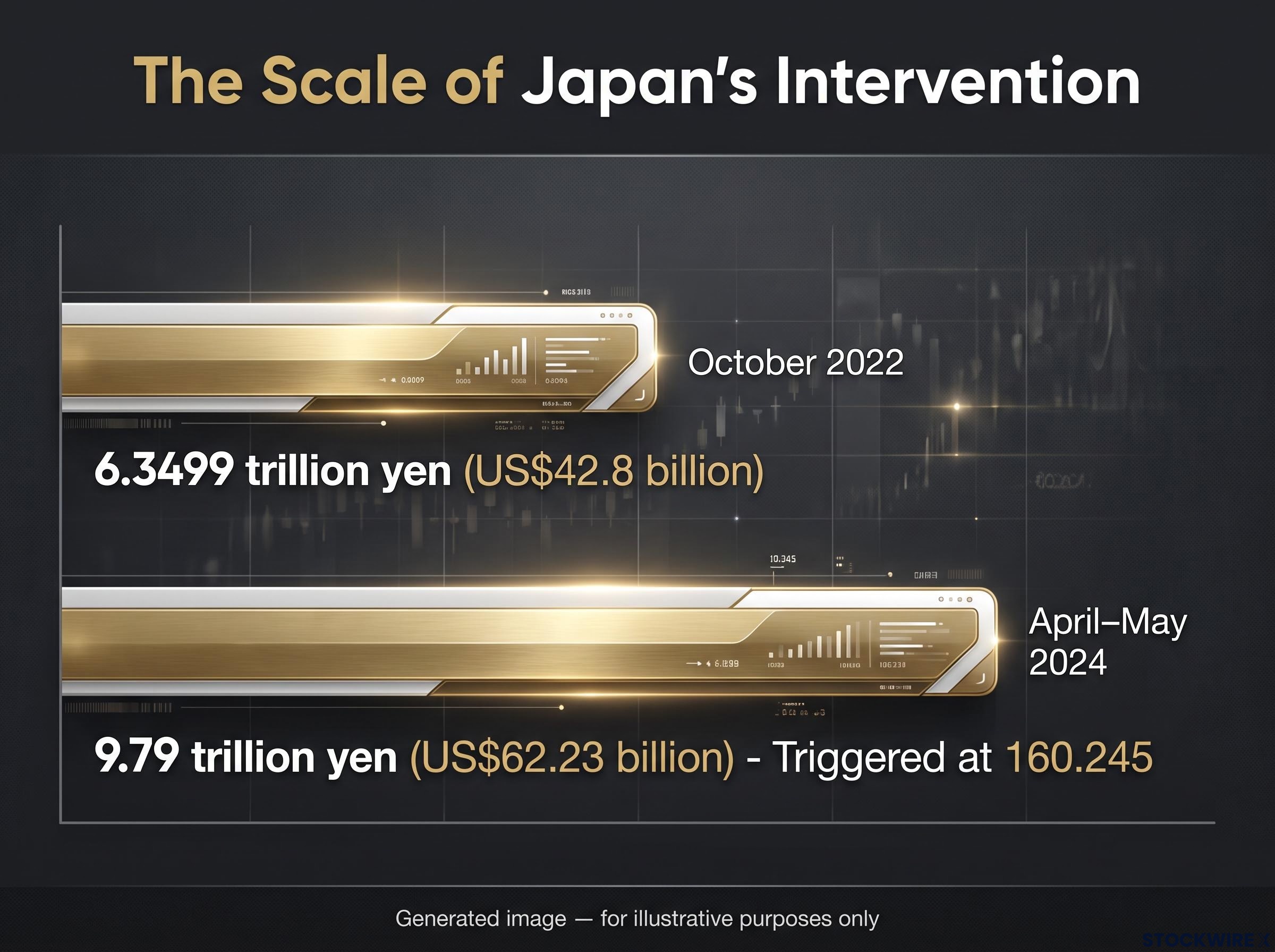
The numbers do the persuading. In October 2022, Japan spent 6.3499 trillion yen (around US$42.8 billion) buying yen and selling dollars, its largest yen-support operation at the time, according to Reuters data. Then came the record: 9.79 trillion yen (roughly US$62.23 billion) across late April and early May 2024, triggered when the pair hit 160.245, the largest single campaign on record.
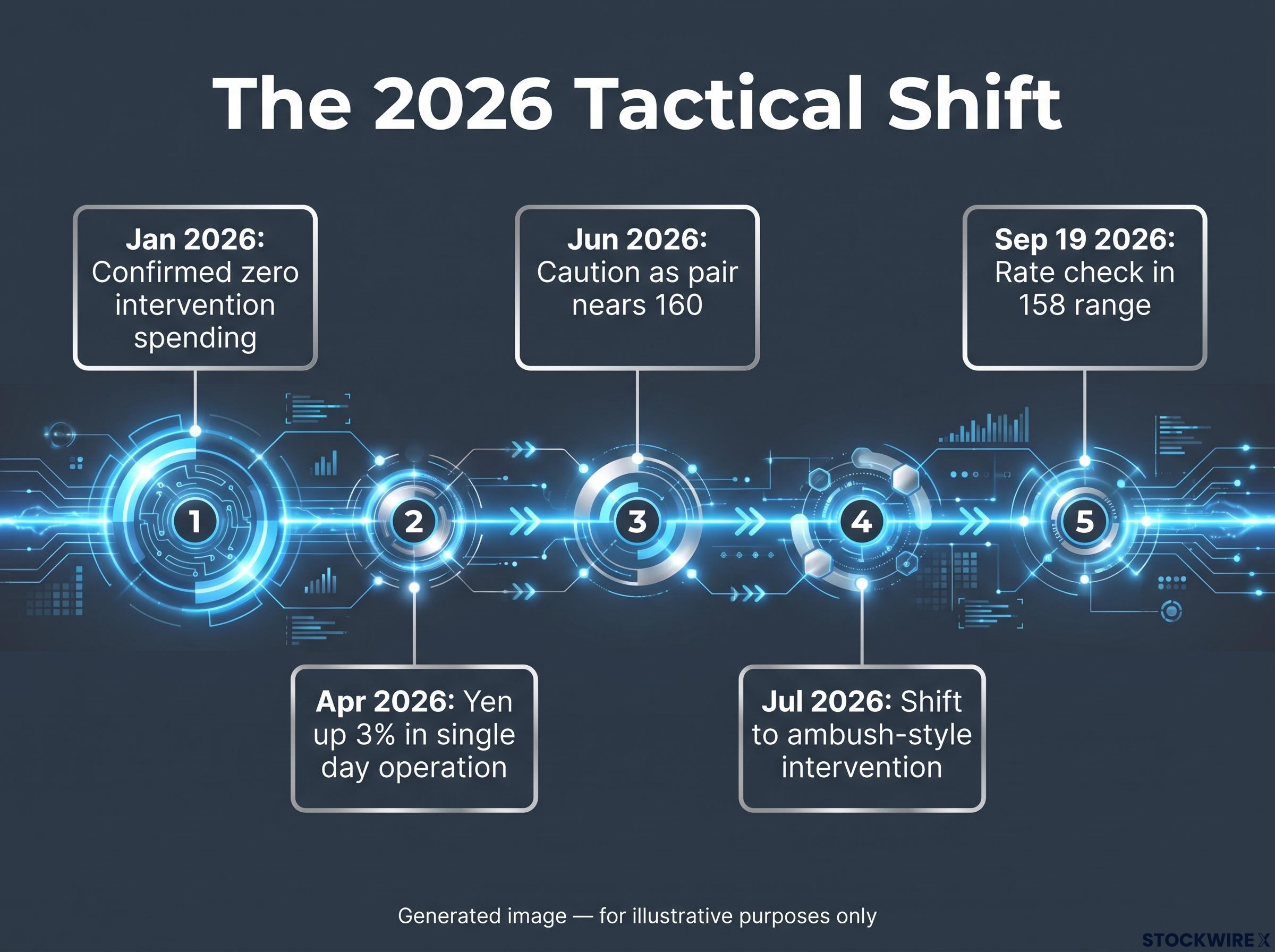
Authorities have shown they will still pull the trigger. In April 2026, Japan stepped into the market for the first time in two years, sending the yen up as much as 3% in a single day.
Yet the ladder does not always end in action. Ministry of Finance data published on 30 January 2026 confirmed zero intervention spending from 29 December 2025 through 28 January 2026, a five-week stretch that ran right through active verbal warnings.
The MoF monthly intervention data, published by the Ministry of Finance and updated through the most recent reporting period, provides the primary source record for every yen-support operation, including the zero-spending confirmation for the five-week window through late January 2026 that the article references.
That zero-spending window tells you something precise. Verbal escalation and rate checks are not automatic preludes to action. Working out where authorities actually sit on the ladder means reading the whole sequence, not any single rung. A rate check is a checkpoint, and its meaning depends on what came before it and which levels are politically sensitive at the time.
Why holiday windows amplify the stakes around rate checks
Start with how liquidity works. In foreign-exchange markets, liquidity is simply how many buyers and sellers are active and how much currency they are willing to trade at a given moment. It varies enormously by session and by calendar.
During holiday periods, domestic participants step back and the order books thin out. Fewer players are standing ready to absorb large trades, so the same volume of currency pushes the price farther than it would in a deep, fully staffed market.
That single mechanical fact is why holidays matter to intervention:
- Thinner order books amplify every price move
- Domestic participants step back, reducing the resistance to official operations
- Authorities achieve a larger effect for each yen deployed
The Golden Week intervention of April-May 2026 is the clearest modern case study in how holiday windows change the arithmetic of official operations, with an estimated 8-9 trillion yen deployed precisely because thin domestic liquidity amplified each yen of firepower.
In other words, thin markets hand authorities a structural advantage. The same firepower buys a bigger move, which is exactly why the timing of rate checks is rarely accidental.
The pattern shows up cleanly in the recent record. The 19 September 2026 rate check was timed directly ahead of the five-day Silver Week holiday, with the pair near 158 after the Ueda press conference. An earlier episode ran in the New York session before a three-day holiday window, and the yen firmed below 157 in the following Asian Monday session, according to MUFG’s Michael Wan.
Reuters notes that Japanese authorities monitor FX markets during foreign holidays because reduced participation can magnify the effect of official operations or sharp exchange-rate moves.
The large operations of October 2022 and April-May 2024 also landed while the yen was moving rapidly, often in thinner conditions.
For you, holding a yen position into a known Japanese or US holiday, this is not soft background. The risk of sudden official action is structurally elevated, not because the calendar changes fundamentals, but because it shifts the economics of intervention in the authorities’ favour. Holiday windows are operational risk variables, and they move the probabilities in a direction the historical record has documented repeatedly.
How to read a rate check as a market signal (and where the reading can go wrong)
Ask three analysts what a rate check predicts and you may get three answers. Each camp has a real case.
The first camp treats rate checks as reliable pre-intervention signals. Their strongest evidence is the April 2026 sequence: verbal warnings and reported checks, followed by Japan actually entering the market and pushing the yen up around 3% in a single day, its first operation in two years. On this reading, when the currency nears politically sensitive levels, the signals lead the action.
The second camp sees potential empty threats with diminishing returns. Their evidence is the January 2026 zero-spending confirmation, and Reuters reporting from 2 June 2026 that authorities held back from stepping up warnings even as the pair neared 160, reflecting caution after interventions delivered only “fleeting impact.” Even the 9.79 trillion yen deployed in 2024 produced temporary relief rather than a durable trend reversal.
Reserve constraints across Asian currencies show that yen defence is not an isolated challenge: cumulative Asian equity outflows reached $134 billion through mid-June 2026, more than triple the 2025 total, and the RBI alone spent more than $53 billion in spot FX sales while the PBOC engineered yuan stability through midpoint management rather than transparent intervention.
The third camp points to a change in tactics. Reuters reported on 2 July 2026 that Japan had shifted toward ambush-style intervention, with officials abandoning the habit of telegraphing intervention risks in favour of sudden moves designed to squeeze speculators.
That shift matters more than it might first appear. It means you can no longer treat the presence or absence of visible escalation signals as a reliable guide to whether intervention is imminent. For anyone holding leveraged yen positions, that raises the baseline risk in both directions at once.
Carry trade unwind mechanics sit beneath the surface of every intervention episode: when authorities successfully push the yen higher, leveraged yen-funded positions across global equities, bonds, and emerging-market assets face simultaneous pressure, meaning the cross-asset consequences of a successful rate check follow-through extend well beyond the currency pair itself.
Five risk factors to hold alongside any rate-check reading
- False or non-binding signals. The five weeks of zero spending through late January 2026, despite active warnings and reported checks, prove signalling alone does not guarantee an operation.
- Intervention fatigue and diminishing returns. Reuters’ June 2026 reporting cites official caution after interventions delivered only fleeting impact, meaning markets increasingly fade the threat.
- Sudden gap risk from ambush tactics. The July 2026 shift away from telegraphing raises the odds of sharp overnight gaps, slippage, and stop-outs when authorities act without warning.
- Liquidity and execution risk in holiday windows. Rate checks cluster near holidays, and any follow-through operation can produce outsized moves and wider spreads, as the Silver Week timing illustrates.
- Reserve capacity and political-constraint risk. Trillions of yen in 2022 and 2024 bought only temporary relief, a reminder that policymakers may simply choose not to act if they judge the weak yen consistent with domestic policy.
| Signal type | What it suggests | Limitation |
|---|---|---|
| Verbal warning | Authorities uncomfortable with the move | Can persist for weeks with no action |
| Rate check | Readiness to intervene is elevated | Not always followed by an operation |
| Confirmed zero intervention | Authorities chose restraint | Can reverse without notice |
| Actual FX operation | Direct, funded price defence | Impact may prove temporary |
| Ambush intervention | Deliberate surprise to squeeze shorts | Removes the warning signals entirely |
A rate check is a meaningful signal. It is not a binary predictor. A framework that holds all three interpretations at once gives you a more defensible basis for position management than treating any single headline as definitive.
Reading the yen’s defence playbook without overconfidence
Pull the threads together and the core lesson is straightforward. A BoJ rate check is a genuine signal of official readiness and elevated risk. It also sits inside a framework where the link between signalling and action has been made deliberately ambiguous.
The September 2026 episode illustrates both the value and the limit at once. A rate check at 158, ahead of five days of thinned Silver Week liquidity, following a policy rate hike to around 1.25%, is a configuration that ticks several risk boxes simultaneously. None of them guarantees a specific outcome.
That is why the full picture beats any single headline. Whether the next rate check graduates to actual intervention will depend on a handful of variables worth watching:
- How close the pair sits to historically sensitive levels, with the 160.245 trigger from April-May 2024 as the reference point
- Known Japanese and major foreign holiday windows, where thin liquidity shifts the economics of intervention
- The official escalation sequence, meaning how many warning layers have already been deployed
The April 2026 re-entry is your reminder that Japan has shown it will act within the current period. Read the rate level, the liquidity window, the policy backdrop, and the tactical evolution together, and you are far better placed to make a calibrated judgment than someone reacting to a single rate-check headline in isolation.
This article is for informational purposes only and should not be considered financial advice. Investors should conduct their own research and consult with financial professionals before making investment decisions. Past performance does not guarantee future results, and forward-looking statements about intervention are speculative and subject to change based on market developments and official policy decisions.