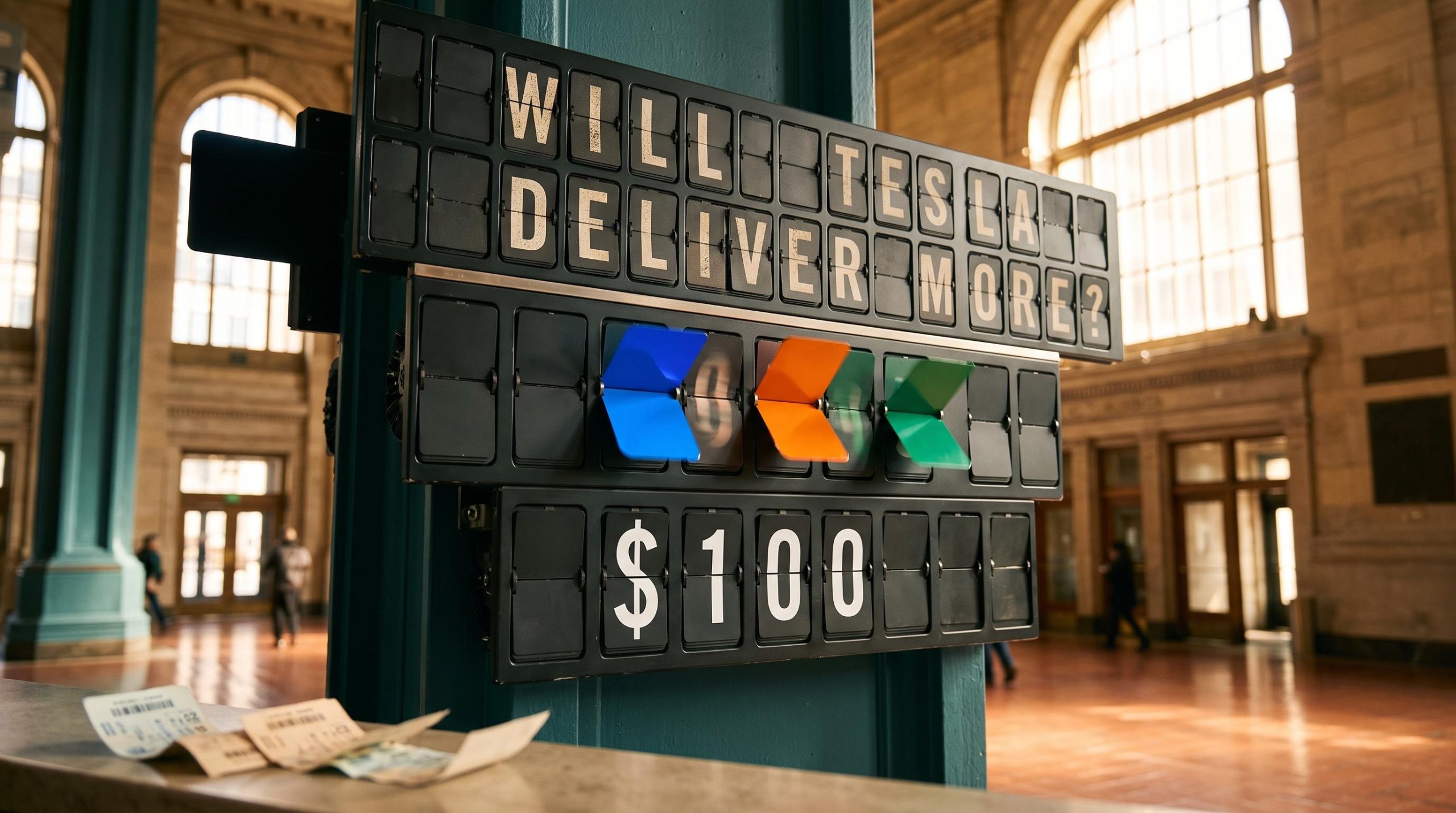
Ask whether Tesla will deliver more vehicles than a set number this quarter, and you might assume there is only one way to bet on the answer. There is not. Depending on who lists it, that question can legally be a security, a swap or an event contract, and each version comes with a different rulebook.
That tension sits at the centre of Cboe prediction markets. Cboe Global Markets has placed outcome-based products inside the listed-options system you may already know. Kalshi and Polymarket, by contrast, operate under different frameworks.
Each product is at a different stage. As of 9 November 2026, Cboe’s XSP binary options and spreads are trading. Its corporate metric options have regulatory approval but have not been reported live, and its macroeconomic products are still at the planning stage.
Once you know how these products work, you can tell them apart, see why the regulatory route shapes each design, and judge where each one might fit your own objectives. All figures are in US dollars.
What is Cboe building, and how does it differ from Kalshi and Polymarket?
Cboe groups its outcome-based products under the name Cboe Predicts. Joe Green, Cboe’s head of prediction markets, has described the market as early stage. You will see why when you look at the status of each product family:
- Live: Binary options and quoted $1-wide vertical spreads on XSP, the mini-sized S&P 500 index option. These launched in June 2026.
- Approved, awaiting launch: Corporate key performance indicator (KPI) options. A KPI is a measurable business result a company reports, such as deliveries or subscribers.
- Planned, no firm dates: Macro-indicator products, such as nonfarm payrolls and inflation, for Cboe’s side regulated by the Commodity Futures Trading Commission (CFTC).
The comparison with rivals is about structure, not about which platform is better. Cboe’s products sit under the Securities and Exchange Commission (SEC), while Kalshi runs as a CFTC-regulated designated contract market (DCM), the CFTC’s term for a regulated futures and event-contract exchange.
| Attribute | Cboe Predicts | Kalshi | Polymarket |
|---|---|---|---|
| Regulatory route | SEC securities-options framework | CFTC-regulated DCM | Varies; has engaged with both SEC and CFTC |
| Clearing | Options Clearing Corporation (OCC) for XSP; Cboe Clear U.S. for KPI products | Kalshi Klear, a CFTC-registered clearing house | Varies by product and venue |
| Counterparty model | Central clearing house becomes principal counterparty | Central clearing through Kalshi Klear | Not the same securities-clearing model |
| Product style | Standardised listed options with market makers and surveillance | Yes/no event contracts | Event contracts, terms vary |
Green argues that CFTC-only venues cannot list spread packages, because they lack the underlying options markets those spreads are built from. Commentator Elias Piwak has added that an exchange or clearing house counterparty removes the over-the-counter (OTC) worry about the other side of a private deal failing to pay.
For you, the takeaway is simple. “Prediction market” is a label covering structurally different products, so comparing platforms by name alone will mislead you.
If you are new to the category, it helps to see how prediction markets work at a basic level: traders buy and sell contracts whose prices reflect the crowd’s implied probability of an outcome, and the data on who profits is sobering.
When big ASX news breaks, our subscribers know first
How do XSP binary options and $1 vertical spreads actually work?
Start with the live products, since they are the ones you can trade today. Cboe offers two shapes of payoff, and the difference between them explains why both exist.
Binary payoff
A binary option is a contract that pays a fixed amount or nothing. On XSP, it pays $100 if it finishes in the money and zero otherwise. Your maximum loss is the premium you paid.
Say you buy a binary call that pays if XSP closes above a chosen strike. If XSP closes even slightly above that level, you collect $100. If it closes slightly below, you get nothing. That is the cliff.
Vertical spread payoff
A vertical spread is a pair of options with the same expiry but different strike prices, bought and sold together as one package. Cboe’s quoted spreads are $1 wide and pay between $0 and $100. If XSP settles between the two strikes, you receive a partial payout that rises with where XSP lands.
Suppose XSP settles halfway between the strikes. Your payout would sit around the middle of that range rather than at zero or the full amount. The slope softens the cliff, so you still need to be right on direction, but you need less precision.
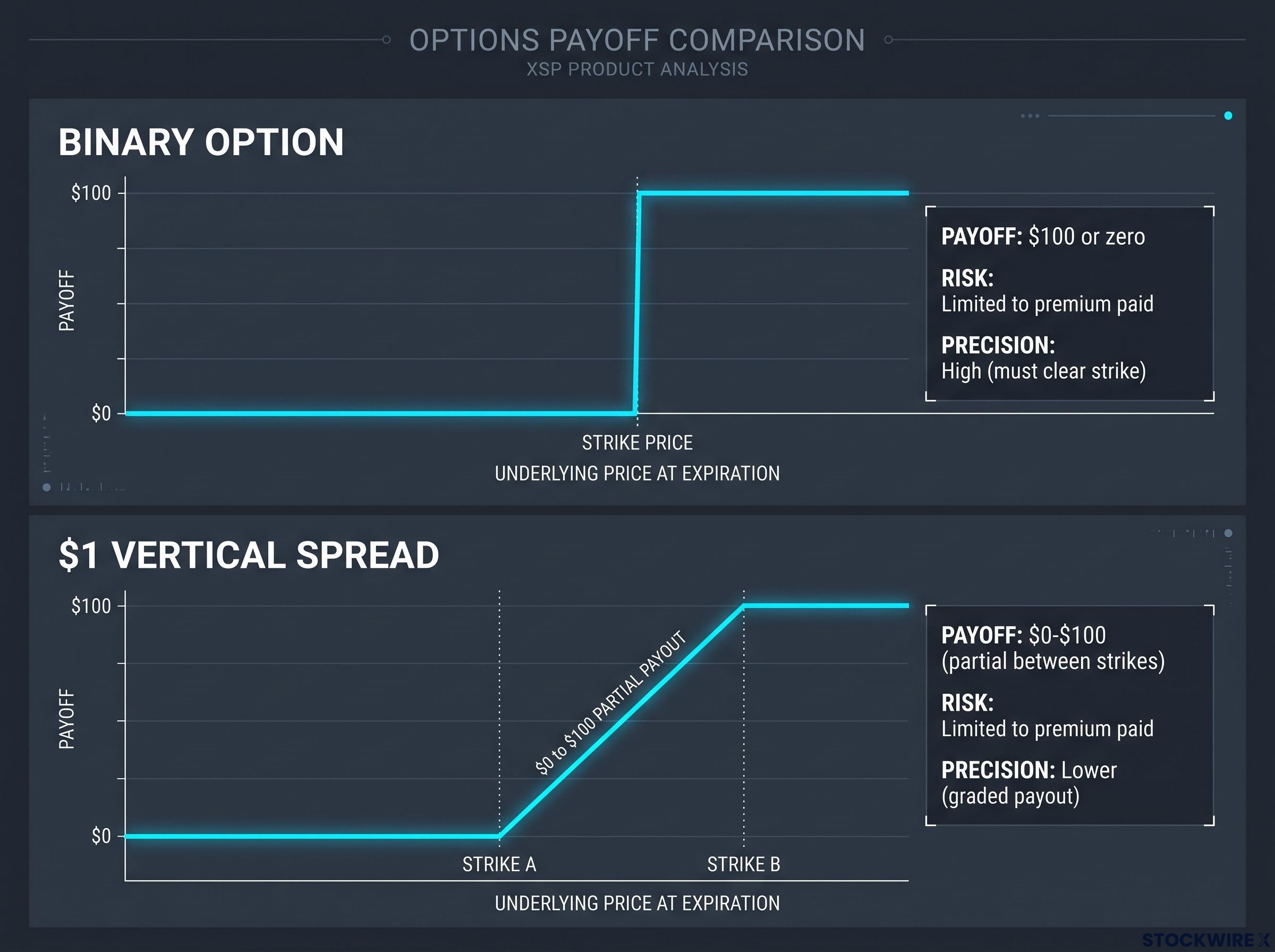
Binary options pay out $100 or zero, whereas $1 vertical spreads offer a graded partial payoff between $0 and $100.
| Feature | Binary option | $1 vertical spread |
|---|---|---|
| Payoff | $100 or zero | $0-$100, partial between strikes |
| Risk | Limited to premium paid | Limited to premium paid |
| Precision needed | High: must clear the strike | Lower: graded payout |
| Design role | Simple directional view | Defined risk with conventional options behaviour |
Expirations run on the current and next trading day, known as 0DTE and 1DTE (zero or one day to expiration). Cboe says every possible $1-wide call and put spread on listed XSP strikes can be designated for quoting through its Quoted Spread Book, and all of it clears through the OCC. Trading follows three sessions:
- Global Trading Hours: 8:15 p.m.-9:25 a.m. ET
- Regular Trading Hours: 9:30 a.m.-4:15 p.m. ET
- Curb: 4:15-5:00 p.m. ET
Round-the-clock trading is a stated goal, but Cboe has given no confirmed timetable.
Broker distribution matters as much as the contract design, and retail access to binary options is expanding as Schwab prepares to offer the XSP contracts to its customers alongside the all-or-nothing payout risks that come with them.
Early volume swung sharply. On the second trading day, 147,500 options changed hands, with nearly all of the flow coming from institutions. By the second week, about 200,000 options traded, mostly retail 0DTE binary calls. That swing tells you early flow is unsettled, and one day’s participation mix says little about who this market will ultimately serve.
Why does the securities-versus-commodities split shape product design?
The XSP products are clearly securities, because they reference a stock index. Once a contract references something else, such as a company’s sales or the inflation rate, the question becomes harder. Which regulator oversees it?
In plain terms, the SEC regulates securities, such as shares and options on them. The CFTC regulates commodities and derivatives, such as futures and swaps. Cboe treats company-reported metrics disclosed in SEC filings as securities, while payrolls and inflation fit commodities-style event contracts. Cboe CEO Craig Donohue put the company’s view plainly in comments reported by Politico in September 2026:
Craig Donohue, Chief Executive Officer, Cboe Global Markets Corporate-metric products are, in Donohue’s view, economically and legally securities.
Green frames the difference as one of purpose. SEC rules focus on capital formation, while the CFTC framework grew out of hedging risk, and he calls both intentional design features. That choice flows into four practical effects:
- Reference asset: Company metrics fit securities-linked KPIs; payrolls and inflation fit economic event contracts.
- Exchange and clearing route: The SEC route uses a registered securities exchange and securities clearing; the CFTC route uses a DCM and a derivatives clearing organisation (DCO).
- Investor protection: The SEC route brings securities rules, exchange surveillance and OCC or Cboe Clear U.S. clearing; the CFTC route brings Commodity Exchange Act (CEA) anti-manipulation rules and DCM oversight.
- Legal uncertainty: The same exposure could be packaged as a security, swap, event contract or impermissible gaming product.
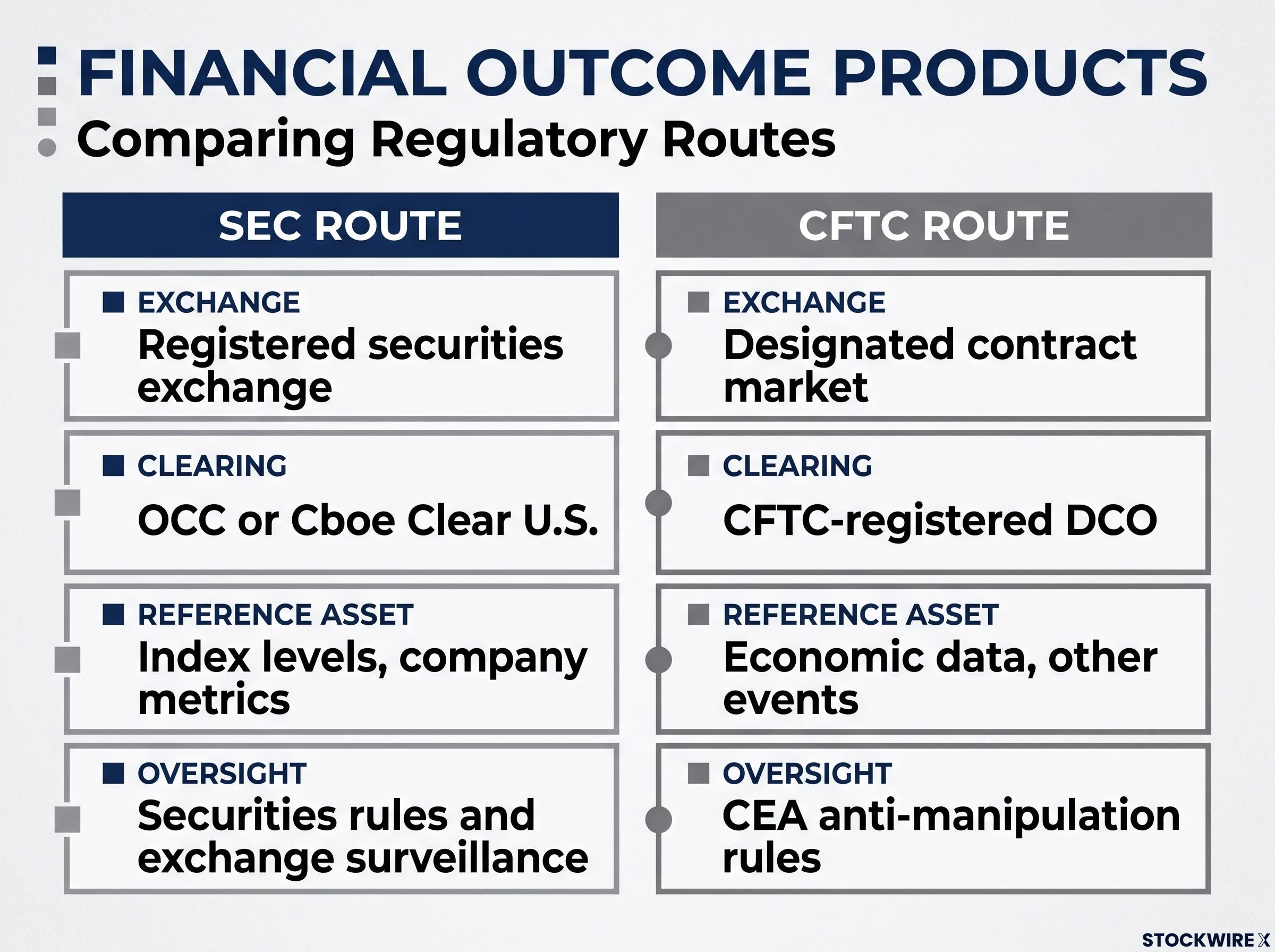
The SEC and CFTC regulatory frameworks dictate different exchange types, clearing houses, and oversight rules for prediction markets.
| Feature | SEC route | CFTC route |
|---|---|---|
| Exchange type | Registered securities exchange | Designated contract market |
| Clearing | OCC or Cboe Clear U.S. | CFTC-registered DCO |
| Reference asset | Index levels, company metrics | Economic data, other events |
| Oversight | Securities rules and exchange surveillance | CEA anti-manipulation rules |
The boundary is contested. Kalshi argued in an SEC comment letter that Cboe’s classification of these contracts as securities options rather than swaps was open to challenge. SEC Chair Paul Atkins noted that the approval did not rule out CFTC jurisdiction over differently structured contracts tied to the same metrics.
Meanwhile, the CFTC asserts exclusive federal jurisdiction over event contracts on its exchanges and has sued states seeking to restrict them, with Kentucky, Wisconsin, Ohio and Tennessee among those challenging this activity. For you, “same bet, different rulebook” is a real difference. Your venue decides your protections and your clearing.
How do corporate KPI options work, and who would use them?
Picture a contract that pays $1 if Tesla’s deliveries clear a set threshold, and nothing if they fall short. That is the basic shape of Cboe’s corporate KPI options: cash-settled, European-style binary options, meaning they can only be exercised at expiry, cleared through Cboe Clear U.S.
The SEC approved the listing rules on 13 October 2026, and Cboe Clear U.S. received temporary clearing registration on 23 October 2026. Management has said it anticipates a November 2026 launch, though trading had not been reported live as of 9 November. The SEC order stated that approving the rules did not itself authorise immediate trading.
The initial universe covers 23 companies. Example metrics include:
- Tesla vehicle deliveries
- Apple iPhone net sales
- Duolingo paid subscribers
- Disney theme-park attendance
- Nvidia data centre revenue
- Amazon AWS revenue
Distribution is planned through Robinhood, with Interactive Brokers also named. Cboe plans expirations from intraday to quarterly, with contract sizes expected to vary. Keep the notional difference straight: XSP binaries pay $100 and clear through the OCC, while KPI contracts pay $1 and clear through Cboe Clear U.S.
Who might hedge with these
Green’s example captures the appeal:
Joe Green, Head of Prediction Markets, Cboe A glass supplier exposed to iPhones could hedge iPhone revenue directly, rather than hedging Apple stock as a whole.
Other uses follow the same logic. A component or logistics supplier could hedge a customer’s unit sales falling below a threshold. A portfolio manager could hedge an earnings-related exposure without shorting the stock or using an OTC swap.
The attraction is reduced basis risk, which is the gap between what you are hedging and what your hedge actually tracks. If you are a hedger, you gain precision by matching the contract to your exposure, but you accept thinner liquidity and settlement-definition risk in return. Any expectations about these products are speculative and subject to change based on market developments and company performance.
For readers wanting to go deeper on company-metric products, our dedicated guide to Cboe KPI contracts explains why the designated data source and metric definition decide whether a correct view actually pays.
What risks and open questions should readers weigh?
Simple payoffs can make a product feel safe. They do not make it low risk. Run through these checks before you trade:
- Liquidity: Trading may concentrate in a few strikes, expirations and market makers, making exits costly.
- Retail suitability: 0DTE products encourage rapid speculation, and a fixed payout can hide the implied probability, fees, spread and time decay you are paying for.
- Settlement definitions: KPI outcomes depend on accounting definitions, reporting periods and restatement policies, so revisions could spark disputes.
- Information asymmetry: Suppliers, analysts and insiders may understand a metric far better than you do.
- Manipulation: Narrow markets may be exposed to reporting-timing games or trading on confidential information.
Volume headlines need care too. The figures below are platform-wide, so they cannot be set against Cboe’s product-specific numbers.
| Platform | Volume | Comparability note |
|---|---|---|
| Kalshi (October 2026) | ~$98.2B | Platform-wide contract volume |
| Polymarket (October 2026) | ~$20.2B | Platform-wide volume |
| Total sector (October 2026) | ~$123.3B | All platforms combined |
| Cboe XSP products | Hundreds of thousands of contracts per week | Product-specific contract counts, not dollars |
Contract volume also differs from the dollars of risk actually transferred. High numbers do not mean a mature market.
Regulation remains the largest open question. Polymarket told CNBC in July 2026 that duplicative or conflicting SEC and CFTC requirements could harm innovation, and state-versus-federal litigation continues.
What to watch as listed prediction products mature
The structure is now clear: a securities route for index and company metrics, a CFTC route for economic data, and increasingly granular contracts. Liquidity and legal boundaries, however, are still forming. Watch for:
- KPI options going live after the anticipated November 2026 launch
- Institutional participation growing beyond the retail-led start Green described
- Launch dates for the CFTC-side macro products
- Progress on 24/7 trading
Before you trade any of these, decide what you are trying to do. A short-term index view, a precise business hedge and an economic-data bet each point to a different product, venue and rulebook.
Investors weighing how new contract types affect the listed venues themselves can look at exchange liquidity moats, which have historically withstood challengers and complicate the disruption case for unregulated prediction markets.
This article is for informational purposes only and should not be considered financial advice. Investors should conduct their own research and consult with financial professionals before making investment decisions.