
You study a company for weeks. You build your earnings model, stress-test the assumptions, and land on an EPS estimate that turns out to be almost exactly right. The company reports. Your number was correct. And you still lose money, because the stock drops 3% on a cautious forward guidance comment that had nothing to do with the quarter’s actual results.
That gap between “right about the business” and “wrong about the stock” is the specific frustration Cboe‘s newest product suite is designed to close. In June 2026, Cboe launched its first binary options on the Mini S&P 500 Index (XSP) under the Cboe Predicts brand, bringing prediction-market-style payoffs onto a regulated U.S. exchange for the first time at scale. Next in the pipeline: KPI binary contracts tied directly to company-reported metrics like EPS and revenue, targeting a launch as early as late Q3 to early Q4 2026, pending regulatory approval.
This is not an incremental update to existing options. It is a structurally new category of instrument. Here is exactly how these contracts work, how they differ from both standard options and prediction market platforms, and which traders they are actually built for.
What “binary” actually means in this context
A binary option pays a fixed amount if a stated condition is met at expiration, and nothing if it is not. That is the entire payoff structure. There is no sliding scale, no multiplier effect, and no scenario where being “more right” earns you more money.
This is the core difference from a standard call or put. With a conventional option, your payoff grows continuously the further the underlying moves beyond your strike. A binary does not work that way. You are either correct or you are not, and the payout is the same either way.
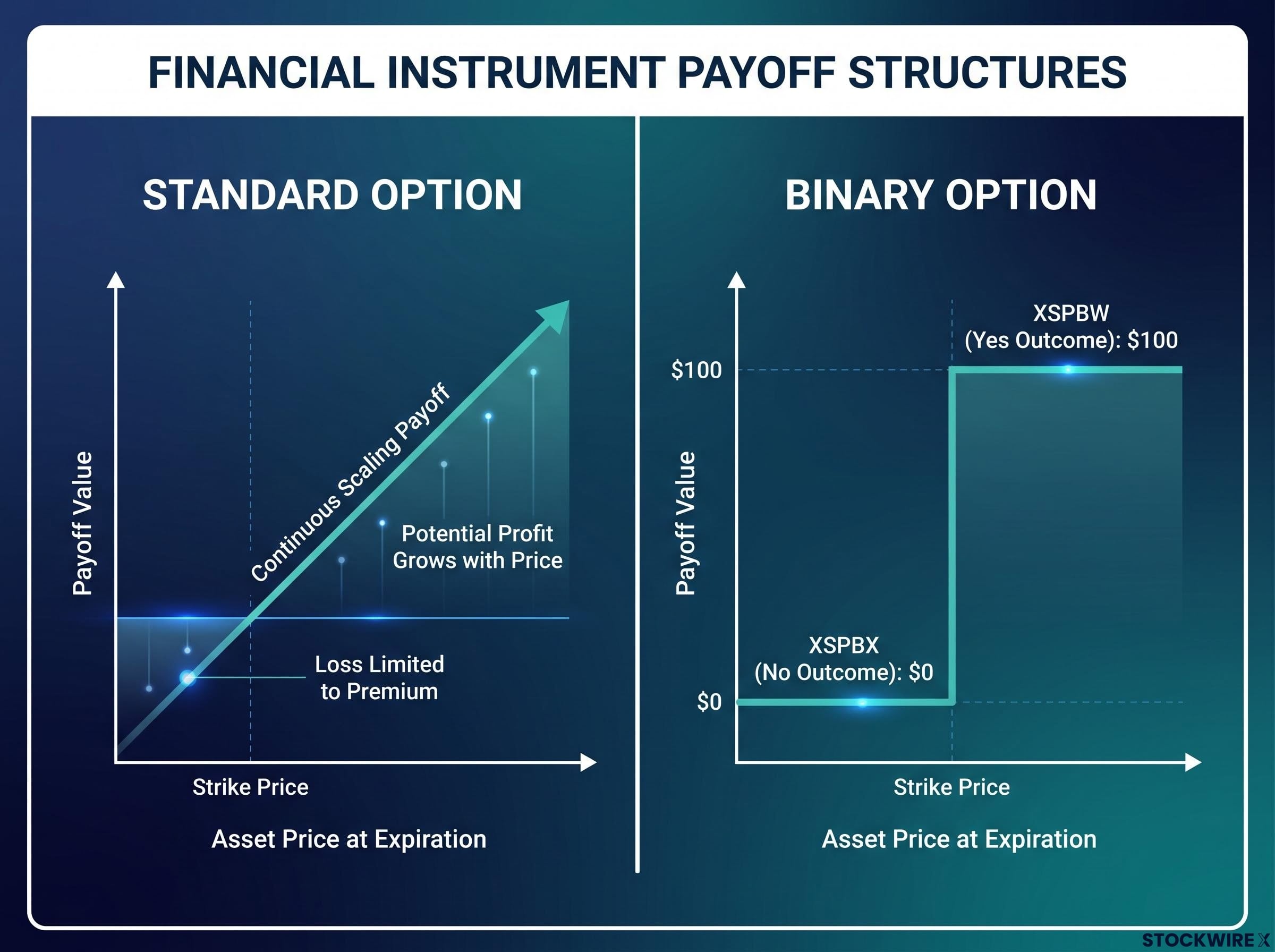
XSP binary payoff: XSPBW (the “Yes” contract) pays $100 if XSP settles at or above the strike at expiration. XSPBX (the “No” contract) pays $100 if XSP settles below. The losing side receives $0. Maximum loss for a long position is the premium paid.
Because the payout is fixed, the price you pay for the contract during trading reflects something specific: the market’s implied probability that the condition will be met. If the contract trades at $65, the market is pricing roughly a 65% chance the condition is satisfied. That makes the analytical task fundamentally different from standard options. You are not competing on how large a move will be. You are competing on whether your probability estimate is more accurate than the market’s consensus.
The Mini S&P 500 Index (XSP) is priced at one-tenth of the full S&P 500 Index (SPX). At an SPX level of 7,400, XSP therefore sits at roughly 740, a range that retail traders already find comfortable given their familiarity with SPY-adjacent instruments. The contracts are European-style, cash-settled, and cleared by the Options Clearing Corporation (OCC), meaning no early exercise and no share delivery.
| Feature | Standard option | Binary option |
|---|---|---|
| Payoff structure | Scales continuously beyond the strike | Fixed amount ($100) or $0 |
| Settlement | Cash or physical delivery | Cash-settled only |
| What the price reflects | Direction, magnitude, time, volatility | Implied probability of the condition being met |
When big ASX news breaks, our subscribers know first
The XSP launch: how Cboe’s first binary products are structured
The XSP binary options are the first live product under the Cboe Predicts suite, launched in June 2026 on the Cboe Options Exchange. They serve as the working proof of concept for the broader binary framework Cboe is building.
The choice of XSP as the underlying is deliberate. It is cash-settled, index-based, and sits in a price range that retail traders already navigate daily. The tickers are XSPBW (Yes contract) and XSPBX (No contract), though writers and traders should verify final ticker symbols against current Cboe exchange listings, as early documentation contained some variation.
Key product specifications:
- Underlying: Mini S&P 500 Index (XSP), one-tenth of SPX
- Contract type: European-style, cash-settled
- Clearing: Options Clearing Corporation (OCC)
- Regulatory oversight: SEC, listed on Cboe Options Exchange
- Expirations at launch: 0-day and 1-day to expiration
- Payout: $100 if condition met; $0 if not
The 0-DTE and 1-DTE expiration structure tells you something important about who these contracts are for. They are designed for traders with a specific, near-term directional view on the index. This is not a portfolio hedging instrument or a multi-week positioning tool. It is a short-dated, event-style contract for expressing a binary view: above or below, yes or no.
Where U.S. traders can currently access XSP binaries
At launch, access is through Interactive Brokers. Cboe has announced planned expansion to platforms including Charles Schwab, though the specific timeline for additional broker availability has not been confirmed.
Liquidity is in its early-building phase. If you are considering these contracts, expect that market depth and bid-ask spreads will evolve as adoption grows. This is a new product on a new infrastructure, not a mature, heavily traded market.
Schwab’s retail rollout of XSP binary options adds five specific risk dimensions that traders should evaluate before entering positions: gambling-style behavioural dynamics, difficulty forecasting short-term index levels, concentrated speculation from intraday expirations, hidden embedded costs in bid-ask spreads, and behavioural traps including loss-chasing.
Decoupling business performance from stock price with KPI contracts
Consider this sequence:
- You build a detailed model of a company’s quarterly revenue, factoring in segment growth, pricing trends, and macro headwinds. Your estimate is $12.8 billion.
- The company reports $12.9 billion, beating consensus. Your fundamental read was correct.
- The stock drops 4% because management guided conservatively on the following quarter, and the broader market sold off on an unrelated geopolitical headline.
- Your standard call option expires worthless. Your analysis was right. Your trade was not.
That is the specific gap KPI binary contracts are designed to close.
The frustration KPI contracts address is a specific instance of a broader structural phenomenon: price and value gaps emerge persistently because passive investing dominance, institutional constraints, and behavioural biases regularly push stock prices away from what fundamentals justify, sometimes for extended periods after a correct earnings call.
Core design principle: KPI binary options pay based on the company-reported metric itself, not on subsequent stock price behaviour. The payout is tied to the data, not to how the market reacts to it.
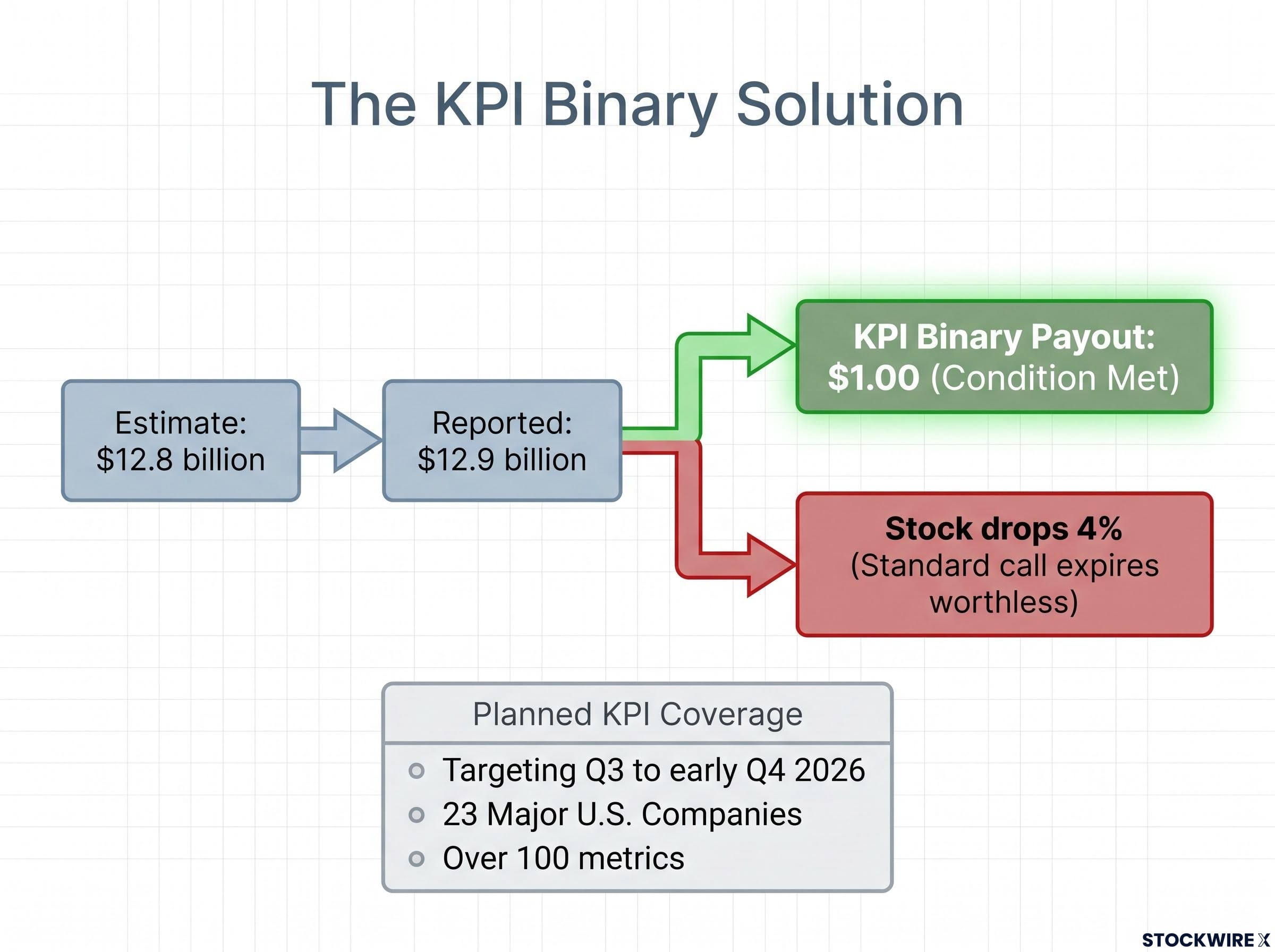
A KPI binary pays $1.00 if the reported metric meets the stated condition (for example, “quarterly EPS at or above $2.15”) and $0.00 if it does not. Settlement is based on the company-reported figure. The stock price is irrelevant to the contract’s outcome.
This explicitly separates two questions that standard options force you to answer simultaneously. “Was my read on the metric correct?” is one question. “Did the stock go up?” is a different question entirely. Standard options require you to be right about both. KPI binaries require you to be right only about the first.
Cboe has filed for KPI contracts initially covering 23 major U.S. companies and more than 100 earnings-related metrics, including EPS, revenue, and other disclosed financial or operating metrics. The targeted launch is as early as Q3 2026, or late Q3 to early Q4, pending approval from the SEC, Cboe Options Exchange, and Cboe Clear U.S. LLC. As of 21 August 2026, these contracts have not yet launched and remain subject to final regulatory approvals.
For any trader who has consistently been correct about business fundamentals but frustrated by unpredictable stock price reactions around earnings, KPI contracts represent a direct path to expressing that analytical work without absorbing the noise of broader market sentiment.
How settlement actually works, and what traders need to read before trading
The appeal of the product is straightforward. The operational reality requires more attention.
For XSP binaries, settlement is relatively clean. The contract settles against the XSP index level at expiration, a single definitive number reported by a single source. There is minimal ambiguity about what the settlement value is.
KPI binaries are more complex. Settlement depends on the precise contract specification: exactly which KPI is referenced, which data source is designated as authoritative, and how edge cases are handled. What happens if a company restates earnings? What if the company reports a metric on a different basis than the contract references? These are not hypothetical concerns. They are the specific details that determine whether a correct fundamental view translates into a paying contract.
| Feature | XSP binary options | KPI binary options |
|---|---|---|
| Underlying | Mini S&P 500 Index (XSP) | Company-reported KPI (EPS, revenue, etc.) |
| Payout if condition met | $100 | $1.00 |
| Payout if condition not met | $0 | $0.00 |
| Clearing | OCC | Cboe Clear U.S. LLC |
| Exchange | Cboe Options Exchange | Cboe Options Exchange |
| Regulatory oversight | SEC | SEC |
| Status | Live since June 2026 | Pending regulatory approval |
Before entering any KPI binary position, you should be able to answer these questions:
- What is the exact KPI definition in the contract specification?
- Which data source is designated as authoritative for settlement?
- How does the contract handle earnings restatements or revised figures?
- Does the metric reference GAAP or non-GAAP reporting, and which does the company emphasise?
- What is the precise settlement timeline relative to the earnings release?
The settlement specification is not fine print to skim. For KPI contracts, the precise definition of the metric and the designated data source determine whether your correct fundamental view translates into a paying contract. Reading the specs is a core part of the trade thesis, not an administrative afterthought.
The regulated-exchange structure of Cboe Predicts and what it provides in practice
The yes/no, fixed-payout structure of Cboe Predicts contracts will look immediately familiar if you have used platforms like Kalshi or Polymarket. The conceptual overlap is real. Both use binary outcomes. Both let you trade on whether specific events occur. The payoff logic is functionally the same.
The binary payoff logic of Cboe Predicts contracts is structurally familiar to anyone who has used Kalshi or Polymarket, but prediction market profit concentration tells a stark story: just 0.1% of accounts on two major platforms have captured 67% of all profits since November 2022, with roughly 70% of users losing money overall.
The difference is structural, not conceptual.
Cboe Predicts contracts are listed on the Cboe Options Exchange under SEC oversight. XSP binaries are centrally cleared by the OCC. KPI binaries, when launched, will clear through Cboe Clear U.S. LLC. You access them through registered broker-dealers with standard custody, margining, and compliance infrastructure already in place.
| Feature | Cboe Predicts | Prediction market platforms |
|---|---|---|
| Regulatory oversight | SEC | Varies (CFTC, offshore, or unregistered) |
| Clearing | OCC / Cboe Clear U.S. LLC | Platform-specific or none |
| Access point | Registered broker-dealers | Direct platform accounts |
| Contract type | Listed securities options | Event contracts |
| Enforcement history | Operates within SEC framework | Offshore platforms have faced U.S. enforcement actions |
That history matters. Unregistered offshore binary platforms have faced enforcement actions from U.S. regulators and often lacked protections against fraud or manipulation. According to Henry Schwarz, VP of Market Intelligence at Cboe, the regulated-exchange framework is a deliberate part of the product’s design and strategic direction.
For institutional investors and their compliance functions, the distinction between a prediction market platform and a listed, SEC-regulated, OCC-cleared contract is not a technicality. It is a structural requirement. Compliance teams, custodians, and risk management frameworks are built around exchange-listed products. That difference is precisely why Cboe Predicts has an addressable audience that standalone prediction platforms currently do not.
Who these contracts are actually built for
Not every trader needs these products. But three specific profiles stand to gain a capability that existing instruments do not provide.
- Retail traders seeking short-term directional exposure: XSP binaries offer a simplified yes/no structure for expressing a near-term view on the S&P 500, with defined risk (you cannot lose more than the premium paid) and no need to manage Greeks or rolling positions. Access through Interactive Brokers at launch, with Schwab planned.
- Fundamental investors and small funds with metric-specific conviction: If you build detailed earnings models and have high conviction on a specific number, but uncertainty about how the market will react to the release, KPI binaries let you express that view directly. Your analysis of the business is the trade. The stock’s reaction is someone else’s problem.
What early adopters should factor in
- Institutional investors and sell-side analysts: Larger funds and analysts can calibrate positions specifically to metrics where they have strong conviction, while avoiding unwanted exposure to macro shocks, sector rotation, or the sentiment dynamics that drive post-earnings price moves. An analyst may be highly confident about a company’s revenue figure without certainty about whether the stock rallies or sells off on the number.
If you find yourself consistently correct about business fundamentals but frustrated by unpredictable stock price reactions around earnings, you are the primary audience KPI contracts were designed for. Recognising that fit is the first step in evaluating whether to engage.
There are practical considerations to weigh. XSP binaries are new products with liquidity still in the building phase. Spreads and market depth should be expected to evolve as adoption grows. KPI binaries are not yet live, and the regulatory approval timeline (SEC, Cboe Options Exchange, Cboe Clear U.S. LLC) should be actively tracked by anyone planning to trade them. The contract specification due-diligence requirement is not a one-time exercise; it applies to every individual KPI contract, as each references a different metric, company, and data source.
The all-or-nothing payoff of binary contracts removes leverage risk, but the broader context of leveraged derivatives loss rates, where 74-89% of retail CFD accounts lose money according to ESMA data, is a useful calibration point for any trader assessing how new instrument categories perform across retail populations when they first reach mainstream access.
A new instrument category in its regulatory infancy, not a finished market
Cboe Predicts represents a genuine structural innovation: it brings prediction-market payoff logic into a regulated, cleared, exchange-listed framework for the first time at scale in the U.S. The product design separates questions that have always been bundled together in standard options, and that separation creates real analytical value.
The honest limitations are equally clear. KPI binaries are not yet live. Liquidity on XSP binaries is in early development. The full broker rollout is incomplete. The product pipeline (covering 23 companies and more than 100 metrics) is ambitious, but its practical value depends entirely on whether the contracts attract enough participation to produce prices that reflect genuine market consensus rather than thin-book noise.
The forward-looking question: The infrastructure around these products, not the product design itself, is what separates an interesting concept from a practically useful trading instrument. That infrastructure is the variable to monitor.
Key open questions you should track over the coming quarters:
- Regulatory approval status for KPI binaries (SEC, Cboe Options Exchange, Cboe Clear U.S. LLC)
- Broker rollout progress beyond Interactive Brokers
- Liquidity development and spread tightening on XSP contracts
- KPI launch timing and initial product coverage
The question is not whether the instrument design is innovative. It is. The question is whether the market infrastructure builds fast enough for the contracts to be practically useful, and that is the variable worth monitoring over the next two to three quarters.
This article is for informational purposes only and should not be considered financial advice. Investors should conduct their own research and consult with financial professionals before making investment decisions. KPI binary options have not yet launched and remain subject to regulatory approval. Forward-looking statements regarding launch timing, broker availability, and product coverage are based on publicly available filings and are subject to change based on regulatory and market developments.