
How to Filter Australia’s 70 Fixed Interest ETFs to a Short List
2 hrs ago


Most investors build their ETF portfolios by sorting last year’s performance tables and buying whatever sits at the top. Over a 25-year horizon, that instinct is a liability. The funds that compound wealth through to roughly 2051 are not necessarily the ones leading the charts in May 2026; they are the ones built around structural themes, geographic resilience, and business quality characteristics that endure across multiple economic regimes, technological shifts, and market cycles.
Australian investors increasingly treat ASX-listed ETFs as the backbone of long-term wealth accumulation. The question is no longer whether to invest in ETFs but which combination of funds is designed to last. What follows is an assessment of five ASX-listed ETFs, NDQ, IVV, VEU, RBTZ, and QUAL, each selected for a distinct role in a long-horizon portfolio. Each fund is evaluated not on recent returns but on why it belongs in a portfolio built to compound across decades.
Short-term price volatility dominates the attention of most fund selectors. Over a 25-year holding period, that volatility becomes structurally less relevant. Brief market fluctuations carry reduced significance when the investment window spans multiple recessions, recoveries, rate cycles, and sector rotations.
The question for a multi-decade investor is not which sector is performing now, but which themes, geographies, and financial characteristics are likely to compound across an era that stretches from 2026 to 2051. Economic and sector leadership can shift substantially over that span; the industries driving returns in the next five years may bear little resemblance to those driving returns in the final five.
The five ETFs in this article were selected to represent distinct roles in a long-horizon portfolio rather than overlapping bets on the same theme. The selection criteria that distinguish 25-year ETF logic from short-term fund picking include:
ASX ETF structure and costs affect long-run compounding in ways that are easy to underestimate: a seemingly small difference in management expense ratio compounds into a meaningfully different terminal balance over a 25-year horizon, and understanding how distributions are taxed year-by-year shapes which funds belong in which account types.
The iShares S&P 500 ETF (ASX: IVV) provides diversified exposure to hundreds of major American companies across technology, healthcare, financial services, industrials, and consumer products. It is one of the most widely held ETFs available on the ASX, a signal of both liquidity depth and institutional credibility that matters when the holding period stretches to 25 years.
A global ETF comparison on the ASX shows that IVV’s combination of a 0.04% MER and average daily traded value above $27 million places it among the most cost-efficient and liquid options available to Australian investors, attributes that matter increasingly as portfolio balances grow over a 25-year accumulation phase.
Representative holdings include Microsoft (NASDAQ: MSFT), Amazon (NASDAQ: AMZN), and Walmart (NYSE: WMT). The breadth of sector coverage means the fund is not a bet on any single industry but on the productive capacity of the US economy as a whole.
The sectors leading the S&P 500 in 2026 will likely differ substantially from those leading it in 2040 or 2051. A decade ago, energy and financials carried greater index weight than they do today; a decade from now, the composition will have shifted again in ways that are impossible to predict with precision.
For a 25-year holder, this self-rebalancing characteristic is the fund’s most powerful feature. Because the S&P 500 naturally reflects US economic leadership as it evolves, the investor does not need to make active sector-rotation decisions. The fund does the structural work automatically. IVV removes the sector-prediction burden while still capturing the long-run trajectory of the world’s largest equity market.
An ASX investor holding IVV and NDQ already carries heavy US equity concentration. Over a quarter-century, that is a structural bet that American economic and market leadership persists indefinitely. It might. It also might not.
The Vanguard All-World ex-US Shares Index ETF (ASX: VEU) resolves that concentration risk by providing equity exposure entirely outside the United States, spanning both developed and emerging economies. Representative holdings include Taiwan Semiconductor Manufacturing Company (NYSE: TSM), Samsung Electronics, and Nestlé (SWX: NESN).
Geographic coverage breaks down into two broad categories:
Over 25 years, economic leadership can shift between regions. The productive capacity outside the US is substantial, and a portfolio without exposure to it is implicitly assuming that the current American-led cycle extends through to 2051 without interruption. VEU adds geographic resilience without requiring the investor to hold a specific view on which non-US market will outperform. It is the natural complement to a US-focused core.
The Betashares Nasdaq 100 ETF (ASX: NDQ) carries higher short-term price volatility than any broad-market fund on this list. That is the cost of admission. The fund provides concentrated exposure to technology and innovation-driven businesses, and the companies that define that frontier do not move in gentle increments.
Representative holdings include Netflix (NASDAQ: NFLX), Broadcom (NASDAQ: AVGO), and Tesla (NASDAQ: TSLA). The sectors captured under this umbrella are broader than the “tech” label suggests:
For an investor with a 25-year window, the volatility trade-off changes shape. Short-term drawdowns that feel severe in the moment compress into minor dips on a multi-decade return chart. The question is not whether technology will matter in 2051 but whether a patient investor can tolerate the journey there.
Access to businesses driving transformative change across the global economy, priced for patience: that is the long-term case for NDQ.
Every other fund on this list selects holdings based on geography, sector, or theme. The VanEck MSCI International Quality ETF (ASX: QUAL) selects based on financial characteristics. That distinction becomes more material with every year added to the holding period.
QUAL filters international companies through quality criteria rather than weighting them by market capitalisation alone. The selection methodology targets:
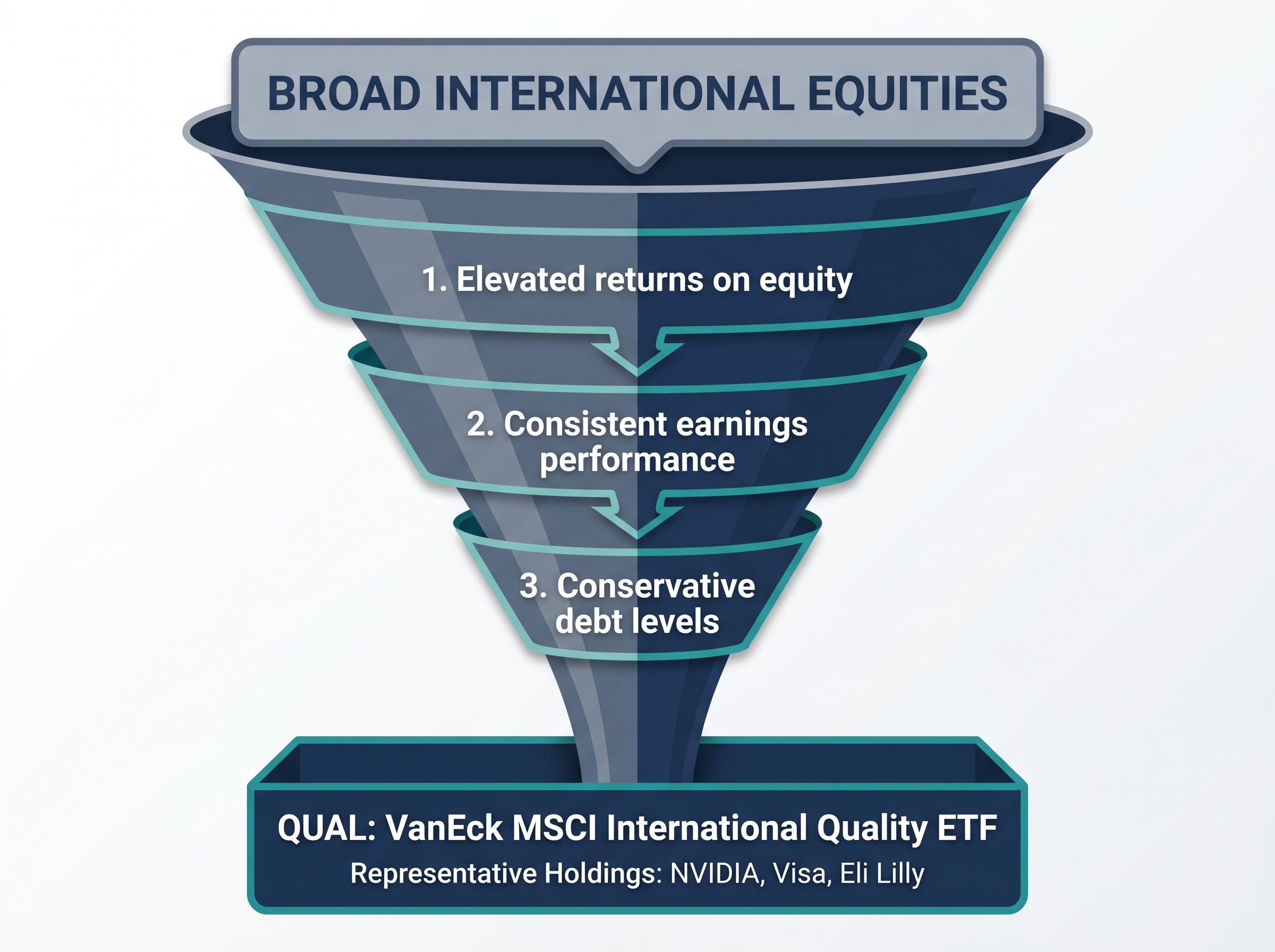
Representative holdings include NVIDIA (NASDAQ: NVDA), Visa (NYSE: V), and Eli Lilly (NYSE: LLY). As of May 2026, VanEck analysts had identified QUAL as a recommended option, as reported by The Motley Fool Australia.
A standard market-cap index weights companies by size regardless of financial health. Every company that meets the size threshold is included, whether its balance sheet is strong or deteriorating. QUAL adds a filter layer that retains only companies meeting defined quality thresholds.
This distinction becomes most material during economic contractions, when financially weaker companies in a broad index can drag overall returns. Over 25 years, a portfolio will encounter multiple prolonged downturns. Companies with strong balance sheets and durable earnings are better positioned to reinvest efficiently, endure those periods without structural damage, and sustain compounding across full cycles. The quality filter is insurance against holding the next generation of structurally impaired businesses through the rough patches.
For investors wanting to understand the quality factor in more depth before allocating to QUAL, our dedicated guide to quality investing on the ASX examines high-ROE and low-leverage screening criteria in detail, compares QUAL against the domestic AQLT alternative, and walks through how the factor has behaved during periods of market stress, including November 2025 when QUAL outperformed the MSCI World ex Australia Index by 105 basis points.
Extensive factor premium research covering more than 150 years of equity market data supports the case that quality and other systematic factors generate durable return advantages across full market cycles, providing an academic foundation for the quality-screening logic underpinning QUAL’s construction methodology.
The Betashares Global Robotics and Artificial Intelligence ETF (ASX: RBTZ) is the highest-risk fund on this list. Unlike broad index funds, it is a concentrated thematic position tied to a specific set of technologies. That introduces higher idiosyncratic risk alongside the potential for outsized returns if the thesis proves correct.
The thesis is straightforward: robotics, automation, and AI will become progressively more embedded in the global economy over the coming decades. The structural demand drivers underpinning this theme are:
Representative holdings include Intuitive Surgical (NASDAQ: ISRG), Keyence (TYO: 6861), and ABB (SWX: ABBN). As of May 2026, Betashares analysts had identified RBTZ as a recommended option, as reported by The Motley Fool Australia.
A 25-year horizon is precisely the time window over which this thesis is most likely to play out. RBTZ is the portfolio’s forward-looking risk position, the fund that performs best if automation follows its anticipated trajectory through the sectors expected to be reshaped by mid-century.
By 2051, proponents of the automation thesis expect these technologies to be deeply embedded across manufacturing, logistics, healthcare, agriculture, and services.
Individually, each fund makes a case for inclusion. Together, they form a portfolio with differentiated coverage across geographies, investment factors, and structural themes. None of the five is redundant; each provides exposure the others do not.
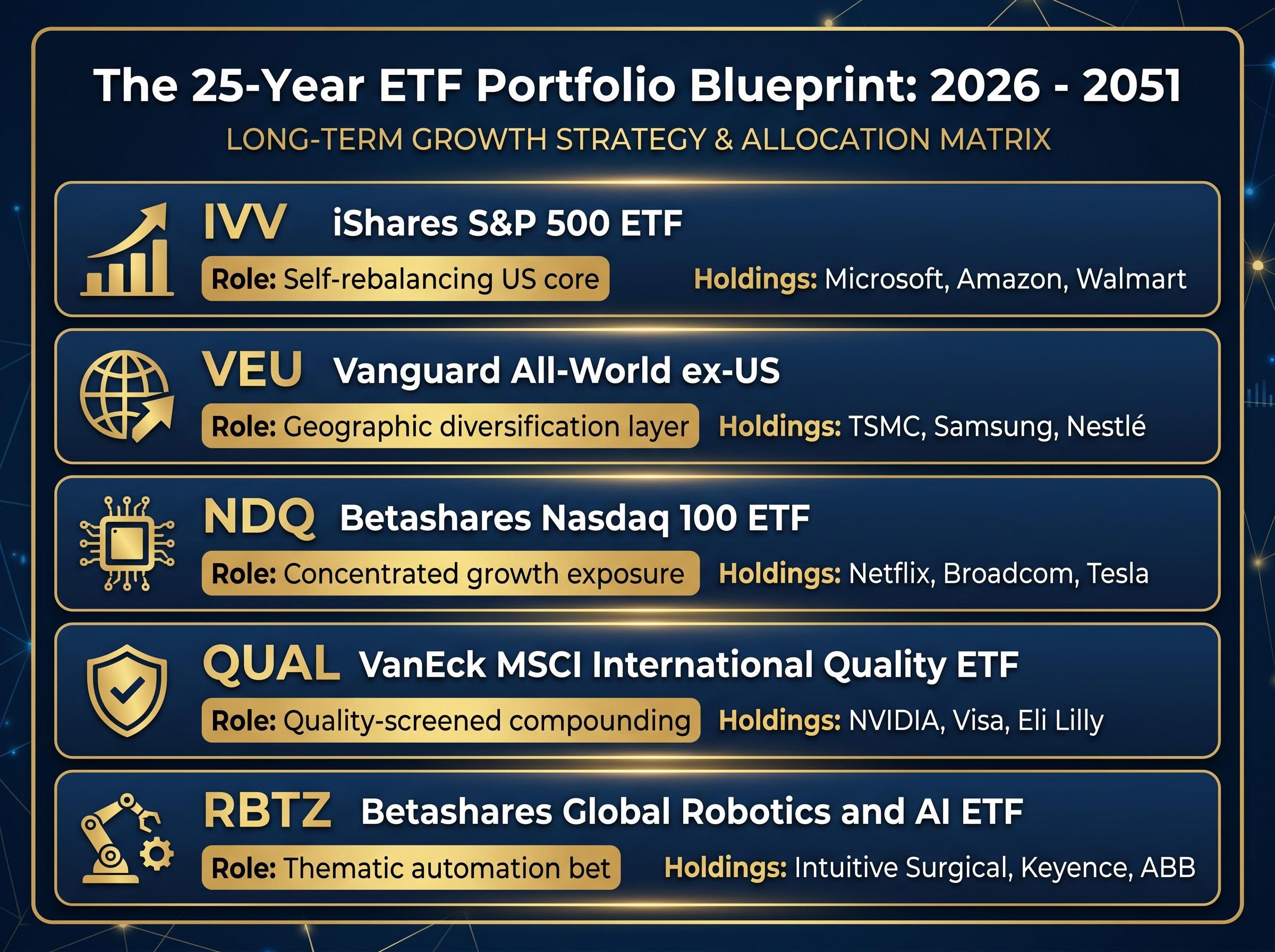
| ASX Code | Fund Name | Core Exposure | Portfolio Role | Key Holdings |
|---|---|---|---|---|
| IVV | iShares S&P 500 ETF | Broad US large-cap equities | Self-rebalancing US core | Microsoft, Amazon, Walmart |
| VEU | Vanguard All-World ex-US Shares Index ETF | International developed and emerging markets | Geographic diversification layer | TSMC, Samsung, Nestlé |
| NDQ | Betashares Nasdaq 100 ETF | US technology and innovation leaders | Concentrated growth exposure | Netflix, Broadcom, Tesla |
| QUAL | VanEck MSCI International Quality ETF | International quality-factor equities | Quality-screened compounding | NVIDIA, Visa, Eli Lilly |
| RBTZ | Betashares Global Robotics and AI ETF | Global robotics, automation, and AI | Thematic automation bet | Intuitive Surgical, Keyence, ABB |
The appropriate weighting between these funds will vary by individual risk tolerance, existing holdings, and investment goals. IVV and VEU together form a geographic core that spans developed and emerging markets globally. NDQ adds concentrated growth exposure at the technology frontier. QUAL layers a quality-screening discipline over international equities. RBTZ introduces a thematic position that pays off most if automation adoption accelerates as anticipated.
ETF portfolio structure, particularly the proportional split between growth and defensive assets, is considered by Morningstar to be a more important determinant of long-term outcomes than the specific funds chosen, which means the weighting decisions between IVV, VEU, NDQ, QUAL, and RBTZ deserve at least as much attention as the individual fund selections themselves.
This content is general in nature and does not constitute personal financial advice. Readers should consider their own circumstances or consult a licensed financial adviser before making investment decisions.
A 25-year horizon rewards investors who select for structural durability, diversification, and compounding quality rather than chasing recent performance tables. The five funds assessed here, IVV as the self-rebalancing US core, VEU as geographic counterweight, NDQ as concentrated innovation exposure, QUAL as quality-screened international compounding, and RBTZ as the thematic automation position, each occupy a distinct role that the others do not replicate.
The most important step for a long-horizon investor is not identifying the perfect fund. It is building a diversified foundation and maintaining the discipline to stay invested through the inevitable market cycles ahead.
Investors considering any of these ETFs should review the current Product Disclosure Statement (PDS) and fact sheet for each fund directly from the issuer before making investment decisions. Those with significant capital may benefit from consulting a licensed financial adviser to assess the right weighting for their individual circumstances.
ASIC Regulatory Guide 282 establishes the disclosure and issuance obligations that apply to exchange-traded products listed on the ASX, including the PDS requirements that investors should review before committing capital to any of the funds discussed here.
This article is for informational purposes only and should not be considered financial advice. Investors should conduct their own research and consult with financial professionals before making investment decisions. Past performance does not guarantee future results.
The article identifies five ASX ETFs suited to a 25-year horizon: IVV (S&P 500 broad US core), VEU (international diversification), NDQ (Nasdaq 100 technology exposure), QUAL (quality-factor international equities), and RBTZ (global robotics and AI theme), each occupying a distinct portfolio role.
The quality factor screens companies based on elevated returns on equity, consistent earnings performance, and conservative debt levels, rather than weighting by market capitalisation alone; over a 25-year horizon this filter helps exclude financially weaker businesses that may drag returns during economic downturns.
Holding only US-focused ETFs such as IVV and NDQ creates a structural concentration risk, implicitly betting that American market leadership persists through to 2051; VEU provides equity exposure across developed and emerging markets outside the US, adding geographic resilience without requiring a view on which specific region will outperform.
Even a small difference in MER compounds into a materially different terminal balance over a 25-year accumulation phase; IVV, for example, carries an MER of 0.04%, which the article highlights as one of the most cost-efficient options available to Australian investors.
RBTZ is described as the highest-risk fund in the five-ETF portfolio because it is a concentrated thematic position tied to robotics, automation, and AI rather than a broad index; the 25-year horizon is identified as the window over which the automation thesis is most likely to play out, but the fund carries higher idiosyncratic risk than diversified alternatives.