Australia’s public markets have a friction problem. The number of new ASX listings has been declining, private capital is absorbing deal flow that once fed IPO pipelines, and the regulatory plumbing governing how companies go public has not been substantially modernised in decades. ASIC is now moving to change that, and the pace of activity across 2025 and 2026 is unlike anything seen in Australian capital markets regulation for a generation.
Between February 2025 and August 2026, the Australian Securities and Investments Commission (ASIC) has launched a fast-track IPO pilot, published a sweeping capital markets report, remade the core legislative instruments governing fundraising mechanics, proposed an overhaul of pre-IPO advertising rules, and flagged a dramatic simplification of sell-side research guidance. These are not isolated tweaks. They form a coordinated programme with a single thesis: Australia’s public markets need structural modernisation to remain competitive as private capital deepens and superannuation scales.
Here is the full reform agenda mapped out, what is driving it, and what each piece means for companies considering a listing, investors watching the IPO pipeline, and advisers navigating new deal execution rules.
Why Australia’s public markets reached a turning point
Three structural pressures sit behind ASIC’s reform agenda, and understanding them tells you whether these changes amount to a genuine reset or a surface-level patch:
- Declining new listings. The number of companies choosing to list on the ASX has been falling for years. ASIC’s own publications and its February 2025 discussion paper characterise this as a sustained trend, not a cyclical dip.
- Accelerating private capital flows. Private equity, venture capital, and private credit have grown into a direct competitive alternative to public listing, offering companies capital without the disclosure and regulatory overhead of going public.
- Superannuation scale. Australia’s superannuation system is one of the largest pools of managed savings in the world, and super funds are allocating an increasing share to unlisted assets. That raises a systemic concern: if public markets shrink while super grows, Australian investors get less exposure to early-growth companies through the public arena.
ASIC’s corporate plan frames this in terms of “competitiveness, attractiveness and efficiency” of public markets, language that links the reform agenda directly to long-term investment outcomes for the superannuation system.
The decline in listings is not simply a market cycle story. It signals that structural regulatory friction was making private capital comparatively more attractive, and Australian investors, including through their super, were consequently getting less access to early-growth companies in a public, regulated setting.
ASX IPO return statistics for 2026 illustrate why structural reform matters beyond headline figures: the 34.5% average first-day return masks a cohort in which three outlier listings (Bison Resources, Kaoko Metals, and KTEK Aerosystems) account for the entire positive aggregate, while the remaining 13 companies averaged a cumulative loss of 11.8%.
What ASX was already asking for
The exchange itself recognised the same problem. ASX explicitly proposed reforms including capping the exposure period at seven days, allowing retail applications during that period, relaxing free-float requirements, and revisiting corporate bond listing settings.
That matters because it means the regulator and the exchange arrived at the same diagnosis independently. What followed was coordinated movement, not a top-down directive.
When big ASX news breaks, our subscribers know first
The fast-track IPO pilot: what it does and who it is for
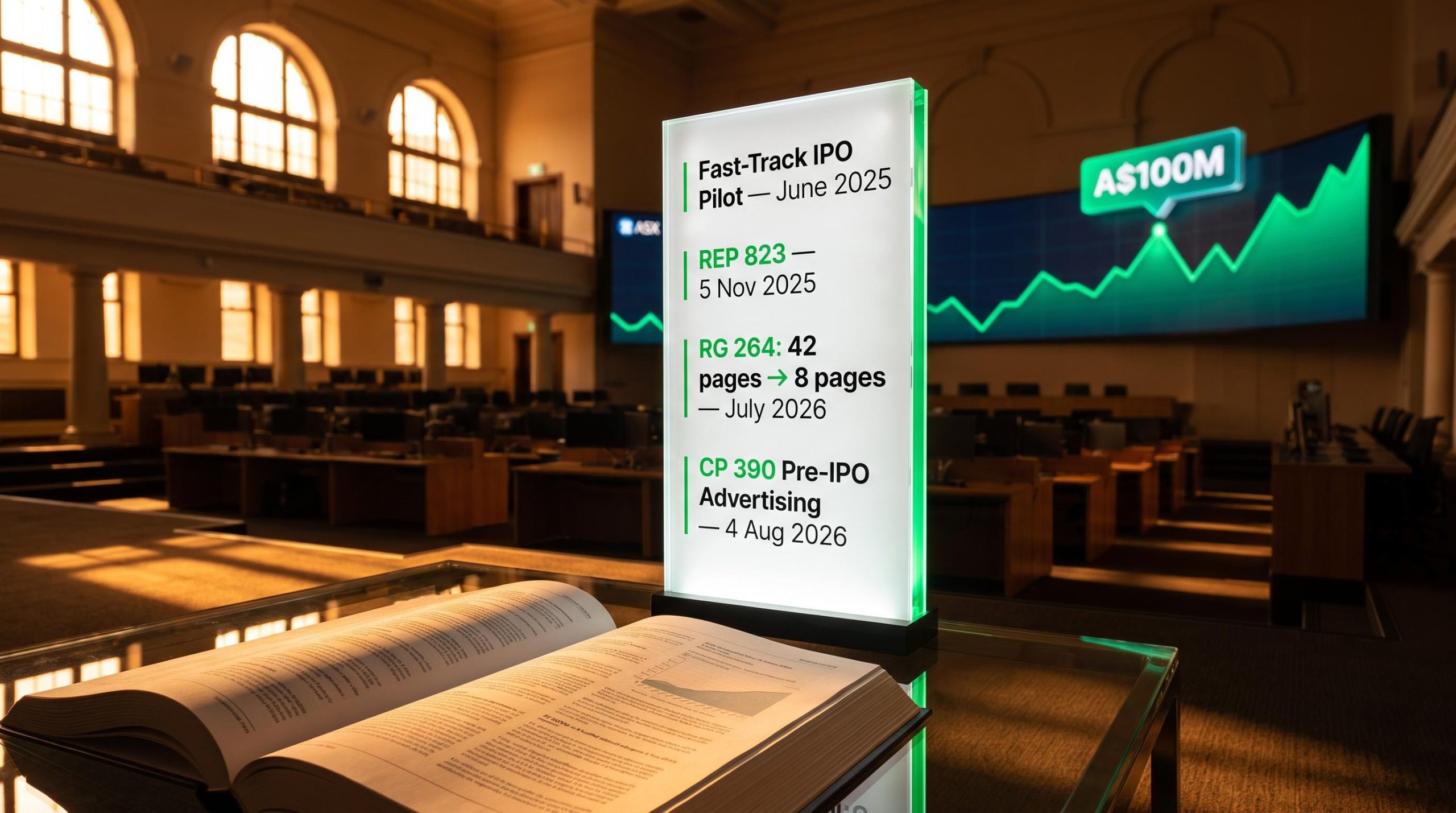
Launched in June 2025 (ASIC media release 25-096MR), the fast-track IPO pilot was designed to cut deal execution risk for eligible ASX listings by shortening the overall IPO timetable. Running as a two-year trial, it works by informally reviewing offer documents two weeks before public lodgement, trimming the process by up to a week, and REP 823 (published 5 November 2025) confirmed its continuation as a core initiative. Four features define it:
- Confidential pre-lodgement ASIC review. ASIC reviews a draft offer document, typically a pathfinder prospectus without pricing, two weeks before public lodgement. Issues get resolved before the document enters the market, not after.
- Shorter IPO timetable. By front-loading the regulatory review, the pilot can compress the overall IPO timetable by up to one week compared to standard procedures.
- Retail applications during the exposure period. ASIC issued a class “no-action” position allowing eligible IPOs to accept retail investor applications during the seven-day exposure period, cutting administrative timelines and supporting smoother bookbuilds.
- Eligibility criteria. The pilot is limited to ASX listings with no escrow requirements and expected market capitalisation above A$100 million.
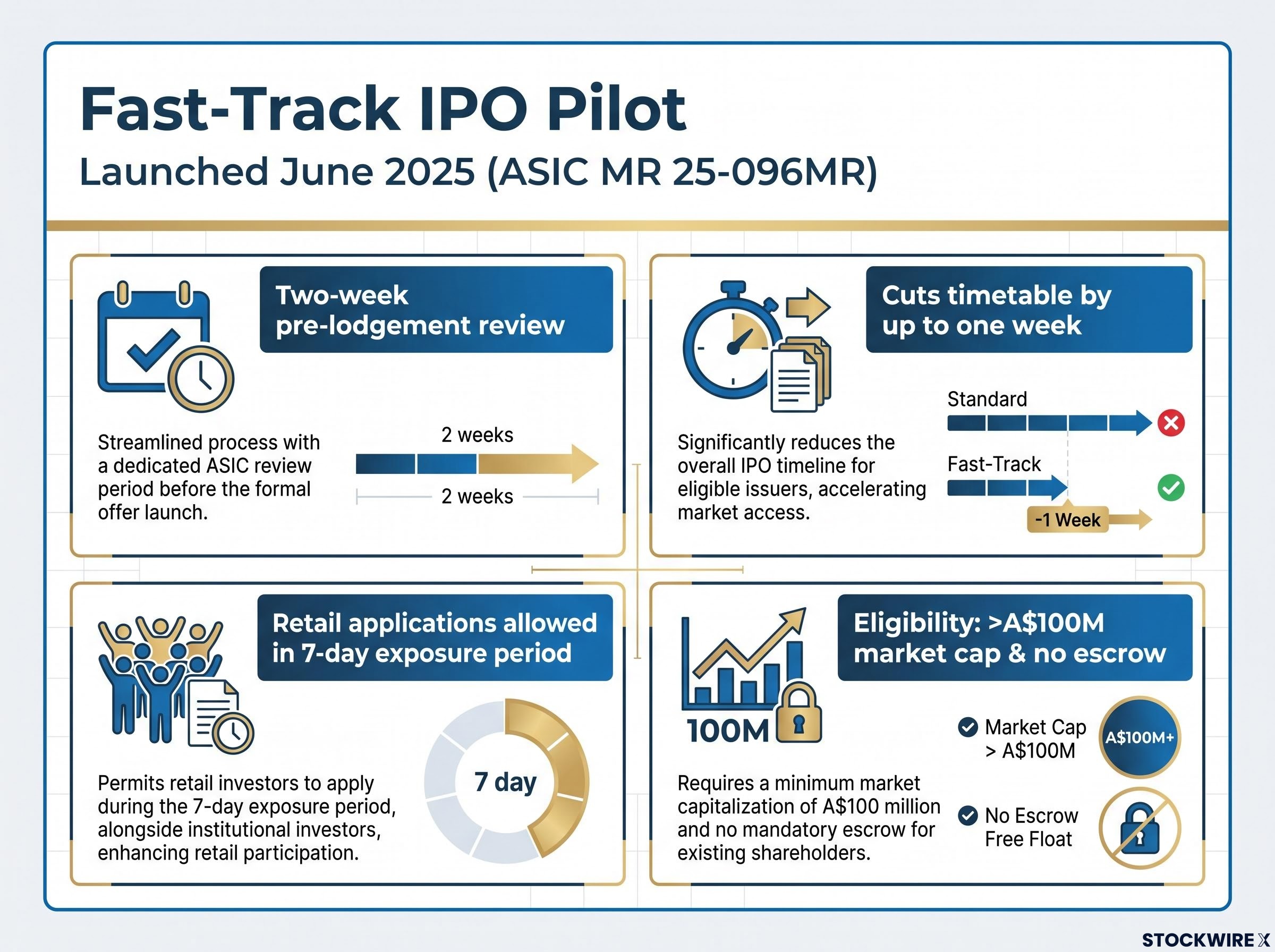
Time at risk is the concept that makes this pilot commercially significant. The longer the window between lodgement and close, the greater the chance that market volatility, regulatory feedback, or a shift in investor sentiment kills a deal mid-process. The pilot’s pre-lodgement review and shorter timetable directly reduce that window, lowering the financial and reputational cost of an aborted listing.
For a company weighing an ASX listing in 2025 or 2026, this is not a minor procedural convenience. It is a material reduction in the cost of an aborted deal, which has historically deterred smaller and mid-sized businesses from attempting to list at all.
The A$100 million market capitalisation threshold tells you this initial phase is aimed at established businesses, not micro-caps. Industry commentary suggests the pilot is “here to stay” subject to positive results, though ASIC has not yet published formal evaluation metrics. If it works and ASIC broadens eligibility, the downstream effect on IPO flow and your investment opportunity set could be meaningful.
For readers wanting to understand how these structural reforms intersect with their own position in a deal, our full explainer on IPO investing mechanics covers why retail investors typically cannot access shares at the offering price and how the expectations gap between business performance and offering valuation drives post-listing returns.
REP 823 and the public-versus-private markets question
The individual reforms, the pilot, the instrument remakes, the advertising proposals, can look like isolated measures unless you see the strategic document that holds them together. That document is REP 823.
On 26 February 2025, ASIC released a discussion paper posing eight foundational questions about whether the regulatory boundaries between public and private markets remain appropriate. The paper gathered industry submissions on disclosure rules, fundraising restrictions, and listing frameworks.
REP 823, published on 5 November 2025 under the title Advancing Australia’s Evolving Capital Markets, summarised those submissions and set out four workstreams ASIC committed to pursue:
| Workstream | Regulatory instrument targeted | Current status | Expected outcome |
|---|---|---|---|
| IPO streamlining | Fast-track pilot, exposure period relief | Pilot running; two-year trial | Permanent embedding if results are positive |
| Regulatory guide reviews | RG 228, RG 254, RG 264 | RG 254 update in Q2 2026; RG 264 consultation announced July 2026 | Simplified, modernised guidance |
| Fundraising publicity modernisation | Pre-prospectus advertising rules | CP 390 published August 2026; consultation open | Expanded pre-IPO advertising flexibility |
| Listing frameworks | Free float, SME pathways, foreign exemptions | Under consideration with ASX | Subject to ASX cooperation and potential legislative change |
REP 823 is not a final position. It is a forward work programme. It tells you what ASIC intends to do, not what it has done. But it gives coherence to everything else happening in capital markets reform.
The REP 823 capital markets report documents submissions gathered from the February 2025 discussion paper and sets out the four workstreams ASIC committed to pursue, making it the primary reference for tracking which parts of the regulatory framework remain live targets for change beyond 2026.
One finding in particular set up what came next: REP 823 concluded that the rules restricting pre-prospectus advertising had fallen behind contemporary information-sharing practices and sat at odds with the advertising regime that applies to product disclosure statements (PDS). That diagnosis made CP 390, published nine months later, a direct consequence rather than a standalone initiative.
If you want to understand where the reform agenda is heading beyond 2026, REP 823 is the primary source to track. It tells you which parts of the regulatory framework are still live targets for change, including prospectus disclosure rules that affect what information companies must provide before you invest.
Pre-IPO advertising, remade instruments, and the rules companies actually use
This is where the reform agenda becomes concrete for anyone involved in running or investing in a deal.
CP 390: proposed pre-IPO advertising rules
On 4 August 2026, ASIC published CP 390, Proposed reform to the pre-lodgement advertising and publicity regime (media release 26-178MR), with submissions closing 11 September 2026. The proposal would broaden the relief companies currently have from Corporations Act restrictions, opening up more room to publicise upcoming IPOs in the period before a prospectus is lodged.
Current restrictions were calibrated to traditional media, print and broadcast, and are now misaligned with digital and social media communications. The proposal seeks to align pre-IPO publicity rules with equivalent settings in comparable international markets and with other domestic fundraising frameworks, such as crowd-sourced equity funding and offers structured around a product disclosure statement.
Under the proposed rules, companies could advertise unquoted securities before prospectus lodgement, subject to four conditions being satisfied:
- The issuer and seller of the securities must be clearly identified.
- A prospectus must be made available no later than the point at which the security is listed.
- Prospective investors must be told where and when the prospectus will be available.
- All advertising must direct investors to the prospectus as the document they should read before making any investment decision.
ASIC emphasises that the prospectus remains the central disclosure document, even as communications become more flexible. The expanded advertising is designed to build awareness and test market appetite, not to replace prospectus-based investor protection.
If CP 390 is adopted as drafted, companies will be able to build investor awareness and test market appetite before lodging a prospectus. That compresses the gap between private pre-marketing and public offering mechanics, and it changes the information environment in which you encounter new listings.
For you as a retail investor, this is the critical point: under the proposed regime, you may see promotional material about an upcoming IPO before a prospectus exists. The prospectus itself, not the advertising, remains the document on which any investment decision should be based.
CP 390 remains in consultation. The degree of flexibility ultimately granted will depend on submissions and ASIC’s final position.
Remade instruments: the plumbing beneath the reforms
In April 2026, ASIC remade a suite of legislative instruments that govern the procedural mechanics of IPOs and capital raising. These are the instruments that deal-execution teams use daily:
- ASIC Corporations (Exposure Period) Instrument 2026/90
- ASIC Corporations (Market Research and Roadshows) Instrument 2026/93
- ASIC Corporations (Minimum Subscription and Quotation Conditions) Instrument 2026/87
- Consents, debenture prospectus, and various sale-offer instruments
These replaced older versions that were due to expire and are now aligned with ASIC’s current policy settings. Alongside them, RG 254 (Offering securities under a disclosure document) is scheduled for update in Q2 2026, meaning the guidance and the black-letter rules are being refreshed in parallel.
This is less visible than the fast-track pilot or CP 390, but equally important. Updated procedural instruments reduce the technical uncertainty that creates friction in day-to-day IPO execution.
Sell-side research and the modernisation of market guidance
A 42-page regulatory guide being condensed to eight pages is not a minor edit. It is a statement about how much of the existing framework was process overhead rather than genuine investor protection.
In July 2026, ASIC published CS 59, Proposed Updates to RG 264, setting out a principles-based proposal to cut the sell-side research regulatory guide from 42 pages down to eight, with the stated aim of making local market investment more commercially viable. The consultation was announced on 23 July 2026.
42 pages to eight. That is the scale of simplification ASIC is pursuing for its sell-side research guidance, one of the most striking concrete indicators of how much regulatory overhead the current framework carries.
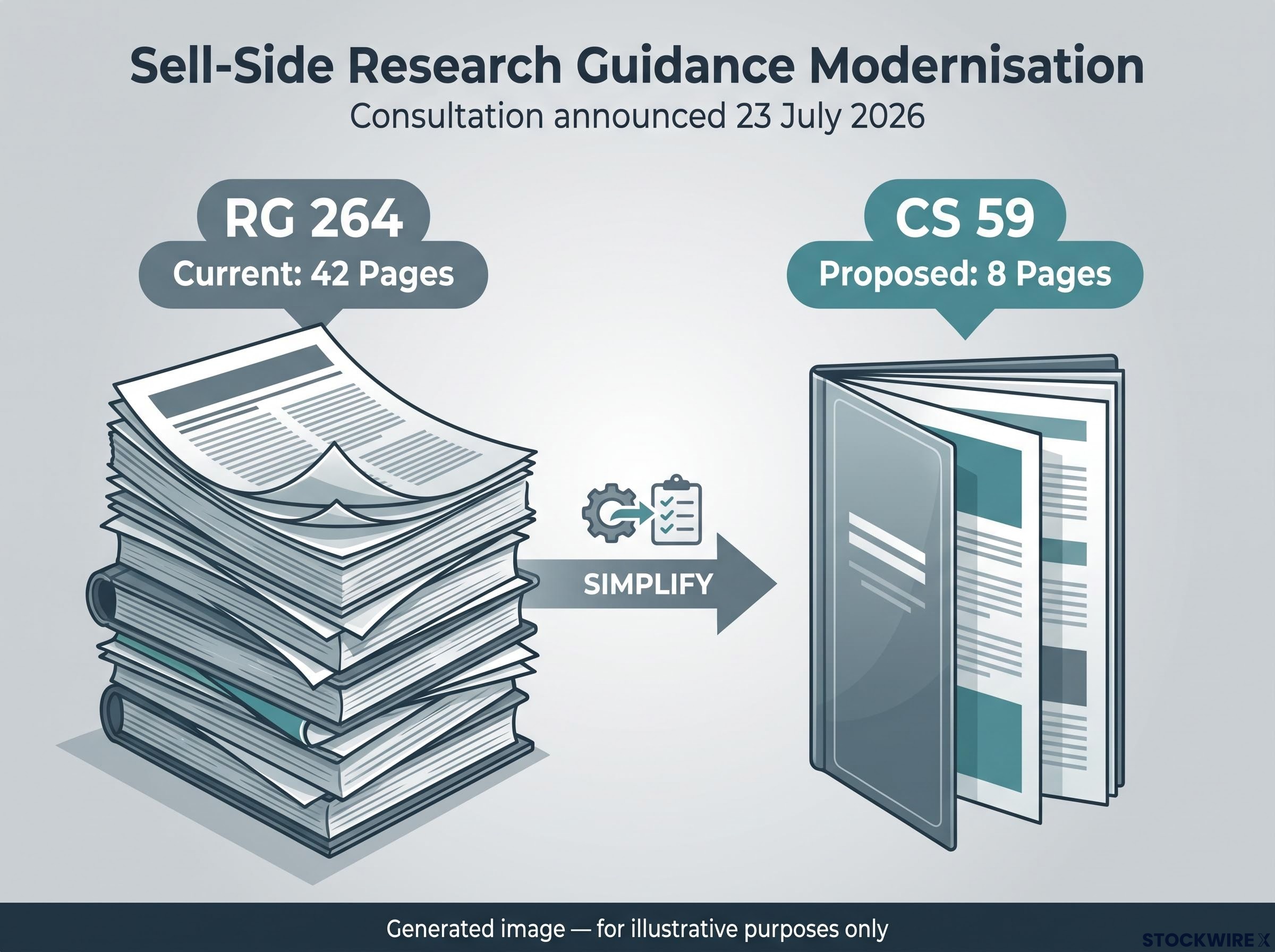
RG 264 governs how sell-side analysts produce and distribute research. Its complexity has been a constraint on research production, particularly for small and mid-cap ASX companies that are already under-covered. If you hold or follow smaller listed companies, the amount of professional research available to inform your decisions is partly a function of how expensive and onerous it is to produce that research.
The earliest public signal came in ASIC’s Market Integrity Update Issue 173 in November 2025, which noted that ASIC was considering sell-side research ideas as part of efforts to “promote the attractiveness, competitiveness and efficiency of Australia’s public markets.” REP 823 subsequently listed RG 264 among the regulatory guides subject to review.
Three regulatory guides are now under active review:
- RG 228 (prospectus disclosure): review committed in REP 823; timeline to be confirmed.
- RG 254 (offering securities under a disclosure document): update scheduled for Q2 2026.
- RG 264 (sell-side research): CS 59 consultation announced 23 July 2026; condensation from 42 to 8 pages proposed.
The condensed guide is subject to consultation and the final form is not yet confirmed. But if simplified research guidance makes it commercially easier to cover mid-cap and small-cap ASX companies, the likely downstream effect is more research coverage, which historically improves investor awareness and supports liquidity. For you as a retail investor, improved sell-side coverage of smaller listed companies is one of the most direct and practical benefits that could flow from this modernisation agenda, even though it is the least discussed element publicly.
What the reform agenda still needs to deliver
ASIC has moved faster and further on capital markets modernisation than at any point in recent memory. The ambition is real. So are the limits.
Several questions remain genuinely open:
- Pilot evaluation. The fast-track IPO pilot has no published evaluation metrics. Industry expects it to continue, but ASIC has not committed to permanence.
- CP 390 final form. The pre-IPO advertising proposals are in consultation, with submissions closing 11 September 2026. The flexibility ultimately granted depends on the responses ASIC receives.
- Regulatory guide depth. The proposed condensation of RG 264 from 42 to 8 pages is subject to consultation outcomes. RG 228 and RG 254 updates are scheduled but substantive changes will only be clear once draft revised guides are released.
- Listing framework reforms. Changes to free-float requirements, SME listing pathways, and foreign exempt listings require ASX cooperation and, in some cases, legislative engagement. These remain under consideration.
ASIC’s own framing is measured: regulation can reduce friction and help level the playing field between public and private markets, but cannot alone reverse structural trends driving capital toward private vehicles. The 2025-2026 agenda is best understood as necessary but not sufficient groundwork for a healthier listing environment.
The IPO-focused workstreams described in REP 823 sit within a wider regulatory simplification agenda that, by May 2026, had already produced measurable operational change: ASIC’s REP 830 progress report confirmed the elimination of approximately 45,000 paper-based submissions annually and a 380% expansion in electronic lodgement options.
| Date or period | Event or milestone |
|---|---|
| 26 February 2025 | ASIC discussion paper on public and private market dynamics released |
| 10 June 2025 | Fast-track IPO pilot announced (media release 25-096MR) |
| November 2025 | Market Integrity Update Issue 173: sell-side research signals |
| 5 November 2025 | REP 823 published |
| 31 March 2026 | ASX governance inquiry report due (concluded) |
| April 2026 | Remade fundraising instruments commence |
| Q2 2026 | RG 254 update scheduled |
| 23 July 2026 | CS 59 announced: RG 264 condensation from 42 to 8 pages proposed |
| 4 August 2026 | CP 390 published: pre-lodgement advertising reform |
| 11 September 2026 | CP 390 submissions close |
| End-2026 | Provider-neutral instrument updates targeted |
The decisions made in the back half of 2026, particularly on CP 390 and the RG 264 consultation, will determine whether Australia’s IPO market exits this reform period genuinely more competitive or merely less administratively complex. For companies weighing a public listing and for investors tracking the IPO pipeline, the next six months represent the moment when this reform agenda either delivers on its thesis or reveals the limits of regulatory optimism.
For investors wanting to see how the reformed listing environment is translating into actual market outcomes, our dedicated guide to 2026 ASX IPO performance tracks the standout listings, including Ballard Mining’s 178% return, alongside the pipeline of larger candidates expected to test the market later in the year.
This article is for informational purposes only and should not be considered financial advice. Investors should conduct their own research and consult with financial professionals before making investment decisions.
These statements regarding future regulatory outcomes are speculative and subject to change based on ASIC’s consultation processes and final policy decisions.