
One enterprise client reportedly ran up approximately US$500 million on Anthropic’s Claude in a single month. Not because of a billing error or a security breach, but because nobody set a spending limit. That anecdote, reported by Axios on 29 May 2026 via an AI consultant, has become a symbol of a broader reckoning inside corporate finance: AI budgets have grown large enough to matter on income statements, yet many organisations still lack the governance frameworks to manage them. The same week, Uber’s CEO publicly criticised “tokenmaxxing.” Microsoft quietly terminated most of its Claude Code licences. The era of unconstrained AI experimentation is ending. What follows explains how token-based AI costs work, why they spiral so quickly inside enterprises, what the shift to disciplined return on investment frameworks looks like in practice, and why investors monitoring AI sector fundamentals should pay close attention to where this is heading.
The $500 million wake-up call that changed how executives think about AI
The number is striking on its own. According to Axios, an AI consultant disclosed that a single enterprise client accumulated roughly US$500 million in charges on Anthropic’s Claude in one month after employees were granted effectively uncapped access under an enterprise plan. No alerts fired. No spend thresholds triggered a review. Finance did not realise what was happening until the invoice arrived.
The figure remains unverified, and Axios did not independently confirm it. That caveat matters. But the anecdote resonated so widely because it crystallised a question finance leaders were already starting to ask: what, exactly, is all this AI spending producing?
The scepticism is not coming from AI laggards. It is coming from some of the most AI-sophisticated organisations in the world:
- The unnamed enterprise client: Approximately US$500 million in one month on Claude, with no usage limits or cost ownership in place.
- Uber: Deployed its entire AI budget in the first four months of 2026 without producing additional consumer-facing features. CEO Dara Khosrowshahi and COO Andrew Macdonald spoke publicly about the problem.
- Microsoft: Reportedly terminated most of its Claude Code licences, partly due to cost concerns.
Dara Khosrowshahi, CEO of Uber, characterised the practice of maximising token consumption without clear product outcomes as “tokenmaxxing,” a term now circulating widely inside the industry. Rapid Response Podcast, 23 May 2026
Andrew Macdonald told the same podcast that AI costs are getting harder to justify, even for a company with sophisticated engineering resources. That admission, from a company that has invested heavily in AI infrastructure, signals that the scrutiny is structural rather than reactionary.
When big ASX news breaks, our subscribers know first
How the “thousand flowers bloom” strategy quietly became a liability
The governance gap did not appear overnight. It grew out of decisions that, at the time, seemed sensible.
Many corporate AI rollouts followed what Axios described as a “thousand flowers bloom” approach: leadership purchased broad licences, distributed them widely across teams, and waited to see what useful applications emerged. IT and AI teams made capability-first procurement decisions, asking what a model could do, while deferring questions about cost controls, per-team budgets, and alerts.
The asymmetry was predictable in hindsight. Organisations optimised for speed of adoption while leaving cost governance for later. The result was a familiar pattern: AI budgets rising sharply while productivity improvements remained ambiguous or unevenly distributed across teams.
The gap between experimentation and genuine operational embedding is larger than most budgets reflect: an estimated 70-80% of enterprise AI pilots fail or stall, with poor data integration identified as the primary cause rather than any shortfall in the underlying models.
This mirrors the trajectory of cloud computing. In the early days, unconstrained developer access to cloud resources led to surprise bills that blindsided finance teams. Over time, companies adopted FinOps (financial operations for cloud), reserved capacity pricing, and real-time dashboards. Cloud adoption did not decline. Waste did. AI is now entering an equivalent governance phase.
The FinOps for AI framework published by the FinOps Foundation addresses precisely this governance gap, outlining allocation, forecasting, and optimisation disciplines that help enterprises connect AI consumption to measurable business value rather than treating it as an unattributed overhead.
Why CFOs started asking harder questions in 2026
The shift accelerated once finance teams gained line-item visibility over AI spending. Ad hoc tool usage, spread across hundreds or thousands of employees, is structurally difficult to attribute to measurable productivity gains. That makes it nearly impossible for a CFO to defend a rapidly growing AI line item to a board.
The response has been swift. Four governance practices are now becoming standard across enterprises:
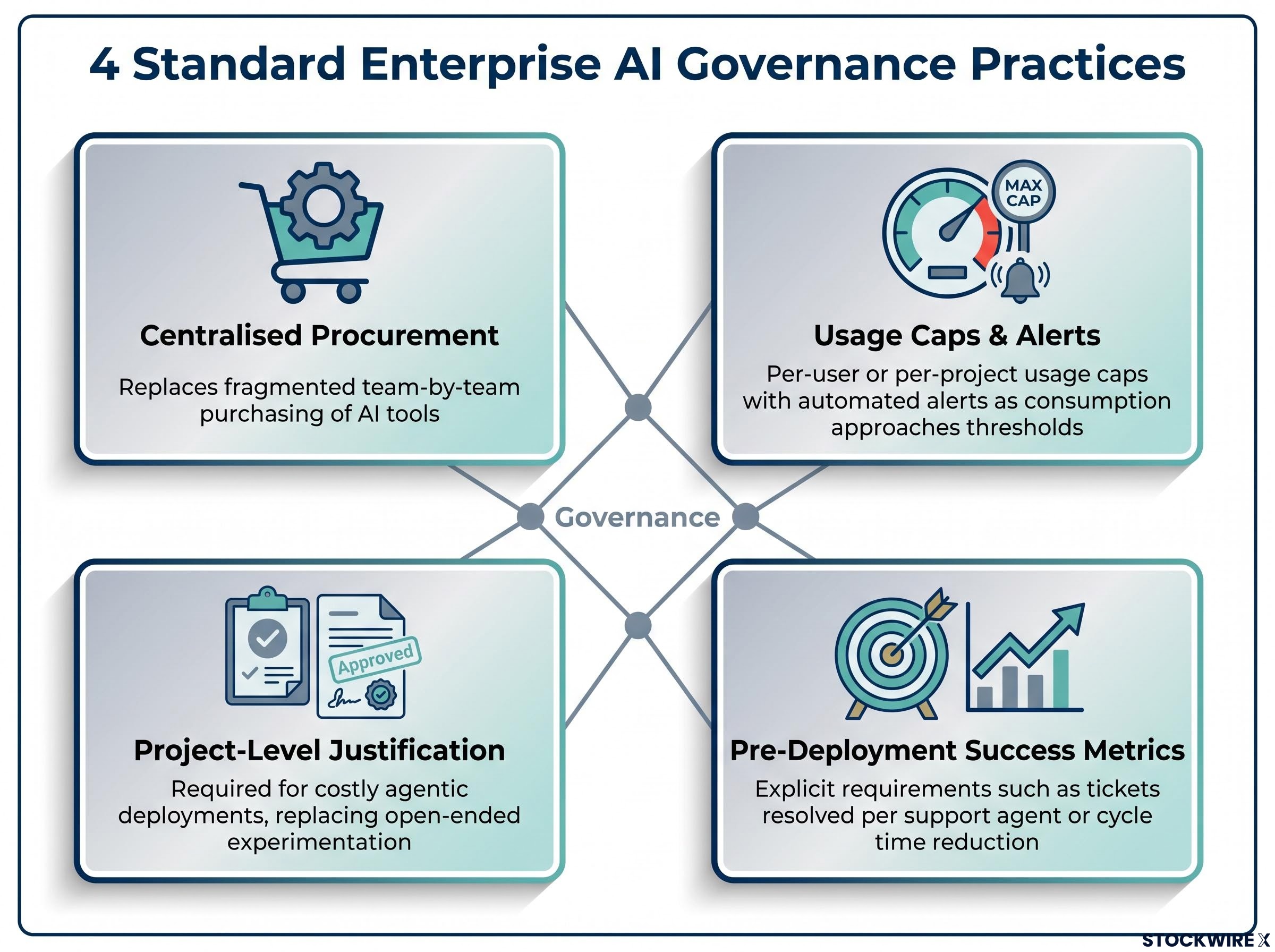
- Centralised procurement of AI tools, replacing fragmented team-by-team purchasing.
- Per-user or per-project usage caps with automated alerts as consumption approaches thresholds.
- Project-level justification requirements for costly agentic deployments, replacing open-ended experimentation.
- Explicit pre-deployment success metrics, such as tickets resolved per support agent or cycle time reduction for a defined workflow, required before teams gain access to expensive models.
What a token actually costs you, and why the bill grows faster than anyone expects
A token is a fragment of text, not a full word. In standard large language model (LLM) tokenisation, approximately 100 tokens corresponds to roughly 75 words. Every component of an interaction consumes tokens: the prompt, any retrieved context, intermediate reasoning steps, and the response itself.
For a simple chat completion, where a user sends a question and receives an answer, the cost is relatively contained. The problem begins when organisations deploy AI agents, systems that pursue multi-step goals with minimal human supervision. In agentic workflows, every intermediate step consumes tokens, not just the final answer. This is the non-intuitive mechanism behind most surprise bills.
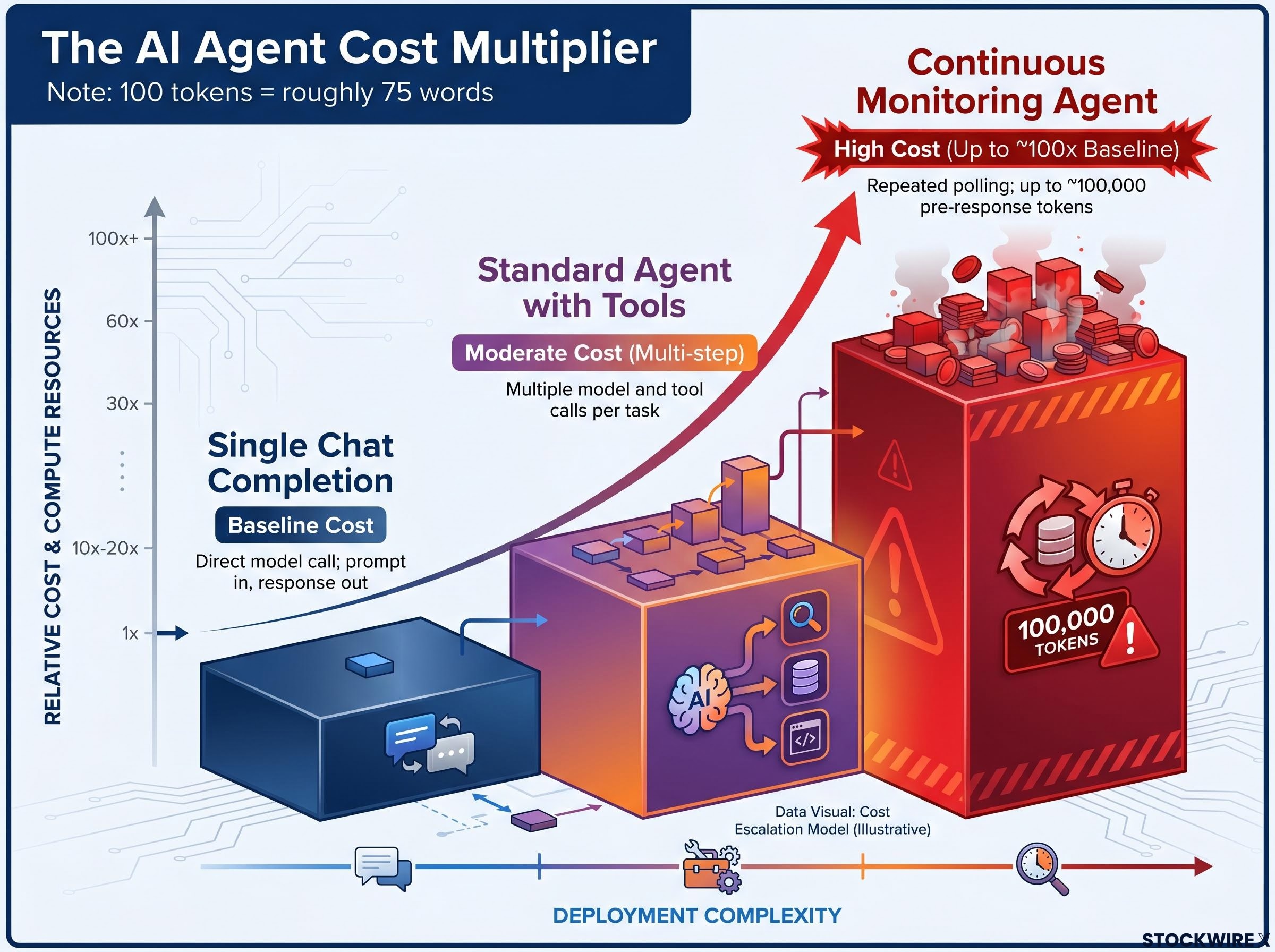
According to practitioner commentary, multi-step autonomous agents can be up to approximately 100 times more expensive than a single chat completion. Research firm SemiAnalysis has noted that a monitoring agent can consume up to approximately 100,000 tokens before generating any response at all, simply by polling data sources and maintaining state across steps.
| Deployment type | Relative cost | Key driver |
|---|---|---|
| Single chat completion | Baseline | Direct model call; prompt in, response out |
| Standard agent with tools | Moderate (multi-step) | Multiple model and tool calls per task |
| Continuous monitoring agent | High (up to ~100x baseline) | Repeated polling; up to ~100,000 pre-response tokens |
Because most enterprise AI contracts are token-metered rather than flat-rate, these cost dynamics translate directly into volatile, hard-to-forecast spend. Three patterns drive the most common blow-outs:
Consumption-based AI pricing is simultaneously the mechanism behind enterprise bill shock and the structural force dismantling the per-seat SaaS model that dominated enterprise software for two decades, as AI-native vendors enter markets with token-metered alternatives priced to undercut incumbents by 80-90%.
- Continuous polling agents that track markets, news, or competitors, consuming tokens even when nothing actionable occurs.
- Poorly scoped context windows that force models to re-read large document sets or re-run tools unnecessarily, multiplying token usage per interaction.
- “All-you-can-eat” internal culture that enables thousands of employees to invoke expensive frontier models for trivial tasks a standard search engine could handle.
What disciplined AI spending actually looks like in practice
Diagnosis without a remedy is incomplete. Across enterprises that have moved beyond the experimentation phase, three categories of discipline are emerging:
- Usage governance: Quotas, alerts, and approval workflows to control token consumption at the user, team, and project level.
- Output attribution: Instrumenting AI-augmented workflows so each deployment can report measurable results per dollar of AI spend.
- Model and architecture choices: Routing tasks to the right model at the right cost, rather than defaulting to the most capable (and expensive) option for every query.
Uber’s own admission illustrates what happens when output attribution is absent. The company’s leadership stated that deploying its entire AI budget within the first four months of 2026 had not resulted in additional consumer-facing features of practical value. A large spend with no attributable output is precisely the scenario that triggers board-level scrutiny.
Organisations that are managing this transition more effectively are defining narrow, measurable success metrics before granting teams access to costly models: contract review time cut by a specific percentage, tickets resolved per support agent, cycle time reduction for a defined workflow. Blanket claims that “AI increased productivity” are no longer sufficient.
On the architecture side, routing high-volume simple tasks to smaller or cheaper models, while reserving frontier models for cases where they clearly outperform alternatives, has emerged as a meaningful cost lever. And on the vendor side, committed-use contracts and volume-based discounts, analogous to cloud reserved instances, are replacing purely on-demand pricing.
AI is moving from a strategic experiment to a line item that must be defended.
Why investors should care: revenue quality, capex sustainability, and the valuation question
The governance shift is not only a corporate cost management story. It carries direct implications for the revenue trajectories of AI model providers and the valuation assumptions underpinning the sector’s largest companies.
Roger Montgomery, Founder and Chairman of Montgomery Investment Management, has observed that a high proportion of recent revenue growth at AI companies such as Anthropic may be attributed to high-volume token consumption driven by benchmarking activities at Meta and Amazon, rather than sustainable commercial deployment. If that assessment is accurate, a meaningful share of headline revenue growth reflects activity that is unlikely to recur at the same rate once governance frameworks take hold.
On the supply side, the largest US hyperscalers are on a substantial AI infrastructure spending trajectory, with combined capital expenditure potentially exceeding US$700 billion (though this projection has not been independently confirmed). That level of spending is premised on demand assumptions that enterprise governance practices may complicate.
When enterprise discipline becomes a demand-side variable
The logical chain is straightforward. As enterprises roll out centralised procurement, usage caps, and project-level justification requirements, per-customer token consumption may flatten or decline, even as the number of enterprise AI customers continues to grow. The result could be a revenue trajectory that disappoints relative to the run-rate currently implied by AI sector valuations.
Frontier AI business models face a structural stress test that enterprise governance is now accelerating: when enterprises introduce hard budgets and usage caps, the revenue assumptions embedded in multi-hundred-billion-dollar infrastructure contracts become contingent on sustained token consumption that may not survive the transition to disciplined procurement.
Montgomery has also observed that this spending discipline is coinciding with stock markets exhibiting hyper-exponential price appreciation and private equity valuations reflecting peak optimistic sentiment. If realised enterprise demand does not match the assumptions embedded in current valuations, the mismatch could become material.
According to Roger Montgomery of Montgomery Investment Management, substantial Anthropic revenue has been attributed to benchmarking activity at Meta and Amazon rather than durable commercial deployment, raising questions about the sustainability of current revenue trajectories.
For investors tracking AI sector fundamentals, the shift from experimentation to governance is not a side story. It is a demand-side variable that existing valuation models may not have priced.
The governance phase has arrived, whether AI vendors are ready or not
The pattern is now clear. The transition from unconstrained AI adoption to disciplined return on investment frameworks mirrors the FinOps evolution that reshaped cloud computing a decade ago, and it is accelerating through mid-2026. Uber’s public remarks on 23 May 2026, followed by Axios reporting on 29 May 2026, marked the moment this shift entered mainstream corporate discourse. Industry executives and consultants quoted by Axios have described it as a “healthy shift.”
Where this leads is not yet certain. Governance may reduce waste without reducing genuine adoption, in which case AI vendors with durable commercial use cases will continue to grow. Alternatively, it may reveal that a meaningful share of token consumption was never commercially sustainable, which would be disruptive to current valuations across the sector.
The questions that matter when evaluating any AI investment thesis have shifted accordingly. Revenue durability, not headline growth, is the metric that will separate durable business models from inflated run-rates. How much consumption survives the introduction of hard budgets? How much was benchmarking, experimentation, or trivial usage that governance frameworks will eliminate?
Those are the questions finance teams are now asking internally. Investors would benefit from asking them as well.
For investors building a view on when enterprise discipline translates into visible earnings pressure across the sector, our dedicated guide to AI software revenue timelines covers Goldman Sachs analyst Gabriela Borges’s 2027 framework in full, including the specific quantified additive revenue test that separates genuine AI fundamental stories from narrative-driven momentum plays.
This article is for informational purposes only and should not be considered financial advice. Investors should conduct their own research and consult with financial professionals before making investment decisions. Financial projections and forward-looking statements referenced in this piece are subject to market conditions and various risk factors.