

NanoSensor clears second milestone as UV and wavelength detection confirmed in the lab
Simble Solutions (ASX: SIS) has confirmed the second capability output from its NanoSensor development program, with laboratory testing demonstrating detection across the UV-A, UV-B and UV-C bands and into the visible spectrum. The result follows the company’s initial gas-detection results announced on 1 September 2026, with the broader program having commenced on 10 June 2026.
The NanoSensor gas detection milestone confirmed in late August 2026 completed the same first two stages of the five-stage pathway now replicated in the UV and wavelength workstream, with benchmark testing on that earlier capability also underway in parallel.
Sensor fabrication and initial capability testing are now complete. Formal benchmark testing is underway, with results expected to guide functional-prototype specifications and subsequent customer-validation pathways.
The NanoSensor is exclusively licensed and patented, and the announcement notes that the underlying architecture supports extension into higher wavelength ranges as application requirements are further confirmed.
When big ASX news breaks, our subscribers know first
What the NanoSensor’s UV capability means and why it matters
Where conventional UV sensors fall short
Conventional UV sensors typically rely on silicon-based photodiode architectures that respond across both UV and visible wavelengths. This cross-sensitivity means signals from ambient light can mask, distort or mimic UV measurements, requiring complex optical filtering and signal processing to extract meaningful data.
The practical consequence is bulkier devices, higher power consumption and reduced reliability in real-world environments where lighting conditions are uncontrolled. This is not a niche concern. The announcement identifies defence, medical sterilisation, environmental monitoring and related fields as sectors where false readings carry significant operational, safety or regulatory consequences.
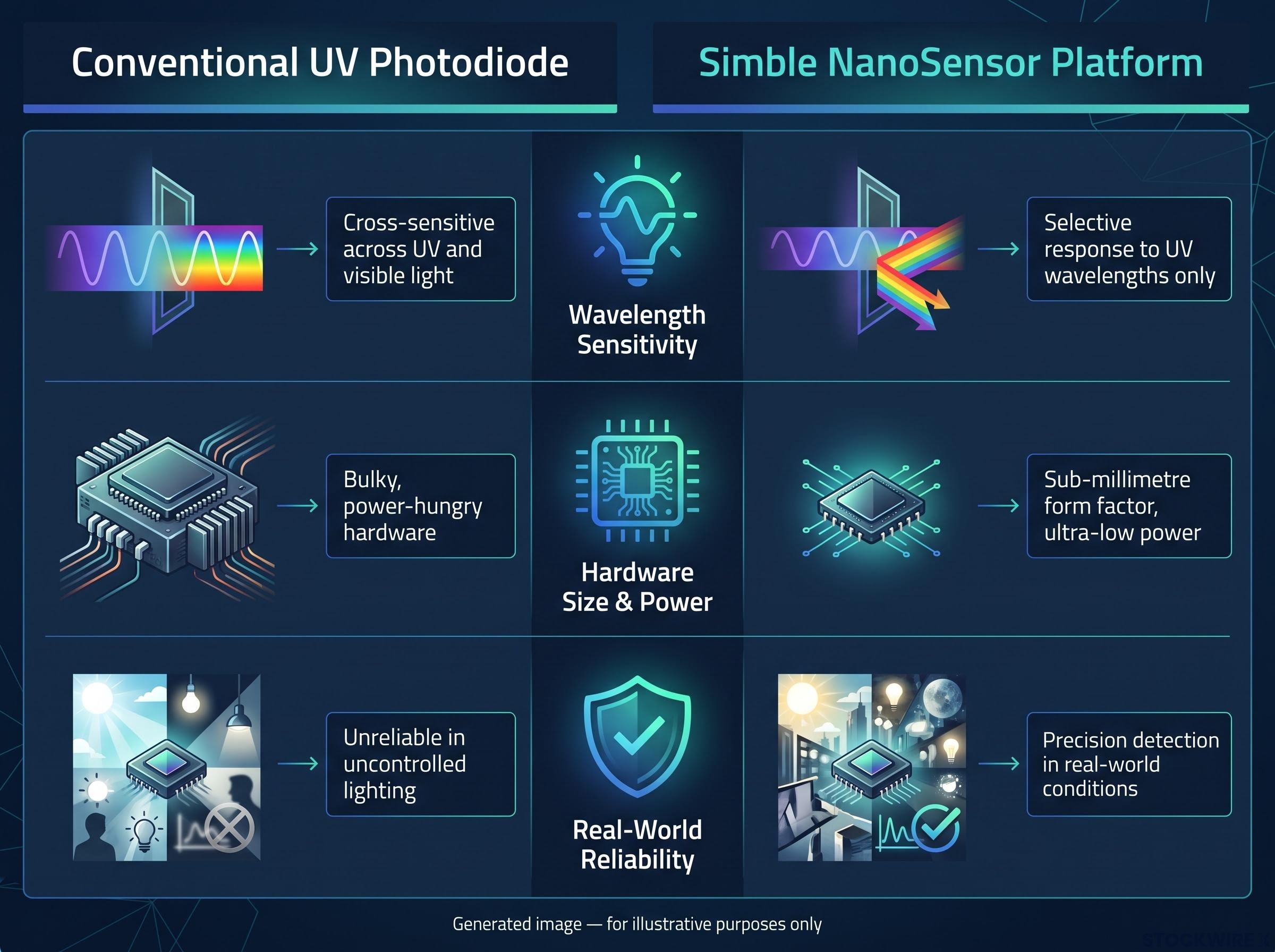
The characteristics of conventional technology compared with the NanoSensor’s design are outlined below. Note that comparative performance remains subject to formal benchmarking.
| Characteristic | Conventional UV Photodiode Technology | Simble NanoSensor Platform |
|---|---|---|
| Wavelength sensitivity | Cross-sensitive across UV and visible light | Selective response to UV wavelengths only |
| Hardware size and power | Bulky, power-hungry hardware | Sub-millimetre form factor, ultra-low power |
| Real-world reliability | Unreliable in uncontrolled lighting | Precision detection in real-world conditions |
The five-stage development pathway
The UV and wavelength workstream is advancing along the same defined five-stage pathway as the gas-detection workstream. Stages 1 and 2 are now complete, with Stage 3 currently in progress.
- Sensor Fabrication — Complete
- UV & Wavelength Testing — Complete
- Benchmark Testing — In progress
- Functional Prototype — Planned
- Customer Trials — Planned
Formal benchmarking will systematically characterise the NanoSensor’s spectral response, sensitivity, selectivity, response and recovery times, repeatability, stability and performance under application-relevant conditions. These results will in turn inform functional-prototype specifications and the prioritisation of commercial pathways.
Application pathways the benchmark data will help prioritise
The initial results point toward applications where conventional UV hardware has historically performed poorly, specifically environments requiring a small sensor, low power draw and the ability to separate UV from ambient light under uncontrolled conditions. Each pathway below remains subject to benchmarking, prototype development and customer validation.
- Drone atmospheric surveying: Sub-millimetre, ultra-low-power sensing integrable into drone payloads for real-time UV and atmospheric capture.
- Defence and security: Zero cross-sensitivity for CBRN field detection and covert sensing in compact field kit.
- Medical sterilisation: UV-C dose verification across hospital, pharma and food settings, plus phototherapy monitoring.
- Water purification: Dose verification for water-treatment operators where compliance depends on measurement accuracy.
- Space and optical communications: Suited to CubeSat payloads and optical ground terminals, extensible into near-infrared.
- Solar and renewable energy: Continuous UV monitoring of solar assets, feeding degradation data for predictive maintenance.
Beyond UV, the NanoSensor’s wavelength detection capability opens potential pathways into optical communication, space-based sensing and atmospheric monitoring as additional application categories. Simble has stated it will use benchmark data from the next program stage to determine which pathways to prioritise.
Connecting sensing capability to Simble’s existing platforms
Simble is pursuing a dual-track strategy that pairs hardware development with its existing software ecosystem. On the hardware side, the NanoSensor sensing element and a separate transparent, stretchable polymer workstream are progressing in parallel, with the polymer platform providing a potential physical foundation for future wearable and e-skin formats.
The stretchable polymer platform is itself tracking a parallel five-stage development pathway, with personal UV exposure monitoring identified as its most immediate target application given the sensing results now confirmed in the lab.
Subject to successful prototype development and validation, NanoSensor-derived UV and wavelength data could be ingested by SimbleSense and visualised alongside existing energy and environmental information. CarbonView could provide a further reporting layer where UV or irradiation data supports operational, safety or sustainability-related records. The announcement notes that platform-readiness work is being advanced in parallel so that data-ingestion and visualisation requirements can inform future prototype design.
CEO Fadi Geha
“Achieving initial UV and wavelength detection results is the second capability output from our NanoSensor development program, following the initial gas-detection results. Completing this capability testing gives us the laboratory baseline we need for formal benchmarking, and the next step is to measure how the sensor performs under conditions relevant to the applications we are considering.
“The workstreams have distinct roles: the NanoSensor provides the sensing capability, the polymer could provide a wearable format, and SimbleSense and CarbonView offer a potential route to connected monitoring and reporting.
“We will use the benchmark data to define prototype specifications and prioritise applications. Functional-prototype development and customer trials remain planned stages, with progression dependent on the results.”
What comes next for the NanoSensor program
With two capability milestones achieved in rapid succession, Simble’s next focus is formal benchmark testing to characterise the NanoSensor’s performance parameters under application-relevant conditions. Those results will guide functional-prototype specifications, with customer trials as a planned subsequent stage.
The polymer platform workstream is progressing in parallel as the potential physical foundation for future wearable formats. Achieving two capability outputs within this structured program positions Simble to make data-driven decisions on prototype prioritisation and commercial pathways, though all progression remains conditional on benchmark outcomes.
Don’t Miss the Next ASX Tech Breakthrough
Big News Blast delivers FREE breaking ASX tech news directly to your inbox within minutes of release, complete with in-depth analysis. Join 20,000+ subscribers already staying ahead of the market. Click the “Free Alerts” button at StockWire X to get the next market-moving announcement the moment it drops.