


NanoSensor platform targets solar sensing as Simble extends commercial roadmap
Simble Solutions (ASX: SIS) is extending its exclusively licensed NanoSensor Technology into solar sensing applications, with an immediate focus on terrestrial solar performance monitoring. The move builds directly on optical characterisation results announced on 14 September 2026, where the NanoSensor demonstrated reliable multi-band detection across UV-A, UV-B, UV-C and visible light wavelengths — validated capability that removes the need for greenfield sensor development. This is a natural extension of the company’s existing footprint: Simble already serves commercial and industrial solar customers through SimbleSense and SimbleEnergy.
When big ASX news breaks, our subscribers know first
Where conventional solar monitoring falls short
As utility-scale and commercial solar deployments accelerate globally, asset owners face mounting pressure to maximise energy yield and detect degradation early. Current industry standards rely on pyranometers, reference cells, and inverter-level electrical metrics that aggregate performance across entire strings or arrays, masking localised faults within string-level averages.
Legacy instruments are bulky, power-intensive, and require ongoing recalibration, making high-density deployment commercially and physically impractical. The consequence is a persistent operational compromise: cell-level visibility with existing hardware exponentially increases cabling complexity, parasitic power draw, and installation overhead.
Simble’s NanoSensor architecture is being characterised to address this gap, pairing a sub-millimetre form factor and ultra-low power consumption with precision multi-wavelength optical detection. The comparison below outlines the targeted design characteristics against conventional approaches — all NanoSensor targets remain subject to formal validation.
| Conventional Solar Monitoring | Simble NanoSensor Platform (Target) |
|---|---|
| Aggregated at string or array level, not per panel | Designed for panel- and cell-level monitoring — Design goal, pending formal benchmarking |
| Bulky, calibrated hardware per monitoring point | Sub-millimetre form factor, ultra-low power — Design goal, pending solar validation |
| Localised faults masked within the average | Precision detection of panel-level performance loss — Design goal, pending benchmark testing |
Development stage and the path to solar validation
Solar sensing does not begin at Stage 1 of Simble’s five-stage NanoSensor development framework. Sensor fabrication and UV and longer-wavelength detection capability testing are both complete. Solar sensing enters at the formal benchmark testing stage, which is currently in progress.
The NanoSensor commercial roadmap spans six distinct application areas, including gas detection, UV sensing, e-skin, and defence, each evaluated through a five-stage framework designed to deploy capital only where a commercialisation case is formally established.
The company’s immediate workstream priorities for this pathway are:
- Complete formal benchmark testing under solar-relevant conditions
- Assess the suitability of the architecture for harsher deployment environments, including space-related applications
- Advance internal work to ensure NanoSensor-derived solar sensing data can be visualised and reported through SimbleSense and CarbonView
- Report capability-specific updates to the market as the workstream matures
The design targets outlined in Figure 2 of the announcement remain subject to formal validation and should not be interpreted as proven performance outcomes.
For readers interested in how the benchmark testing stage works in practice across other NanoSensor application areas, our full explainer on NanoSensor gas detection validation covers the five-stage process in detail, including the sensitivity, selectivity, and stability criteria the platform must meet before advancing to device development.
Six application areas and the market opportunity
The NanoSensor Technology is designed to combine molecular-level sensitivity, sub-millimetre form factor, ultra-low power consumption, and integration flexibility, subject to application-specific validation. Simble is evaluating the following six solar sensing application areas:
- Solar Performance Monitoring: Cell-level detection of degradation, soiling, and micro-fractures beyond panel-level resolution
- UV and Visible Light Sensing: Validated across UV-A, UV-B, UV-C and into the visible spectrum for irradiance monitoring
- Remote and Off-Grid Deployment: Ultra-low-power sensing for remote, off-grid sites where conventional hardware is difficult to deploy
- Embedded Sensing for Dense Arrays: Sub-millimetre form factor embeds directly into modules without disrupting design or weight
- Integration with Software Platforms: Data flows into SimbleSense and CarbonView, already serving commercial customers
- Space-Based Solar (Longer Term): An emerging opportunity subject to further characterisation and confirmation of the commercial case
The application areas sit across several large and growing addressable markets:
- PV Monitoring Systems: approximately US$3.4 billion projected by 2030
- Solar Panel Monitoring: approximately US$5.57 billion projected by 2033
- Space-Based Solar Power: approximately US$10.7 billion projected by 2035
- All three segments sit within the broader Industrial IoT market, projected to reach approximately US$1.69 trillion by 2030
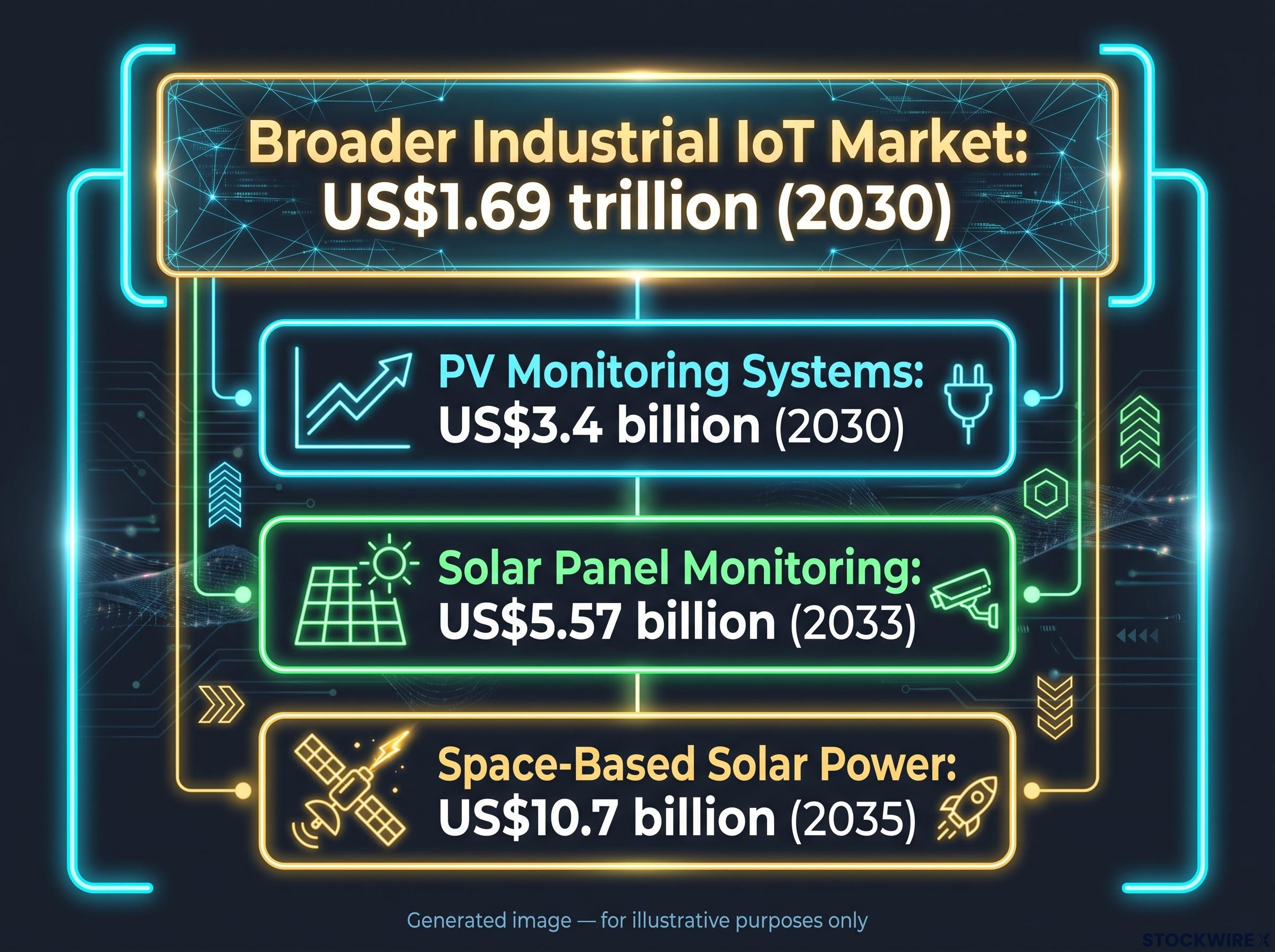
Space-based solar is explicitly a longer-term opportunity, subject to further characterisation and confirmation of the commercial case, and should not be interpreted as a near-term revenue driver.
Software integration — the existing infrastructure advantage
A defining commercial differentiator for this pathway is that it builds on existing software infrastructure rather than requiring a new platform. SimbleSense already has established data pipelines, visualisation logic, and reporting outputs for solar generation data. The addition of a NanoSensor sensing layer would extend the resolution and diagnostic depth of existing solar monitoring capability — not create a new product category from scratch.
For existing customers, this means NanoSensor-derived data can be delivered through platforms they already use. For Simble, it means a more direct route from technical validation to customer-ready capability than would be available for application areas without existing platform infrastructure.
CEO commentary
Fadi Geha, Chief Executive Officer
“Solar monitoring has always been part of Simble’s commercial story through SimbleSense and SimbleEnergy, and the NanoSensor platform gives us a natural way to extend that capability further. The characteristics that make this technology valuable, including precision wavelength sensitivity, ultra-low power consumption and a sub-millimetre footprint, are exactly the characteristics next-generation solar sensing requires.
Our immediate focus is on terrestrial solar performance monitoring, where we already have an established customer base, while continuing to monitor space-based solar, including its relevance to growing AI and data-centre power demand, as a longer-term opportunity. Every new sensing category adds to the operational data asset we’re building across the business, and this is a logical extension of the platform we are already building. It strengthens the connection between our existing commercial operations and our broader technology direction.
We will report progress on solar-specific benchmark testing, and on the space-based solar opportunity, as the program advances.”
Geha will provide further updates on solar-specific benchmark testing and the space-based solar opportunity as the development program progresses.
Investment thesis — why this matters for SIS
For investors assessing the strategic significance of this announcement, four points are worth considering:
- Existing commercial base reduces time-to-market risk. Established SimbleSense and SimbleEnergy customers provide a direct route to commercialisation once validation is complete, without requiring Simble to build a new customer acquisition channel.
- No greenfield sensor development required. Proven wavelength detection capability means the solar sensing program enters at the benchmark testing stage, not Stage 1, compressing the development timeline relative to a de novo sensor program.
- Software-first integration advantage. NanoSensor data is intended to route into existing SimbleSense and CarbonView platforms, expanding data asset depth without the overhead of building an entirely new product category.
- Longer-term optionality in space-based solar. Space-based solar and AI-driven power demand are explicitly flagged as speculative and subject to commercial confirmation, but represent strategic upside worth monitoring as the technology matures.
Simble will update the market as solar-specific benchmark testing progresses.
Stay Ahead on ASX Tech News
Big News Blast delivers FREE breaking ASX announcements straight to your inbox within minutes of release, complete with in-depth analysis already done. Join 20,000+ subscribers who never miss a market-moving update. Click the “Free Alerts” button at StockWire X to get the next big tech story before the market moves.