


Simble Solutions advances NanoSensor platform toward first commercial findings
Simble Solutions has reported substantial progress in its structured development programme for the exclusively licensed NanoSensor Technology, with initial outcomes expected in the near term. The platform, acquired through the December 2025 Next Nano transaction, comes with years of laboratory data, working prototype devices and characterisation work already developed.
The programme is investigating commercial potential across multiple high-value application areas to identify which pathways warrant accelerated development. Simble holds the exclusive global commercialisation licence through wholly-owned subsidiary Next Nano Pty Ltd, covering patented technology filed under PCT/AU2024/050143.
The company is transitioning from technology acquisition to commercial pathway identification, with near-term clarity expected on which applications offer the strongest development case.
When big ASX news breaks, our subscribers know first
Six application areas under commercial evaluation
The development programme is evaluating six distinct application areas, each representing a separate commercial opportunity. The breadth of pathways available from a single platform reduces reliance on any single application succeeding, while successful outcomes in any area could unlock Simble-branded sensor device potential.
-
Gas Detection — molecular-level detection of toxic, hazardous and diagnostic gases for industrial safety, workplace exposure, defence CBRN operations and medical diagnostics
-
UV & Wavelength Sensing — precision UV detection for defence sensing, medical sterilisation verification, drone-based environmental monitoring and solar asset management
-
E-Skin & Flexible Sensing — flexible sensor films opening pathways into wearables, soft robotics, prosthetics and continuous personal health monitoring
-
Defence & Security Sensing — CBRN-relevant field detection, autonomous monitoring platforms and defence wearable concepts, subject to technical validation and customer engagement
-
Multi-Sensor Integration — multiple sensor types on a single integrated platform for advanced wearable, IoT and industrial devices, extending addressable market beyond single-purpose sensors
-
Platform Readiness — SimbleSense and CarbonView positioned to ingest, visualise and report NanoSensor data, providing immediate channel through existing customers
What is nanosensor technology?
Nanosensors are sensors engineered at the nanoscale, meaning their core sensing elements are measured in billionths of a metre. At that scale, sensing materials behave fundamentally differently to bulk materials, enabling characteristics not achievable with conventional sensor designs.
The NanoSensor platform is designed to combine four key characteristics, subject to application-specific validation: molecular-level sensitivity, sub-millimetre form factor, ultra-low power consumption and integration flexibility. These characteristics are intended to address structural limitations in conventional sensor hardware.
The platform is positioned to detect what conventional sensors miss, fit where conventional sensors cannot, and operate continuously where conventional sensors cannot be powered. This addresses structural constraints in markets where existing solutions are fundamentally limited by size, sensitivity or power requirements.
Target markets represent multi-billion dollar opportunities
The development programme targets segments of large, growing markets where conventional sensor hardware is structurally limited by size, sensitivity and power consumption constraints. The platform is positioned to compete in addressable segments of these markets, not capture entire markets.
| Market Segment | Projected Value | Target Year | Source |
|---|---|---|---|
| Industrial IoT | US$1.69 trillion | 2030 | Market Research Future |
| CBRNe Defence Sensing | US$30 billion | 2033 | CBRNE Defense Market Size, Share & Forecast Report – 2034 |
| Wearable Medical Devices | US$139 billion | 2035 | Market Research Future |
These markets represent segments where purpose-built nanosensor platforms can compete against structurally limited conventional hardware.
Five-stage development framework provides shareholder visibility
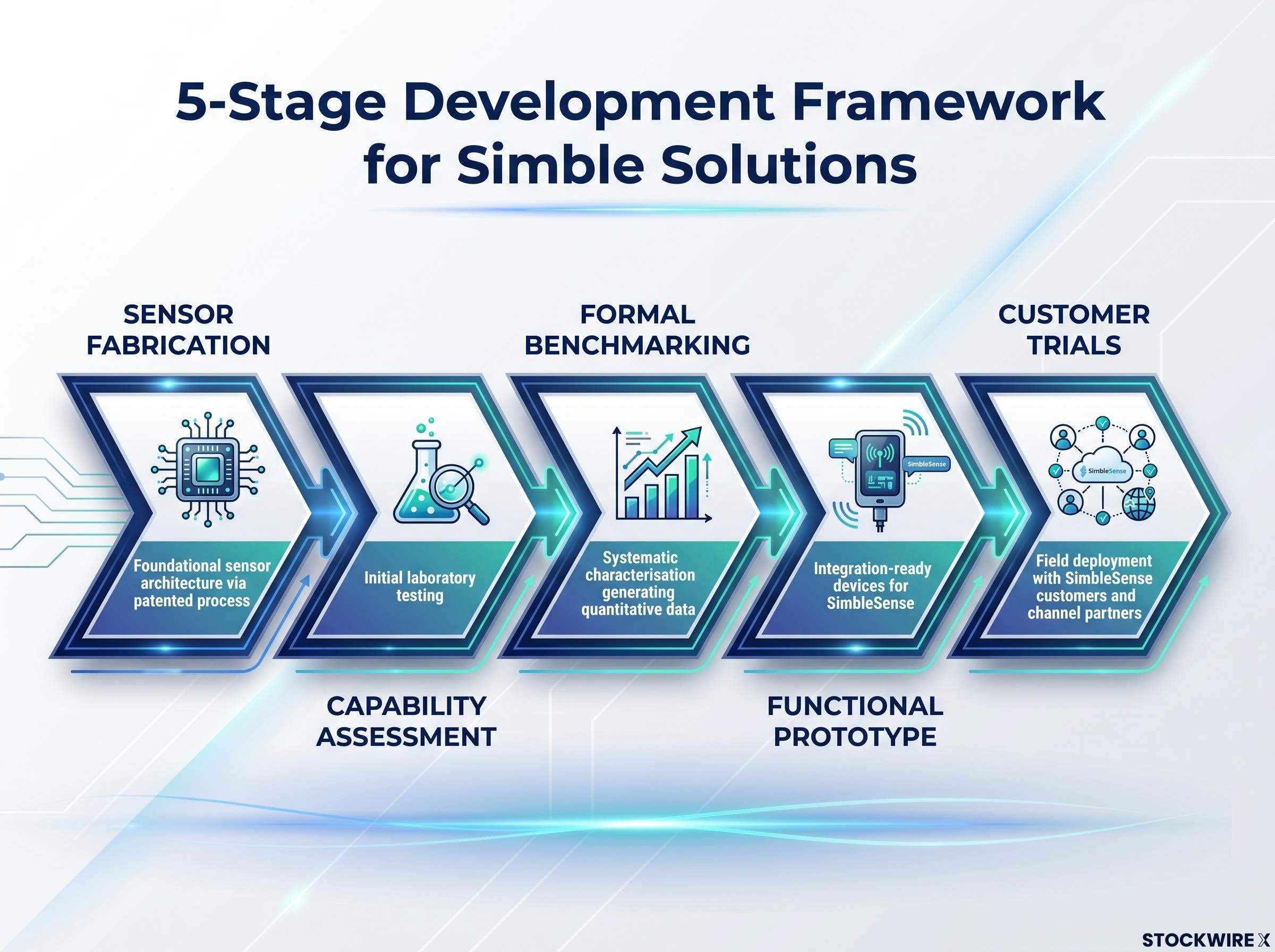
Application areas under development progress through a structured five-stage framework designed to provide shareholders with a transparent view of progress and decision points. The framework ensures capital is deployed progressively based on demonstrated commercial viability, with functional prototype development (Stage 4) undertaken only where commercial viability is established.
-
Sensor Fabrication — production of foundational sensor architecture using the patented manufacturing process
-
Capability Assessment — initial laboratory testing to evaluate functional capability in a given application area
-
Formal Benchmarking — systematic characterisation of performance parameters under application-relevant conditions, generating quantitative data to inform commercialisation decisions
-
Functional Prototype — engineering of integration-ready devices designed to interface with SimbleSense, undertaken only where commercial viability is established
-
Customer Trials — field deployment with selected SimbleSense customers and channel partners to validate real-world performance ahead of rollout
This staged approach means capital is allocated based on demonstrated commercial viability rather than speculative development across all application areas simultaneously. Shareholders receive updates at clear decision points as each area is assessed.
SimbleSense and CarbonView positioned for sensor data integration
Simble’s engineering and product teams are concurrently assessing how existing platforms SimbleSense and CarbonView can ingest, visualise and report data from sensor applications that progress toward deployment. This concurrent approach is intended to materially shorten the time between commercialisation decisions and customer-ready capability.
The existing platforms already serve commercial and industrial (C&I) and mid-sized enterprise customers across Australia and the United Kingdom. Successful commercialisation of any NanoSensor application could flow directly through these existing customer channels, improving product economics and enabling deeper technical integration across Simble’s platform.
This positions the company toward vertical integration and Simble-branded sensor devices, rather than relying solely on third-party sensor hardware.
CEO outlines systematic approach to commercial evaluation
Management has committed to a structured, transparent process rather than pre-committing to specific outcomes before completing commercial assessments.
Fadi Geha, Chief Executive Officer
“We have acquired exclusive rights to a genuinely differentiated piece of sensor technology, and our task now is to determine where it creates the most value. The development program we are running is designed to do exactly that and systematically investigate the platform’s commercial potential across a number of high-potential application areas, and identify which pathways warrant accelerated development. We are not pre-committing to any specific outcome. We are committing to a structured, transparent process and to reporting our findings as they emerge, so that shareholders can see the commercial trajectory of this asset as it develops.”
The statement signals disciplined capital allocation, prioritising evidence-based commercialisation decisions over speculative development across all application areas simultaneously. Shareholders will receive updates as findings emerge from the evaluation programme.
What Simble holds today
Following completion of the April 2026 acquisition, Simble holds all assets required to undertake a credible development programme. The platform comes with an inherited research foundation rather than requiring early-stage research funding.
- Exclusive global commercialisation licence to patented NanoSensor Technology (PCT/AU2024/050143)
- Working laboratory devices including physical sensor devices, miniature sensor-on-chip and flexible nanosensor strip
- Years of laboratory data, prototype development, characterisation work and peer-reviewed research
- Two commercial platforms (SimbleSense and CarbonView) serving customers across Australia and the UK
- Established routes to market via direct B2B sales and channel-partner relationships across multiple geographies
The company is not funding early-stage research but evaluating commercial pathways for technology with existing laboratory validation and working prototypes. Initial outcomes from the most advanced application areas under evaluation are expected to be reported in the near term.
The development programme is further supported by a formal two-year Macquarie University nanosensor collaboration, under which Simble contributes $288,000 toward project-related costs while retaining exclusive commercialisation rights to any technology improvements developed through the partnership.
Want the Next Tech Breakthrough in Your Inbox?
Join 20,000+ investors getting FREE breaking ASX technology news delivered within minutes of release, complete with in-depth analysis. Click the “Free Alerts” button at Big News Blast to start receiving alerts the moment market-moving announcements drop.