

BrainChip outlines edge AI leadership at Pitt Street Research investor webinar
In its September 2026 investor presentation, BrainChip Holdings (ASX: BRN) CEO Sean Hehir outlined the company’s technology positioning and market opportunity in edge AI and neuromorphic computing. Hehir presented at the Pitt Street Research AI & Semiconductors: ASX-Listed Stocks Investor Webinar on 22 September 2026, with the session covering BrainChip’s Akida™ processor, described in the presentation as the world’s first commercialised neuromorphic AI chip.
When big ASX news breaks, our subscribers know first
The edge AI opportunity BrainChip is targeting
The presentation opened with a macro shift: AI is migrating from cloud data centres to physical devices at the edge, driven by data centre cost, power, and latency constraints, alongside growing privacy and data sovereignty requirements. Hehir noted that every industry is independently moving toward edge intelligence.
To frame the scale of the opportunity, the presentation cited third-party market projections across several sub-segments:
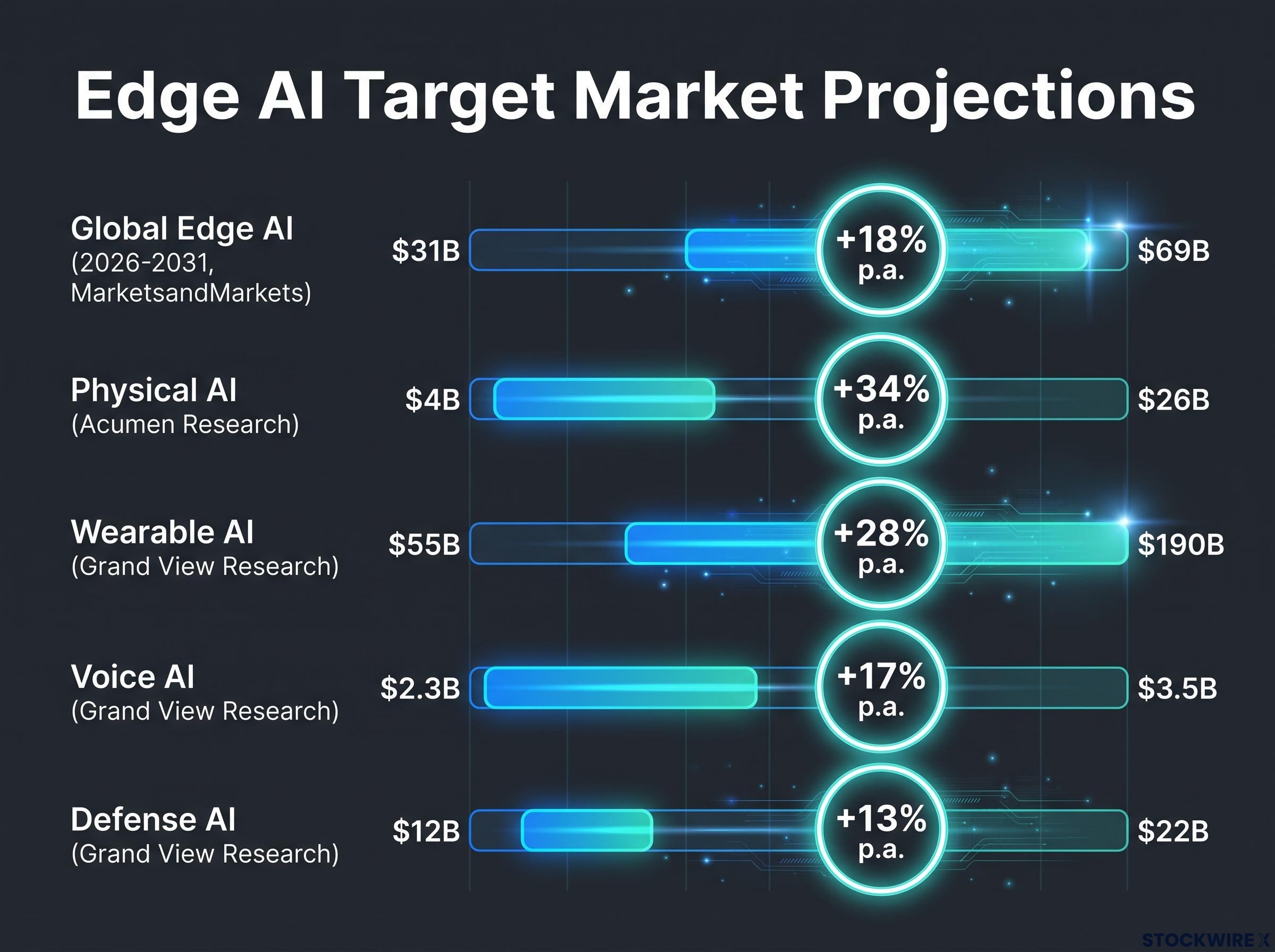
- Global Edge AI market: $31B to $69B (2026–2031, +18% p.a.) — MarketsandMarkets
- Physical AI: $4B to $26B (+34% p.a.) — Acumen Research
- Wearable AI: $55B to $190B (+28% p.a.) — Grand View Research
- Voice AI: $2.3B to $3.5B (+17% p.a.) — Grand View Research
- Defense AI: $12B to $22B (+13% p.a.) — Grand View Research
What is edge AI and why does it matter?
Edge AI refers to running AI processing directly on a device (such as a sensor, wearable, or radar unit) rather than sending data to a remote cloud server for analysis. For investors, the commercial appeal is clear: edge AI reduces latency, lowers power consumption, improves data privacy, and removes dependence on cloud infrastructure.
BrainChip’s core differentiation lies in neuromorphic processing, which mimics how the human brain handles information. Rather than processing continuous data streams, Akida analyses only meaningful sensor inputs at the point of acquisition, making it significantly more efficient than conventional AI chips.
BrainChip’s competitive position — IP, silicon, and scalable solutions
Hehir presented six key competitive advantages for BrainChip in the edge AI space:
- First to commercialise neuromorphic AI — Akida is already in market across a range of products and services
- Protected IP — 67 patents either secured or under review
- Customer flexibility — solutions available as modules, chips, or IP licensing
- Plug-and-play capability — hardware, software, and easy-to-run modules
- Ultra-low power, low latency, and privacy-preserving processing — event-based architecture responds quickly at milliwatt-level power
- Hybrid compute capability — workloads routed between Akida, CPU, and GPU for improved efficiency
On hybrid computing, the presentation explained that BrainChip released the IBM Spectrum Symphony Community Akida bundle on GitHub. This enables each task to be routed to the most appropriate processor: CPU for general-purpose serving, GPU for high-throughput acceleration, and Akida for event-driven, milliwatt inference. The presentation also noted that this approach could be extended to other workload management solutions such as Kubernetes.
The ASICLAND IP licensing agreement, signed in May 2026, illustrates how this distribution model works in practice: the South Korean ASIC design firm integrates Akida neuromorphic IP into custom SoC designs for multiple end customers across edge AI, automotive, and IoT markets, while BrainChip retains full IP ownership and earns volume-based royalties on net sales.
BrainChip’s scalable product platform spans from silicon and IP licensing through to full reference solutions:
| Category | Products |
|---|---|
| Reference Platforms | Akida Comms, AkidaTag, Akida Radar |
| Dev. Kits | AKD1500 M.2 Card, AKD1500 PCIe Card, AKD1500 Raspberry Pi 5 Dev. Kit, AKD1000 M.2 Card, AKD1000 PCIe Card, AKD1000 Raspberry Pi 5 Dev. Kit |
| Silicon | AKD1500 Edge AI Co-Processor, AKD1000 Edge AI SoC (System-on-Chip) |
| License IP | Akida 1, Akida Pico, Akida 2, Sequora |
| Tools | metaTF, metaONNX, BrainChip Developer Akida Cloud |
Key verticals where Akida is gaining traction
Defense — real-time drone classification
The presentation identified counter-drone false alarms as costing $1.8B to $2.0B annually, with existing solutions unable to distinguish threats from noise in real time without cloud connectivity. BrainChip’s Akida Radar Reference Platform is positioned to address this directly, delivering on-device, real-time drone classification. The platform, as presented, comprises a Radar Sensor AK5818 FMCW, a Raspberry Pi 5 host, and the AKD1500 processor, with each object uniquely identified without cloud dependency.
Medical and consumer wearables — seizure prediction
The presentation highlighted Onsor Nexa, a wearable device that uses a BrainChip module to predict epileptic seizures. Three value points were noted in the slide: proactive health management, freedom and independence, and future-proof design.
Space — the GR801 neuromorphic AI solution
The presentation featured the Frontgrade Gaisler GR801, described as the first neuromorphic AI solution for space. Key attributes cited included capability for extreme space environments, unprecedented power efficiency, and enhanced mission capabilities. The GR801 serves as validation of Akida’s IP reaching high-specification, safety-critical markets.
Investment thesis in brief
The presentation’s closing “Edge AI Leadership” slide summarised a three-point investment case. BrainChip positions itself as a leader in edge AI technology, providing IP, silicon, software, and solutions. The company pointed to strong industry trends maturing the edge AI market, alongside strategic traction across Defense, Wearables, Space, and adjacent verticals.
The Akida 2 license with EDGEAI, a Korea-based semiconductor company, extends this royalty-generating model into smart cameras, robotics, and intelligent mobility, with commercial shipment volumes expected to drive quarterly royalty payments to BrainChip over time.
Don’t Miss the Next ASX Tech Breakout
Big News Blast delivers FREE breaking ASX tech news directly to your inbox within minutes of release, complete with in-depth analysis already done for you. Join 20,000+ subscribers who stay ahead of the market the moment announcements drop. Click the “Free Alerts” button at Big News Blast to get started today.