
MXene produced in first Flash Joule Heating runs
Environmental Clean Technologies (ASX: ECT) has announced that Xenica Inc, a wholly owned subsidiary of its acquisition target Xenica Pty Ltd, has produced MXene in the first runs of its scale-up optimisation program using Metallium’s Flash Joule Heating (FJH) reactor platform. The announcement was released on 9 October 2026.
Key points from the update include:
- Two separate flashes have been completed in a structured program
- Independent X-ray diffraction (XRD) analysis by Moore Analytical showed changes in interlayer spacing consistent with the formation of chlorine-terminated MXene
- The work was completed in line with the previously announced timetable, under the existing R&D and Engineering Agreement with Metallium Ltd (ASX:MTM)
The result is an early technical validation that ECT says supports its proposed acquisition. It is not commercial production, as the stated goal is repeatable production of MXene to commercial specifications, with an initial focus on defence applications.
Justin Sharp, Chief Scientist and CTO
“Successfully producing MXenes in the first flash runs marks a major milestone for ECT and provides strong support for our proposed acquisition…”
When big ASX news breaks, our subscribers know first
What are MXenes and why does FJH matter?
MXenes explained
MXenes are an emerging class of two-dimensional (2D) materials that combine high electrical conductivity, low weight and highly tuneable surface chemistry. According to the announcement, this makes them one of the most promising materials for electromagnetic interference (EMI) shielding and advanced defence coatings.
Potential defence applications listed by the company include:
- EMI shielding for electronics and communications systems
- Radar-absorbing and signature-management coatings
- Protective coatings for sensitive equipment
The company states these are performance-critical uses where materials are selected on capability rather than price, and where high-quality, Western-produced MXene is not currently available at scale.
Conventional production vs FJH
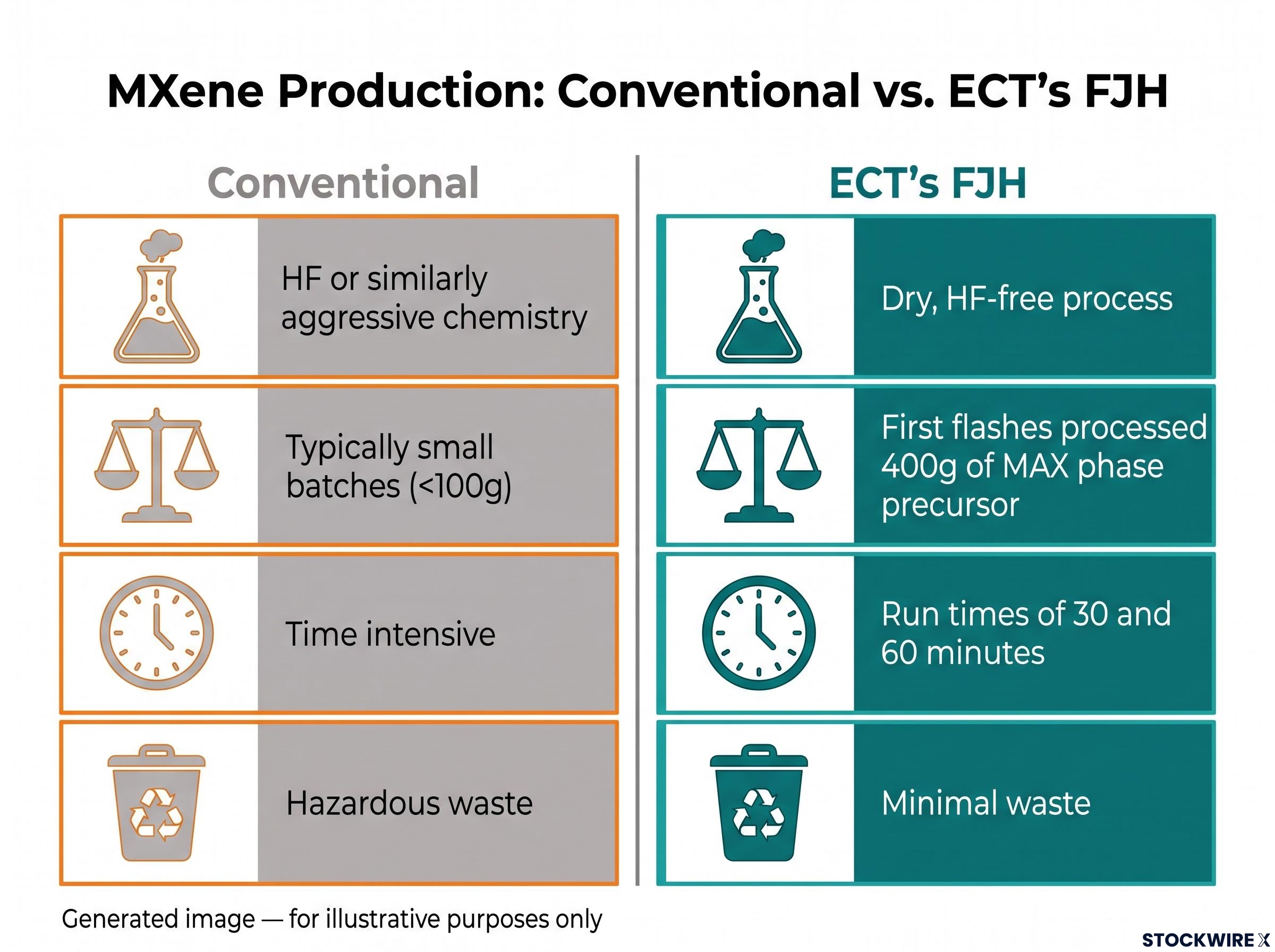
Conventional MXene manufacture selectively removes aluminium from a layered ceramic precursor (MAX phase) using hydrofluoric acid (HF) or similarly aggressive chemistry. ECT states adoption has been held back by the cost, safety and limited scalability of these methods.
| Factor | Conventional | ECT’s FJH |
|---|---|---|
| Chemistry | HF or similarly aggressive chemistry | Dry, HF-free process |
| Batch size | Typically small batches (<**100g**) | First flashes processed **400g** of MAX phase precursor |
| Time | Time intensive | Run times of **30 and 60 minutes** |
| Waste | Hazardous waste | Minimal waste |
Published research in Nature Synthesis provides only an “early indication” that FJH is faster, eliminates bulk acid handling, materially reduces waste and is potentially more scalable than conventional methods. Nothing has yet been demonstrated at scale.
An SEM image of the bulk reaction product from the second flash, captured at the Rice University Shared Equipment Authority, shows the open, layered structure expected of an etched MAX phase grain.
Defence customer pathway and next steps
Entry strategy
Xenica Inc holds a sublicence from MXene Inc. to produce, use or sell MXenes for military end-use, per ECT’s ASX announcement of 14 September 2026. ECT describes defence as an attractive entry market because procurement is performance-led and demand for secure, Western-produced supply exceeds current availability.
ECT intends to:
- Map priority defence applications, beginning with EMI shielding and defence coatings, against the material specifications each requires
- Engage with prospective defence customers and programmes to understand performance requirements and qualification pathways
- Benchmark FJH-produced material against conventionally produced MXene
- Deliver samples to prospective customers for evaluation as material meets target specifications
The approach is consistent with research in Renewable and Sustainable Energy Reviews, which proposed establishing early revenue in high-return military and medical applications and using that position to fund the manufacturing scale-up needed for broader industrial markets.
Metallium collaboration
Through Metallium, ECT has access to an existing FJH reactor platform, engineering expertise and U.S.-based scale-up infrastructure. This allows the process to be evaluated beyond laboratory scale without ECT having to build its own specialised processing infrastructure.
The binding 12-month Engineering Agreement gives ECT access to the Gator Point facility in Texas for an upfront fee of US$500,000 plus quarterly access fees, a capital-light route to testing the process beyond laboratory scale.
Michael Walshe, Metallium Managing Director and CEO
“This program highlights the commercial potential of Metallium’s FJH platform beyond metals recovery…”
Next steps
The structured flash program will continue, with the next steps being:
- Further flashes across a range of process conditions, working towards repeatable production at Metallium’s Gator Point facility in Texas, USA
- Independent characterisation of the material against defence-relevant specifications
- Delivery of samples to prospective defence customers
- Customer and programme qualification
Faldi Ismail, Executive Chairman
“These initial results are a highly encouraging step towards establishing a scalable, cost-effective U.S. source of MXenes for defence applications…”
Investment significance
The result is a technical proof-of-concept that ECT says supports the proposed acquisition of Xenica Pty Ltd. It is an early step rather than a commercial outcome.
The announcement does not disclose timelines, customer contracts, revenue figures, or yield, purity or conversion data. According to Mr Sharp, the focus with Metallium is now on improving conversion and product consistency, and on characterising the material against defence-relevant specifications.
Don’t Miss the Next Advanced Materials Breakout
Join 20,000+ investors getting FREE breaking ASX news delivered to their inbox within minutes of release, complete with in-depth analysis. Click the “Free Alerts” button at Big News Blast to get market-moving news the moment it breaks and stay ahead of the market.