

FDA confirms Mayne Pharma has fulfilled IMVEXXY® post-marketing requirements
Mayne Pharma Group Limited (ASX: MYX) announces that the US Food and Drug Administration (FDA) has confirmed it has fulfilled its post-marketing requirement (PMR) for IMVEXXY® (estradiol vaginal inserts), according to an ASX announcement dated 9 October 2026. The FDA reviewed the final study report submitted by Mayne Pharma and concluded that the requirement has been fulfilled.
With this outcome, Mayne Pharma has no remaining post-marketing requirements with the FDA for IMVEXXY®. The announcement states that completion of the PMR closes all outstanding FDA post-marketing regulatory requirements for the product.
Key points from the announcement:
- The study covered more than 9.5 million US postmenopausal women.
- The pooled hazard ratio was 1.00 (95% CI 0.69–1.45), showing no association with endometrial cancer when very-low-dose vaginal estrogen was used as prescribed.
- IMVEXXY® delivered FY26 net sales of US$29.3 million.
Aaron Gray, CEO of Mayne Pharma
“The study is one of the largest real-world safety analyses of very-low-dose vaginal estrogen ever undertaken and its conclusion shows no association with endometrial cancer when used as prescribed.”
When big ASX news breaks, our subscribers know first
Study of 9.5 million women finds no endometrial cancer link
Study design and scale
The study was conducted by independent research organisation RTI Health Solutions, using two large US health-insurance claims databases spanning commercial and Medicare Advantage populations. As previously announced to ASX on 20 August 2026, the results were presented at the International Society for Pharmacoepidemiology (ISPE) 2026 annual meeting in Milan, Italy. The study was funded by Mayne Pharma, according to the announcement’s references.
The earlier release of the IMVEXXY safety data framed the 9.5 million-woman analysis alongside the FDA’s move to remove boxed warnings from IMVEXXY® and BIJUVA® prescribing information.
In propensity score-matched comparative analyses, and in the pooled meta-analysis across both data sources, there was no evidence of an association between use of very-low-dose vaginal estrogen (VLDVE) products as prescribed and endometrial cancer risk relative to non-use.
| Metric | Result |
|---|---|
| Postmenopausal women analysed | More than 9.5 million |
| VLDVE users | Approximately 86,700 |
| Pooled hazard ratio | 1.00 |
| 95% confidence interval | 0.69–1.45 |
| VLDVE treatment episodes with no concomitant systemic estrogen use | Approximately 89% |
What the result means
A hazard ratio of 1.00 indicates that the risk of endometrial cancer was approximately the same for VLDVE users as for nonusers. The approximately 89% figure is consistent with the targeted, local mode of action of very-low-dose vaginal therapy, according to the announcement.
Dr Frank Casty, Global Head of R&D and Chief Medical Officer
“…It directly addresses a long-standing concern among clinicians and patients regarding endometrial safety and complements a growing body of evidence and guideline support for local vaginal estrogen in the management of genitourinary syndrome of menopause.”
What very-low-dose vaginal estrogen is and why safety data matters
Menopause can cause vulvar and vaginal atrophy (VVA), and the announcement refers to genitourinary syndrome of menopause (GSM). IMVEXXY® is FDA-approved for the treatment of moderate-to-severe dyspareunia, a symptom of VVA due to menopause.
In the study, VLDVE was defined as ≤10 μg estradiol or ≤0.30 mg conjugated estrogens daily. A post-marketing requirement is a safety study the FDA requires after a product has been approved.
For investors, the endometrial safety question is the one Dr Casty described as a long-standing concern among clinicians and patients. The study results address that question directly, according to management.
Guidelines and real-world evidence support local vaginal estrogen
The joint American Urological Association, Society of Urodynamics, Female Pelvic Medicine & Urogenital Reconstruction and American Urogynecologic Society (AUA/SUFU/AUGS) guideline (September 2025) recommends local low-dose vaginal estrogen for appropriate patients with GSM and recurrent urinary tract infections (rUTIs). It also states that local low-dose vaginal estrogen does not increase the risk of endometrial hyperplasia with atypia or endometrial cancer.
An observational analysis of approximately 1.9 million women with rUTIs, published in the journal Urology in 2026, compared women with a vaginal estrogen prescription within two months of diagnosis against those without one. Ranges reflect results across age groups (20–39, 40–54, 55–69 and 70–99 years):
- Sepsis: 4.2%–10.4% of vaginal estrogen recipients vs 8.5%–24.1% of nonrecipients.
- Hospitalisation: 7.5%–12.0% vs 15.7%–27.5%.
- Mortality: 0.3%–3.9% vs 0.8%–9.6%.
The study was retrospective and observational, its findings demonstrate association rather than causation, and they were not specific to IMVEXXY®.
IMVEXXY® growth and the US menopause opportunity
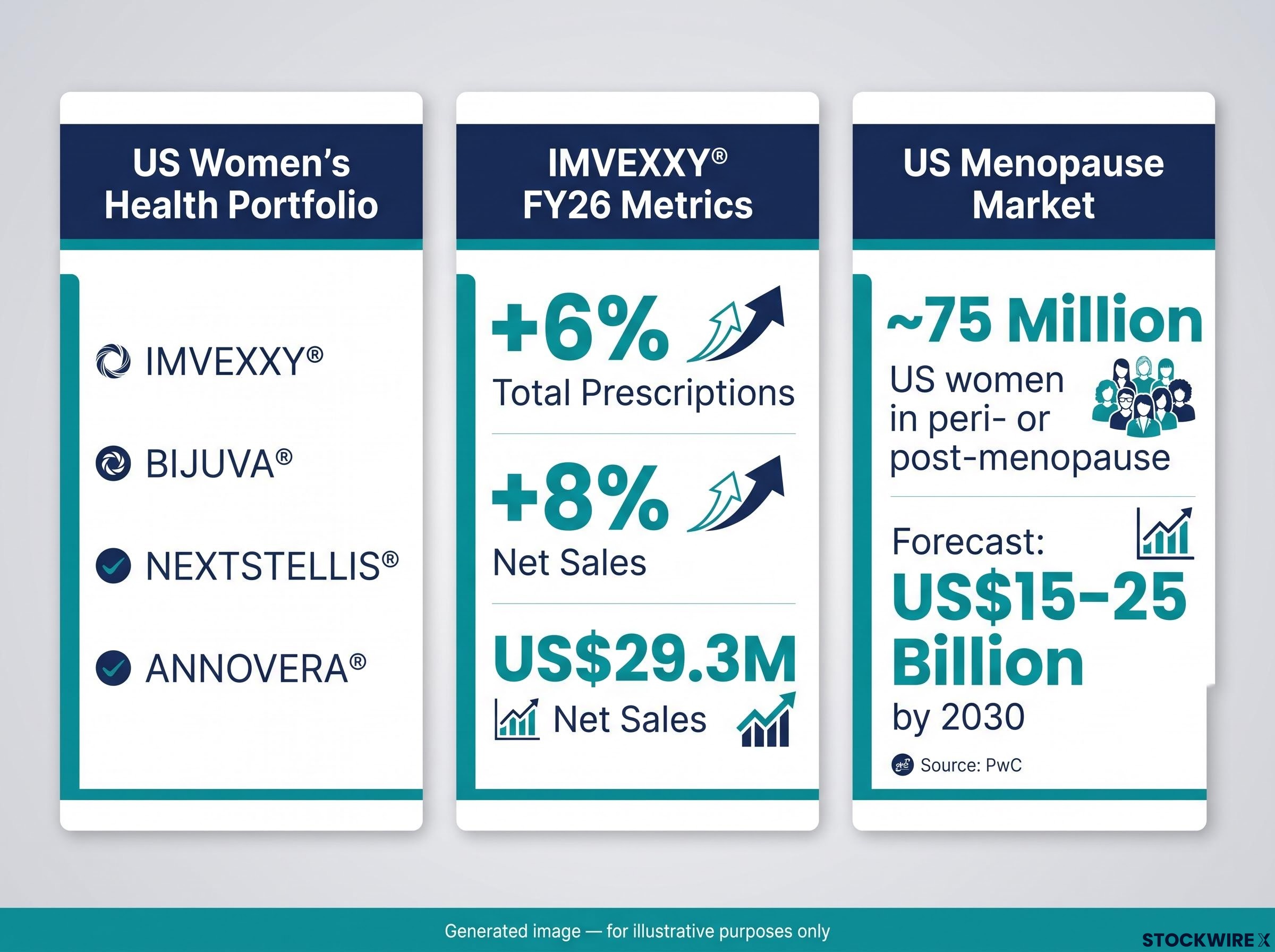
IMVEXXY® is a core product in Mayne Pharma’s US Women’s Health portfolio, alongside BIJUVA®, NEXTSTELLIS® and ANNOVERA®. In FY26, IMVEXXY® total prescriptions grew 6% and net sales increased 8% to US$29.3 million.
Approximately 75 million US women are now in peri- or post-menopause, and the US menopause market is forecast to reach US$15–25 billion by 2030, citing PwC.
The announcement notes that prescriber and patient confidence in hormone therapy continues to strengthen following the FDA’s removal of the boxed warning from menopausal hormone therapy labelling, including for BIJUVA® in February 2026. Mr Gray said this, together with growing evidence for local estrogen therapy, strengthens confidence in IMVEXXY® and “potentially supports its black box warning removal in the future.”
The announcement does not disclose any financial impact from completion of the PMR.
Investors exploring how Women’s Health volumes feed into group earnings can read our detailed coverage of Mayne Pharma FY26 results, which breaks down the non-cash earn-out gain, margin expansion and DistributeRx growth.
Get Healthcare News Before the Market Moves
Join 20,000+ investors receiving FREE breaking ASX news within minutes of release, complete with in-depth analysis already done. Click the “Free Alerts” button at Big News Blast to get the next healthcare announcement in your inbox the moment it breaks, and stay ahead of the market.