


ClearVue unlocks global façade market with BIPV coating breakthrough
ClearVue Technologies (ASX: CPV | OTCQX: CVUEF) has achieved an industry-first capability to apply soft high-performance Low-E coatings on surface 4, the optimal position for maximum solar heat control, on its Gen 3 Vision Glass. The Company announced the milestone on 3 August 2026.
The new manufacturing capability means laminated glass units can now be coated via a magnetron sputter process with soft solar control Low-E coatings after the photovoltaic cells have been laminated and processed.
These coatings are specified on most commercial façades worldwide. ClearVue’s energy-generating glazing now meets that requirement, opening access to a significantly wider set of commercial projects.
When big ASX news breaks, our subscribers know first
Why surface 4 changes the game for ClearVue
What sets the Company apart is where the coating is applied. Placing a Low-E coating on surface 4 delivers the greatest reduction in solar heat gain. ClearVue believes it is currently the only BIPV supplier in the world able to pass a solar panel through a magnetron coating machine.
By contrast, other BIPV products typically carry their Low-E coating on surface 5, a position that substantially reduces the coating’s effectiveness. This increases the solar heat gain coefficient (SHGC), meaning more heat is transmitted into the building.
For investors, the distinction matters. It allows ClearVue to deliver the thermal performance architects and engineers design for, alongside on-site clean energy generation, a combination no other BIPV product can currently offer.
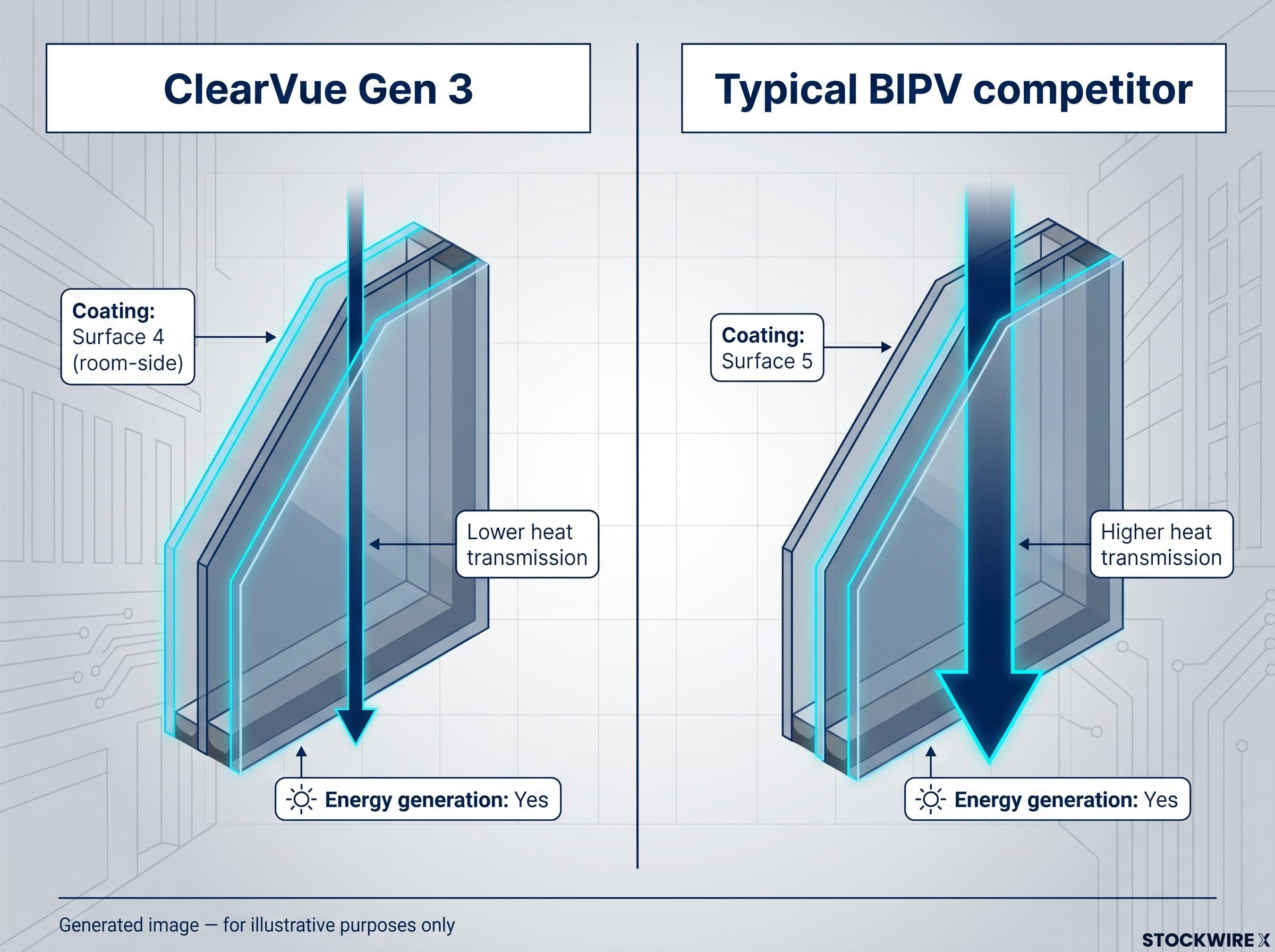
| Feature | ClearVue Gen 3 | Typical BIPV competitor | Investor impact |
|---|---|---|---|
| Coating position | Surface 4 (room-side) | Surface 5 | Max solar heat control |
| SHGC outcome | Lower heat transmission | Higher heat transmission | Meets façade specs |
| Energy generation | Yes | Yes | Dual benefit |
Proven in production with AGC Interpane
The capability was validated in a live production environment with AGC Interpane, one of Europe’s leading flat glass processors and part of AGC Glass Europe.
Gen 3 Vision Glass units were sent to AGC Interpane’s plant in Plattling, Germany, where they were cleaned, coated with one of the company’s widely used solar control coatings, and tested through the line. The coating was applied successfully with no changes to the coating process. ClearVue’s units ran on the same production line, at the same settings, as conventional float glass.
Gen 3 Vision Glass had already passed EN 1279-5:2018 ahead of the production run, a European curtain wall sealing standard that confirms hermetic integrity with industry-standard aluminium spacers and is a prerequisite for product specification in regulated construction markets across the continent.
This result carries commercial significance because it confirms compatibility at industrial scale. Laminated photovoltaic units can be processed on existing coating lines without specialised equipment, lowering the barrier for glass manufacturers to adopt the product.
AGC Interpane’s profile includes:
-
Founded 1971, headquartered in Lauenförde, Germany
-
Production plants in Germany, Austria, France and Slovakia
-
Part of AGC Glass Europe, one of the world’s leading manufacturers of flat, automotive and display glass
-
Specialises in high-performance coated glass, including the ipasol solar control range
CEO Doug Hunt on the breakthrough
Chief Executive Officer and Managing Director Doug Hunt framed the development as a defining moment for the Company.
Doug Hunt, Chief Executive Officer & Managing Director
“This is one of the most significant milestones in ClearVue’s history. It puts us in a class of our own. We can place a high-performance soft Low-E coating on surface 4, the room-side face of an energy-generating glazing pane, which is exactly where it delivers the greatest solar heat control. We believe no other BIPV supplier in the world can currently do that. It means our customers get the thermal performance a commercial building is designed around and clean energy from the same glass. That is a genuine breakthrough for the industry, and it lets us pursue commercial façade opportunities worldwide at real scale.”
What BIPV means and why coatings matter
Building-integrated photovoltaics (BIPV) refers to solar technology built directly into building surfaces such as façades, cladding, spandrel, balustrade and skylight elements, rather than added on top of them. This allows the building envelope itself to generate renewable energy.
The solar heat gain coefficient (SHGC) governs how much solar heat enters a building. It directly affects the cooling load, running cost and comfort of the space, which is why architects and engineers pay close attention to it during design.
Because Low-E coatings are standard specification on commercial façades, a BIPV product that could not accept them was effectively locked out of many projects. This breakthrough removes that barrier, allowing BIPV glazing to be specified, coated and processed in the same way as conventional architectural glass.
Two routes to scale and what comes next
The capability gives ClearVue two commercial routes to manufacture. The Company can build units from pre-coated glass supplied by leading glass manufacturers, or send its laminated units to specialist coating companies to be finished.
Both routes draw on established industry supply chains rather than bespoke equipment. This supports scale and gives the Company flexibility in how and where its products are made.
Gen 3 Vision Glass holds triple global certification covering IECEE CB, CE, and TUV MARK Safety, opening simplified specification pathways into more than 50 international construction markets and providing the compliance foundation commercial facade projects require before a product can be formally specified.
For investors, the development positions ClearVue to pursue global commercial façade opportunities at scale, effectively expanding its addressable market. The Company has not disclosed specific financial figures, revenue targets or timelines in connection with the announcement.
Get the Next Clean Energy Breakout in Your Inbox
Big News Blast delivers FREE breaking ASX news directly to your inbox within minutes of release, complete with in-depth analysis already done for you. Over 20,000 active subscribers trust it to stay ahead of market-moving announcements across Tech, Healthcare, Manufacturing and more. Click the “Free Alerts” button at Big News Blast to start receiving alerts the moment news breaks.