

ClearVue’s Gen 3 Vision Glass secures triple global certification for international rollout
ClearVue Technologies (ASX: CPV | OTCQX: CVUEF) has announced that its Gen 3 Vision Glass has achieved multiple international certifications, following a comprehensive independent testing programme conducted by TÜV SÜD. The certifications provide objective validation of the technology’s performance, durability and long-term reliability.
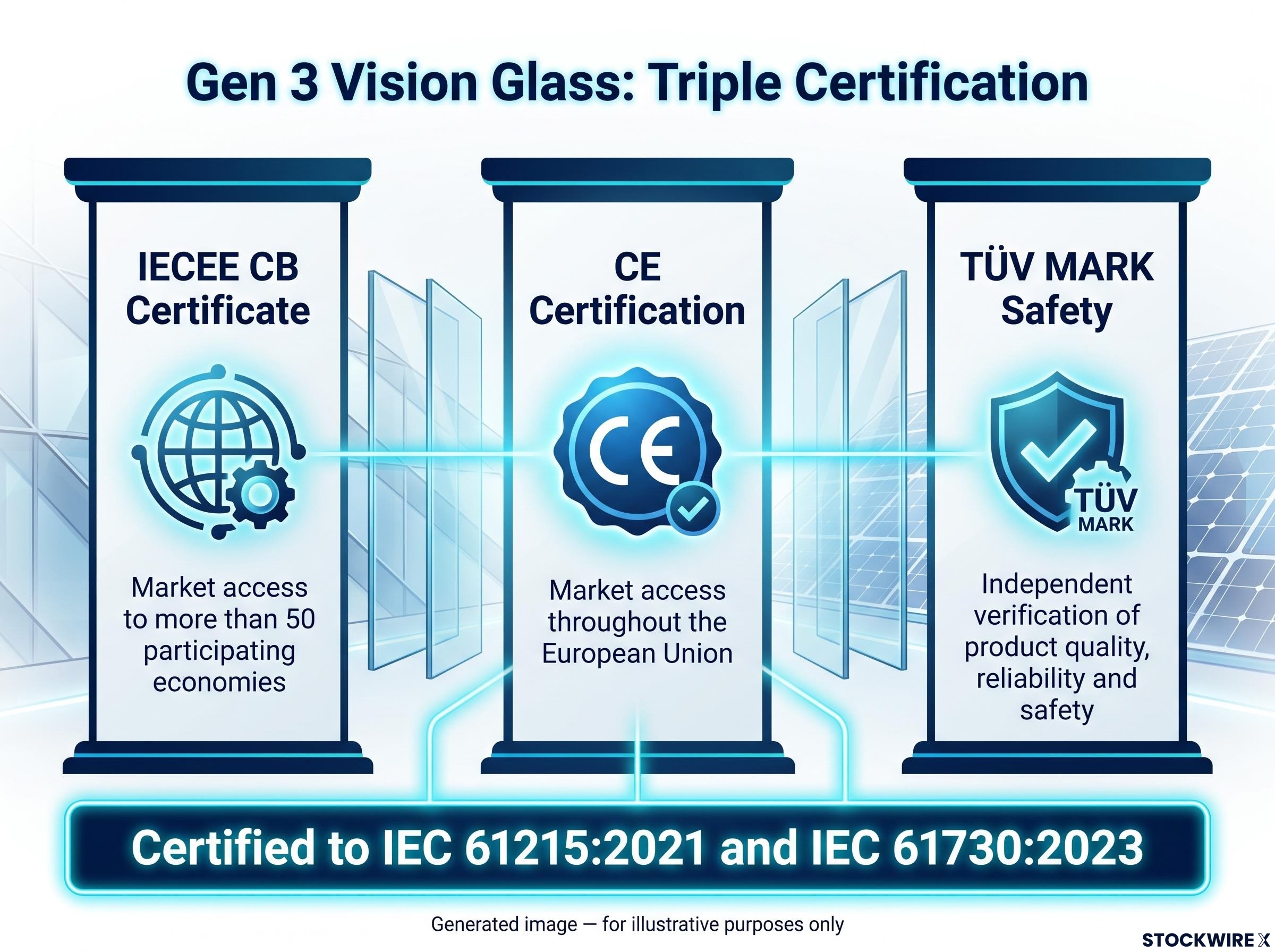
The smart building materials company confirmed on 7 July 2026 that Gen 3 Vision Glass was awarded three top-level certifications (IECEE CB, CE and TÜV MARK Safety), certified to IEC 61215:2021 and IEC 61730:2023. The programme covered four product variants ranging from 9W to 336W, opening specification pathways into major global construction markets.
When big ASX news breaks, our subscribers know first
What the three certifications unlock
Each certification serves a distinct commercial function, with all certifications achieved using ClearVue’s proprietary Thermal Bridge Junction Box. According to the Company, the three approvals together provide an important commercial foundation for international deployment.
ClearVue’s TÜV SÜD junction box certification, awarded under IEC 62790, validated the in-house designed component at 1,000V and 30A with IP68 waterproofing, forming the electrical extraction backbone that the Gen 3 glazing units depend on for safe power output.
-
IECEE CB Certificate — enables test results to be recognised across more than 50 participating economies, significantly simplifying local certification pathways into overseas markets.
-
CE Certification — confirms compliance with mandatory European regulatory requirements and enables market access throughout the European Union.
-
TÜV MARK Safety — provides internationally recognised independent verification of product quality, reliability and safety.
For architects, façade engineers, developers, regulators and building owners, internationally recognised certification is often a prerequisite for product specification. It offers independent evidence that a product has been rigorously assessed against internationally accepted standards, forming the commercial foundation for international deployment.
Understanding BIPV and why certification matters
Building Integrated Photovoltaic (BIPV) technology embeds solar energy generation directly into building materials. ClearVue integrates solar generation into vision glass, cladding, spandrel, balustrade and skylight solutions while preserving glass transparency, allowing buildings to generate renewable energy without sacrificing aesthetics.
The certified variants use Tunnel Oxide Passivated Contact (TOPCon) photovoltaic cells.
Why does this matter to investors? Certification transforms a promising technology into a specifiable, saleable product. Independent validation de-risks the path from innovation to commercial revenue, giving customers confidence that the technology has been independently tested and verified against the latest international standards.
The certified product platform and testing depth
The certification programme covers four Gen 3 Vision Glass product variants incorporating TOPCon photovoltaic cells, spanning full-cut, half-cut, one-third-cut and one-quarter-cut configurations. The table below summarises the certified platform.
| Attribute | Detail |
|---|---|
| Variants | Full-cut, half-cut, one-third-cut, one-quarter-cut |
| Power output | 9W to 336W |
| Construction | Frameless single- and double-glazed |
| Electrical | Class II protection; max 1,000V DC system voltage |
| Fire rating | UL790 Class A |
ClearVue described the process as one of the most comprehensive independent qualification, reliability and safety testing programmes undertaken for Gen 3 Vision Glass. The testing spanned five broad categories:
-
Electrical performance — STC verification before and after individual stress tests.
-
Environmental reliability — thermal cycling, damp heat ageing, humidity-freeze and UV preconditioning.
-
Mechanical performance — hail impact, static and cyclic mechanical load, and materials creep.
-
Electrical safety — hot-spot endurance, PID resistance, dielectric insulation, wet leakage, and bypass diode thermal and functional safety.
-
Construction and compliance — visual inspection and construction assessment to IEC 61730-1:2023.
According to the Company, Gen 3 exceeded key international reliability testing requirements, reflecting an engineering philosophy of designing beyond minimum compliance rather than merely meeting the standards.
Engineering beyond the standard
Managing Director Douglas (Doug) Hunt emphasised that ClearVue’s internal benchmarks were set well above the certification thresholds. The international standards are designed to simulate 25 years of ageing on a building, yet the Company states it tests products to over double the cycling requirements of these standards in its own design validation.
Douglas Hunt, Managing Director
“The standards we have achieved are designed to simulate 25 years of ageing on a building. In our own design validation testing we successfully test products to over double the cycling requirements of these standards meaning simulation of well over 25 years normal weathering in the built environment. […] We believe failure in the testing lab is far better than failure onsite. This is an ethos that is at the core of all our engineering.”
Hunt noted that Gen 3 glazing products have also recently achieved AS/NZS 2208 and EN1279-5 testing, passing construction standards for safety glass including delamination and IGU sealing tests. According to Hunt, both of these have been “a failure point on many legacy competitor BIPV installs globally,” underscoring the durability focus behind the platform.
The investment case and what comes next
Certification removes a key barrier to international sales and de-risks deployment by providing independent, third-party validation of performance and safety. For a technology company transitioning from innovation to commercial revenue, this shifts Gen 3 Vision Glass from a promising concept to a specifiable product.
The approvals position the Gen 3 platform for specification by global developers and façade engineers across major construction markets. As the Company noted, internationally recognised certification is frequently a prerequisite before a product can be written into project specifications.
The Cyprus BIPV retrofit at the Rio Business Centre in Paphos illustrates what certified specifications unlock commercially: a A$305,000 contract covering more than 800m² of solar glazing, with ClearVue selected in part because its technical credentials matched the project’s certified performance requirements.
The result also reinforces ClearVue’s positioning as an Australian technology innovator in the net-zero building transition, extending solar energy generation across vision glass, cladding, spandrel, balustrade and skylight applications that can offset a building’s operational energy requirements.
The announcement does not disclose specific revenue targets, project pipelines or timelines tied to these certifications. The forward-looking significance lies in enabling market access, with the triple certification providing a commercial foundation for the global rollout of ClearVue’s BIPV solutions.
Don’t Miss the Next Clean Tech Breakthrough on the ASX
Get FREE breaking ASX news delivered to your inbox within minutes of release, complete with in-depth analysis already done for you. Join 20,000+ subscribers staying ahead of the market on the latest tech and clean energy developments. Click the “Free Alerts” button at StockWire X to start receiving alerts the moment market-moving announcements hit.