

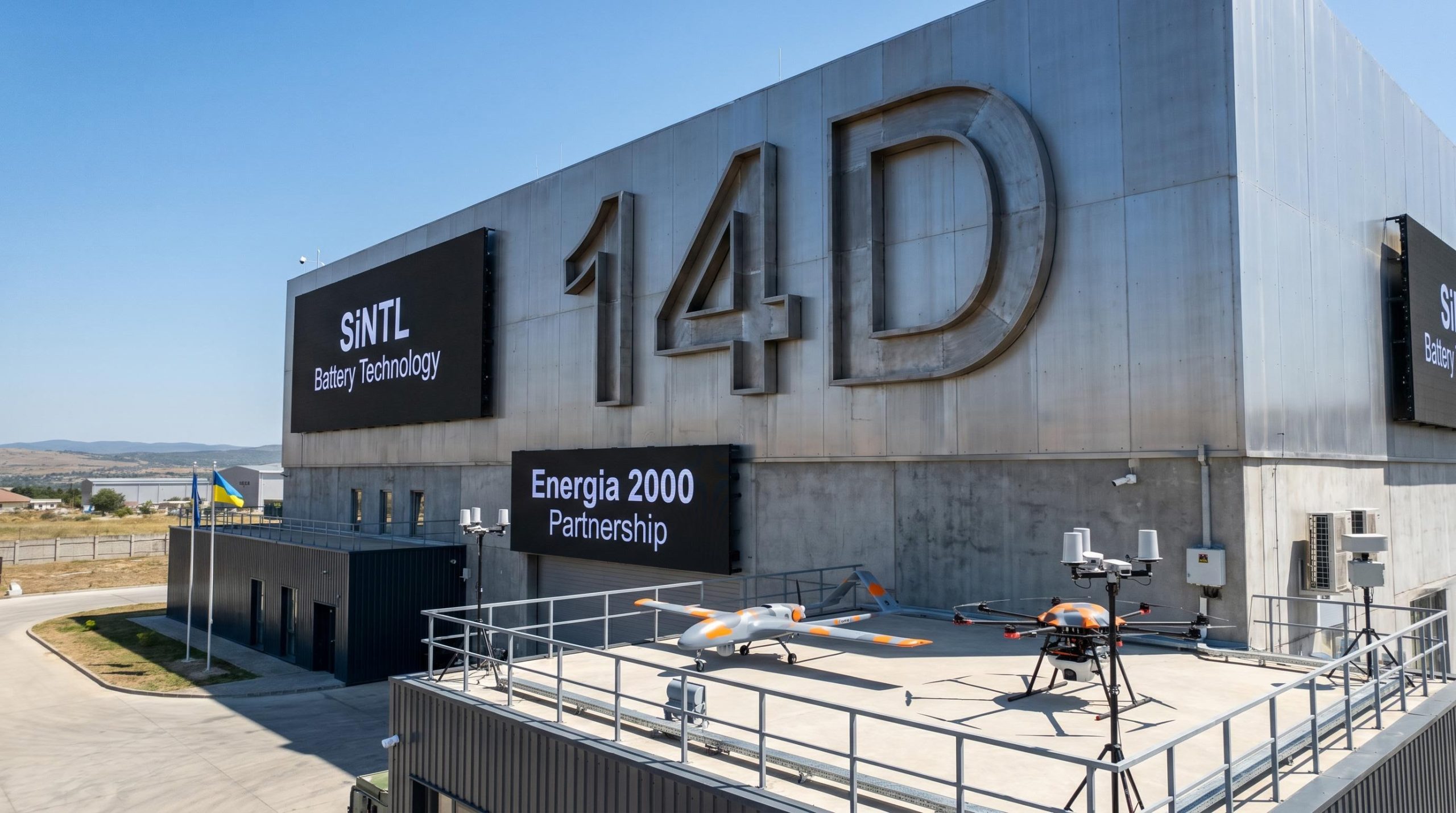
1414 Degrees secures first defence partnership to test SiNTL batteries in live Ukrainian battlefield conditions
1414 Degrees has entered into a Battery Qualification Testing Agreement with Energia 2000, a Ukrainian Government-approved defence manufacturer producing 72,000 military drones and UAVs annually. This represents the company’s first defence sector partnership for its SiNTL silicon-anode battery technology.
Successful testing is intended to create a pathway to adoption across Energia 2000’s full UAV production, with the Ukrainian manufacturer planning to scale output to 360,000 units annually within 24 months through its subsidiary Spectech Industries. The programme is structured to provide 14D with direct access to five active Ukrainian drone battalions for operational evaluation, subject to final documentation, logistics and security approvals.
Energia 2000 brings over 25 years of operational history supplying both domestic and international defence markets. The partnership positions 14D with a first defined commercial pathway into the defence sector through a manufacturer already operating at significant scale.
When big ASX news breaks, our subscribers know first
Why Ukraine is the world’s most important drone testing ground
Ukraine has emerged as the global epicentre of military drone production, manufacturing over 4 million military drones annually — more than all other NATO countries combined. This represents a circa 100-fold production increase in just three years, transforming the country into the world’s largest military drone user.
More than 500 drone manufacturers now operate in Ukraine, where new technology is frequently developed and deployed within weeks rather than years. This compressed development cycle creates an unprecedented environment for rapid technology validation.
SiNTL-based batteries are proposed to be tested in live battlefield conditions during the Ukraine-Russia conflict. Real-world combat testing provides validation data that controlled laboratory environments cannot replicate, potentially positioning SiNTL ahead of competing technologies limited to non-combat evaluation programmes.
How SiNTL addresses the critical limitation facing military drones
The battery capacity problem
Battery capacity functions as the primary limiting factor for drone range, payload and mission duration. Drone operators face direct trade-offs between flight distance, cargo weight, and airborne endurance — all constrained by battery energy density.
This limitation becomes particularly acute in military applications, where extended range provides tactical advantage. The Ukrainian Armed Forces recently struck targets in St Petersburg, approximately 1,200km from Kyiv, marking the furthest distance achieved in the conflict and demonstrating the strategic value of enhanced battery performance.
SiNTL’s performance advantage
SiNTL has demonstrated specific capacity of 530 mAh/g against graphite’s theoretical maximum of 372 mAh/g, with the programme targeting 600 mAh/g. This represents a material performance improvement over conventional lithium-ion battery anode materials.
| Metric | Graphite (Current Standard) | SiNTL (Demonstrated) | SiNTL (Target) |
|---|---|---|---|
| Specific Capacity | 372 mAh/g (max) | 530 mAh/g | 600 mAh/g |
The technology is designed to improve lithium-ion battery performance through silicon-anode material compatible with existing manufacturing pathways, directly addressing the range and payload constraints that limit UAV operational effectiveness.
The six-stage testing programme structure
The testing programme is structured to proceed through six defined stages:
- SiNTL sample and cell validation
- Laboratory cycling and performance testing
- Battery pack testing
- Bench testing on selected UAV platforms
- Flight testing and operational assessment
- Final qualification report and commercialisation review
Each stage includes a pass/fail review before proceeding to the next phase. If the technology does not meet required performance thresholds at any stage, results will be returned to 14D for technical review and improvement before further testing proceeds.
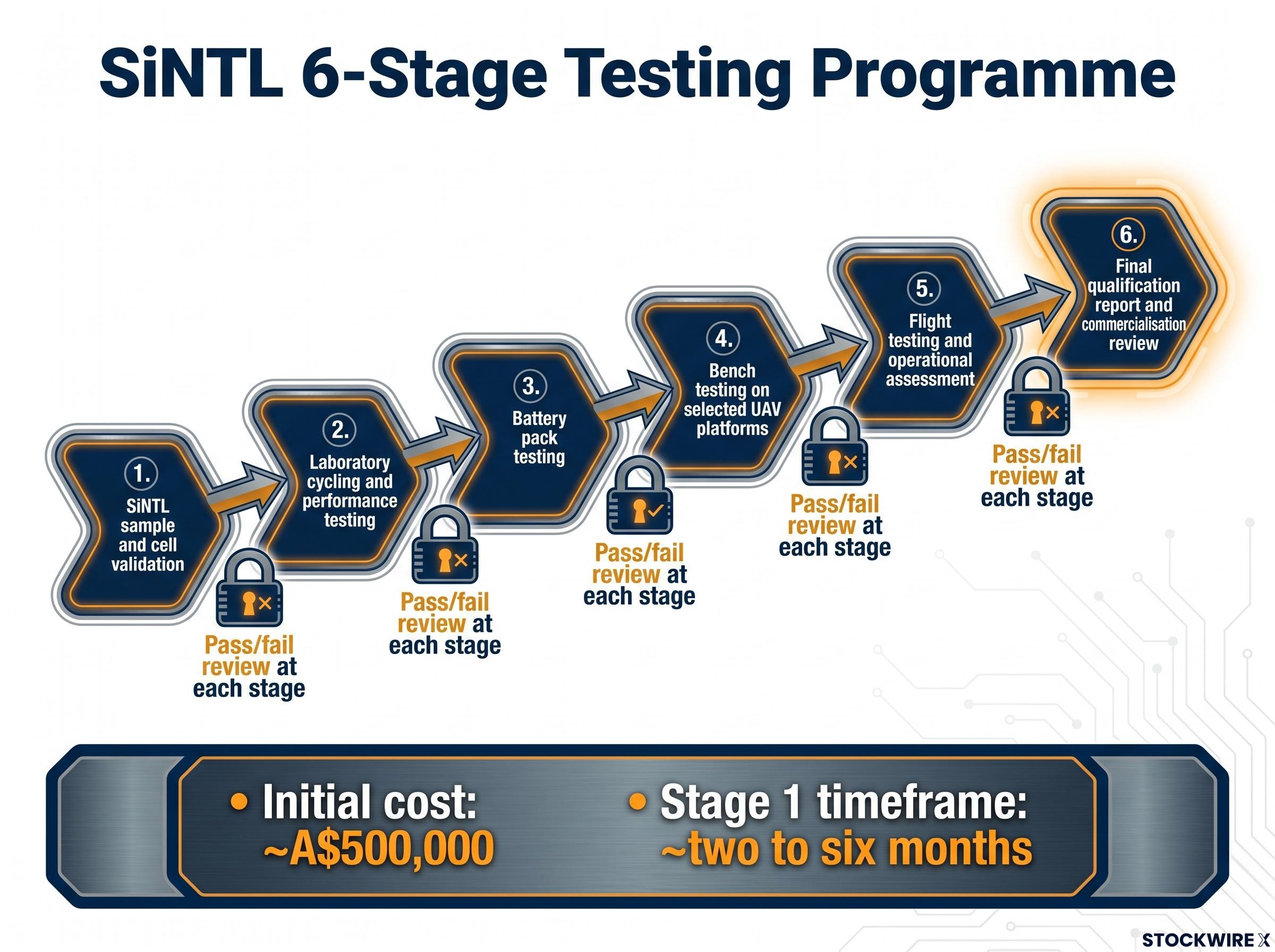
The initial programme is expected to cost approximately A$500,000, with the first stage anticipated to run over approximately two to six months, subject to regulatory approvals, logistics and battery availability. Successful completion of the qualification programme is intended to form the basis for Energia 2000’s adoption of SiNTL-based batteries into its drone production.
This milestone-driven structure creates defined checkpoints that provide shareholders with visibility on commercialisation progress as the programme advances through operational validation.
Drone platforms selected for SiNTL evaluation
Testing will cover three principal UAV classes: fixed-wing UAVs, heavy multirotor bomber/interceptor systems, and FPV strike platforms. These platforms represent battery-sensitive applications where range, endurance, payload and charging performance directly affect operational value.
The initial testing programme plans to evaluate SiNTL across the following specific platforms:
- AirPlast V1.0 fixed-wing UAV — endurance and range testing
- ST.10(6)B Hexa Bomber — heavy multirotor payload and endurance testing
- ST.17FO Warlord Fiber Optics 30km — FPV strike platform and battery load testing
- ST Dragon Mk.II / Mk.III Interceptor — high-speed interceptor battery performance testing
Together, these platforms provide comprehensive test coverage across the principal UAV classes relevant to Ukrainian battlefield deployment. Testing across multiple platform types generates validation data applicable to the broader defence and aerospace markets beyond this initial partnership.
14D’s commercial model and revenue pathway
14D holds an exclusive global licence to the SiNTL technology and retains full commercial rights under that licence. Subject to successful testing and further commercialisation agreements, the company’s commercial model is expected to include:
- Supply of SiNTL anode material
- Battery technology licensing
- Royalties on approved battery packs or platforms using SiNTL
- Future supply arrangements with defence, UAV and aerospace customers
Successful completion of the qualification programme is intended to form the basis for Energia 2000’s adoption of SiNTL-based batteries into its drone production. Any future production, supply or distribution arrangements will be subject to separate binding agreements.
Positioning SiNTL to address Western supply chain vulnerabilities
China currently produces over 92% of global battery-grade graphite anodes, creating supply chain concentration risk for Western defence and aerospace applications. SiNTL represents a next-generation silicon battery anode technology developed by an Australian company (14D) and George Washington University in Washington DC.
This development origin potentially reduces Western supply chain reliance on China for battery components, a consideration increasingly relevant to NATO-aligned defence procurement decisions. Working with a Ukrainian Government-approved manufacturer is expected to raise 14D’s industry profile and lead to additional collaboration opportunities within allied defence sectors.
The 14D Aerospace and Defence division, launched in May 2026 under Peter Yaron, who holds an active Australian NV1 security clearance and brings prior experience with BAE Systems, Saab, and Thales, provides the organisational infrastructure through which this Ukrainian partnership is being progressed.
The geopolitical dimension creates strategic value for non-Chinese battery technology solutions, particularly for applications where supply chain security forms part of procurement criteria alongside technical performance.
Executive perspective on the partnership
Dr Kevin Moriarty, Executive Chairman
“This programme gives 14D a direct and practical pathway to test SiNTL™ in one of the most demanding battery environments in the world. UAV performance is increasingly limited by battery range, endurance, charging time and reliability. SiNTL was developed to address precisely these challenges. By working with Ukrainian defence-sector partners, we intend to generate the operational data needed to support future commercial discussions with defence, UAV and aerospace customers. Importantly, 14D retains full control of the SiNTL technology and is positioning the programme around a scalable supply, licensing and royalty model.”
Next steps and near-term catalysts
The parties are finalising programme documentation and the testing framework. Subject to execution of final binding agreements, 14D expects the initial testing stage to commence following delivery of the required SiNTL test batteries and associated technical materials.
The company has received additional interest from other drone, UAV, satellite and related industry participants in its energy storage technology. Working with a Ukraine Government-approved drone manufacturer is expected to materially raise 14D’s industry profile in the defence sector.
14D will update shareholders as material milestones are achieved through the six-stage testing programme, providing defined near-term catalysts for investors monitoring commercialisation progress.
For investors exploring the full commercial infrastructure 14D is building around this testing programme, our dedicated guide to 14D’s defence advisory board covers the six-member panel of Pentagon insiders and defence prime veterans from Lockheed Martin, Northrop Grumman, and General Dynamics assembled to accelerate SiNTL commercialisation across NATO-aligned procurement channels.
Want the Next Defence Technology Breakthrough in Your Inbox?
Join 20,000+ investors receiving FREE breaking ASX news within minutes of release, complete with in-depth analysis. Click the “Free Alerts” button at StockWire X to get industrials, defence and technology announcements delivered straight to your inbox the moment they hit the market.