

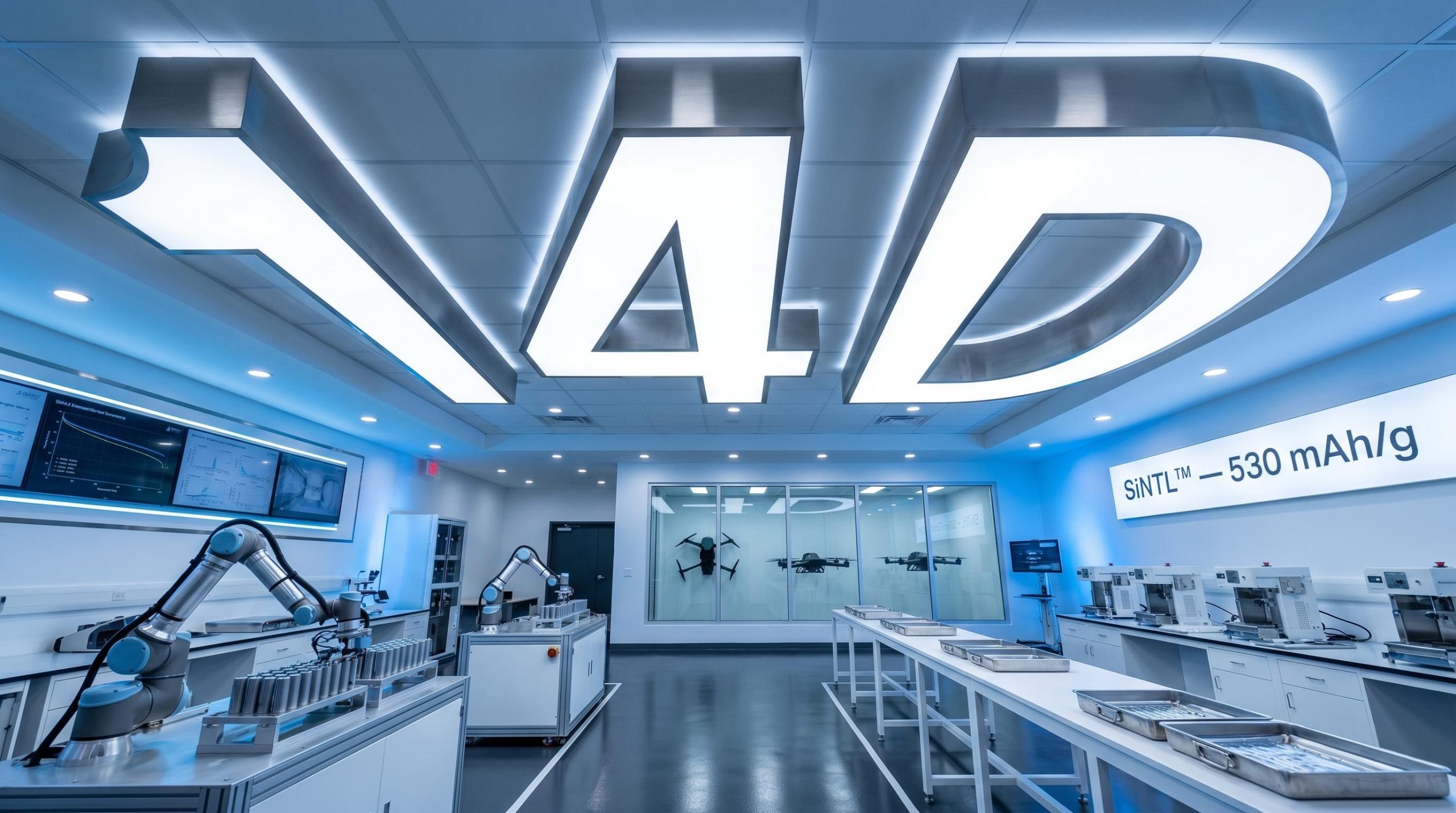
1414 Degrees launches dedicated aerospace and defence division to target the drone battery market
1414 Degrees (ASX: 14D) has established 14D Aerospace & Defence, a new business division focused on commercialising its SiNTL™ silicon nanoparticle anode technology across the drone, UAV, and aerospace markets. The announcement arrives against a backdrop of rapid sector growth, with the global drone market forecast to reach approximately US$160 billion by 2030. Two macro tailwinds are accelerating the opportunity: the Australian Government’s $5 billion defence drone commitment announced in April 2026, and a formalised US policy treating small drones as expendable assets equivalent to ammunition.
When big ASX news breaks, our subscribers know first
Why drones and why now — the SiNTL™ performance case
The battery bottleneck limiting drone capability
Battery energy density is the single most binding performance constraint facing commercial and military drones. Flight time, payload capacity, and operational range are all directly determined by how much energy a battery can store per unit of weight.
Conventional graphite anodes in lithium-ion batteries have a theoretical maximum of approximately 370 mAh/g, a ceiling that limits what drone operators can achieve regardless of advances elsewhere in the platform. For investors, the implication is straightforward: the company that solves the battery density problem holds the performance advantage in a market growing toward US$160 billion.
What SiNTL™ delivers
SiNTL’s laboratory-demonstrated performance addresses the graphite ceiling directly. Key metrics from testing include:
- Specific capacity of 530 mAh/g, approximately 50% higher than conventional graphite anodes
- Development continuing toward 600 mAh/g and beyond
- Faster charging capability, supporting higher fleet utilisation in both commercial and military environments
- Aluminium coating process addressing the volume-expansion degradation challenge common to silicon anode materials
- Air- and water-stable nanoparticles, providing a safety and handling advantage for defence-grade battery production
A critical commercial consideration is that SiNTL is being developed as a drop-in replacement for graphite anodes in existing lithium-ion battery production lines. Battery cell manufacturers would not require capital-intensive retooling to adopt the material. The synthesis process is one-step, low-temperature, and avoids hazardous reagents, supporting a credible path to scalable production.
| Metric | Conventional Graphite | SiNTL™ (Current) | SiNTL™ (Target) | Advantage |
|---|---|---|---|---|
| Specific Capacity (mAh/g) | ~370 mAh/g (theoretical max) | 530 mAh/g | 600+ mAh/g | ~50% higher energy density currently demonstrated |
| Charge Speed | Standard | Faster | Faster | Higher fleet utilisation for commercial and military operations |
| Cycle Stability | Established | Maturing (aluminium coating process applied) | Improved | Volume-expansion degradation addressed via coating technology |
| Manufacturing Compatibility | Standard production lines | Drop-in replacement | Drop-in replacement | No capital-intensive retooling required for manufacturers |
| Air/Water Stability | Standard | Air- and water-stable | Air- and water-stable | Safety and handling advantage for defence-grade production |
A focused division, a defence-ready leader, and a clear commercial mandate
Peter Yaron appointed to lead 14D Aerospace & Defence
Peter Yaron, currently serving as Chief Technology and Operations Officer of 1414 Degrees, has been appointed to head the new division. His profile is deliberately matched to the mandate: technical depth in the core material combined with a track record of commercial execution at scale.
Yaron holds an active Australian NV1 security clearance and has direct experience in silicon nanoparticle technology development and manufacturing scale-up, having previously led the commercialisation of silicon nanoparticle materials at Fortune 500 level. His background includes defence industry partnerships with BAE Systems, Saab, and Thales, spanning the full pathway from laboratory prototype to ASX-listed production company. He holds Australian, United States, and United Kingdom citizenship, an attribute that broadens the division’s access across key allied defence markets.
What the division will pursue
14D Aerospace & Defence will operate as a commercially oriented business unit within the 1414 Degrees group, with five defined mandates:
- Identifying and engaging strategic partners across the global drone and UAV battery supply chain, including battery cell manufacturers, drone OEMs, systems integrators, and defence primes
- Pursuing SiNTL qualification and adoption with leading drone battery manufacturers across commercial and military segments
- Pursuing licensing and technology transfer opportunities with battery manufacturers seeking to integrate SiNTL into drone-optimised battery cells
- Pursuing grant funding, co-investment, and collaborative research with government agencies, defence innovation funds, and research institutions
- Exploring potential corporate, M&A, and collaborative opportunities
Executive Chairman, Dr Kevin Moriarty
“The aerospace and defence technology market has specific, well-defined performance requirements that align closely with what SiNTL delivers today. Establishing a dedicated division gives us the structure and focus to pursue those opportunities properly.”
Market timing and the path to commercialisation
The alignment between SiNTL’s current development stage and drone market requirements is a material point worth noting. US policy treating small drones as expendable assets means maximum energy density, not longevity, is the primary performance requirement for that class of platform. SiNTL’s current envelope, outstanding energy density with maturing cycle life, is suited to this application at this stage of development.
At the domestic level, Australia’s $5 billion defence drone commitment (April 2026) reflects a deliberate policy shift toward unmanned systems as a core component of national defence capability. Sovereign industrial development in drone technology is a stated government priority, which is directly relevant to an Australian company with battery materials technology at this stage of commercialisation.
The Company’s ongoing collaboration with Professor Michael Wagner’s team at George Washington University, under an exclusive global licence, is now being directed in part toward drone and UAV application qualification. This includes cycle life testing under representative discharge profiles and OEM-ready sample production. Commercial applications across delivery logistics, precision agriculture, infrastructure inspection, and emergency services broaden the addressable opportunity beyond the defence segment.
The company has commenced discussions with drone and related industry participants and will update the market as those discussions progress.
Don’t Miss the Next Aerospace and Defence Breakout
Big News Blast delivers FREE breaking ASX news straight to your inbox within minutes of release, complete with in-depth analysis already done for you. Over 20,000 investors rely on it to stay ahead of market-moving announcements across tech, defence, healthcare, and more. Click the “Free Alerts” button at Big News Blast to start receiving alerts today.