
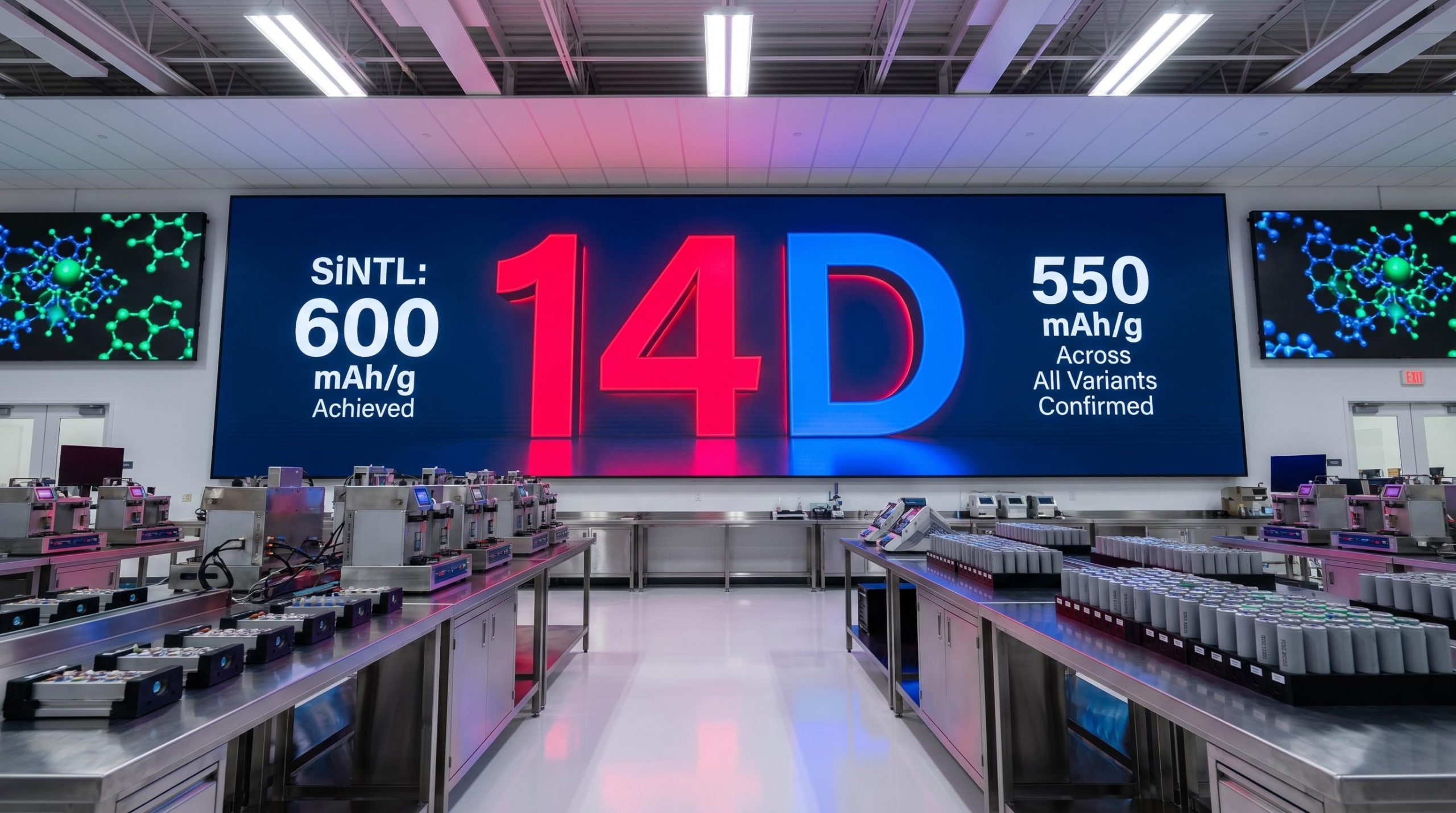
SiNTL clears 550 mAh/g milestone with optimised cells reaching 600 mAh/g
1414 Degrees (ASX:14D) has reported that its SiNTL silicon anode cells have exceeded 550 mAh/g across all tested configurations, with optimised formulations recording above 600 mAh/g on initial cycles.
The Company described the result as over 50% higher than conventional graphite anodes and approximately 20% above current commercial silicon-enhanced anode benchmarks.
Testing was conducted with George Washington University (GWU) under an exclusive global licence. Management has identified consistent 600 mAh/g performance as the near-term target, with carbon-enhancement work expected to deliver that baseline.
The result is positioned by 1414 Degrees as confirmation that SiNTL’s core material performance is on a credible commercialisation trajectory toward a drop-in product compatible with existing lithium-ion battery manufacturing lines.
When big ASX news breaks, our subscribers know first
Inside the test results: three variants, three outcomes
Testing of the latest SiNTL cell configurations produced results across three distinct cell variants. Two performed strongly on initial cycles, while a third, formulated with lower silicon content, recorded slightly lower figures.
| Cell variant | Initial cycle capacity | Capacity at higher rates | Notes |
|---|---|---|---|
| Variant 1 | Exceeded 600 mAh/g | Stabilised above 550 mAh/g | High performer |
| Variant 2 | Exceeded 600 mAh/g | Stabilised above 550 mAh/g | High performer |
| Variant 3 (lower silicon) | Just under 600 mAh/g | Just over 500 mAh/g | Lower silicon content |
The reduction in capacity at higher charge and discharge rates is attributable to the inherently low electrical conductivity of silicon, which limits the speed at which ions can be inserted and extracted during fast cycling.
According to the Company, this is a well-understood characteristic of silicon anode materials and does not affect the demonstrated peak capacity performance.
Cycle life testing is underway, with results to be reported as they become available. The Company regards these results as confirmation that SiNTL’s core material performance is on a credible commercialisation trajectory toward a drop-in product compatible with existing lithium-ion battery manufacturing lines.
Extended cycling performance at the 530 mAh/g level was already confirmed at George Washington University in prior testing, with sustained capacity retention across repeated charge and discharge cycles representing the dataset OEMs require before evaluating commercial integration.
The carbon pathway to consistent 600 mAh/g
The development group at George Washington University is evaluating carbon-enhanced SiNTL nanoparticle material to improve the rate performance of charge and discharge cycles. The Company describes this as a proven technique for improving the electrical conductivity of silicon in lithium-ion battery anodes.
1414 Degrees expects carbon-enhanced SiNTL formulations could maintain 600+ mAh/g at elevated rates, extending the performance window relevant to high-demand applications.
The 600 mAh/g result represents the latest step in a progression that began with the 500 mAh/g silicon anode milestone, which the Company achieved months ahead of its original schedule and which first validated the SiNTL platform as a credible commercial candidate.
The SiNTL material is produced via a process with the following credentials:
-
Low-temperature synthesis (125–180°C)
-
Single-step process
-
Approximately 97% demonstrated yield
-
Compatible with conventional lithium-ion production lines
Professor Michael Wagner’s team at GWU continues to lead the technical programme.
Peter Yaron, Chief Technology and Operations Officer
“SiNTL cells are now surpassing 550 mAh/g across our test configurations, with our best-performing cells recording above 600 mAh/g at slow rates. That gives us real confidence in the material. The carbon enhancement work is the path to making 600 mAh/g the consistent operating baseline.”
Why silicon anode capacity matters for investors
Graphite-anode cells from manufacturers such as Samsung, Panasonic, CATL and LG are generally limited to around 372 mAh/g. The measure mAh/g refers to milliamp-hours per gram, indicating how much energy a battery material can store per unit of weight.
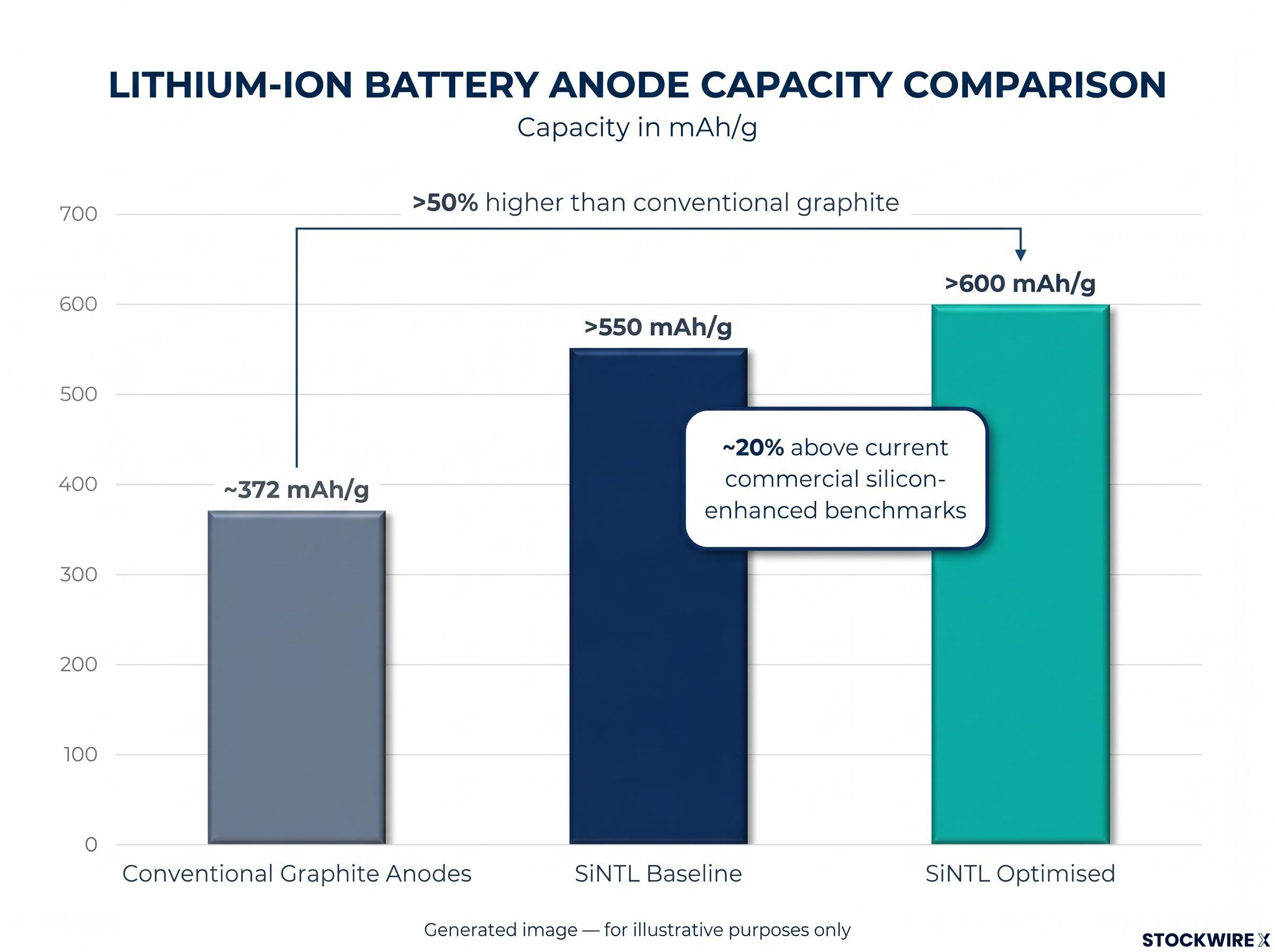
A higher figure means more energy can be stored in the same mass, supporting batteries that are lighter, longer-lasting, or both for a given application.
SiNTL is designed as a drop-in upgrade for battery manufacturers, with no re-tooling or process redesign required, making it a compelling option for global battery manufacturers.
High-growth application markets SiNTL targets
The Company believes higher-capacity silicon anode batteries address demanding applications where energy density and power performance are critical. These include:
-
Drones and UAVs, where weight sensitivity favours longer flight times and larger payloads
-
Electric vehicles, where 1414 Degrees suggests a 500-km EV could become a 650-km range vehicle
-
Electric aircraft and eVTOL air taxis
-
Spacecraft, satellites and space defence lasers
-
Military systems, robotics, marine applications and portable medical devices
These markets are characterised by high sensitivity to energy density, where incremental improvements can meaningfully expand operating performance.
Well-funded to advance commercialisation
1414 Degrees has stated it is well-positioned to progress commercialisation following its well-supported $8.45 million placement in June 2026. The Company has indicated this funding allows it to continue its existing commercial development pathways, leverage its new Advisory Board, and explore additional expansion initiatives and market applications.
SiNTL sits within the broader 1414 Degrees platform, an integrated clean-energy and industrial decarbonisation business spanning grid-scale storage, industrial heat, hydrogen and advanced battery materials. SiNTL is one of several silicon-based platforms alongside SiBrick, SiBox and SiPHyR, unified by a single materials engineering approach.
Looking ahead, carbon-enhanced results are expected in the near term, while cycle life testing remains ongoing. The Company has stated it looks forward to updating the market in due course.
This announcement was authorised by Dr Kevin Moriarty, Executive Chairman, on behalf of the Board of Directors.
Don’t Miss the Next Battery Technology Breakout
Get FREE breaking ASX tech and materials news delivered to your inbox within minutes of release, complete with in-depth analysis already done for you. Join 20,000+ subscribers who stay ahead of the market the moment announcements drop. Click the “Free Alerts” button at Big News Blast to start receiving alerts today.