
$1M program launched to accelerate SiNTL battery material production
1414 Degrees (ASX: 14D) is expanding its SiNTL™ silicon-based anode material program from university-based laboratory development into company-led manufacturing development, supported by a $1 million investment by 14D. The move is designed to speed up supply of SiNTL batteries material for commercial partner evaluation.
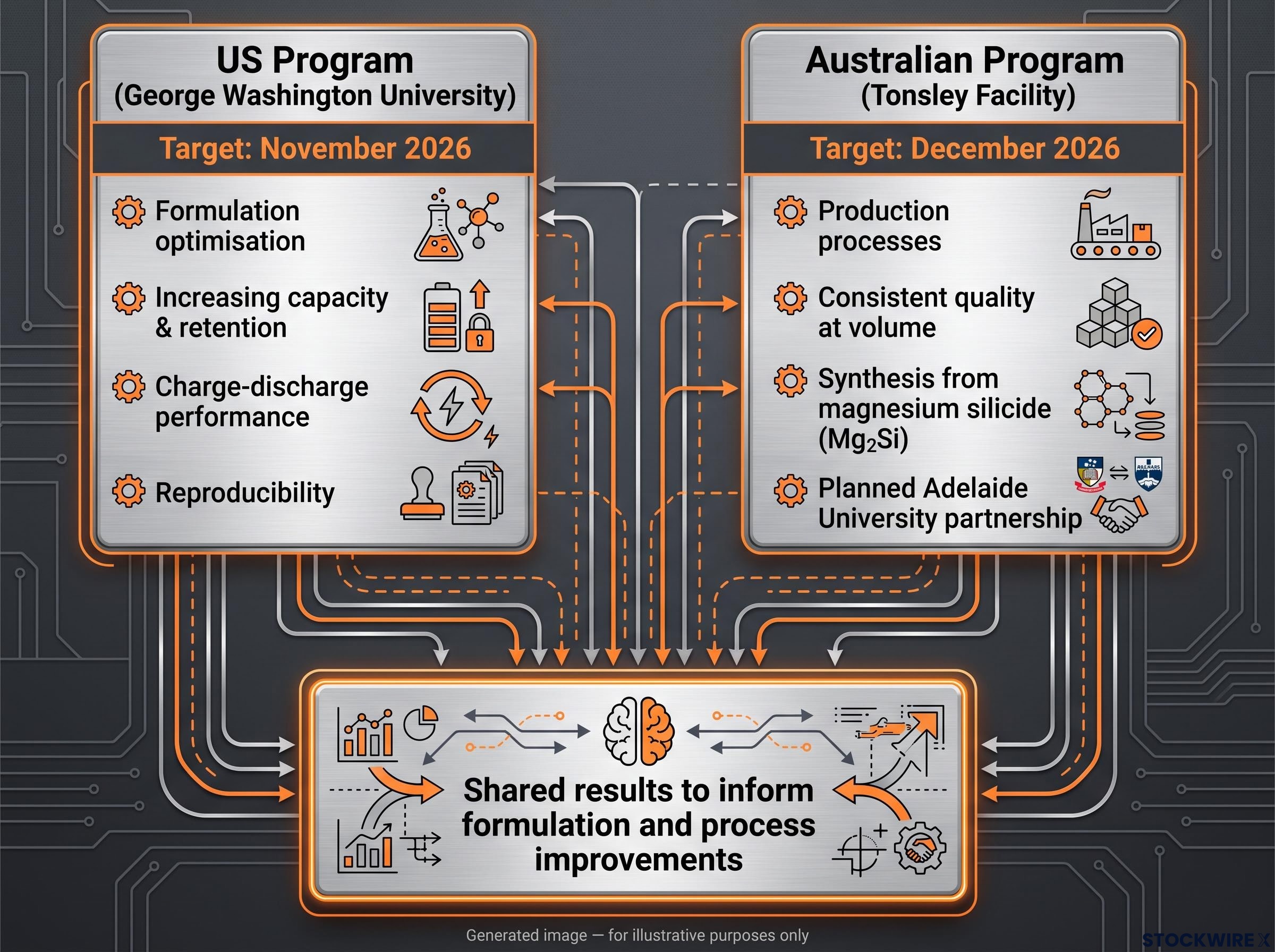
The company has set up parallel programs at George Washington University (GWU) in the US and at its Tonsley facility in South Australia. Scaled-up material production is targeted to begin at GWU in November 2026 and in Australia from December 2026.
For investors, the shift from laboratory work to manufacturing development matters because it addresses the production capability that cell manufacturers and commercial partners are looking for. The announcement does not disclose contract values or revenue.
Key highlights from the 12 October 2026 announcement:
- SiNTL has demonstrated at least 50% greater specific capacity than traditional graphite anodes, according to an earlier ASX announcement dated 28 April 2026.
- Initial battery cell builds at Rochester Institute of Technology (RIT) are planned to commence in December 2026.
- Batteries are targeted for delivery to drone and space industry partners in early 2027.
When big ASX news breaks, our subscribers know first
Two programs, one goal: US formulation and Australian process know-how
GWU is focused on formulation optimisation, while the Australian program targets production processes and consistent material quality at larger volumes. Both programs will contribute material production capacity, and results will be shared between the teams to inform formulation and process improvements.
US program at GWU
An experienced associate professor is working full-time at GWU to optimise the SiNTL formulation. Commissioning of a fluidised bed reactor, carbon-coating furnace and mercury porosimeter for material processing and characterisation is underway.
The work will focus on increasing capacity, improving capacity retention and charge–discharge performance, and scaling production while maintaining consistent material quality. The announcement also names reproducibility as a focus of the GWU program.
SiNTL cell performance results have already cleared 550 mAh/g across all tested configurations, with optimised variants recording above 600 mAh/g, which is the baseline the GWU formulation work aims to hold consistently at scale.
Australian program at Tonsley
1414 Degrees is procuring equipment and consumables at Tonsley to produce SiNTL anode material at scale for battery cell production. The program aims to develop production know-how and potential proprietary process IP relating to the handling and synthesis of SiNTL particles derived from magnesium silicide (Mg₂Si).
The Australian program plans to partner with Adelaide University (AU), and the company is working toward a formal arrangement. Planned access to AU battery cell-making and testing facilities would allow the Australian team to evaluate locally produced material alongside testing at GWU.
14D holds an “exclusive global licence” to the SiNTL material technology from George Washington University. Scaled-up production in Australia is targeted from December 2026, “subject to equipment commissioning and export compliance clearance.”
Dr Peter Yaron, Chief Technology Officer
“Running the US and Australian programs side by side means we’re working on the material and the manufacturing process at the same time, rather than one after the other. The Tonsley work gives 14D its own process know-how for producing SiNTL at volume, and that’s the part a cell manufacturer will look at when deciding whether it can go into their lines.”
What anode material means for battery performance
The anode is the part of a battery that stores lithium ions during charging. Graphite is the traditional anode material, and SiNTL is a silicon-based alternative.
According to the company, SiNTL is designed to increase lithium-ion battery energy density while remaining compatible with existing cell manufacturing processes. The commercial objective is to offer manufacturers a practical performance upgrade using their existing production infrastructure, which could lower the barrier to adoption.
The company states the increased specific capacity offers potentially significant increases to range, payloads and mission times for drones and UAVs, electric vehicles, robotics, military systems and industrial power tools.
Partner evaluation and indicative timeline
RIT will incorporate SiNTL anode material into battery cells for the company’s existing evaluation programs with Energia-2000, a Ukrainian drone manufacturer (announced 11 June 2026), and Space Industries, a European satellite company (announced 17 June 2026). These programs support drone, UAV and space applications.
The company provided the following indicative timeline:
| Indicative timing | Milestone |
|---|---|
| Q3–Q4 2026 | Continue equipment procurement and commissioning. Progress engagement with cell manufacturers in South Korea, the EU and the US. Complete US export requirements. Identification of additional OEMs interested in qualifying SiNTL material. |
| Q4 2026 – Q1 2027 | Scaled-up anode material production begins in the US and Australia. Battery cell builds for commercial partners at RIT. |
| Q1–Q2 2027 | Delivery of batteries to Energia-2000 for drone and UAV evaluation, and Space Industries for satellite evaluation. Export of Australian-produced anode material to JR Energy Solution for commercial scale production. |
| From Q2 2027 | Cells supplied to additional OEMs and end-users for qualification, guided by the SiNTL Advisory Board. |
The timeline is indicative and depends on equipment delivery, regulatory and export approvals, third-party availability and technical results.
The planned export of Australian-produced anode material to JR Energy Solution reflects a capital-light route to cell production, with the South Korean manufacturer’s existing facility and 500 MWh annual capacity giving SiNTL a potential scale pathway without 14D building its own cell plant.
Dr Kevin Moriarty, Executive Chairman
“…Our objective is to prove that SINTL batteries can outperform traditional graphite-based batteries in the most demanding defence and commercial applications, and then rapidly commercialise our technology for widespread industry adoption…”
Next steps to watch include the targeted production starts in November and December 2026, the RIT cell builds from December 2026, and the targeted battery deliveries to partners in early 2027.
Don’t Miss the Next Battery Technology Breakout
Join 20,000+ investors getting FREE breaking ASX news in their inbox within minutes of release, with in-depth analysis already done. Click the “Free Alerts” button at Big News Blast to stay ahead of the market on the next move in tech and industrial innovation.