

Orthocell’s Remplir reports encouraging early outcomes in nerve-sparing prostatectomy
Orthocell (ASX: OCC) has reported excellent early functional recovery data from an initial five-patient Remplir™ case series in clinically complex patients with advanced prostate cancer undergoing nerve-sparing prostatectomy. The company is presenting the series as a pilot to inform a larger prospective trial.
Adoption in Australia is gathering momentum, with more than 300 prostatectomy procedures now completed using Remplir. Multiple surgeons routinely use the product, including several who have performed more than 20 procedures.
Dr Peter Chong, Urological Surgeon
“I am encouraged by these early results, particularly given that these patients underwent limited nerve-sparing surgery… The technique does not add significant operating time…”
When big ASX news breaks, our subscribers know first
Case series results: continence, erectile function and safety
Who the patients were
Patients were aged 57 to 69 years, and most had other health conditions that can make recovery more challenging, including diabetes, high blood pressure and obesity. Some also experienced urinary symptoms or erectile dysfunction before surgery.
All five had prostate cancer that had grown beyond the outer edge of the prostate. Two had high-grade tumours and three had intermediate-grade tumours.
Extensive removal of prostate tissue was required, including the nerves on the affected side. Only partial preservation of nerve tissue on the unaffected side was possible, which made recovery of urinary continence and erectile function more challenging.
Functional and safety outcomes
The table below summarises the reported results.
| Measure | Result | Timeframe | Context |
|---|---|---|---|
| Urinary continence | **80%** showed encouraging outcomes | Pad-free at **3 to 4 months** (two patients) and by **6 months** (third patient) | The two patients who did not achieve full continence had pre-existing urinary symptoms |
| Erectile function | **75%** of patients with pre-surgery function showed a return of function | **12 months** | Of **four** patients with pre-surgery function: one with oral medication alone, two with partial function on second-line treatment, one had not regained function |
| Placement and safety | Placed in **all five** patients; no Remplir-related complications | Approximately **12 months** of follow-up | No technical difficulties or significant additional operative time reported |
| PSA | Undetectable in **all five** patients | At the time of reporting | Includes one patient with a small amount of tumour tissue that could not be surgically removed |
The findings come from only five patients with no control group, so they provide preliminary evidence rather than definitive proof of benefit.
The small prostatectomy series sits alongside a broader evidence base, including an expanded real-world study of 66 patients that reported a 90% success rate across 78 nerve repair procedures with no adverse events.
How nerve-sparing prostatectomy works and why Remplir matters
Radical prostatectomy is surgery to remove the prostate. Nerve-sparing techniques aim to preserve the neurovascular bundles (NVBs), the nerve-carrying structures responsible for erectile function and urinary continence.
Published research estimates that up to 75% of patients undergoing radical prostatectomy may be eligible for nerve-sparing procedures (Moris et al., 2022).
Remplir is designed to protect peripheral nerves and support nerve healing following surgical handling or injury, with the potential to support post-operative functional recovery. For investors, the development represents a new application for an existing product.
US market opportunity and the path to launch
Expanding the addressable market
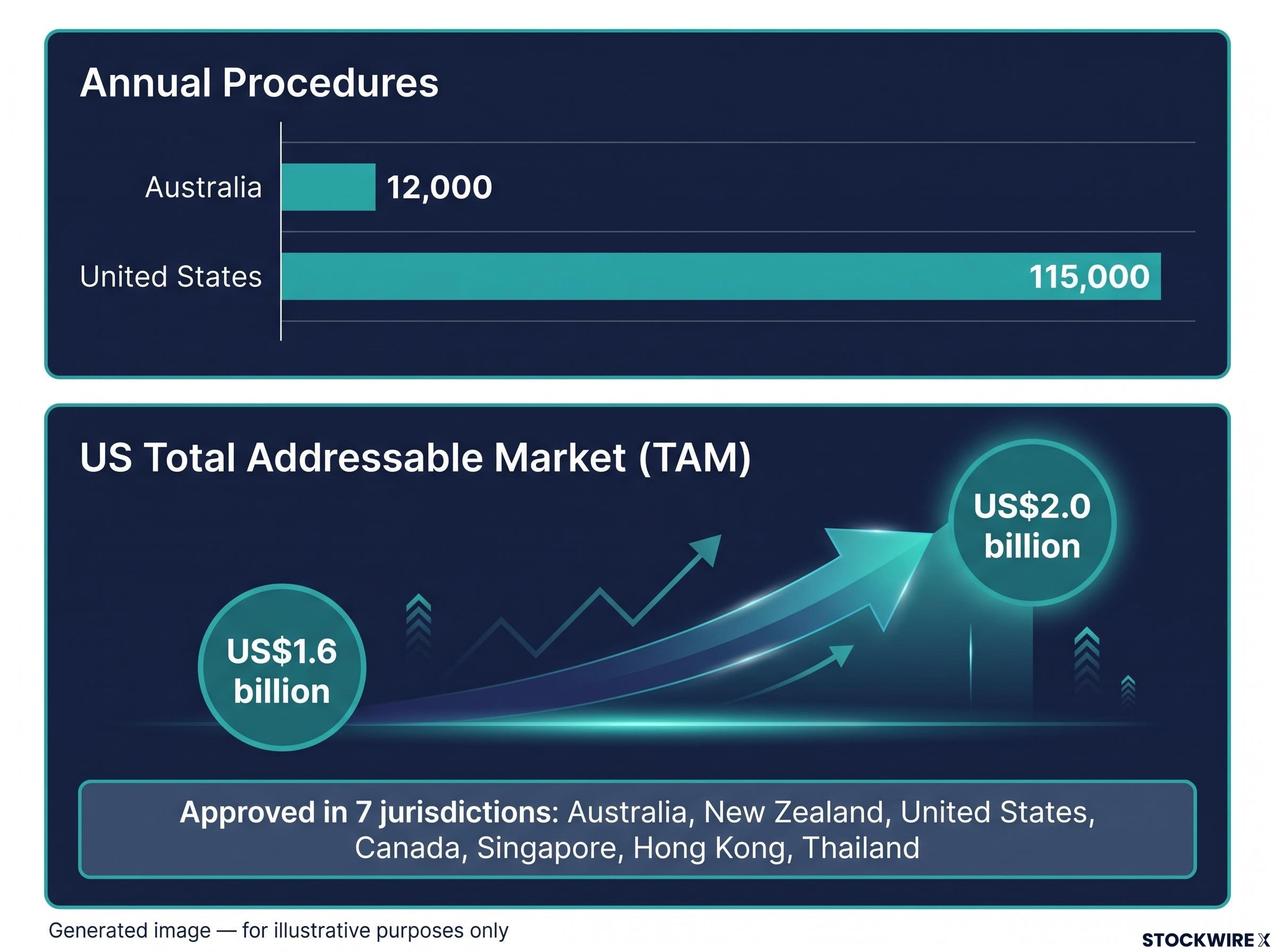
Approximately 12,000 robotic-assisted radical prostatectomy procedures are performed annually in Australia, while approximately 115,000 prostatectomies are performed annually in the US, the majority using robotic techniques. Multiple devices may be used per procedure.
| Market | Annual procedures |
|---|---|
| Australia | More than **12,000** |
| United States | Approximately **115,000** |
Orthocell estimates that adoption of Remplir in nerve-sparing robotic prostatectomy could expand its estimated US total addressable market (TAM) from US$1.6 billion to approximately US$2.0 billion.
No new approvals required
Remplir is already approved in seven jurisdictions: Australia, New Zealand, the United States, Canada, Singapore, Hong Kong and Thailand. According to the company, no additional regulatory clearance is required for use during prostatectomy procedures in these markets.
Next steps and funding
Orthocell is progressing the development of a larger prospective clinical study to generate more evidence on post-operative erectile function and urinary continence outcomes. The resulting evidence is intended to support medical education and inform broader adoption and commercialisation across existing approved international markets, with an initial focus on the United States. The announcement does not disclose a trial start date or timeline.
Paul Anderson, Managing Director
“This pilot did what a first series should… The next step is a larger, adequately powered, prospective trial to support use of Remplir in improving recovery of erectile function and continence after nerve-sparing robotic prostatectomy.”
Orthocell reported A$44.1 million in available funds as at 30 June 2026, comprising $5.0 million in cash and cash equivalents and $39.1 million in term deposits with maturities ranging from 3 to 12 months. The company reported no debt.
Investors exploring how international growth could extend beyond the US can read our detailed coverage of Orthocell’s UK and EU expansion, which covers the LEDA Orthopaedics distribution deal, the pending UK regulatory submission and the US$750 million market opportunity.
Get Healthcare News Before the Market Moves
Join 20,000+ investors receiving FREE breaking ASX news within minutes of release, complete with in-depth analysis and the full announcement. Click the “Free Alerts” button at Big News Blast to get real-time healthcare alerts the moment market-moving news breaks, so you stay ahead of the crowd.