

14D fast-tracks entry into Europe’s sovereign space battery market via Italian satellite maker
1414 Degrees (ASX:14D) has entered into an agreement with Space Industries S.p.A., a Turin-based satellite manufacturer, and Orbit Boy Ltd for a staged program to evaluate, integrate and qualify its SiNTL™ silicon-anode battery technology for use in satellite power systems.
Announced on 6 August 2026, the partnership commences 1414 Degrees’ entry into Europe’s sovereign space and defence markets. Under the arrangement, SiNTL cells and packs supplied by 14D will be characterised and integrated into a representative satellite bus energy-storage system, then progressed toward space-representative testing and, subject to outcomes, design-in for serial production.
Space markets are traditionally close-knit, and it can take many years to build the trust required to qualify and distribute product within the sector. By partnering with two established participants, 14D expects to fast-track that entry and “materially reduce the effective cost of entering the sector and producing its SiNTL batteries.”
Notably, no cash consideration is payable by any party for the milestone program. This structure gives shareholders low-capital exposure to an under-serviced European sovereign battery market alongside established industry players.
When big ASX news breaks, our subscribers know first
Why this deal matters, from a cell to a flying, repeat-order product
The investment thesis turns on a distinction between a one-off test and recurring serial demand. Space Industries produces serialised smallsats in the 100–500 kg class (up to 700 kg), meaning that if SiNTL qualifies, it could be specified into every satellite that follows off the same production line.
The agreement operates alongside a two-part pathway. Orbit Boy, announced 17 June 2026, provides responsive launch, in-orbit servicing and access to its space-sector network. Space Industries provides the satellite manufacturing, integration and qualification. Together, the two agreements connect SiNTL from a cell to a qualified, launched satellite.
The Orbit Boy partnership, announced in June 2026, established the initial commercial framework for SiNTL in space applications, with Orbit Boy bringing relationships across eight major space agencies and institutions including ESA, ThalesAlenia and Germany’s DLR.
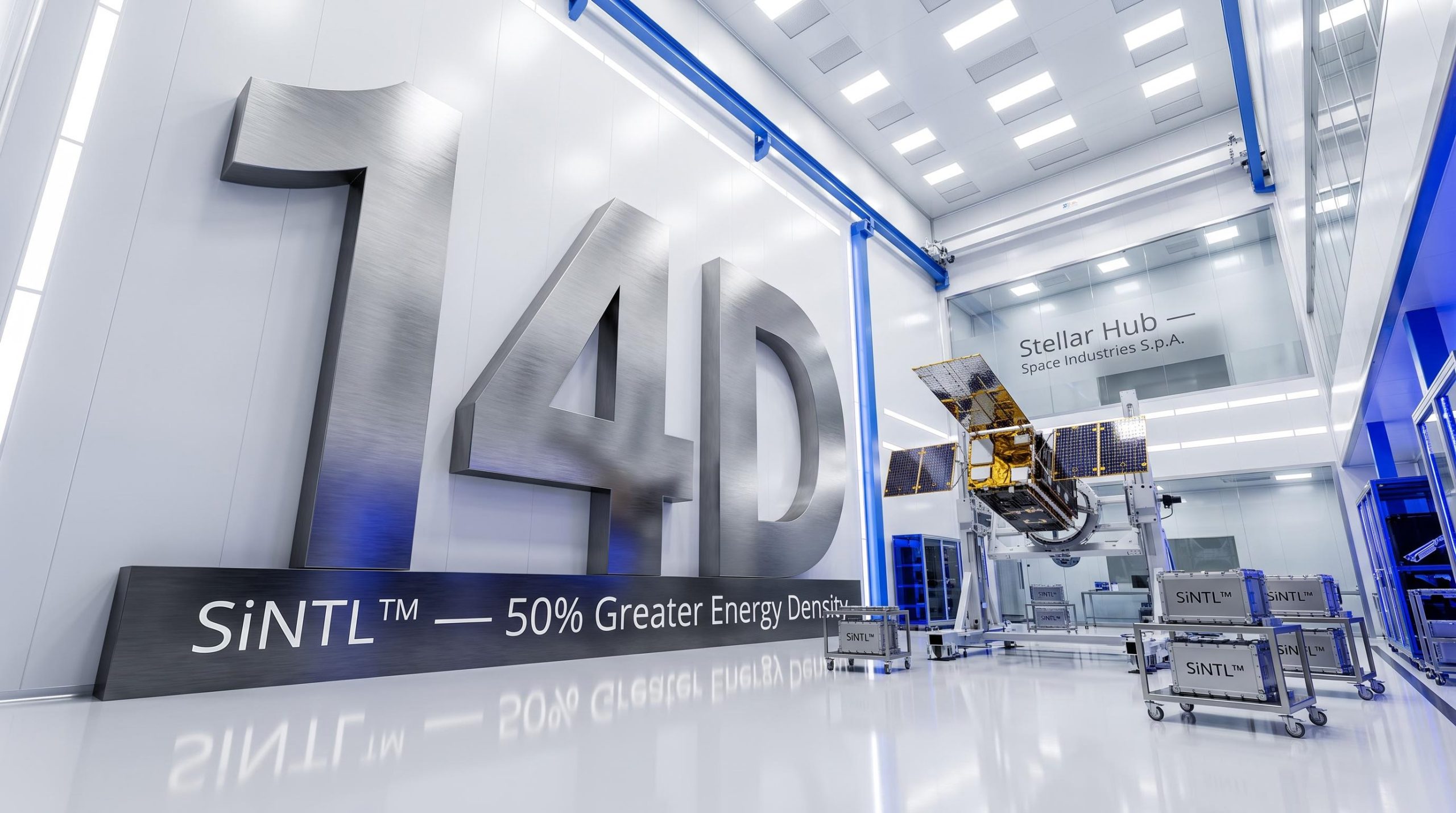
Space Industries offers full in-house Assembly, Integration and Testing (AIT) at its Stellar Hub facility, among the largest clean-room environments in Europe. The company is backing a serialised, industrial approach to satellite manufacturing with circa €15 million of planned investment to 2030.
Dr Kevin Moriarty, Executive Chairman
“This agreement represents another important step in the commercialisation of SiNTL. The Orbit Boy agreement established SiNTL’s pathway into the space sector. Space Industries is the next step, it doesn’t build one satellite, it builds many, off the same line, and to the same design. If SiNTL qualifies, it’s not flying once, it’s specified into everything that comes off that line afterwards. That’s what made this partner different from the others we looked at, and it’s the difference between a qualification test and a repeat customer.”
SiNTL explained, why energy density is a binding constraint in space
In space applications, battery energy density operates as a binding constraint. The launch cost per kilogram of payload, combined with the inability to replace a satellite’s batteries once in orbit, means manufacturers demand maximum capacity and long cycle life. A battery failure can render an entire satellite inoperable, placing a premium on light, high-energy-density, long-life cells.
SiNTL raises lithium-ion energy density using silicon-anode material. According to an ASX announcement dated 28 April 2026, the technology has demonstrated at least 50% greater energy density than traditional graphite anodes, while remaining compatible with existing battery manufacturing processes as a drop-in upgrade.
The endurance requirement is severe. Many satellite missions require batteries capable of reliable performance for 5–15 years or more without replacement. SiNTL’s material advantage directly addresses the sector’s core constraint.
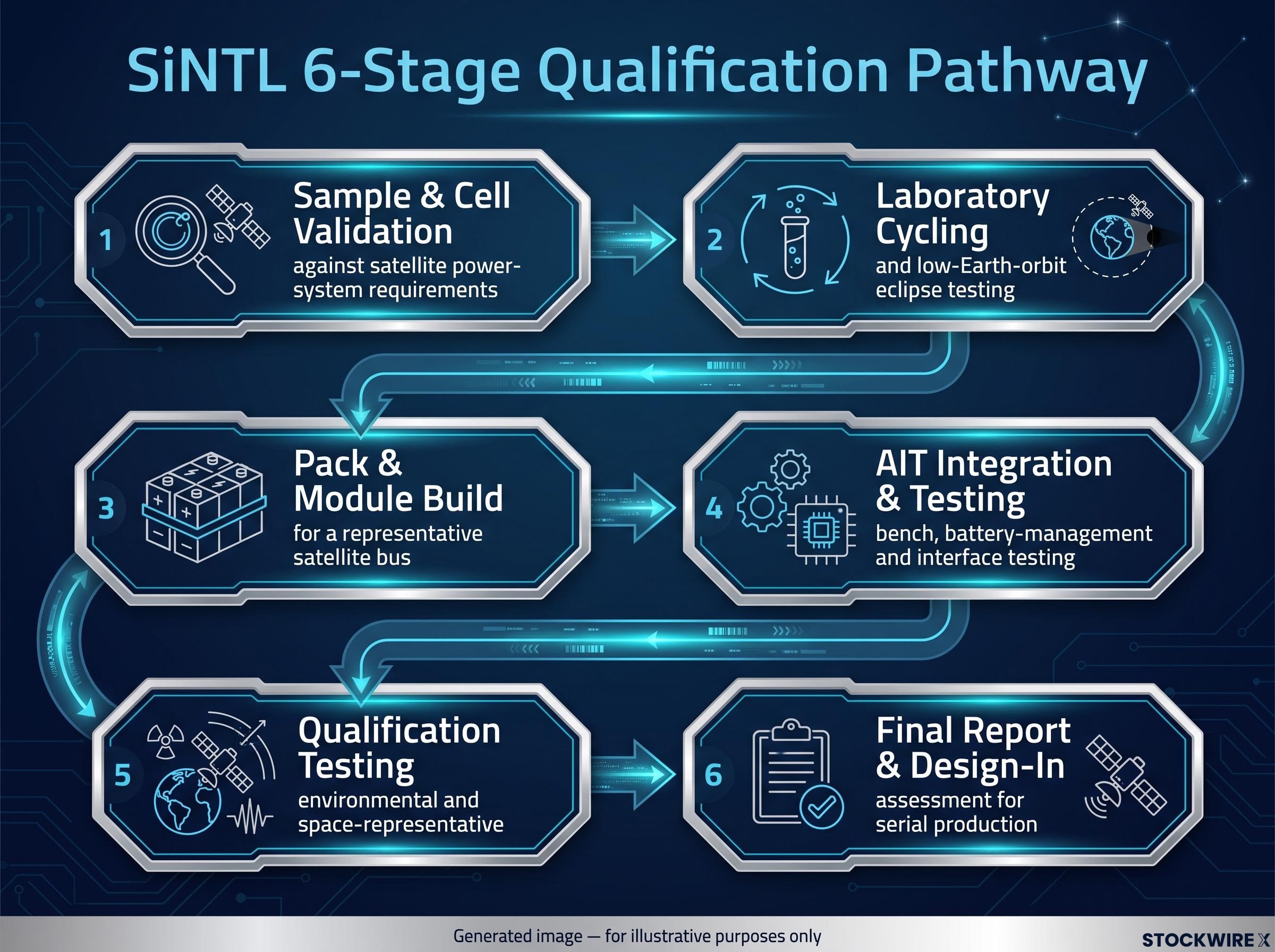
The program runs in six milestone-gated stages:
-
SiNTL sample and cell validation against satellite power-system requirements
-
Laboratory cycling and low-Earth-orbit eclipse testing
-
Battery pack and module build for a representative satellite bus
-
Integration, bench, battery-management and interface testing within Space Industries’ AIT facility
-
Environmental and space-representative qualification testing
-
Final qualification report and assessment of design-in for serial production
The market opportunity and sovereign supply angle
The global space battery market is estimated at approximately US$3.4 billion in 2025 and is forecast to grow strongly over the remainder of the decade. According to Mordor Intelligence, batteries exceeding 200 Wh/kg are expected to be the fastest-growing energy-density segment, highlighting increasing demand for the high-energy-density technologies that SiNTL is designed to enable.
Europe currently has very few sovereign space and defence battery manufacturers, with many products relying on critical materials, cells or components sourced from Asia, including China. This dependence creates sovereign supply chain risk and can limit the ability to market batteries as fully European-made.
Cells qualified and integrated through an Italian manufacturer support a European-built, sovereign power-system narrative for defence, telecommunications and orbital-infrastructure customers. 14D intends to be among the first, alongside Space Industries and Orbit Boy, to deliver a fully EU-manufactured, sovereign, long-life space battery for the sector.
A parallel defence sector qualification pathway has been developing simultaneously, with 14D signing a Battery Qualification Testing Agreement with Ukrainian drone manufacturer Energia 2000, whose production is planned to scale to 360,000 UAV units annually, illustrating how the same six-stage qualification model is being applied across multiple sovereign defence markets.
Space Industries is owned by Gruppo Comat, an Italian industrial group with decades of expertise in energy systems and advanced facilities, and is led by Chief Executive Officer Giuseppe Santangelo.
| Phase | Focus | Activity | Outcome |
|---|---|---|---|
| Phase 1 – Bus Power | Integration | SiNTL packs into representative smallsat energy-storage module; tested for energy density, mass, eclipse cycling and cycle life in LEO | Space-representative data |
| Phase 1 – AIT Qualification | Testing | Assembly, Integration and Testing in clean-room facility | Toward flight heritage |
| Phase 2 – Serial Design-In | Production | SiNTL-enabled packs engineered into serially produced satellite platforms | Recurring volume supply |
| Pathway – Sovereign Supply | Commercial | European-integrated qualified power systems | Defence, telco, orbital-infrastructure customers |
Revenue model and what comes next
Ownership of SiNTL and related intellectual property is retained by 14D and George Washington University at all times. SiNTL is developed under 14D’s exclusive global licence from George Washington University.
Subject to successful qualification and separate binding agreements, 14D expects revenue from multiple future lines:
-
Anode material supply
-
Technology licensing
-
Royalties on approved packs or platforms
-
Recurring supply into serial satellite production
No cash consideration is payable for the current milestone program. Future production and supply, licensing and royalties will be covered by separate binding agreements. Orbit Boy organises, coordinates and controls the testing program on behalf of 14D, defining space-application requirements and acting as the primary interface among the parties.
Beyond SiNTL, 14D advances an integrated clean-energy platform spanning SiBrick®, SiBox® and SiPHyR®, unified by a single silicon materials platform used to store, convert and enhance energy across multiple sectors.
Don’t Miss the Next ASX Space and Defence Breakout
Big News Blast delivers FREE breaking ASX announcements straight to your inbox within minutes of release, complete with in-depth analysis already done for you. Over 20,000 active subscribers rely on it to stay ahead of market-moving news across tech, industrials, healthcare and more. Click the “Free Alerts” button to start receiving alerts the moment news breaks.