

Syntara (ASX:SNT) has confirmed that its Phase 1b trial of topical pan-lysyl oxidase (pan-LOX) inhibitor SNT-9465 in hypertrophic scars has surpassed the 50% recruitment mark, with 60% of participants now commenced on treatment.
Recruitment is expected to close in Q3 2026, with top-line results remaining on track for 2026. The progress helps de-risk the pathway toward a planned FDA Investigational New Drug (IND) application, a key regulatory step for the clinical-stage drug developer.
Inside the Phase 1b hypertrophic scar study
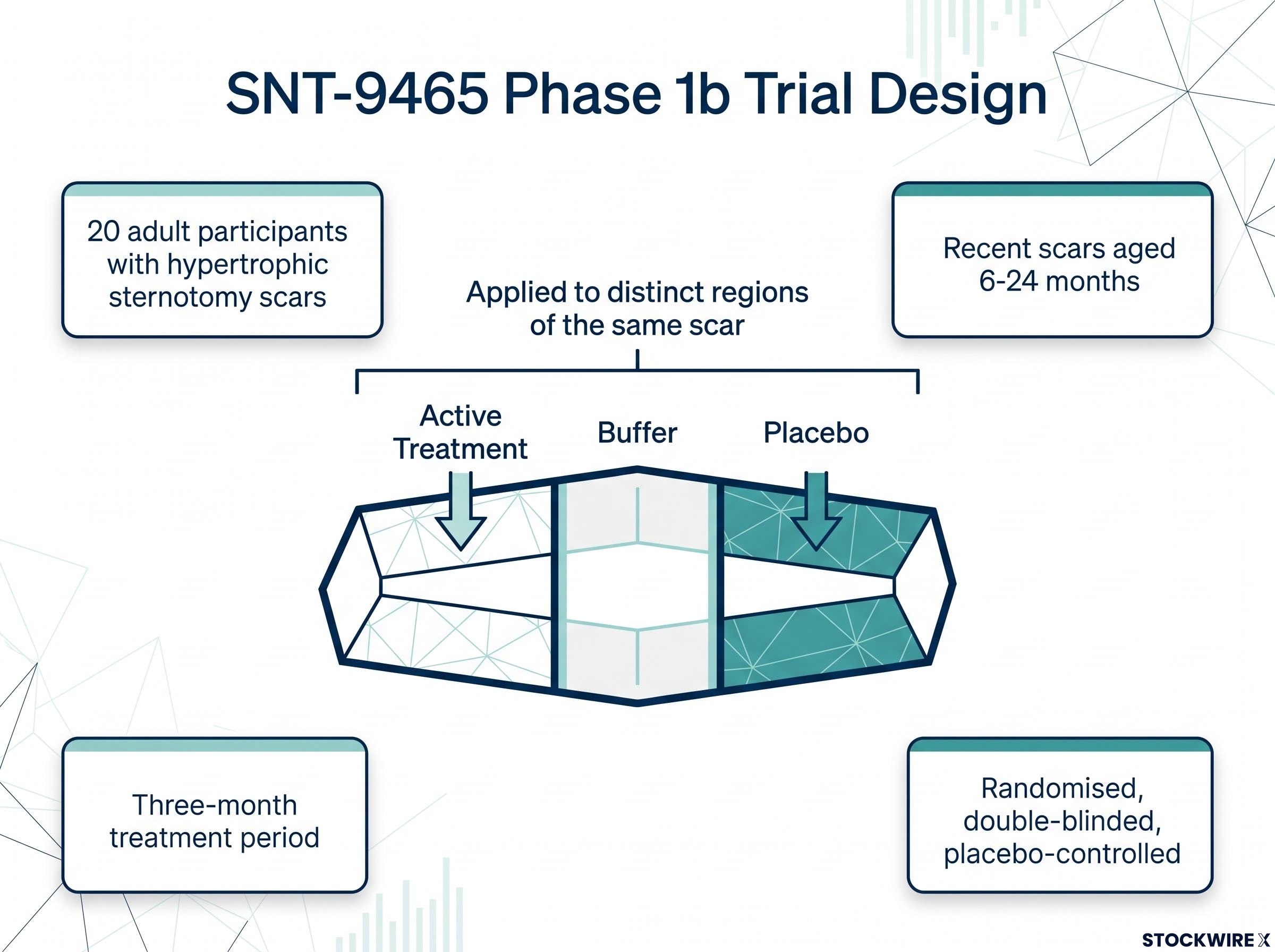
The Phase 1b study is designed to test SNT-9465 in a controlled setting so that its effect can be measured directly against a placebo. Key trial parameters include:
- Randomised, double-blinded, placebo-controlled design
- 20 adult participants with hypertrophic sternotomy scars
- Enrolling recent scars aged 6–24 months
- Active treatment and placebo applied to distinct regions of the same scar, separated by a buffer
- Three-month treatment period, followed by state-of-the-art imaging and assessment
According to the company, a recent social media campaign identified additional patients and boosted recruitment, confirming a substantial pool of patients seeking treatment for hypertrophic scars.
When big ASX news breaks, our subscribers know first
Baseline LOX data validates the trial’s scar-type choice
The most notable scientific signal from the update relates to baseline lysyl oxidase (LOX) activity. Biopsies from five participants with scars less than 24 months old showed markedly higher LOX activity than that observed in the earlier SOLARIA2 study, where the average scar age was 13 years.
Syntara noted that differences exist in the aetiology and location of the scars between the two studies (burns versus surgical). Despite this, the company anticipates that higher LOX levels may drive faster tissue turnover within the scar, creating a greater opportunity for a pan-LOX inhibitor to remodel scar architecture.
Gary Phillips, CEO
“This is an innovative and pioneering study, and it’s encouraging to see patients coming forward for treatment and such strong engagement in the trial centres as we work towards completing recruitment in Q3 2026. Our choice of scar type has been vindicated by the high levels of LOX activity observed in participants’ scars prior to treatment; LOX is clearly an important driver of scar formation, and we have a genuine opportunity to demonstrate a clinically meaningful benefit for these participants later this year.”
What is lysyl oxidase and why it matters
Lysyl oxidase (LOX) is clearly an important driver of scar formation. By inhibiting pan-LOX, SNT-9465 aims to remodel scar architecture.
The investment context is worth noting. There is currently no approved pharmacological treatment for skin scarring. Syntara’s top-line results are intended to support an FDA IND application, paving the way for a global development programme targeting what the company describes as the first approved pharmacological treatment for skin scarring, an aspirational goal rather than a present achievement.
| Milestone | Detail | Timing | Investor Significance |
|---|---|---|---|
| Phase 1b recruitment | 60% of participants commenced | Close expected Q3 2026 | De-risks progress toward data readout |
| Top-line results | SNT-9465 hypertrophic scar trial | On track for 2026 | Primary value catalyst for the programme |
| FDA IND application | Intended, post-results | Following top-line data | Enables planned global development programme |
| SNT-4728 iRBD data | Parkinson’s disease study | Anticipated shortly | Separate near-term clinical readout |
Keloid study progresses in parallel
Running alongside the flagship trial is the exploratory UWA Investigator Initiated Study, known as SATELLITE. This study examines the first-generation topical pan-LOX inhibitor SNT-6302 in keloid scars, in collaboration with Professor Fiona Wood and the University of Western Australia.
Keloid scars have significantly different biology from the hypertrophic scars studied in the SNT-9465 trial. SATELLITE has now reached an interim point, with a significant number of patients having completed three months of treatment. These participants will be monitored by UWA investigators for an extended follow-up period after stopping treatment.
The data may help define which keloid scar subtypes are more susceptible to lysyl oxidase inhibitors and could be targeted in future clinical programmes.
A news-rich period ahead for Syntara
Syntara has framed the coming months as a news-rich period, with several disclosed catalysts on the horizon:
-
SNT-9465 hypertrophic scar recruitment closing in Q3 2026, with top-line results on track for 2026, intended to support an FDA IND application
-
SATELLITE keloid study extended follow-up data
-
Preliminary results from the iRBD Parkinson’s disease study of SNT-4728, anticipated shortly
The SNT-4728 Parkinson’s trial reached its own milestone earlier in 2026, with the final patient dosed and top-line safety and efficacy results expected imminently, funded non-dilutively through an A$1.7 million payment from Parkinson’s UK.
The intended IND application is designed to pave the way for a global development programme.
The amsulostat myelofibrosis programme secured FDA backing for its Phase 2b trial design in April 2026, adding a separate near-term regulatory milestone to Syntara’s already crowded clinical calendar and reinforcing the company’s multi-asset development strategy.
Don’t Miss the Next ASX Healthcare Breakthrough
Big News Blast delivers FREE breaking ASX healthcare news directly to your inbox within minutes of release, complete with in-depth analysis already done for you. Join 20,000+ investors who stay ahead of the market the moment announcements drop. Click the “Free Alerts” button at StockWire X to start receiving alerts today.