

SNT-4728 delivers significant motor function improvement in Phase 2 iRBD study
Syntara Limited (ASX: SNT) has reported a statistically significant difference (p=0.021) in clinician-assessed motor signs for SNT-4728 versus placebo in its Phase 2 study in participants with isolated REM Sleep Behaviour Disorder (iRBD). The difference was measured on the MDS-UPDRS Part III at Week 24, which is 12 weeks after completion of treatment.
The result is the second positive readout from the study. The primary imaging endpoint was reported on 6 July 2026.
The randomised, double-blind, placebo-controlled Phase 2 study enrolled 41 participants with iRBD, randomised 3:1 to receive SNT-4728 or placebo. The study evaluated safety, tolerability and exploratory efficacy of SNT-4728, which Syntara describes as its first-in-class neuro-targeted anti-inflammatory therapy.
Principal Investigator Professor Simon Lewis is due to present the results today (7 October 2026) at the Clinical Breakthroughs Plenary Session at the International Congress of Parkinson’s Disease and Movement Disorders in Seoul, South Korea.
For investors, clinical signals of motor improvement now sit alongside the previously reported biological evidence. Syntara states this converging evidence supports further clinical development of SNT-4728 as a potential disease-modifying therapy in prodromal and early Parkinson’s disease.
When big ASX news breaks, our subscribers know first
Motor scores stabilise on treatment while placebo deteriorates
What the data showed
The completed clinical dataset shows a progressive between-group difference in clinician-assessed motor signs at Week 12 and Week 24. The pattern of scores over time was as follows:
- After 12 weeks of treatment: participants on SNT-4728 showed slightly improved MDS-UPDRS Part III total scores, while participants on placebo showed a worsening in motor scores.
- Week 24 (12 weeks off treatment): the SNT-4728 group showed further improvement, while the placebo group continued to deteriorate.
The deterioration in the placebo group is consistent with the expected direction for this iRBD population, as observed in published studies. The stabilisation in the SNT-4728 group, both during and 12 weeks after treatment, suggests a persistent clinical response from the anti-inflammatory and anti-oxidant effect of inhibiting both MAOB and SSAO enzymes in the brain.
The finding was also directionally consistent with an exploratory motor composite score derived from participant-performed smartphone tasks. That difference between treatment groups was not statistically significant.
No treatment-related serious adverse events were reported, and all adverse events previously reported across treatment arms were mild or moderate.
Professor Simon Lewis, Principal Investigator, Macquarie University Brain Institute and Clinic
“This study provides convergent exploratory evidence that SNT-4728 has biological activity in people with iRBD, together with an improvement in clinician-assessed motor function that was maintained after treatment ceased…”
Converging evidence table
The table below summarises the two readouts alongside the smartphone measure.
| Endpoint | Result | Statistical significance |
|---|---|---|
| TSPO PET, putamen (reported 6 July 2026) | Reduction in brain inflammation observed unilaterally; 67% of participants recorded a reduction from baseline | p=0.0145 |
| MDS-UPDRS Part III at Week 24 | Difference in clinician-assessed motor signs, SNT-4728 versus placebo | p=0.021 |
| Smartphone composite score | Directionally consistent with clinician assessment | Not statistically significant |
Understanding iRBD and why it matters for Parkinson’s research
iRBD is a sleep disorder associated with a high risk of progression to Parkinson’s disease and related synucleinopathies. That link makes it a potential early-intervention population for therapies aimed at slowing neurodegeneration.
The MDS-UPDRS is a widely used clinical outcome assessment in Parkinson’s disease trials. Part III evaluates motor features including bradykinesia (slowness of movement), rigidity, tremor, gait and postural stability.
TSPO PET imaging measures brain inflammation. The putamen, where the reduction was observed, is a region involved in motor control and is affected in Parkinson’s disease and related synucleinopathies.
The earlier TSPO PET imaging readout showed a statistically significant reduction in putamen inflammation after 12 weeks of treatment, and the new motor data now adds a clinical layer to that biological signal.
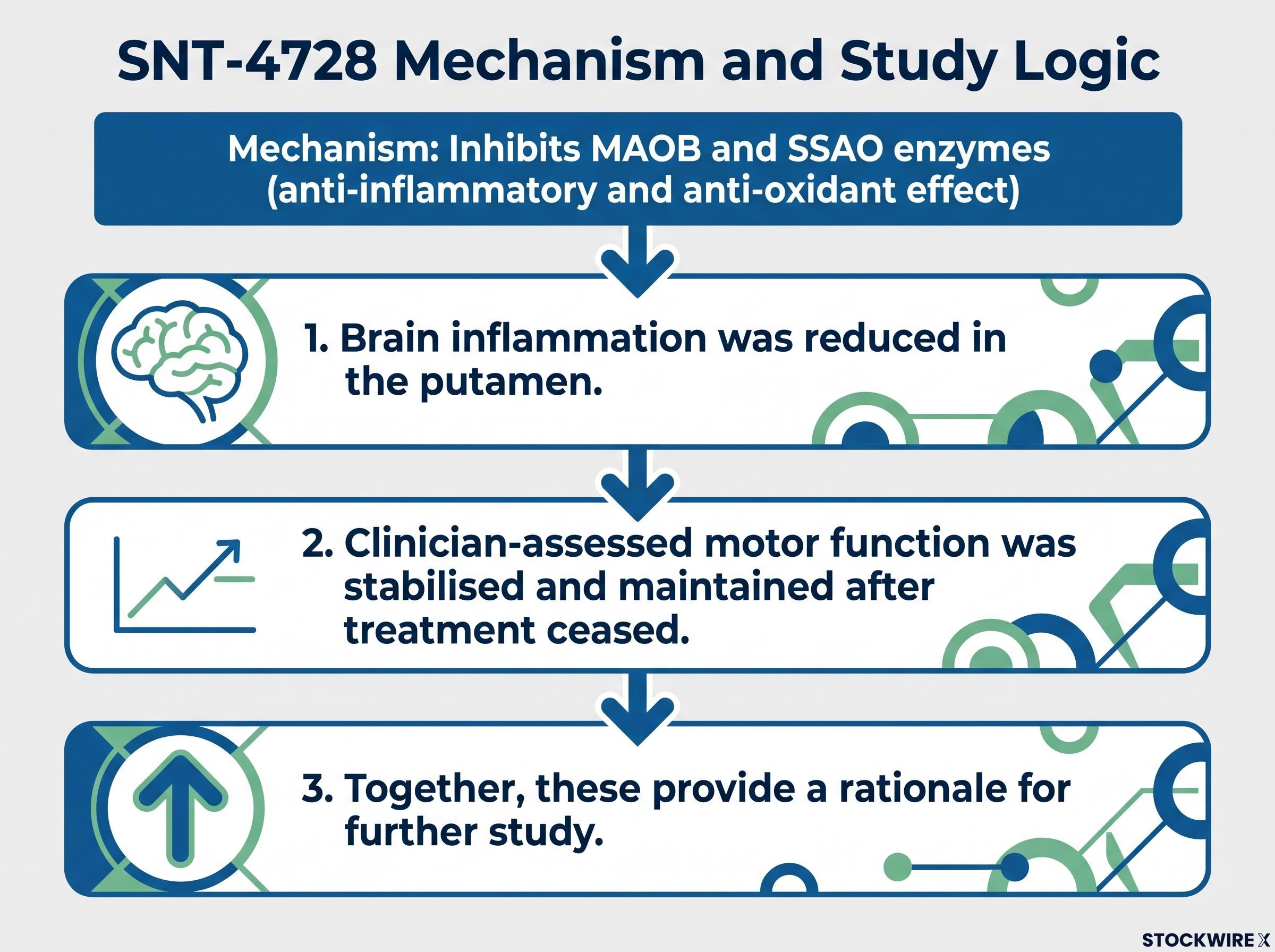
SNT-4728 inhibits both the MAOB and SSAO enzymes, which is associated with an anti-inflammatory and anti-oxidant effect. The study’s logic runs in three steps:
- Brain inflammation was reduced in the putamen.
- Clinician-assessed motor function was stabilised and maintained after treatment ceased.
- Together, these provide a rationale for further study.
Syntara Chief Executive Officer Gary Phillips noted that there remains a large unmet need for drugs that go beyond symptomatic control.
Next steps and what it means for investors
Development pathway
Professor Lewis said the results, together with the earlier TSPO PET findings, “provide a rationale to evaluate SNT-4728 further in appropriately designed studies, potentially including patients in the early stages of Parkinson’s disease.” The announcement does not detail any new trial, timeline or funding.
No marked changes over time were observed in other MDS-UPDRS measures or in the Montreal Cognitive Assessment (MoCA), 36-Item Short Form Health Survey (SF-36) and REM Sleep Behaviour Disorder Questionnaire (RBDQ). Given the exploratory nature of these assessments, the small study size and the relatively short 12-week treatment period, the study was not designed to detect changes across all clinical and participant-reported measures.
Further analysis of the digital endpoint data, alongside clinical, biological and imaging biomarkers, remains outstanding. It is expected to be the subject of a future scientific presentation or publication.
Gary Phillips, Chief Executive Officer, Syntara
“This study, which we believe is the first interventional study of its kind in iRBD, has been made possible through funding from Parkinson’s Research Ventures, the dedication of our Principal Investigators, Professor Simon Lewis in Sydney and Professor Michele Hu in Oxford…”
Parkinson’s Research Ventures is a Parkinson’s UK-led initiative run in partnership with the Parkinson’s Foundation.
Beyond SNT-4728, Syntara’s lead candidate is amsulostat for the bone marrow cancer myelofibrosis, which has completed a Phase 2a trial.
For investors weighing the wider pipeline, our detailed coverage of the FDA-backed amsulostat Phase 2b myelofibrosis trial design explains the approximately 100-patient study, the Fast Track and Orphan Drug Designations, and the JAK inhibitor-refractory target population.
Ready to Explore Syntara’s SNT-4728 Parkinson’s Opportunity?
SNT-4728 has now delivered a statistically significant motor improvement (p=0.021) alongside earlier evidence of reduced brain inflammation in its Phase 2 iRBD study. This converging data supports further development of the first-in-class therapy as a potential disease-modifying treatment in prodromal and early Parkinson’s disease.
Discover more about the pipeline, including the lead candidate amsulostat for myelofibrosis, by visiting the Syntara investor coverage page. Review the full data and assess what it could mean for your portfolio.