


SNT-9465 cohort expansion signals growing clinical confidence
Syntara Limited (ASX: SNT), a clinical-stage drug development company, has announced an expansion of its Phase 1b study of SNT-9465, a second-generation topical pan-lysyl oxidase (pan-LOX) inhibitor, in participants with hypertrophic sternotomy scars. With recruitment of the initial 20-participant cohort nearing completion, the study will be expanded to 30 participants, with the double-blind, placebo-controlled design maintained throughout.
The decision to expand was driven by encouraging feedback from clinical sites and participant engagement, not interim efficacy data, as the study remains blinded. Key developments from the announcement include:
SNT-9465 enrolment progress earlier in 2026 was validated by baseline biopsy data from five participants, which showed markedly higher LOX activity in scars under 24 months old compared to the older scar ages recorded in the earlier SOLARIA2 study, supporting the trial’s patient selection strategy.
- Initial 20-participant cohort recruitment nearing completion
- Study expanded to 30 participants to support a larger safety, tolerability, and exploratory activity dataset
- The Skin Hospital, Sydney, added as an additional clinical site to support timely recruitment
- Top-line results expected in Q1 2027
Expanding the cohort at this stage increases the robustness of the eventual dataset, and the company has noted the expansion is cost-effective given the study’s current stage.
When big ASX news breaks, our subscribers know first
Understanding pan-LOX inhibition and why skin scarring is a major unmet need
Lysyl oxidase (LOX) enzymes play a role in cross-linking collagen and elastin within the extracellular matrix, the structural framework that supports body tissue. Inhibiting these enzymes is intended to reduce the abnormal accumulation of scar tissue by disrupting the biological process that drives excessive collagen cross-linking.
Hypertrophic scars are raised, thickened scars that remain confined to the boundary of a wound, commonly forming after surgical procedures such as sternotomy. Keloid scars, by contrast, extend beyond the original wound boundary. Both types represent areas of significant unmet medical need.
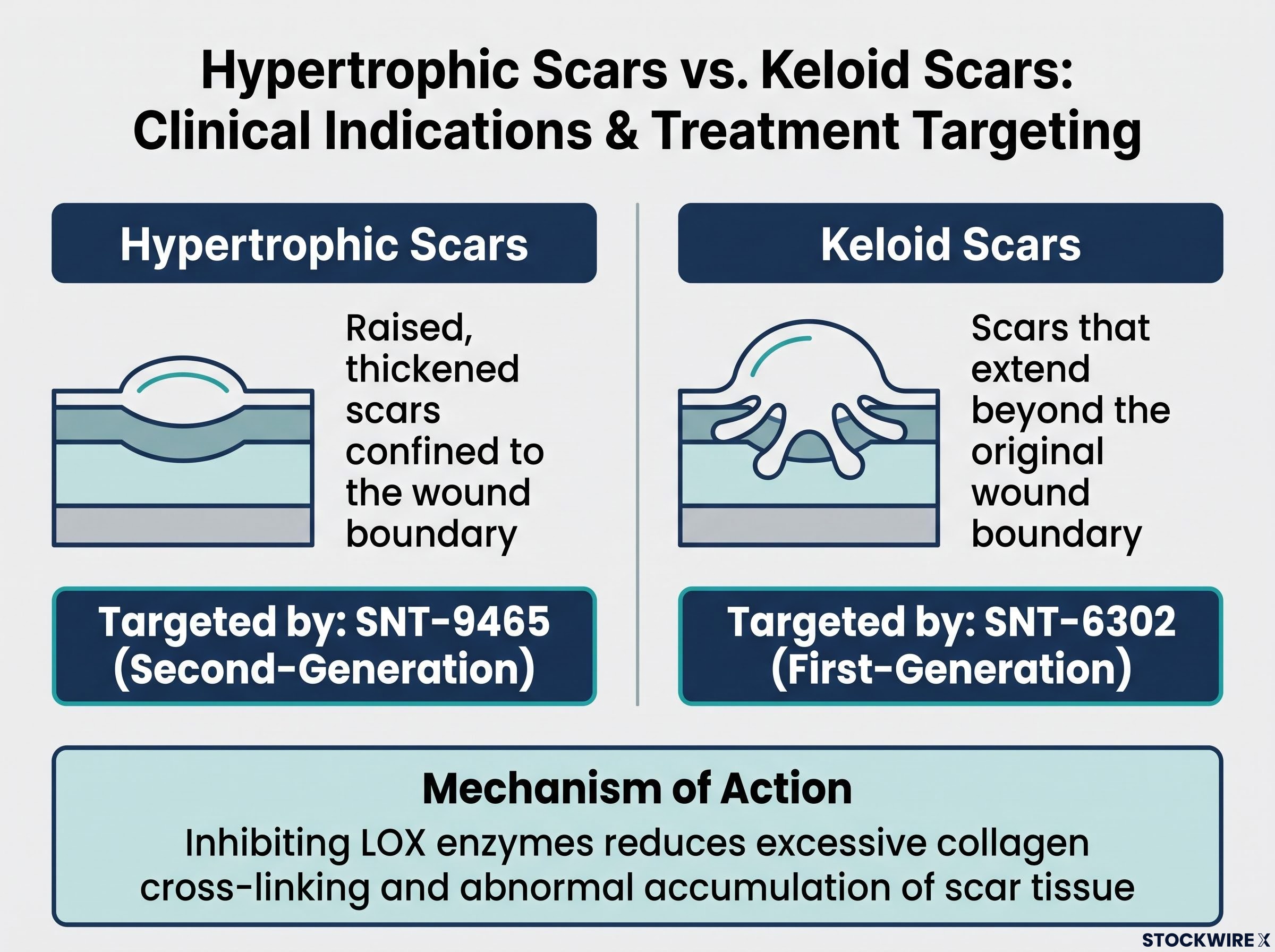
SNT-9465 was developed as a second-generation compound, designed to improve tolerability while retaining the intended pan-LOX pharmacology of Syntara’s first-generation inhibitor, SNT-6302. Tolerability observations from the exploratory SNT-6302 study, outlined below, further support the rationale for progressing SNT-9465.
CEO commentary
Gary Phillips, CEO, Syntara Limited
“We are pleased with the strong engagement from participants and clinical sites in the SNT-9465 Phase 1b study. This has supported our decision to expand recruitment from 20 to 30 participants to ensure we capture the maximum learnings, while maintaining the study’s blinded design.
“Expanding the study at this stage is very cost effective and will deliver more robust results in Q1 2027. Hypertrophic scarring remains an area of significant unmet need, and we look forward to evaluating whether the biological rationale for pan-LOX inhibition translates into an acceptable safety and tolerability profile and evidence of clinical activity in this study.”
SNT-6302 SATELLITE study: early biological signals support the next-generation strategy
The exploratory SATELLITE investigator-initiated study is being conducted in collaboration with the University of Western Australia and the Fiona Wood Foundation. The study evaluates SNT-6302, Syntara’s first-generation topical pan-LOX inhibitor, to characterise the biological and clinical effects of pan-LOX inhibition in keloid scars.
Six participants completed the 12-week treatment period and remain in follow-up, with assessments planned to continue for nine months after treatment has concluded. Preliminary findings in these participants included an increase in blood-vessel area density at Week 12, an observation directionally consistent with findings in hypertrophic-scar participants in the SOLARIA2 study. No observable differences in Patient and Observer Scar Assessment Scale (POSAS) scores or scar stiffness were identified at Week 12.
Eight participants discontinued treatment due to mild, reversible local skin reactions (erythema and pruritus) after one month or more of treatment. This tolerability profile is consistent with observations from the earlier SOLARIA2 study of SNT-6302, and further supports the rationale for advancing SNT-9465 as the improved second-generation compound.
Syntara has noted that interpretation of these preliminary findings is limited by the exploratory nature of the study, the small number of participants completing treatment, and substantial heterogeneity in baseline scar size, anatomical location, and scar age. Further end-of-treatment and follow-up data remain outstanding and are expected to be the subject of a future scientific presentation or publication. Syntara and Professor Wood will subsequently review the complete dataset and consider how the findings may inform the design of a potential follow-on study in keloid scars.
| Study | Compound | Indication | Participants | Key Status / Timeline |
|---|---|---|---|---|
| SNT-9465 Phase 1b | SNT-9465 | Hypertrophic sternotomy scars | 30 (expanded) | Top-line results expected Q1 2027 |
| SATELLITE | SNT-6302 | Keloid scars | 6 completed 12-week treatment | Follow-up ongoing; future publication expected |
What’s next for Syntara’s skin scarring programs
Near-term catalysts across both programs include:
- Completion of SNT-9465 expanded cohort recruitment (30 participants)
- Top-line SNT-9465 Phase 1b results, expected Q1 2027
- SATELLITE end-of-treatment and follow-up data, expected via future scientific presentation or publication
- Syntara and Professor Wood dataset review, with a potential follow-on keloid study design decision to follow
Beyond the skin scarring programs, Syntara’s broader pipeline includes amsulostat in myelofibrosis and myelodysplastic syndrome, and SNT-4728 being studied in neuroinflammation, reflecting the company’s wider focus on extracellular matrix dysfunction and related conditions.
For investors exploring the neuroinflammation arm of Syntara’s pipeline, our detailed coverage of Syntara’s SNT-4728 Parkinson’s milestone explains the A$1.7 million non-dilutive payment from Parkinson’s UK, the trial completion trigger, and the top-line data timeline that has since resolved with a statistically significant brain inflammation signal.
Ready to Learn More About Syntara’s SNT-9465 Phase 1b Programme?
With cohort expansion to 30 participants underway and top-line results expected in Q1 2027, Syntara’s pan-LOX inhibition approach to hypertrophic scarring is advancing at a pivotal stage. The addition of The Skin Hospital, Sydney as a clinical site signals strong momentum as the study moves toward a more robust final dataset.
To stay across the latest developments across Syntara’s scarring pipeline and broader clinical programmes, explore Syntara’s full coverage on StockWire X for in-depth analysis and investor updates.