

OncoSil study reports 100% local disease control in locally advanced pancreatic cancer
OncoSil Medical Limited (ASX: OSL) announced on 27 October 2026 a peer-reviewed study in the journal Cancers, published on 15 October 2026. It reports early outcomes in 17 patients with unresectable locally advanced pancreatic cancer (LAPC) treated with OncoSil™ plus gemcitabine plus nab-paclitaxel chemotherapy.
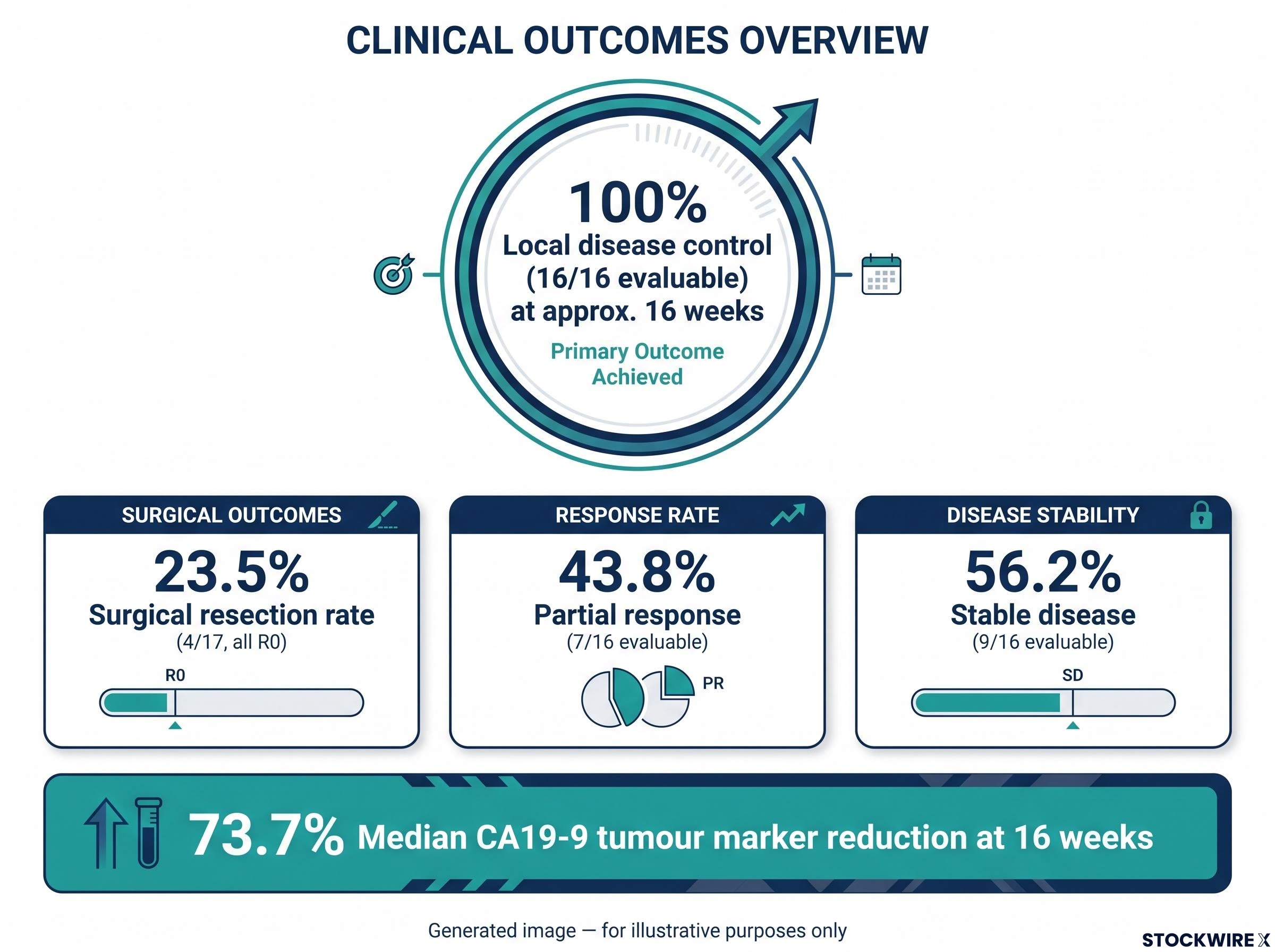
The study reported 100% local disease control (16/16 evaluable patients) at approximately 16 weeks and a 23.5% surgical resection rate (4/17), with all four resections R0 (clear-margin). It was a prospective, single-centre observational study at Agios Savvas Hospital in Athens, Greece, and the company describes the outcomes as preliminary.
The publication (Kontos A, et al., Cancers 2026;18:3331) adds to the growing body of clinical evidence for the OncoSil™ device in unresectable locally advanced pancreatic cancer.
When big ASX news breaks, our subscribers know first
Key results from the Cancers study
The study included 17 consecutive, highly selected patients. It evaluated technical feasibility, preliminary safety, local disease control, tumour response, subsequent surgical resection and exploratory survival outcomes.
Tumour control and response
Denominators matter here. Sixteen patients were evaluable at the 16-week point because one subject underwent surgery before then, while 17 patients were treated in total.
Among evaluable patients, a partial response was seen in 43.8% (7/16) and stable disease in 56.2% (9/16). Local disease control across all treated patients was 94.1% (16/17).
A CA19-9 tumour marker reduction of at least 50% was achieved by 81.2% of evaluable patients (13/16), with a median reduction of 73.7% at 16 weeks. Median tumour diameter fell by 21.4% at approximately 16 weeks.
| Measure | Result | Patients |
|---|---|---|
| Local disease control (approx. 16 weeks) | 100% | 16/16 evaluable |
| Partial response | 43.8% | 7/16 evaluable |
| Stable disease | 56.2% | 9/16 evaluable |
| Local disease control (all treated) | 94.1% | 16/17 |
| Surgical resection rate (all R0) | 23.5% | 4/17 |
| CA19-9 reduction of at least 50% | 81.2% | 13/16 evaluable |
| Median CA19-9 reduction at 16 weeks | 73.7% | n/a |
| Median tumour diameter reduction | 21.4% | n/a |
Safety and survival
Technical implantation succeeded in 100% of patients (17/17), with no implantation-related procedural complications reported. Adverse events were predominantly Grade 1-2, with one Grade 3 abdominal pain event and no Grade 4-5 adverse events recorded.
Survival outcomes reported were:
- Median local progression-free survival of 11.0 months.
- Estimated median overall survival of 20.0 months from chemotherapy initiation.
- Estimated median overall survival of 18.8 months from OncoSil™ implantation, with median local progression-free survival of 9.7 months on the same basis.
There were only three deaths during a median overall survival follow-up of 15.6 months, so the survival estimates remain exploratory and statistically immature.
The Greek cohort sits alongside the TRIPP-FFX trial, which met both co-primary endpoints with an 82.2% local disease control rate and 18.3-month median overall survival in patients treated with OncoSil™ plus FOLFIRINOX.
Management comment
Nigel Lange, CEO & Managing Director of OncoSil Medical, described the findings as encouraging while noting the size of the cohort.
Nigel Lange, CEO & Managing Director
“The reported 100% local disease control among evaluable patients at approximately 16 weeks, together with four patients subsequently achieving R0 surgical resection, are encouraging findings in a patient population with significant unmet medical need…”
“While these results are from a small patient cohort, they provide further clinical experience on the use of OncoSil™ in addition to chemotherapy as part of a multidisciplinary treatment approach for locally advanced pancreatic cancer.”
“We remain focused on advancing the clinical development of OncoSil™ and building the evidence base for targeted phosphorus-32 (P-32) microparticle therapy…”
How OncoSil™ works and why the evidence matters
OncoSil™ is a single-use brachytherapy (internal radiation) device. It delivers a pre-determined dose of beta radiation directly into cancerous tissue through targeted intratumoural placement of Phosphorous-32 microparticles, which the company says limits exposure to surrounding critical organs.
Pancreatic cancer is generally diagnosed at a later stage and has a poor prognosis for long-term survival, with about 500,000 new cases detected globally each year. In markets outside the United States where it has received regulatory approval, OncoSil™ is indicated for unresectable locally advanced pancreatic cancer in addition to gemcitabine-based chemotherapy.
The company’s regulatory footprint includes:
- CE Marking approval, providing marketing authorisation in the European Union and the United Kingdom.
- U.S. Food and Drug Administration (FDA) approval under a Humanitarian Device Exemption for unresectable, non-metastatic distal cholangiocarcinoma (dCCA), as an adjunct to systemic therapy.
- Breakthrough Device designation in Europe and the United States.
- Approval for sale in 30+ countries.
The FDA approval on 17 August 2026 under the Humanitarian Device Exemption pathway made OncoSil™ the first FDA-approved Class III device for distal cholangiocarcinoma, with a full US commercial launch targeted for the second half of FY27.
The US indication relates to dCCA only. The peer-reviewed publication adds to the clinical evidence for OncoSil™ in markets where it is approved for locally advanced pancreatic cancer.
Get Healthcare News Before the Market Moves
Join 20,000+ investors receiving FREE breaking ASX healthcare and biotech news within minutes of release, with in-depth analysis and the full announcement included. Click the “Free Alerts” button at Big News Blast to get real-time alerts the moment market-moving news breaks.