

Updated OSPREY Registry results presented at EANM 2026
OncoSil Medical (ASX: OSL) has announced that updated OSPREY Registry results for patients with unresectable locally advanced pancreatic cancer (LAPC) were presented on 20 October 2026 at the European Association of Nuclear Medicine (EANM) Annual Congress 2026 in Vienna, Austria. Dr Stefan Prado Wohlwend of Hospital Universitario La Fe, Valencia, presented the data on behalf of the OSPREY Registry investigators.
The updated analysis covers 88 patients across 19 centres in Spain, Italy, Greece and Austria. That is up from 64 patients in the earlier abstract (see ASX announcement dated 30 September 2026).
The earlier interim OSPREY data from 64 patients, first presented at ESGE Days, showed median overall survival of up to 22.0 months in first-line patients with no serious adverse device effects reported.
Headline results from the updated dataset include:
- No Grade 3 or higher adverse device effects, and no serious adverse device effects, were reported.
- Local disease control at 12 weeks was 88.6% and 100% in the two largest first-line chemotherapy groups.
- Ten patients subsequently underwent surgical resection with curative intent, including eight R0 (clear margin) resections.
- Median overall survival was 19.8 months and 25.1 months in those same two first-line groups.
For investors, the registry is still recruiting, and the larger dataset adds to the real-world clinical evidence for OncoSil™.
When big ASX news breaks, our subscribers know first
Safety profile and local disease control
Clean safety record
Adverse device effects were reported in 10 of 88 patients (11.4%). These comprised nine cases of Grade 1 abdominal pain (10.2%) and one case of Grade 2 asthenia/fatigue (1.1%).
All reported adverse device effects were transient, managed conservatively and resolved without clinical sequelae.
Local disease control at 12 weeks
Local disease control was assessed at 12 weeks following OncoSil™ implantation. The table below sets out the results by patient group, alongside median overall survival where the announcement discloses it.
| Patient group | Evaluable patients with local disease control | Local disease control rate | Median overall survival |
|---|---|---|---|
| First-line chemotherapy, implanted within 4 months of starting | 31/35 | 88.6% | 19.8 months (95% CI 16.6-21.9) |
| First-line chemotherapy, implanted 4-12 months after starting | 26/26 | 100% | 25.1 months (95% CI 16.8-29.8) |
| First-line chemotherapy, implanted more than 12 months after starting | 2/2 | 100% | Not disclosed |
| Second-line chemotherapy, implanted within 4 months of starting that line | 13/15 | 86.7% | 16.4 months (95% CI 8.4 to not evaluable) |
Some groups are small, with only two evaluable patients in the more-than-12-months group, and the confidence intervals are wide. The figures should be read with that in mind.
The announcement describes the survival measurement in two ways. The key highlights say median overall survival was measured “from diagnosis”, while the body text says it was measured from commencement of the relevant chemotherapy line. The announcement does not reconcile the two descriptions.
Surgical resection signals downstaging potential
Ten patients subsequently underwent surgical resection with curative intent following treatment with OncoSil™. Of these, eight achieved R0 resections, indicating that no residual tumour was identified at the surgical margins.
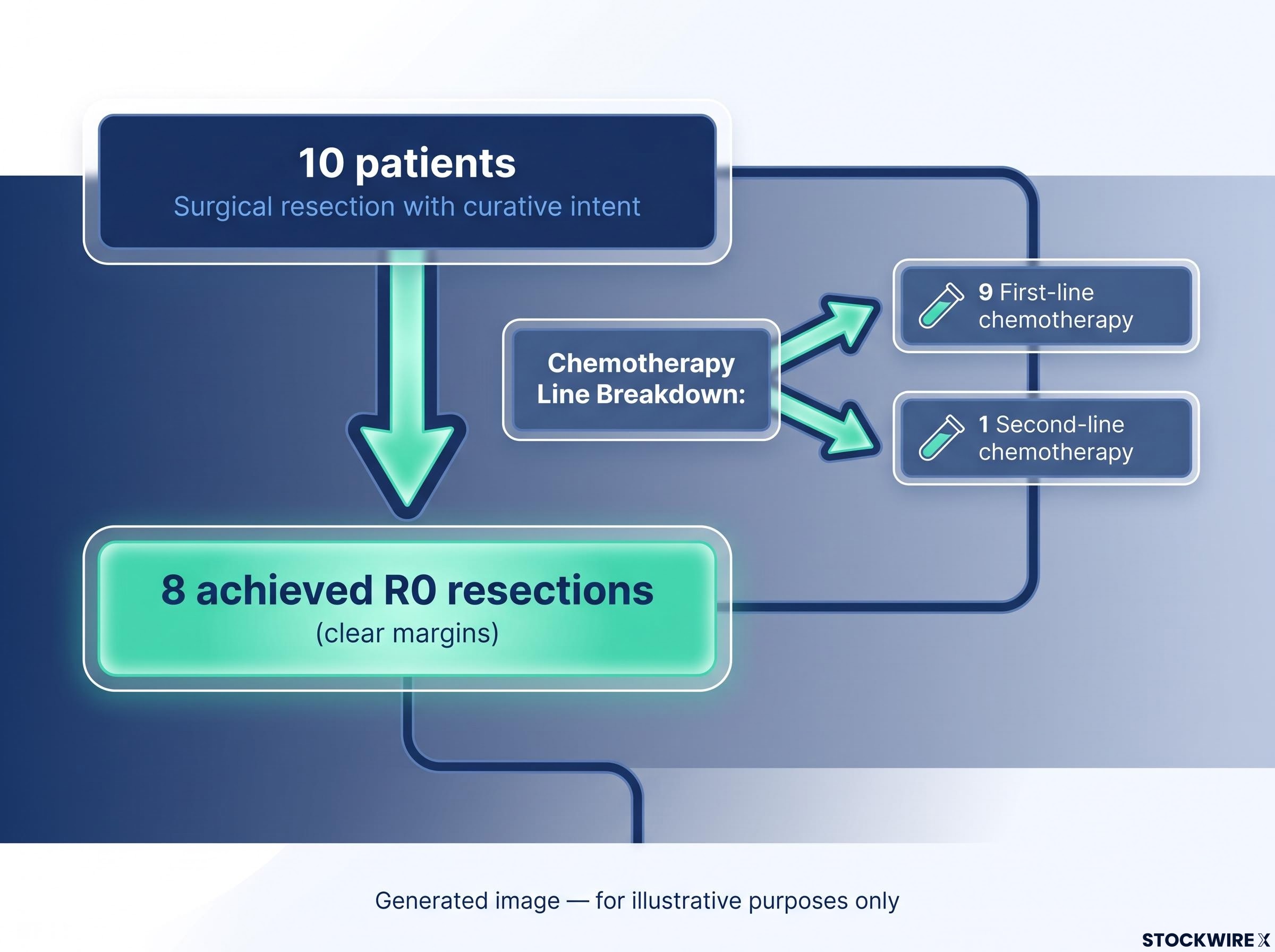
Nine of the ten resections occurred in patients receiving first-line chemotherapy, with one in a patient receiving second-line chemotherapy. According to the announcement, these observations suggest that treatment incorporating OncoSil™ may contribute to downstaging and potentially enable surgical intervention in a proportion of patients initially considered to have unresectable disease.
What the terms mean
“Unresectable” describes a tumour that cannot be removed by surgery. An R0 resection is an operation in which no cancer cells are found at the edges of the removed tissue. Downstaging refers to shrinking or controlling a tumour so that surgery becomes possible.
This matters because pancreatic cancer is generally diagnosed at a later stage and has a poor prognosis for long-term survival. It is the 12th most common cancer in men and the 11th most common in women globally, with 500,000 new cases detected every year.
Real-world registry evidence also adds a different view from controlled trials. It shows how OncoSil™ performs in routine clinical practice, across different treatment centres and patient populations.
Nigel Lange, CEO & Managing Director
“The expanded dataset of 88 patients across 19 European centres continues to demonstrate a favourable safety profile and encouraging local disease control. Particularly promising is that ten patients subsequently underwent surgical resection with curative intent, including eight achieving R0 margins…”
Lange also said the results “reflect growing international clinical interest in this targeted therapy.”
What the data means for OncoSil and next steps
The OSPREY Registry is the company’s ongoing post-market, multi-centre, prospective observational registry. It is designed to evaluate the safety, tolerability and clinical outcomes of OncoSil™ treatment in patients with unresectable LAPC receiving gemcitabine-based chemotherapy.
The data adds to the clinical evidence for a device that is currently approved for sale in 30+ countries. OncoSil™ holds CE Marking approval, providing marketing authorisation in the European Union and the United Kingdom.
In the United States, it has FDA approval under a Humanitarian Device Exemption for unresectable, non-metastatic distal cholangiocarcinoma (dCCA), as an adjunct to systemic therapy. It has also been designated a Breakthrough Device in Europe and the United States.
Additional clinical and imaging research was also presented at EANM 2026. Patient recruitment and follow-up continue, and the company said it looks forward to reporting further outcomes as the registry matures. The announcement does not disclose timelines for further data.
The TRIPP-FFX trial results offer a separate, controlled evidence pillar, with an 82.2% local disease control rate and 18.3-month median overall survival alongside FOLFIRINOX, supporting a planned EU and UK label expansion.
Commercial treatments using the device have already been undertaken in:
- Spain
- Italy
- Austria
- Germany
- Greece
- Türkiye
- Portugal
- Israel
- The UK
Don’t Miss the Next Healthcare Breakthrough
Join 20,000+ investors getting FREE breaking ASX news delivered to their inbox within minutes of release, complete with in-depth analysis. Click the “Free Alerts” button at Big News Blast to receive healthcare and other non-resource alerts the moment market-moving announcements break, and stay ahead of the market.