

TRIPP-FFX trial meets both co-primary endpoints for OncoSil device
OncoSil Medical has reported that its TRIPP-FFX clinical trial has met both co-primary endpoints of safety/tolerability and local disease control rate at 16 weeks in patients with unresectable locally advanced pancreatic cancer. The trial evaluated the OncoSil device used in addition to FOLFIRINOX chemotherapy, the current standard-of-care regimen for this patient population.
The study demonstrated an 82.2% local disease control rate at 16 weeks (95% CI 65-90%) and a median overall survival of 18.3 months in the OncoSil plus FOLFIRINOX arm. Investigators concluded that toxicities associated with adding OncoSil to FOLFIRINOX were limited and manageable. 88 patients were enrolled across 15 sites in Europe and Australia.
OncoSil Medical plans to submit a Change Notification to its EU and UK Notified Body in late 2H CY26 to expand the OncoSil label to include use alongside FOLFIRINOX. Subject to regulatory approval, this label expansion is expected to align with current chemotherapy treatment practice, simplify patient referral pathways, and support broader commercial adoption.
The positive TRIPP-FFX results de-risk the regulatory pathway and position OncoSil for broader commercial adoption by aligning with contemporary treatment practice.
When big ASX news breaks, our subscribers know first
Understanding local disease control rate and why it matters
Local disease control rate (LDCR) measures the percentage of patients whose tumour has not progressed at a specific timepoint. In oncology trials, LDCR is a meaningful efficacy measure for devices and treatments because it demonstrates whether the intervention can prevent disease progression locally.
For the TRIPP-FFX trial, the pre-specified success threshold required the lower bound of the 95% confidence interval to exceed 55% and the interval to reach the 75% target. The observed result of a 95% CI of 68% to 92% satisfied both conditions decisively. The entire range of plausible outcomes sits above 55%, and the interval comfortably spans the 75% benchmark.
LDCR is particularly critical for unresectable tumours where surgery is not an option. Demonstrating that a treatment can prevent local disease progression provides physicians and patients with evidence that the intervention may delay tumour growth and potentially create opportunities for surgical resection that were not previously available.
Efficacy outcomes demonstrate encouraging survival and disease control
The TRIPP-FFX trial generated multiple efficacy metrics across the Intent to Treat (ITT) population. Median overall survival reached 15.9 months in the FOLFIRINOX arm and 18.3 months in the FOLFIRINOX plus OncoSil arm. Best overall response rates showed higher partial response rates in the OncoSil arm at 57.8% compared to 41.9% in the FOLFIRINOX-only arm.
Surgical resection was completed in 14.0% of the FOLFIRINOX arm and 11.1% of the FOLFIRINOX plus OncoSil arm. Among patients who underwent surgical resection, R0 margins (complete microscopic removal of the tumour) were achieved in 16.7% of FOLFIRINOX patients and 60% of FOLFIRINOX plus OncoSil patients.
The trial was not designed for statistical comparison between study arms. Outcomes should be evaluated against historical controls rather than between treatment groups. This design approach was intentional—conducting a statistically powered superiority trial between treatment arms would require substantially more patients and significantly longer completion time.
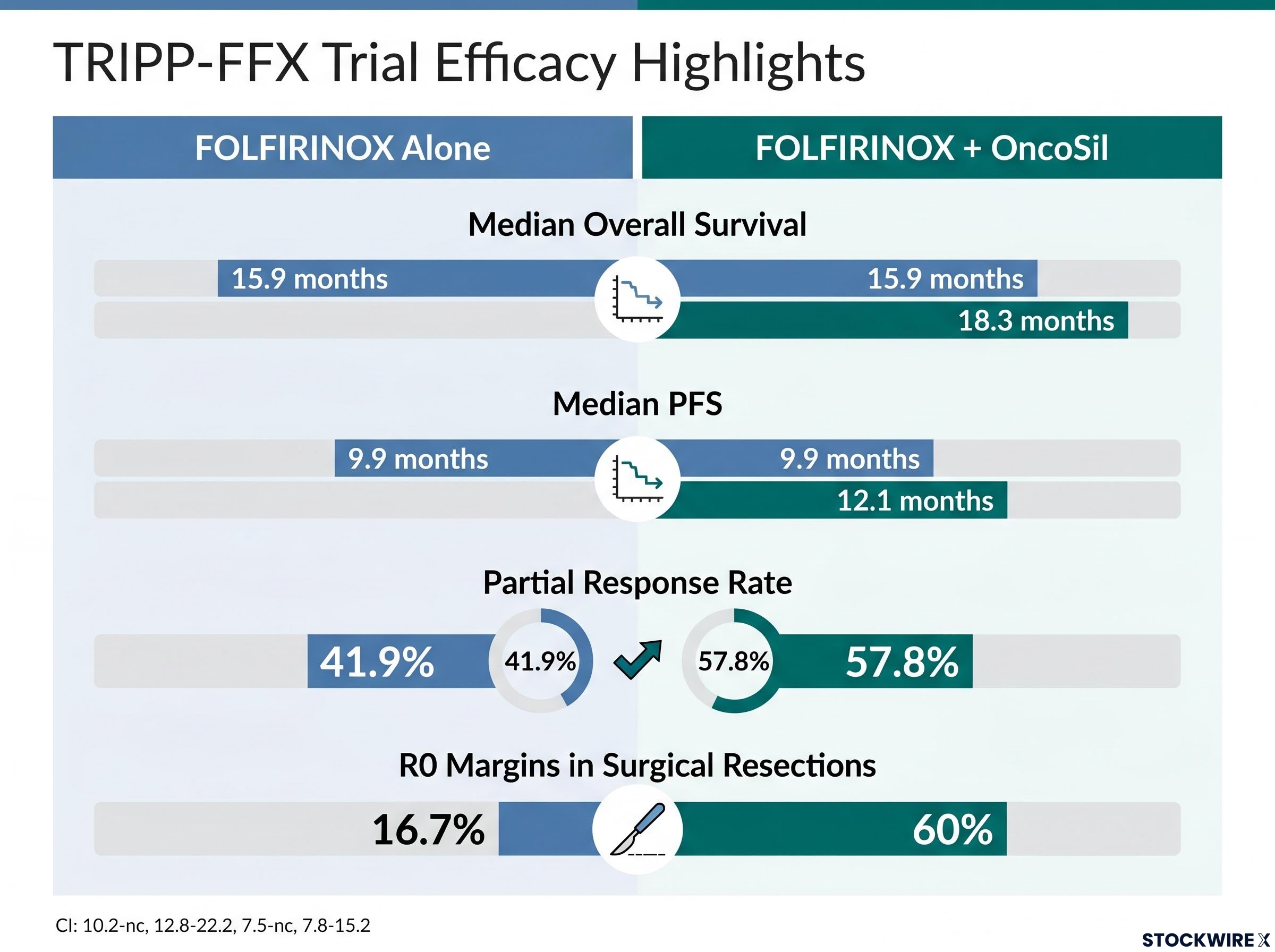
| Endpoint | FOLFIRINOX Alone | FOLFIRINOX + OncoSil |
|---|---|---|
| LDCR at 16 weeks | 86.0% (95% CI 67-92%) | 82.2% (95% CI 65-90%) |
| Median overall survival | 15.9 months (95% CI 10.2-nc) | 18.3 months (95% CI 12.8-22.2) |
| Partial response rate | 41.9% | 57.8% |
| Median PFS | 9.9 months (95% CI 7.5-nc) | 12.1 months (95% CI 7.8-15.2) |
| R0 margins in surgical resections | 16.7% | 60% |
The consistency of outcomes across multiple endpoints reinforces the reproducibility of the OncoSil treatment approach and supports the clinical rationale for label expansion.
Safety profile supports regulatory submission pathway
The Safety Review Committee (SRC) conducted scheduled safety reviews throughout the trial and approved continuation of the study at each assessment. Following review of the safety data, the Principal Investigators concluded that the addition of OncoSil to FOLFIRINOX was safe and demonstrated an acceptable tolerability profile.
Grade 3 or greater Treatment-Emergent Adverse Events (TEAEs) were reported in 60.9% of patients in the FOLFIRINOX arm and 70.7% of patients in the FOLFIRINOX plus OncoSil arm. Investigators concluded that toxicities associated with the addition of OncoSil were limited and manageable.
40 patients treated with OncoSil plus FOLFIRINOX are statistically sufficient to establish the combination’s safety profile. The manageable safety profile is critical for regulatory approval and physician adoption. The SRC’s consistent approval throughout the trial provides confidence in the device’s risk-benefit profile.
Principal Investigators validate clinical significance
Professor Michele Milella, Professor of Medical Oncology at the University of Verona, Italy, and Principal Investigator of the TRIPP-FFX study, emphasised the milestone achievement and consistency of the data.
Professor Michele Milella, Principal Investigator
“The TRIPP-FFX study successfully meeting both primary endpoints is an important outcome and represents a significant milestone in the clinical development of the OncoSil device for patients with unresectable locally advanced pancreatic cancer. Demonstrating both a favourable safety and tolerability profile together with strong local disease control at 16 weeks provides further validation of this treatment approach.
As TRIPP-FFX was designed as a randomized but non-comparative study, the significance of these findings lies in the successful achievement of the predefined clinical endpoints and the consistency of the overall data, with the control arm serving primarily as a benchmark against historical outcomes rather than for direct statistical comparison. In this context, the results are consistent with previously reported findings from historical datasets, including the PANCO trial and the OSPREY Registry and favourably compare with chemotherapy alone or the combination of chemotherapy and other forms of local treatment commonly used in this difficult-to-treat disease setting.
These findings also reinforce the importance of evaluating the OncoSil™ device in addition to FOLFIRINOX, the standard-of-care chemotherapy regimen used in this setting today. We look forward to conducting deeper analysis of the study data, and I would like to sincerely thank the patients, investigators, participating centres and OncoSil Medical for their commitment and collaboration throughout the trial.”
Professor Giuseppe Malleo, Associate Professor of Surgery at the University of Verona, Italy, and Principal Investigator of the TRIPP-FFX study, highlighted the multidisciplinary care perspective and downstaging potential. Professor Malleo noted that the study confirms the possibility to downstage selected patients towards surgical resection. Both investigators acknowledged the contribution of patients, clinical teams, and OncoSil Medical throughout the trial.
Independent validation from principal investigators at a major European institution (University of Verona) adds credibility to the clinical data and supports the regulatory submission.
FOLFIRINOX label expansion could remove key adoption barrier
FOLFIRINOX is the current standard-of-care chemotherapy regimen for fit patients with unresectable locally advanced pancreatic cancer in many major oncology markets. The OncoSil device currently holds CE Marking approval, which provides marketing authorisation in both the EU and the UK. The current OncoSil CE Mark approves use with gemcitabine-based chemotherapy.
Aligning the OncoSil label with FOLFIRINOX would simplify patient referral pathways for medical oncologists. Medical oncologists can more easily identify and refer appropriate patients when the device aligns with the chemotherapy regimen they are already prescribing. This alignment removes a structural barrier to adoption.
OncoSil is currently approved for sale in 30+ countries including the European Union, United Kingdom, Australia, Türkiye, and Israel. Commercial treatments using the device have already been undertaken in Spain, Italy, Austria, Germany, Greece, Türkiye, Portugal, Israel, and the UK.
OncoSil’s commercial footprint received a further boost with TGA approval in Australia, making the device the first and only Class III medical device approved domestically for directly targeting pancreatic tumours, with a new Macquarie Park manufacturing facility nearing completion to support both domestic and global supply.
Label expansion addresses a structural barrier to adoption by allowing medical oncologists to integrate OncoSil into their existing treatment protocols without requiring patients to switch to a different chemotherapy regimen.
Regulatory and commercial roadmap ahead
OncoSil Medical has outlined the following next steps:
- Present initial results at a major oncology congress in 2H CY26
- Submit Change Notification to EU and UK Notified Body in late 2H CY26
- Seek regulatory approval to add FOLFIRINOX to the approved OncoSil product label
CEO Nigel Lange commented on the commercial positioning following the positive TRIPP-FFX results.
Nigel Lange, CEO & Managing Director
“These results are an important step forward in the development of OncoSil and provide a strong foundation for our next phase of growth. Subject to regulatory approval, we believe this could further support physician adoption and strengthen our commercial position across key markets. We look forward to presenting the initial results at a major oncology congress and progressing our planned regulatory submission to expand the OncoSil label in Europe to include use alongside FOLFIRINOX.”
The clear regulatory timeline provides visibility on near-term catalysts. Successful label expansion would position OncoSil for broader market penetration across existing approved jurisdictions.
OncoSil’s position in the pancreatic cancer treatment landscape
Pancreatic cancer is the 12th most common cancer in men and the 11th most common cancer in women globally, with 500,000 new cases detected annually. Since pancreatic cancer is generally diagnosed at a later stage, it has a poor prognosis for long-term survival.
OncoSil employs a differentiated approach through targeted intratumoural placement of Phosphorus-32 microparticles. This targeted approach enables healthcare professionals to deliver a greater radiation dose directly into the tumour compared to external beam radiotherapy, while sparing surrounding critical organs.
OncoSil has received breakthrough device designation in both Europe and the United States. The device is currently approved for sale in more than 30 countries including the European Union, United Kingdom, Australia, Türkiye, and Israel. Commercial treatments using the device have already been undertaken in Spain, Italy, Austria, Germany, Greece, Türkiye, Portugal, Israel, and the UK.
OncoSil addresses a significant unmet medical need in a large and growing patient population. Breakthrough designation and an existing commercial footprint provide a foundation for scaled adoption following label expansion. The TRIPP-FFX results are consistent with the growing body of clinical evidence supporting the use of OncoSil in unresectable locally advanced pancreatic cancer, including the PANCO trial and the OSPREY Registry.
The TRIPP-FFX results are consistent with the growing body of clinical evidence supporting the use of OncoSil in unresectable locally advanced pancreatic cancer, including OSPREY Registry results showing median overall survival of up to 22.0 months in first-line patients alongside a 71.4% R0 margin rate among those who proceeded to surgical resection.
Want the Next Biotech Breakthrough in Your Inbox?
Join 20,000+ investors receiving FREE breaking ASX healthcare news within minutes of release, complete with in-depth analysis. Click the “Free Alerts” button at Big News Blast to get trial results, regulatory approvals, and market-moving announcements delivered straight to your inbox the moment they break.