

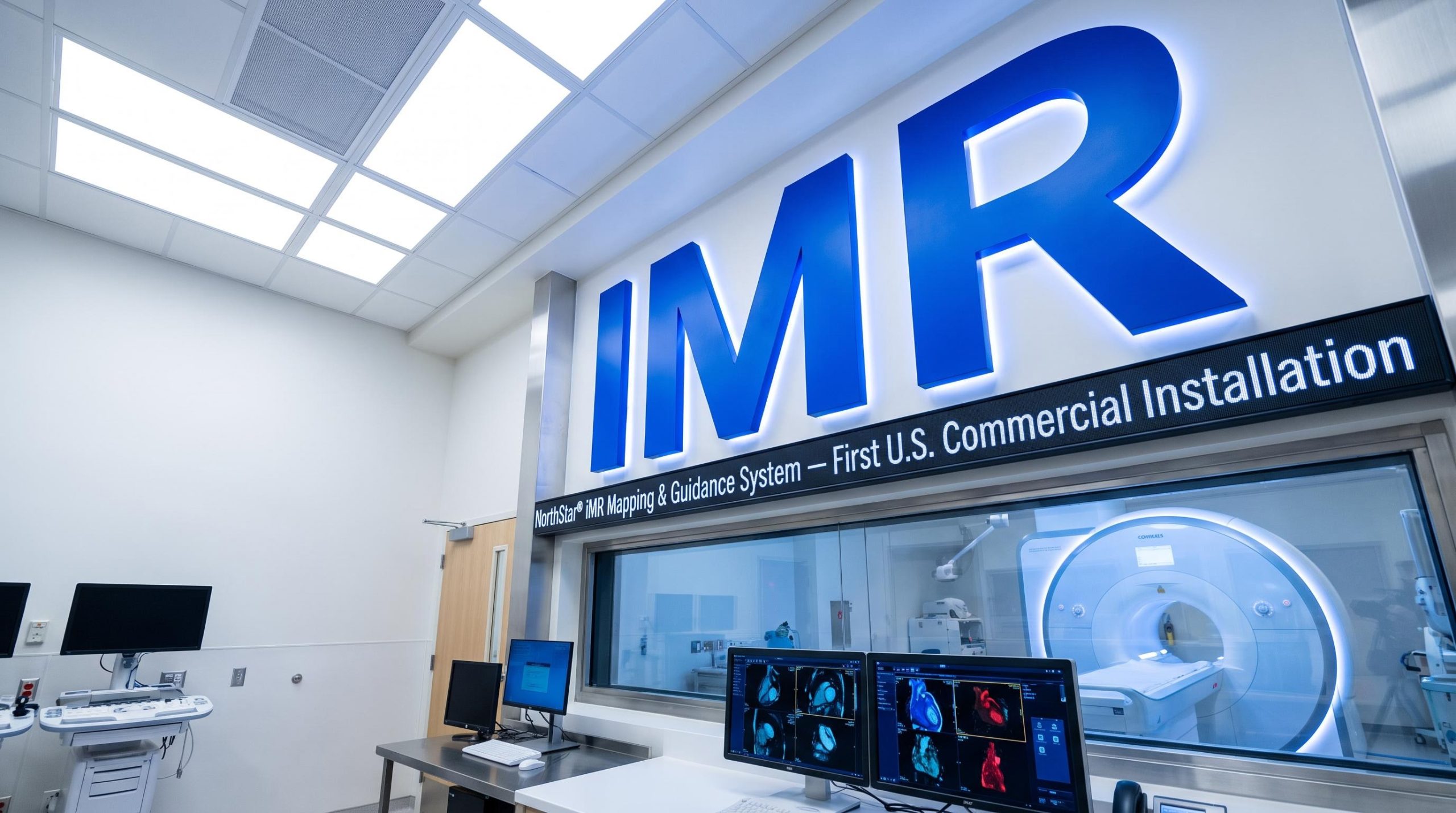
U.S. commercial launch begins with first hospital sale
Imricor Medical Systems (ASX: IMR) has commenced its official U.S. commercial launch, with Rady Children’s Hospital–San Diego becoming the first U.S. commercial customer through the purchase of the NorthStar® iMR mapping and guidance system. The milestone follows FDA 510(k) clearances of NorthStar and the Vision-MR® Diagnostic Catheter, marking the beginning of U.S. commercial operations.
Rady Children’s will launch a NorthStar-guided iMR cardiac catheterisation programme in a 100% radiation-free setting. Notably, revenue from these NorthStar sales is expected to exceed the aggregate full-year revenue from the Company’s European business in 2025.
When big ASX news breaks, our subscribers know first
Imricor Cardiovascular: a new market vertical opens
The launch introduces Imricor Cardiovascular, a new vertical that opens an entirely new market for the Company alongside its existing electrophysiology and ablation business. The offering harnesses magnetic resonance to help physicians perform cardiac catheterisation procedures under real-time MR guidance using NorthStar.
Because NorthStar and the Vision-MR Diagnostic Catheter are cleared for patients of all ages, the addressable market expands considerably. The Company can now serve:
The dual FDA pediatric clearances granted in July 2026 extended both the NorthStar system and the Vision-MR Diagnostic Catheter to patients of any age, removing the final regulatory barrier to the children’s hospital market the Company had identified as its earliest commercial priority.
-
250+ children’s hospitals across the United States
-
2,000+ adult hospitals performing cardiac catheterisation procedures nationwide
Imricor expects to continue adding devices and applications within the Cardiovascular business over time. The market expansion was unlocked by a rapid sequence of U.S. regulatory milestones:
-
January 2026 — FDA 510(k) clearances for the Vision-MR® Diagnostic Catheter (the Company’s first U.S. clearance) and NorthStar, described as the world’s first and only iMR 3D mapping and guidance system
-
July 2026 — FDA cleared pediatric label expansions for both products, permitting their use in patients of any age
What is interventional MR (iMR) and why it matters
Interventional MR (iMR) refers to performing interventional procedures under real-time magnetic resonance guidance rather than under X-ray fluoroscopy. This distinction sits at the heart of Imricor’s commercial proposition.
MR is described as the gold standard in advanced imaging. It eliminates procedure-related exposure to ionising X-ray radiation, while providing superior soft tissue visualisation and richer functional data, such as blood flow or cardiac output, than X-ray fluoroscopy can offer.
The clinical driver behind the first-customer selection is clear. Children born with congenital heart defects may require repeated catheterisations from the earliest years of life and are particularly sensitive to radiation exposure. This differentiation is what unlocks the large hospital addressable market above.
Dr. Brent Gordon, Interventional Cardiologist, Rady Children’s Hospital
“Children born with congenital heart disease often require repeated cardiac catheterizations across their lifetime to measure hemodynamics or treat underlying defects. These procedures have historically been guided by X-ray fluoroscopy, which exposes children to ionising radiation, at a time when they are growing and are particularly susceptible to radiation exposure. MR guidance eliminates exposure to ionising radiation for both patients and staff, while providing us with improved soft tissue differentiation and functional information that fluoroscopy can’t provide. We’re proud that Rady Children’s Health is the first pediatric center in the world to bring this new technology to our patients.”
The hospital economics behind iMR adoption
The clinical case is matched by a commercial one. Cardiac catheterisation in an iMR lab delivers compelling hospital economics that support a broader sales thesis.
In the traditional workflow, a patient may require an MRI scan and a separate X-ray lab catheterisation. That means two sessions, on two different days, each with its own complete clinical team. In the iMR lab, these are combined into a single session with a single team.
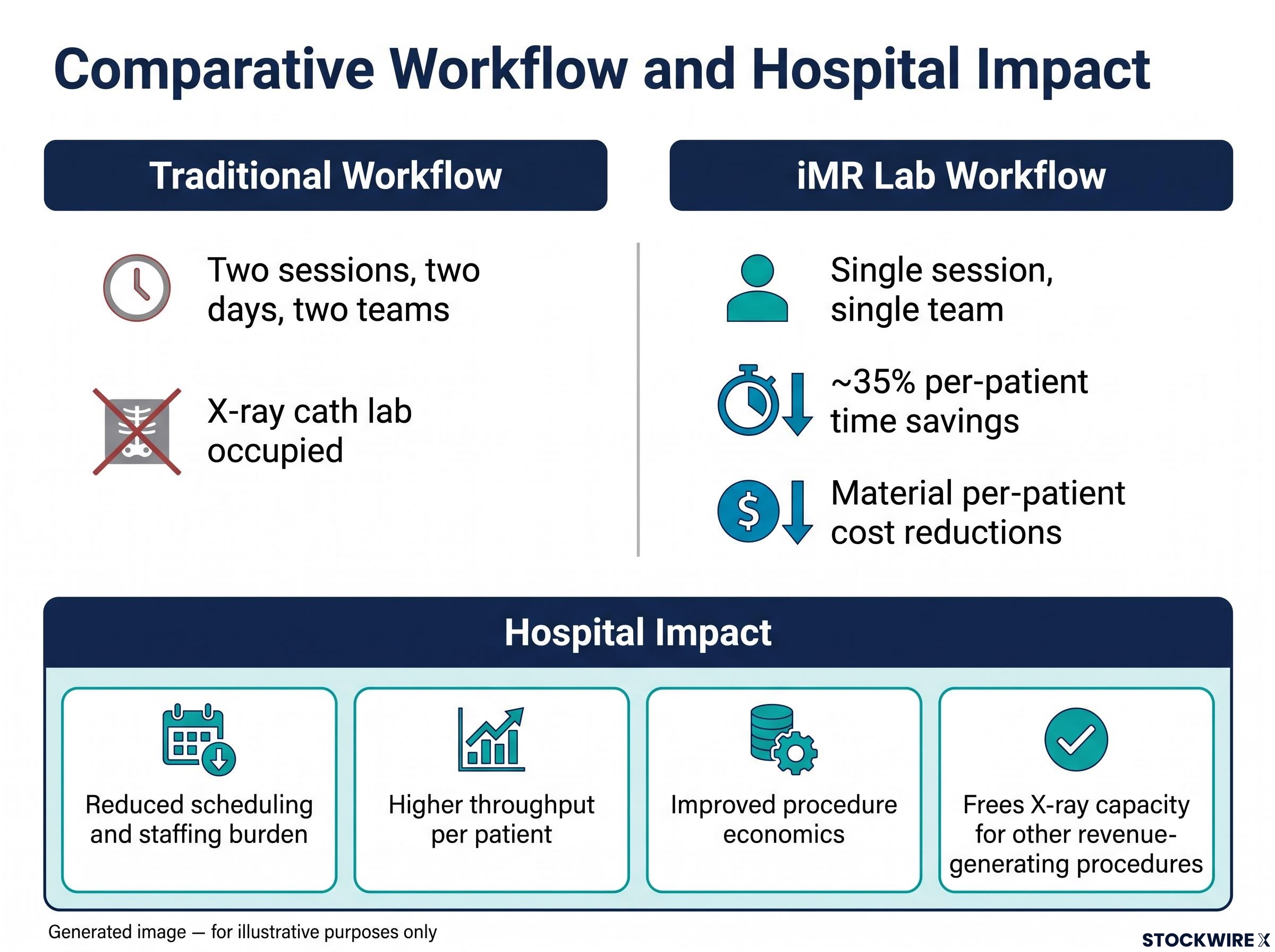
| Metric | Traditional Workflow | iMR Lab Workflow | Hospital Impact |
|---|---|---|---|
| Sessions required | Two sessions, two days, two teams | Single session, single team | Reduced scheduling and staffing burden |
| Procedural time | Baseline | ~35% per-patient time savings | Higher throughput per patient |
| Operational cost | Baseline | Material per-patient cost reductions | Improved procedure economics |
| Capacity | X-ray cath lab occupied | Routine caths moved to iMR lab | Frees X-ray capacity for other revenue-generating procedures |
Moving routine cardiac catheterisations into the iMR lab frees existing X-ray cath lab capacity for other interventional procedures, compounding the economic value an iMR programme delivers to hospital systems.
Dr Alejandro Borquez, Pediatric and Congenital Electrophysiologist, Rady Children’s Hospital
“What excites me most is what MR guidance lets us see — anatomy, function, and flow, in real time. Questions that used to require separate studies on separate days can be answered in a single session, which means fewer anesthetics for our patients, less disruption for families, and better use of the hospital’s resources. This is the direction our field has been waiting to move in, and Rady Children’s is leading it.”
Commercial momentum and expansion plans
Commercial momentum is building beyond San Diego, with a pipeline of prospective customers and expansion plans already taking shape. The near-term signals point to a broadening U.S. footprint:
-
Several additional U.S. hospitals are in the final stages of their purchasing processes, with sales expected over the coming weeks
-
Rady Children’s intends to expand into radiation-free diagnostic electrophysiology and cardiac ablation as soon as possible, offering patients a fully radiation-free pathway
-
The Company is scaling its sales organisation by adding a U.S. Capital Sales Manager for the southeast region, along with additional sales reps and internal sales operations personnel over the coming months
For Rady Children’s, cardiac catheterisation is the beginning, not the end. The hospital’s intention is to offer a fully radiation-free pathway across cardiac catheterisation, diagnostic electrophysiology, and cardiac ablation.
Investment significance: 20 years to a home-market launch
The Company has received FDA clearances, completed the first U.S. commercial sale, launched a new Cardiovascular vertical, and expects revenue to exceed the aggregate full-year 2025 European business.
Management frames the U.S. launch as an early stage rather than a conclusion, describing it as “just the beginning.”
The PMA module submissions covering the ablation platform sit one module away from a complete filing, with clinical data from the VISABL-AFL trial forming the foundation of that final submission and pointing to a commercialisation runway that extends well beyond the diagnostic cardiovascular vertical launched today.
Steve Wedan, Chair and CEO
“Twenty years ago, I sat alone in my basement and wrote a business plan aiming to start a company that would finally (after so many had tried and failed) enable interventional magnetic resonance procedures.”
Steve Wedan, Chair and CEO
“It is particularly meaningful to me that the first patients in the U.S. to benefit from our products (outside of clinical trials) are children, perhaps the most vulnerable patients when it comes to radiation exposure.”
Steve Wedan, Chair and CEO
“This is just the beginning.”
Attention now turns to the near-term pipeline, with additional hospital sales expected over the coming weeks and Rady Children’s intending to expand into radiation-free electrophysiology and cardiac ablation.
Don’t Miss the Next ASX Healthcare Breakthrough
Big News Blast delivers FREE breaking ASX healthcare news and in-depth analysis directly to your inbox within minutes of release. Join 20,000+ investors already getting real-time alerts the moment market-moving announcements hit. Click the “Free Alerts” button to stay ahead of the market before the rest of the crowd catches up.