

Independent review confirms EXO-OC™ science and clears path to US commercialisation
An independent US diagnostics expert has validated INOVIQ Limited’s (ASX: IIQ) own technical assessment of its OC2200 study, confirming that the biology underpinning its EXO-OC™ exosome-based ovarian cancer diagnostic remains sound. The review identified pre-analytical sample handling as the root cause of the study’s variability and outlined a clear path forward. With a staged optimisation and validation program now underway, the company is targeting US Laboratory Developed Test (LDT) commercialisation within 12 to 18 months, with a H1 CY2028 goal.
When big ASX news breaks, our subscribers know first
What the independent review found
The Board commissioned an independent review by Dr Mathew Moore PhD, Principal of ResearchDx, a US-based contract diagnostics organisation. Dr Moore’s recomputation of the OC2200 study results confirmed that INOVIQ’s internal technical assessment was accurate, reproducible and appropriately interpreted.
The review identified pre-analytical sample collection and handling differences across five commercial biorepositories as the largest source of study variability. Differences in blood collection, sample processing, and specimen handling materially affected biomarker measurements. Critically, OC2200 samples contained substantially lower measurable miRNA biomarker levels than the earlier OC500 study, limiting the amount of quantifiable data available for analysis.
The OC2200 study reset confirmed that sample-quality failures across commercial biorepositories, not any flaw in EXO-NET or EXO-OC technology, were responsible for the variability, with INOVIQ’s $9.35m cash position and dual-path commercial strategy remaining intact through the disruption.
The key exoneration finding: within samples sourced from a single collection site, EXO-OC™ distinguished ovarian cancer from benign gynaecological conditions, confirming the biological relevance of the biomarker panel.
Dr Mathew Moore PhD, Principal, ResearchDx
“My independent review confirmed that INOVIQ’s analysis of the OC2200 study was accurate, reproducible and appropriately interpreted… EXO-OC™ distinguished ovarian cancer from benign gynaecological conditions within a single collection site, supporting the biological relevance of the biomarker panel.”
Dr Moore’s three forward recommendations for the EXO-OC™ program are:
- Optimise tumour-specific EV capture to increase signal-to-noise ratio
- Refine the biomarker panel
- Implement consistent sample collection protocols before further clinical evaluation
Understanding LDTs and why the US pathway matters
A Laboratory Developed Test (LDT) is a diagnostic test that is developed, validated, and used within a single certified laboratory. Unlike a conventional in vitro diagnostic (IVD) device, an LDT does not require US Food and Drug Administration (FDA) pre-market approval for initial launch, making it a faster and lower-cost route to market.
To operate as an LDT, the test must be performed in a laboratory certified under CAP/CLIA standards. CAP refers to the College of American Pathologists and CLIA to the Clinical Laboratory Improvement Amendments, both of which are US quality and compliance frameworks for clinical laboratories.
For INOVIQ, pursuing the LDT pathway first is a strategic choice. It enables earlier market entry, generates initial revenue, builds clinical adoption data, and creates a stepping stone to a broader IVD approval pathway in the future. The commercial backdrop supports the ambition: the global ovarian cancer diagnostics market is projected to reach US$3.1 billion by 2035, according to Grand View Research 2025.
Four-stage roadmap to EXO-OC™ commercialisation
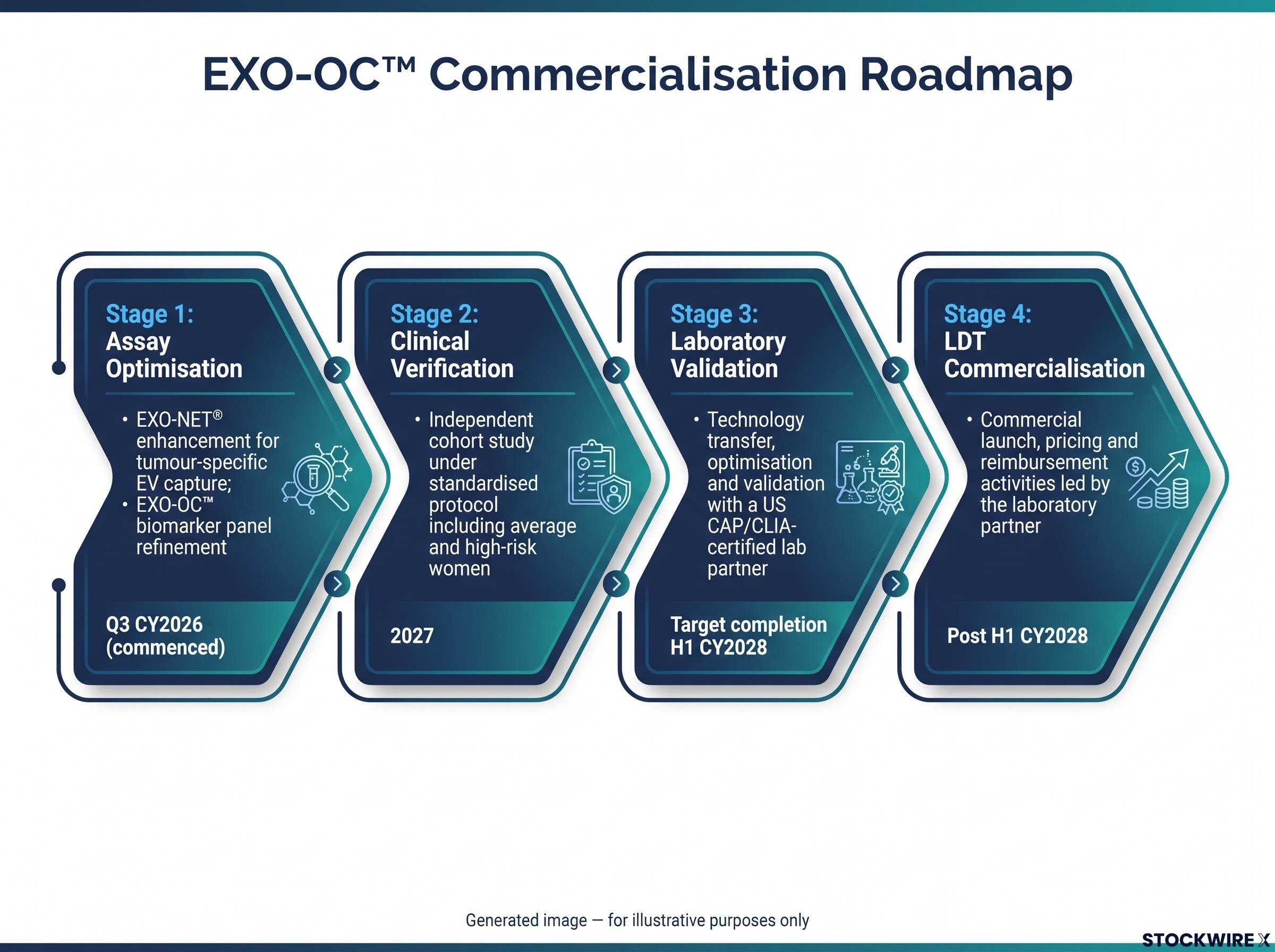
INOVIQ and its scientific advisers have established a staged optimisation, verification and laboratory validation program to advance EXO-OC™ toward US LDT readiness in a capital-efficient, risk-managed manner. Stage 1 (Assay Optimisation) has already commenced in Q3 CY2026, signalling immediate execution.
| Stage | Activity | Key Actions | Target Timing |
|---|---|---|---|
| Stage 1 | Assay Optimisation | EXO-NET® enhancement for tumour-specific EV capture; EXO-OC™ biomarker panel refinement | Q3 CY2026 (commenced) |
| Stage 2 | Clinical Verification | Independent cohort study under standardised protocol including average and high-risk women | 2027 |
| Stage 3 | Laboratory Validation | Technology transfer, optimisation and validation with a US CAP/CLIA-certified laboratory partner | Target completion H1 CY2028 |
| Stage 4 | LDT Commercialisation | Commercial launch, pricing and reimbursement activities led by the laboratory partner | Post H1 CY2028 |
To support verification, validation, and regulatory activities, INOVIQ is actively evaluating biobanks and academic and speciality clinical sites across Australia and the United States. The company expects to work with a specialist contract research organisation and a future laboratory partner, with sample acquisition and laboratory validation activities conducted in parallel to support an efficient commercialisation pathway. Notably, existing EXO-OC™ research workflows are compatible with clinical laboratory integration and support automated, high-throughput processing, which reduces technology transfer risk.
Chairman Peter Gunzburg
“The Board believes that notwithstanding the OC2200 results, our science is sound and we now continue to advance the EXO-OC™ test towards commercialisation in the US with an enhanced understanding of what is required to succeed.”
EXO-OC™ prior performance and the ovarian cancer opportunity
The scientific foundation for EXO-OC™ was established in the earlier 498-sample retrospective case-control study (OC500), which demonstrated 92.3% stage I/II sensitivity and 92.5% all-stage sensitivity at 98% specificity (ASX: 2 June 2025). That data underpins confidence in the underlying biology, independent of the OC2200 outcome.
The EXO-OC sensitivity upgrade to 92.5% all-stage detection at 98% specificity was applied retrospectively to the original OC500 dataset, with an International Patent Application covering the biomarker combinations filed on 29 May 2026 to extend IP protection ahead of commercialisation.
The clinical need is substantial. Ovarian cancer is often diagnosed at a late stage, when survival rates are poor. Globally, there are approximately 330,000 cases and 207,000 deaths annually, according to the Global Cancer Observatory. Early detection represents the greatest opportunity to improve patient outcomes.
INOVIQ’s commercial strategy addresses both near-term and long-term opportunity. The LDT pathway targets women at elevated risk as an initial market, enabling earlier patient access and revenue generation. Beyond that, the company intends to further develop EXO-OC™ as an In Vitro Diagnostic (IVD) for broader ovarian cancer screening, supporting expanded market reach, reimbursement opportunities, and long-term growth.
Don’t Miss the Next ASX Healthcare Breakthrough
Big News Blast delivers FREE breaking ASX healthcare news directly to your inbox within minutes of release, complete with in-depth analysis already done for you. Join 20,000+ subscribers who stay ahead of the market the moment announcements drop. Click the “Free Alerts” button at Big News Blast to start receiving alerts today.