

Enhanced EXO-OC™ algorithm lifts ovarian cancer detection sensitivity to 92%
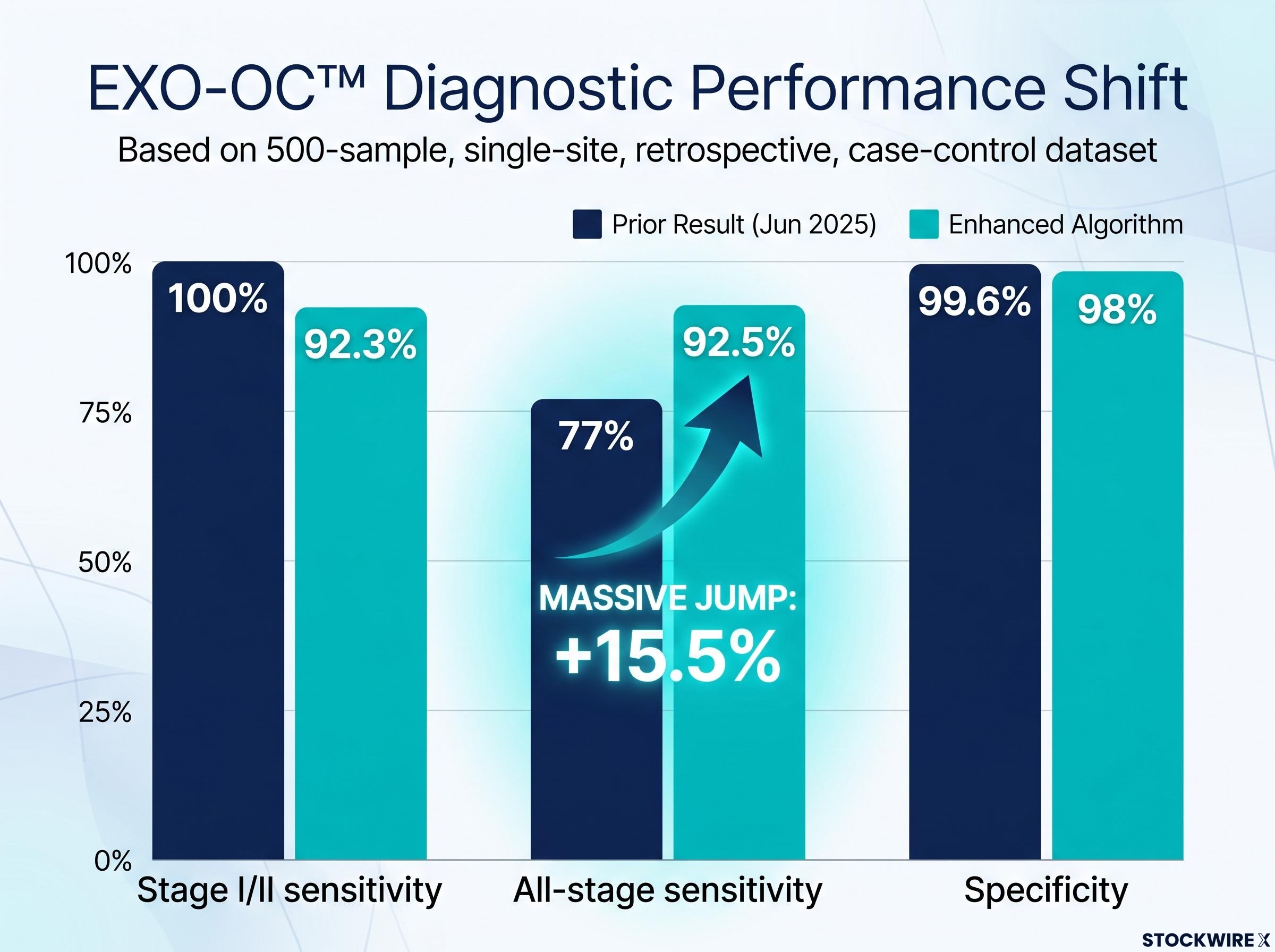
INOVIQ Limited (ASX:IIQ) has reported that continued optimisation of its EXO-OC™ algorithm, applied to the original 500-sample dataset, achieved 92.3% sensitivity for stage I/II ovarian cancer and 92.5% sensitivity across all stages at 98% specificity.
These results build on performance data first announced on 2 June 2025, demonstrating an enhanced model tuned to better meet the clinical need for early detection in high-risk women.
Alongside this positive update, the company disclosed a setback. Its expanded retrospective clinical study, covering approximately 1,200 biobanked plasma samples, was deemed unsuitable for evaluating EXO-OC™ test performance, largely due to variability in external sample quality.
Importantly, INOVIQ stated these sample-quality issues were unrelated to the performance of the EXO-NET® technology or the EXO-OC™ test itself. The problem lay with third-party biorepository samples.
When big ASX news breaks, our subscribers know first
A clear step-up in diagnostic performance
The algorithm optimisation reflects ongoing model tuning applied to the same 500-sample, single-site, retrospective, case-control dataset used in the June 2025 results. The enhanced model delivered a substantial improvement in all-stage sensitivity while trading marginal ground on stage I/II sensitivity and specificity.
| Metric | Prior Result (Jun 2025) | Enhanced Algorithm | Dataset |
|---|---|---|---|
| Stage I/II sensitivity | 100% | 92.3% | 500-sample, single-site, retrospective, case-control |
| All-stage sensitivity | 77% | 92.5% | 500-sample, single-site, retrospective, case-control |
| Specificity | 99.6% | 98% | 500-sample, single-site, retrospective, case-control |
The headline shift is the lift in all-stage sensitivity from 77% to 92.5%. Sensitivity measures how often a test correctly identifies people who genuinely have the disease. A higher all-stage figure means the test misses fewer cancers across early and advanced stages alike.
For women at high risk of developing ovarian cancer, that improvement matters. The enhanced model brings detection performance closer to the threshold required for reliable early identification across the full disease spectrum, not just the earliest stages.
Prof Gregory Rice, Founding Scientist
“The enhanced EXO-OC™ algorithm is well suited to early detection and screening of ovarian cancer…”
What happened with the expanded retrospective study
INOVIQ commenced an expanded clinical study to evaluate EXO-OC™ test performance in biobanked plasma samples across different cancer stages, high-risk groups and confounding diseases. The current phase was a multi-provider, retrospective, case-control design across approximately 1,200 samples sourced from 5 commercial biorepositories.
Sample analysis began in April 2026, with the final samples received in late May 2026 for the ovarian cancer-control group and data analysis completed in June 2026. That analysis identified a clear problem at source.
One biorepository, which supplied 616 samples including 69% of the cancer cases, exhibited reduced protein and miRNA levels consistent with sample degradation. Significant variability was also identified across all biorepositories, likely due to provider-specific pre-analytical collection and logistical factors outside the study’s control.
As a result, the 1,200 samples were deemed unsuitable for evaluating the EXO-OC™ test. Critically, the company confirmed these issues were unrelated to the performance of the EXO-NET® technology or the EXO-OC™ test.
Despite the setback, the study generated valuable insights:
-
The robustness and performance of individual miRNA biomarkers under uncontrolled pre-analytical conditions
-
Evidence of the inherent challenges in using biobanked samples sourced from multiple biorepositories and sites
-
Findings that will inform future development plans, study design and commercial roll-out
Why ovarian cancer early detection matters
Ovarian cancer is typically diagnosed at a late stage, resulting in poor survival outcomes despite available treatments. Early detection represents the greatest opportunity to improve patient outcomes and reduce the broader healthcare burden.
EXO-OC™ is an exosome-based blood test in development for early detection and screening of ovarian cancer. Exosomes are tiny particles released by cells that carry biological information. The test uses INOVIQ’s proprietary EXO-NET® technology to isolate these exosomes, then combines multiple exosomal miRNA biomarkers and CA125 in an AI/Machine Learning (ML) algorithm to support early and accurate detection.
The unmet need is concentrated among high-risk women. Those carrying BRCA1/2 mutations, Lynch Syndrome, or with a family history of the disease can face a lifetime risk of over 50% for developing ovarian cancer. This large addressable population underpins the commercial opportunity the company is pursuing.
INOVIQ’s CAR-exosome platform extends the company’s ovarian cancer focus beyond detection, with preclinical in vitro data showing CA125-targeting constructs killing more than 90% of OVCAR-3 and Caov-3 ovarian cancer cells within 48 hours, positioning the therapeutic programme as a potential complement to EXO-OC in an integrated detect-and-treat strategy.
The commercialisation pathway and next steps
INOVIQ remains committed to rapid commercialisation of EXO-OC™ as a Laboratory Developed Test (LDT) in the US for early detection in high-risk women, before further developing the test as an In Vitro Diagnostic (IVD) for screening in average-risk women.
The LDT path offers patients early access to the test and the potential for a Proprietary Laboratory Analyses (PLA) code for reimbursement. The company is in discussions with potential US laboratory partners to support technology transfer, optimisation, validation and commercialisation.
Future studies will use samples collected under INOVIQ’s standardised protocol, either through a single-site nested prospective clinical study or a real-world study conducted with a laboratory partner or contract research organisation (CRO).
On the intellectual property front, the provisional patent application for EXO-OC™ proceeded to an International Patent Application filed on 29 May 2026, covering various protein and RNA biomarker combinations and methods for the exosome ovarian cancer test.
The forward roadmap can be summarised as follows:
-
Further refine the standardised protocol, biomarkers and algorithm
-
Conduct future studies using samples collected under INOVIQ’s standardised protocol
-
Progress EXO-OC™ toward LDT readiness
-
Commercialise EXO-OC™ as an LDT in the US with a laboratory partner
-
Further develop the test as an IVD for screening in average-risk women
Dr Leearne Hinch, CEO
“Our exosome approach is designed to enable highly sensitive and specific detection of ovarian cancer at its earliest and most treatable stages, positioning EXO-OC™ as a potential screening solution to help save women’s lives. We are focused on advancing development, minimising any impact on timelines and progressing EXO-OC™ toward LDT readiness and commercialisation.”
The investment takeaway
The core message for investors is twofold. The enhanced algorithm demonstrated strong, improved diagnostic performance, lifting all-stage sensitivity to 92.5% while maintaining high specificity. The technology continued to perform as the company refined its model on the original dataset.
The setback, while real, was attributed to an external sample-quality issue with an identified and addressable cause. The degradation and variability arose from third-party biorepositories rather than from the EXO-NET® technology or the EXO-OC™ test.
With the commercialisation strategy intact, active discussions with potential US laboratory partners, and a freshly filed International Patent Application, INOVIQ’s development pathway and IP position remain in place. Management has framed a clear forward plan centred on standardised-protocol studies and progress toward LDT readiness, though execution against revised timelines will be the key measure for investors to watch.
Don’t Miss the Next Healthcare Breakthrough on ASX
Big News Blast delivers FREE breaking ASX healthcare news directly to your inbox within minutes of release, complete with in-depth analysis already done for you. Join 20,000+ subscribers staying ahead of market-moving announcements. Click the “Free Alerts” button at StockWire X to start receiving alerts the moment news breaks.