
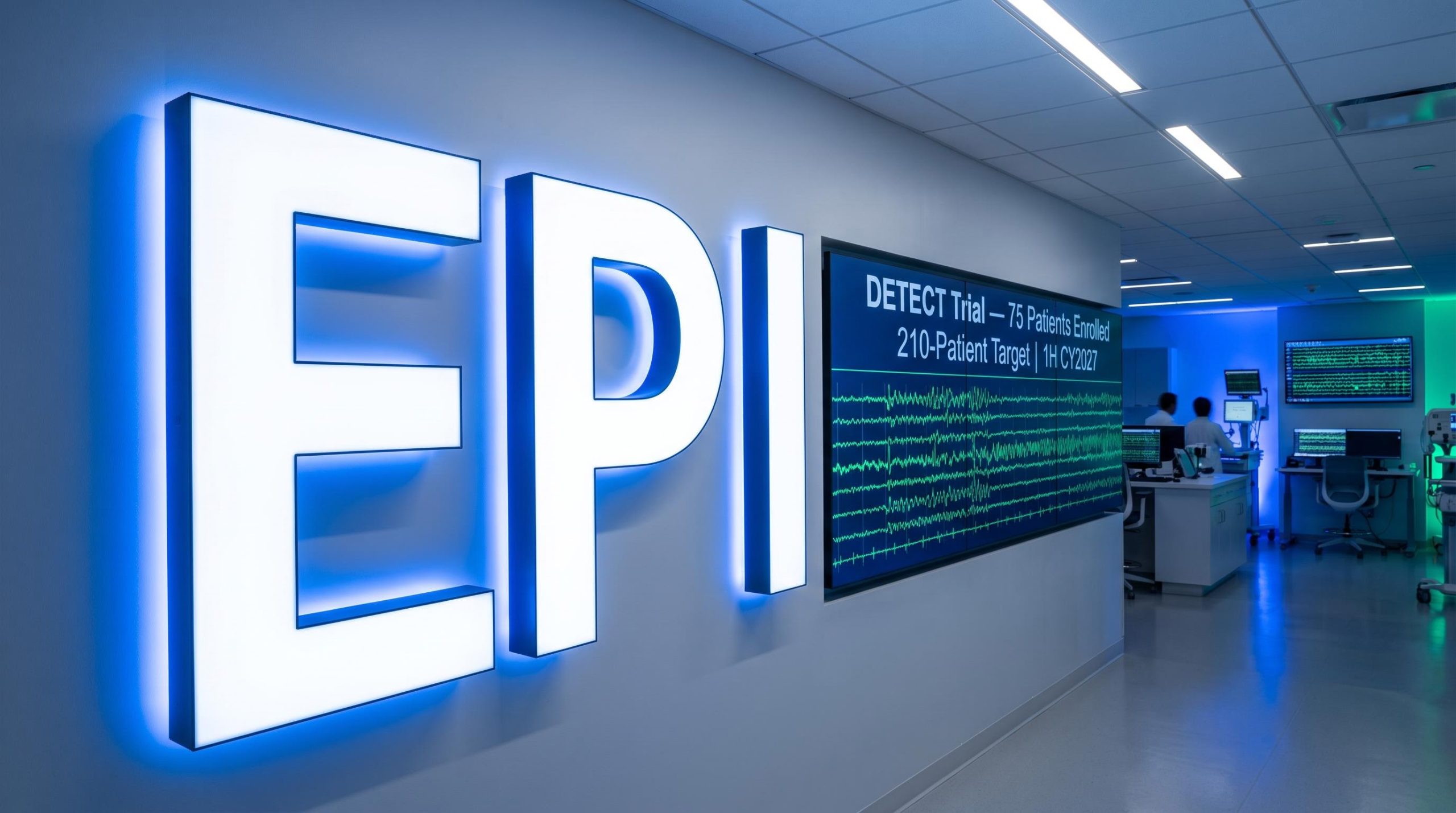
DETECT hits 75-patient milestone on schedule as elite US site network drives momentum
Epiminder (ASX: EPI) has announced the enrolment of its 75th patient in DETECT (Diagnosing Epilepsy To EffeCT change), reaching the milestone in line with its previously announced September 2026 target. The prospective, randomised, controlled, blinded, multi-centre US clinical study evaluates the Minder® System, a minimally invasive implantable continuous EEG Monitoring (iCEM®) device designed for patients with inconclusive inpatient EEG results. With the 100th enrolment anticipated in November 2026 and the full 210-patient target on track for completion by end of 1H CY2027, the programme’s trajectory signals sustained momentum.
When big ASX news breaks, our subscribers know first
What DETECT is — and why 210 patients matters
DETECT is a post-market study conducted using an FDA-authorised device, evaluating the Minder System as a tool to improve clinical decision-making for epilepsy patients following an inconclusive prolonged EEG monitoring assessment. The Minder System records bilateral subscalp EEG continuously and transmits data via an external wearable and smartphone application to a secure cloud platform, enabling real-world monitoring across patients’ normal daily activities over months or years.
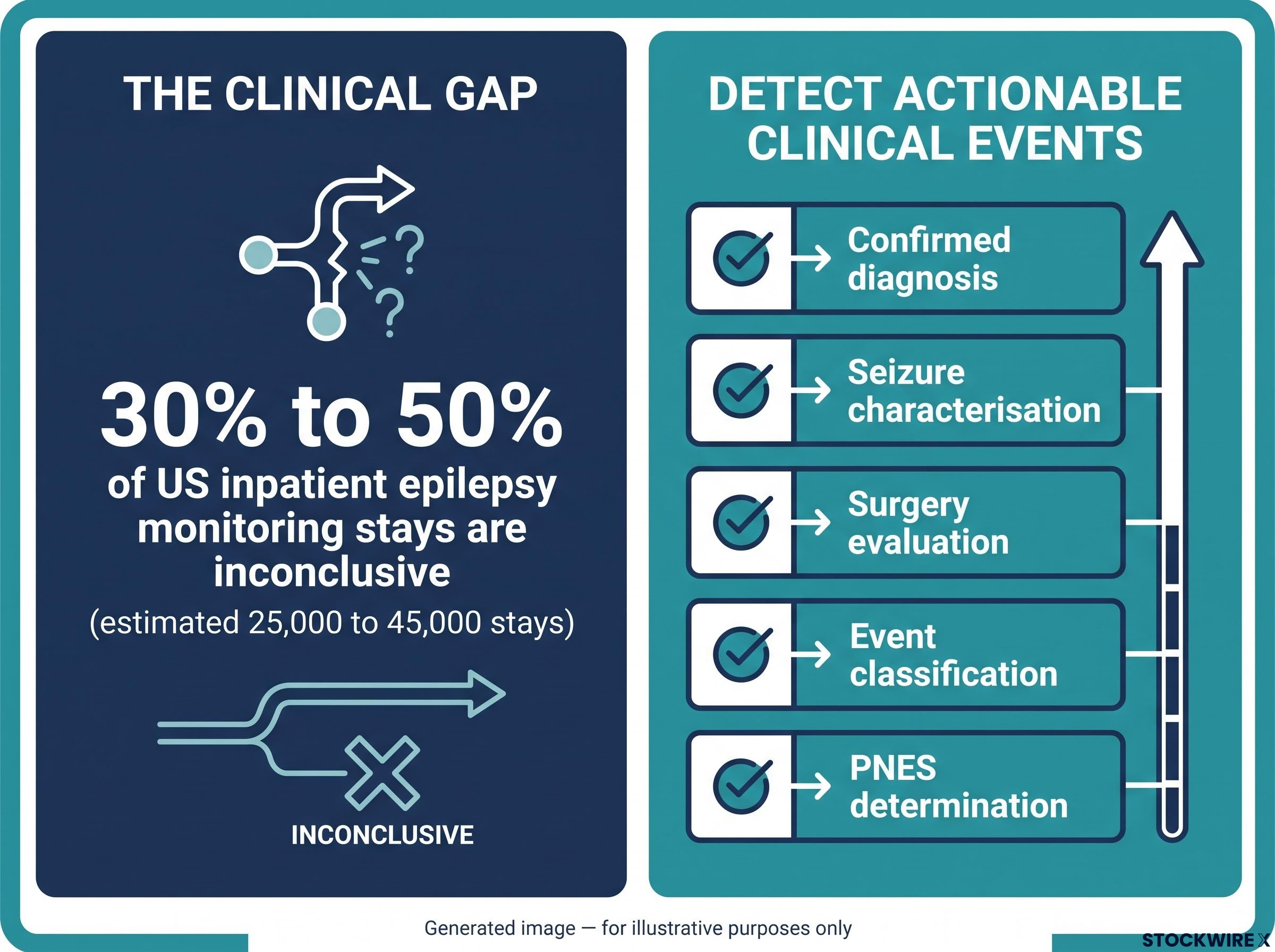
The clinical problem the study is designed to address is substantial. Between 30% and 50% of inpatient epilepsy monitoring unit stays in the United States are inconclusive, representing an estimated 25,000 to 45,000 stays. For patients in that group, many of whom have drug-resistant epilepsy, the consequences are significant: without a confirmed diagnosis or characterised seizure type, access to definitive therapies, including epilepsy surgery, is frequently delayed or denied entirely.
The Minder System was developed precisely for this population. Conventional inpatient EEG monitoring is too short to capture the defining events of many complex patients’ conditions. Long-term continuous monitoring addresses this directly.
DETECT’s primary endpoint is the proportion of subjects who achieve an actionable clinical event, defined as one or more of the following outcomes:
- Confirmed diagnosis
- Seizure characterisation
- Surgery evaluation
- Event classification
- Psychogenic nonepileptic seizure (PNES) determination
Reaching the full 210-patient enrolment target builds the definitive evidence base required for broad clinical adoption. Each milestone achieved on schedule de-risks the path to that outcome.
A world-class site network fuelling enrolment pace
DETECT is now supported by 21 clinical sites across the United States, spanning institutions including Mayo Clinic, Harvard, Stanford, Yale, Duke, and the University of Pennsylvania. The 75th patient was enrolled early in September 2026, during the US summer holiday period, reinforcing the strength of the recruitment pace rather than diminishing it.
The 25-patient enrolment milestone, reached on schedule in May 2026, established the cadence that has carried through to the current 75-patient mark, with each successive target met against a backdrop of consistent site engagement across 19 leading US institutions.
The engagement of clinicians at these institutions reflects a demand-side signal. Leading US epilepsy centres are actively identifying their most diagnostically complex patients for the study, indicating that the epilepsy community sees tangible clinical value in what the Minder System offers.
Rohan Hoare, CEO, Epiminder
“The rate at which we are enrolling patients in DETECT speaks for itself. Reaching 75 patients early in September, and during summer holiday period, in line with our expectations signals to us that US neurologists are actively seeking solutions for their most complex epilepsy patients, and that the Minder System is resonating as that solution. We anticipate we will reach the 100th enrolment milestone in November. With every milestone we attain it gives us greater confidence in the path to 210 patients. We remain on track to enrol 210 patients by end of 1H CY2027, and the programme’s trajectory gives us real confidence in getting there.”
Professor Mark Cook, Founder, Epiminder
“The speed at which DETECT is enrolling patients is a direct reflection of how unmet this need is… The fact that clinicians at institutions like Mayo Clinic, Harvard and Stanford are enrolling their most diagnostically challenging patients into DETECT tells us something important: the epilepsy community understands what this technology can offer, and they want to see the evidence that will allow them to use it at scale. Reaching 75 patients on schedule puts us in a strong position to build a definitive evidence base. The sites, the patient numbers, and the rigour of the study design are all in place. That is exactly what the field needs.”
Milestones ahead — what investors should watch
The roadmap from current position to full enrolment is structured across three key milestones:
- 75th enrolment — achieved, September 2026
- 100th enrolment — anticipated November 2026
- 210-patient full enrolment — targeted by end of 1H CY2027
Supporting the clinical credibility of DETECT, the UMPIRE first-in-human multicentre trial, published in Epilepsia (2025), demonstrated Minder’s safety and high-quality signal acquisition across extended monitoring periods. This provides a validated technical foundation ahead of DETECT results.
The following table summarises the enrolment milestones and their significance:
| Milestone | Target / Status | Timing | Significance |
|---|---|---|---|
| 75th patient enrolled | Achieved | September 2026 | On-schedule delivery validates enrolment pace; confirms site network engagement |
| 100th patient enrolled | Anticipated | November 2026 | Next near-term proof point; demonstrates sustained recruitment momentum |
| 210-patient full enrolment | On track | End of 1H CY2027 | Completes the evidence base required to support broad clinical adoption |
Each milestone reached on schedule compounds the investment case. Consistent on-time delivery reduces execution risk, advances the evidence base needed for widespread clinical use, and demonstrates real-world demand from some of the most respected epilepsy centres in the United States.
Don’t Miss the Next Healthcare Breakthrough
Big News Blast delivers FREE breaking ASX healthcare news directly to your inbox within minutes of release, complete with in-depth analysis already done for you. Join 20,000+ investors who stay ahead of the market the moment news breaks. Click the “Free Alerts” button at StockWire X to start receiving alerts today.