

Symphony™ delivers landmark clinical trial results for diabetic foot ulcers
A prospective, multicentre randomised controlled trial (RCT) published in International Wound Journal has demonstrated that AROA Biosurgery (ASX: ARX) Symphony™ significantly outperforms standard of care alone for the treatment of diabetic foot ulcers (DFUs).
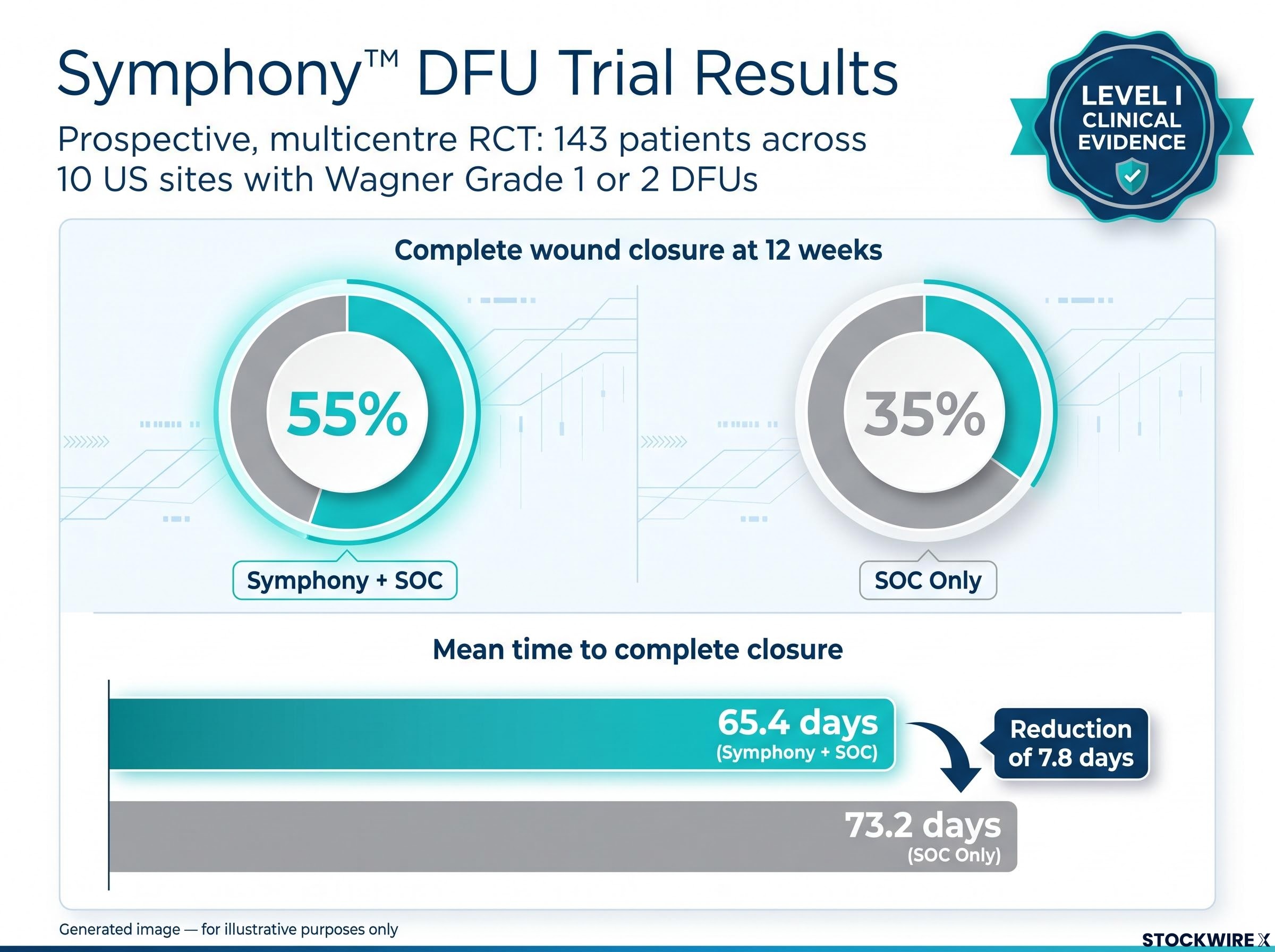
The trial, which enrolled 143 patients across 10 US sites, produced two headline results: a 55% wound closure rate in the Symphony arm versus 35% for standard of care only at 12 weeks, and a mean healing time reduced by 7.8 days (65.4 days versus 73.2 days). Both findings were statistically significant.
These results provide Level I clinical evidence, the highest standard in clinical medicine, positioning Symphony among a small group of Cellular, Acellular and Matrix-like Products (CAMPs) to hold this designation.
When big ASX news breaks, our subscribers know first
What the trial found — breaking down the results
The study randomly assigned patients to either the Symphony arm, receiving weekly treatment with Symphony plus standard of care, or a standard of care only arm. Patients were treated for up to 12 weeks or until complete wound closure was achieved.
The trial enrolled challenging DFU cases classified as Wagner Grade 1 or Grade 2. Grade 1 ulcers involve the full thickness of the skin, while Grade 2 ulcers extend deeper into ligaments, tendons, joint capsules, or deep fascia. These are not mild presentations.
Both primary outcomes reached statistical significance:
- Complete wound closure at 12 weeks: 55% (Symphony + SOC) vs 35% (SOC only), p=0.039
- Mean time to complete closure: 65.4 days (Symphony) vs 73.2 days (SOC only), a reduction of 7.8 days, p=0.041
| Metric | Symphony + SOC | SOC Only | Statistical Significance |
|---|---|---|---|
| Complete wound closure at 12 weeks | 55% | 35% | p=0.039 |
| Mean time to complete closure | 65.4 days | 73.2 days | p=0.041 (reduction of 7.8 days) |
Dr David Armstrong, Lead Investigator
“New technologies and high-quality randomised clinical evidence are essential if we are to continue improving outcomes for patients with diabetic foot ulcers. The Symphony trial demonstrates that combining a novel extracellular matrix bioscaffold with high molecular weight hyaluronic acid can significantly improve wound healing when added to good standard of care. Studies like this help clinicians make informed treatment decisions based on robust evidence.”
Understanding CAMPs and why Level I evidence changes the game
CAMPs, or Cellular, Acellular and Matrix-like Products, are a class of advanced wound care products used to treat hard-to-heal wounds where standard therapies have limited effect. DFUs are among the most clinically challenging wound types, prone to chronic inflammation and poor healing due to impaired circulation and immune response in patients with diabetes.
Symphony is AROA’s CAMP product, combining AROA ECM, a novel extracellular matrix bioscaffold derived from ovine (sheep) forestomach, with high molecular weight hyaluronic acid (HMWHA). HMWHA is a naturally occurring polymer with anti-inflammatory properties and the ability to retain approximately 1,000 times its weight in water, making it well suited to chronic wounds with persistent inflammation and moisture imbalance.
AROA understands Symphony is the only commercially available CAMP incorporating HMWHA, though this is qualified as the company’s own understanding rather than an independently verified claim.
The AROA ECM bioscaffold evidence base extends beyond wound care, with the MASTRR Registry interim analysis, covering 411 patients across 10 US centres, reporting deep tissue infection rates of just 0.7% for Myriad in soft tissue reconstruction, a figure that contextualises the broader clinical credibility of the platform underpinning Symphony.
Level I evidence, generated through a properly conducted RCT, is the gold standard in clinical research. For investors, the distinction is material: payors and reimbursement authorities in the US are increasingly requiring this grade of evidence before granting or maintaining coverage for advanced wound care products. A CAMP that can point to a published, multicentre RCT occupies a meaningfully stronger commercial position than one relying on lower-quality observational data.
What this means for AROA’s commercial position
CEO Brian Ward
“This is a major milestone for Symphony. The study delivered clear, statistically significant results: adding Symphony to standard of care when treating DFUs increased the incidence of complete wound closure at 12 weeks by 55% and reduced the mean healing time by 7.8 days. The multicentre design and involvement of recognised key opinion leaders strengthen the evidence’s credibility and clinical relevance. Amid growing demand from clinicians, payors, and reimbursement authorities for robust RCT data, this publication places Symphony among a small group of CAMPs with Level I effectiveness data, strengthening its differentiation and commercial value proposition.”
The RCT results are expected to support three distinct commercial levers for AROA:
- Product differentiation — Symphony now holds Level I data in a market where few CAMPs can make the same claim, providing a clinically grounded point of distinction.
- Clinical adoption — the involvement of recognised key opinion leaders and the multicentre trial design strengthen the evidence’s credibility with prescribing clinicians, supporting uptake at an institutional level.
- US reimbursement — the publication directly addresses growing demand from clinicians, payors, and reimbursement authorities for robust RCT data, a requirement that is shaping coverage decisions across the advanced wound care segment.
AROA’s US distribution infrastructure is already in place, with access to the market via a direct sales force and partner TELABio, Inc. Symphony is designed to treat hard-to-heal wounds including DFUs and venous leg ulcers, sitting within AROA’s broader soft-tissue regeneration platform built on the proprietary AROA ECM technology.
The CMS reimbursement environment for outpatient skin substitutes has stabilised somewhat since the January 2026 rate change disrupted the broader market, with a proposed rate of US$127.14 per square centimetre into CY2027 providing Symphony a defined pricing floor as AROA accelerates its commercial push.
Don’t Miss the Next Healthcare Breakthrough on ASX
Big News Blast delivers FREE breaking ASX healthcare news directly to your inbox within minutes of release, complete with in-depth analysis already done. Join 20,000+ subscribers who stay ahead of the market the moment announcements drop. Click the “Free Alerts” button at StockWire X to start receiving alerts today.