One word from a US Treasury Secretary just told currency traders more about intervention risk than any price chart could. When Scott Bessent described recent yen depreciation as “orderly,” he was not offering a casual observation. He was broadcasting a calibrated diplomatic signal that shifts the entire risk calculus around USD/JPY.
The remark came in late August 2025, shortly after a rare coordinated US-Japan currency intervention the previous month, with USD/JPY having reached approximately 164 before authorities moved. That episode made the subsequent “orderly” framing all the more deliberate. Understanding why that single adjective matters requires understanding how US-Japan currency diplomacy actually works, and what the language spectrum between “orderly” and “disorderly” tells markets in real time.
The July 2026 coordinated yen intervention was deliberately structured so that US participation involved selling euro reserves rather than dollars or Treasuries, a design choice that reveals how seriously Washington assessed the systemic risk of a disorderly yen collapse transmitting into US bond markets.
Here is a framework for reading official currency language the way professional traders do: not as background noise, but as a live signal about intervention probability, policy direction, and where the medium-term driver of USD/JPY actually sits.
What “orderly” actually signals, and what it rules out
In US-Japan currency diplomacy, “orderly” is defined by contrast. It is the explicit opposite of the language officials use when preparing or justifying intervention. When conditions deteriorate, policymakers reach for phrases like “excessive volatility,” “disorderly movements,” and “appropriate action.” When they instead describe price action as orderly, they are making a threshold declaration: the conditions required to justify fresh coordinated action are not presently met.
That distinction matters more than it might sound. USD/JPY was trading around 147 at the time of Bessent’s remarks. Only weeks earlier, coordinated intervention near 164 had rattled the pair. By publicly labelling the post-intervention price action as orderly, Bessent was telling markets that the acute phase had passed and that current levels, while uncomfortable, sit within policymakers’ tolerance band.
The signal went further than intervention risk. In his comments, Bessent spoke highly of Bank of Japan (BoJ) Governor Kazuo Ueda, describing him as a perceptive economist whose grasp of markets is frequently underestimated. He stopped short of recommending any particular sequencing of rate decisions, and indicated he trusted Ueda to manage monetary policy as he sees fit. That language gives the BoJ implicit room to normalise policy at its own pace without US pressure on specific rate decisions.
Bessent has also stated the US would do “whatever it takes” to support Japan’s effort to stabilise the yen, framing a disorderly yen as a risk that could destabilise markets across Asia and ultimately raise US interest rates.
That framing establishes the stakes. Washington views yen instability not as Japan’s problem alone but as a transmission channel to US borrowing costs. It is precisely because the consequences of disorderly moves are seen as systemic that the “orderly” label carries so much weight. For you, watching USD/JPY, the practical takeaway is direct: near-term intervention tail risk has dropped materially, and the pair’s direction now depends far more on rate differential fundamentals than on the possibility of a surprise coordinated operation.
When big ASX news breaks, our subscribers know first
How Japan’s decades-long monetary experiment created the yen’s structural weakness
To understand why yen depreciation keeps returning as a theme, you need to trace it back to a deliberate policy choice made over a decade ago and follow the consequences forward.
Beginning in 2013, the BoJ launched aggressive quantitative and qualitative easing under what became known as Abenomics, a programme designed to inject liquidity, stimulate inflation, and break Japan out of decades of deflationary stagnation. That easing programme was extended in 2016, when the BoJ added negative interest rates to its toolkit and introduced yield curve control (YCC), a mechanism that bound the central bank to purchasing whatever quantity of 10-year government bonds was necessary to keep yields pinned near a specified ceiling.
These policies compressed Japanese yields to near zero or below, making yen-denominated assets structurally unattractive relative to alternatives. That was, in part, the point. A weaker yen boosted exporters and lifted imported inflation. But the side effects accumulated.
The divergence sharpened considerably from 2022 onwards. While the US Federal Reserve and most other major central banks embarked on aggressive tightening cycles to combat inflation not seen in a generation, the BoJ kept its rates anchored near zero. The widening rate differential, the gap between what you earn holding dollars versus yen, pushed capital into higher-yielding currencies and intensified downward pressure on the yen. That divergence is the structural origin of the carry trade dynamics that have defined USD/JPY for the past several years.
The carry trade dynamics that have defined USD/JPY extend well beyond the rate differential itself: Japan’s record current account surplus, the BoJ’s credibility gap from simultaneous rate hikes and bond purchases, and foreign equity investors mechanically adding short-yen hedges as the Nikkei advances each contribute independent selling pressure that intervention cannot sustainably offset.
From divergence to normalisation: where the rate gap stands now
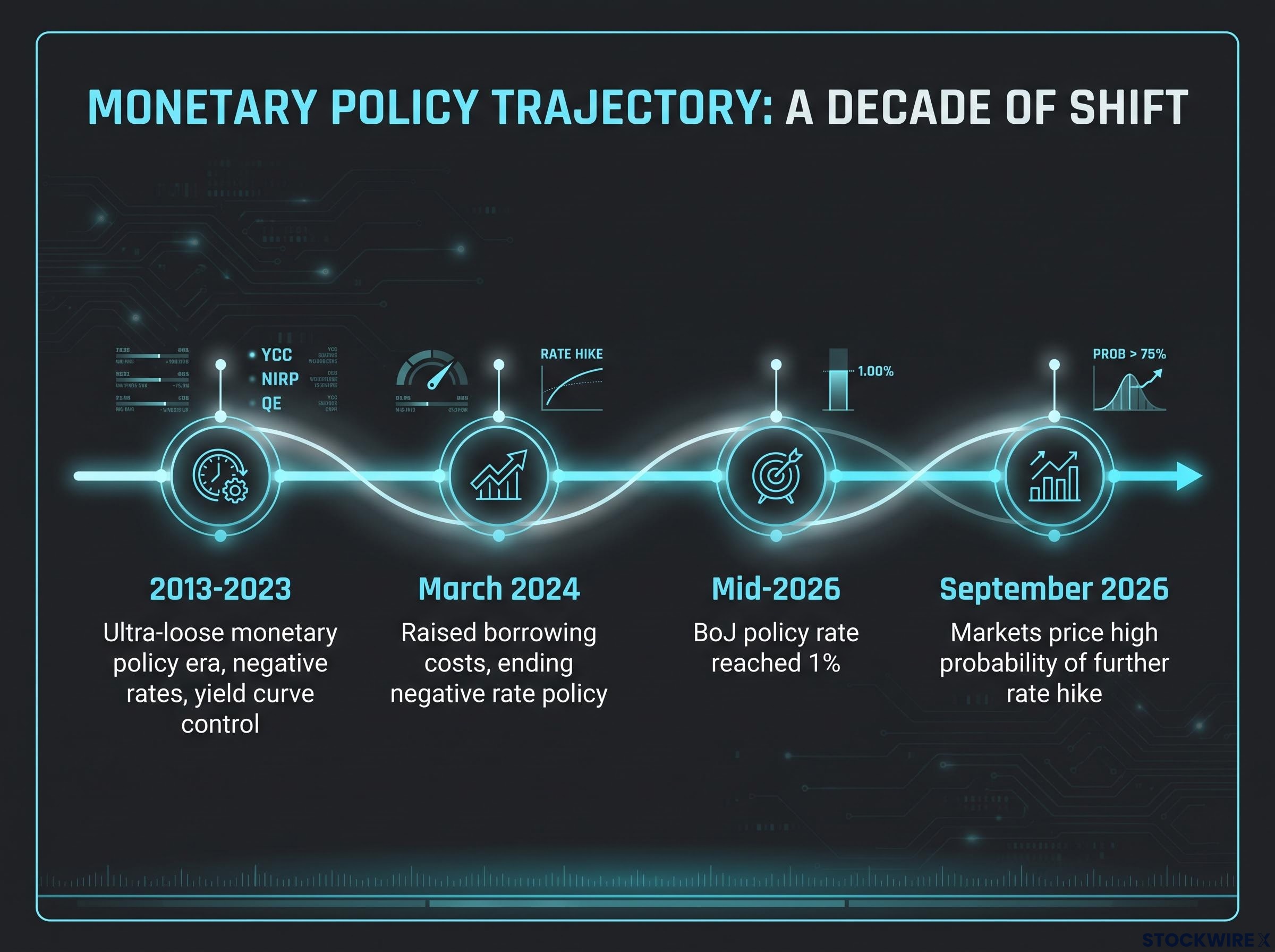
The BoJ’s exit has been gradual but directionally clear. The key milestones tell the story:
- 2013-2023: Ultra-loose monetary policy era, with negative rates and yield curve control suppressing Japanese yields
- March 2024: The BoJ raised borrowing costs for the first time in years, ending negative rate policy
- Mid-2026: The BoJ policy rate reached 1%
- September 2026: Markets are pricing a high probability of a further rate hike at the upcoming meeting
In Bessent’s assessment, Japan appears to have largely completed the monetary reflation phase that defined the Abenomics era, with the extraordinary stimulus of that period now giving way to a more conventional policy footing. US Treasury commentary has explicitly linked yen volatility to the pace of BoJ normalisation, arguing that more conventional monetary policy in Japan would help “reduce excessive exchange rate volatility.” That framing gives the BoJ implicit political support for continued tightening.
Each incremental hike is not just a market event for you to trade around. It is a structural shift that narrows the rate differential underpinning yen weakness. Normalisation reduces, but does not immediately eliminate, the forces that have weighed on the currency for years. The pace at which that gap closes is the single most important medium-term variable for USD/JPY.
Reading the official language spectrum as a live intervention signal
If you only track price levels to gauge intervention risk, you are missing the earlier signal. Official language shifts before official action does, and the vocabulary follows a consistent pattern you can monitor in real time.
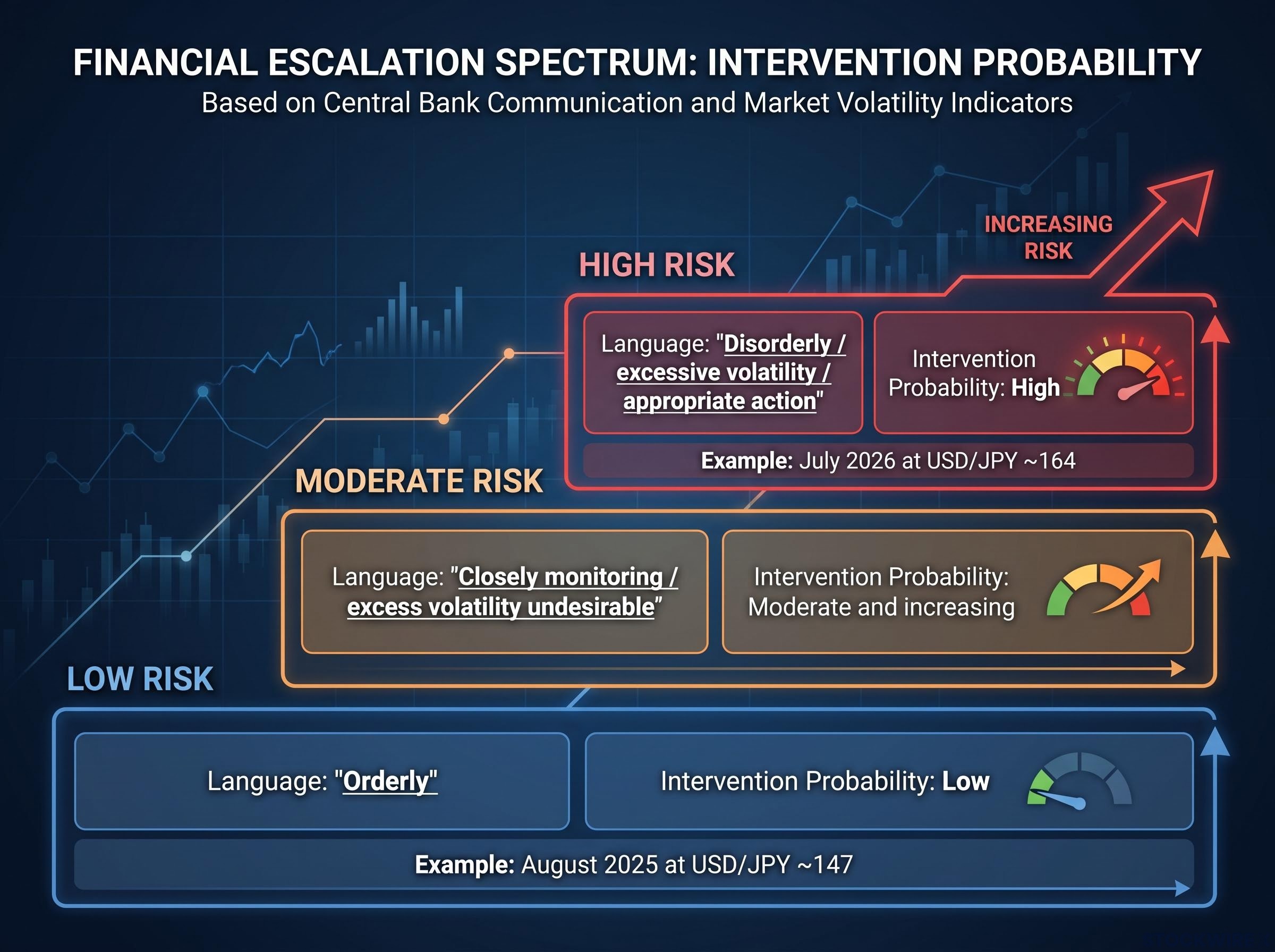
The spectrum operates across three tiers. Each communicates something specific about where policymakers sit relative to the intervention threshold.
| Official language used | What it signals | Intervention probability | Example context |
|---|---|---|---|
| Orderly | Markets within tolerance; no justification for action | Low | Bessent’s late August 2025 characterisation at USD/JPY ~147 |
| Closely monitoring / excess volatility undesirable | Concern rising; coordination channels active | Moderate and increasing | Ministry of Finance warnings as USD/JPY approaches prior intervention zones |
| Disorderly / excessive volatility / appropriate action | Conditions seen as destabilising; intervention underway or explicitly on the table | High | July 2026 coordinated intervention at USD/JPY ~164 |
The July 2026 episode illustrates what tier-three language looks like in practice. When USD/JPY reached approximately 164, Japan’s Ministry of Finance and the US Treasury described their coordinated yen-buying intervention as countering “excessive volatility and disorderly movements.”
Japan’s finance minister explicitly warned that the government “will take appropriate action against disorderly FX moves, including those driven by speculation.”
That is intervention-grade language. Compare it to Bessent’s “orderly” characterisation weeks later and the distance between the two descriptors tells you exactly how much the risk environment had shifted.
Intervention credibility limits are documented across Japan’s $215 billion in yen operations since 2022: BNY iFlow data show post-intervention yen selling intensity of 0.86, confirming traders consistently treated official bounces as exit opportunities rather than reversal signals, which is why the language framework in this article matters more than the price levels alone.
The practical value of tracking this vocabulary is timing. A sudden shift in official phrasing from “orderly” toward “excess volatility” language is an early-warning signal that conditions are moving toward the intervention threshold. If you monitor statements from the US Treasury, Japan’s Ministry of Finance, and the BoJ simultaneously, you get a multi-source confirmation method rather than relying on any single official’s words. That approach gives you a timing advantage over traders who only react once price levels breach a remembered threshold.
Three signal streams traders should monitor around USD/JPY
Knowing the language spectrum is the foundation. Applying it means tracking three distinct but complementary signal streams that, taken together, give you a structured picture of when the risk environment around USD/JPY is genuinely shifting versus holding steady.
- Official language from the three key institutions
- What to watch: Whether statements from the US Treasury, Japan’s Ministry of Finance, and the BoJ use “orderly,” “excess volatility,” “disorderly,” or “appropriate action” when discussing currency moves.
- What a change implies: A sudden shift in phrasing, particularly from “orderly” toward “excess volatility” or “appropriate action,” often precedes or follows concrete intervention measures. The vocabulary moves before the money does.
- BoJ policy normalisation signals
- What to watch: BoJ guidance on rate hike pace, commentary on inflation and wage dynamics, and Federal Reserve policy expectations that affect the other side of the rate differential.
- What a change implies: The US Treasury has framed Japanese normalisation as a mechanism to reduce volatility, which implicitly supports gradual yen strengthening over time. Faster normalisation narrows the rate gap that has weighed on the yen; any pause or reversal widens it again.
- US-Japan coordination markers
- What to watch: Joint statements, references to “close contact” and “robust coordination,” and explicit descriptions of interventions as countering “disorderly” moves.
- What a change implies: When coordination language is prominent, authorities are actively managing the currency relationship. When such language fades and “orderly” reappears, it usually marks a stabilising phase where fundamentals reassert themselves.
With USD/JPY at approximately 147 in late August 2025, following intervention near 164 the prior month, the current positioning illustrates all three streams in action. The “orderly” label tells you near-term tail risk is lower. The BoJ’s rate at 1% with a September hike expected tells you the fundamental gap is narrowing. The shift from coordination language back to comfort language tells you the stabilisation phase is underway.
Tracking all three together, rather than treating each official remark in isolation, gives you a much cleaner picture of when the risk environment is genuinely shifting versus when it is holding steady.
What the “orderly” verdict means for USD/JPY positioning from here
The “orderly” framing concretely alters the near-term picture. Intervention tail risk is lower. Surprise joint operations are less likely absent a sharp pickup in volatility or a renewed push toward levels that triggered action previously. The focus shifts back to rate differential fundamentals, which is where the medium-term direction of the pair has always been determined.
What the label does not resolve is equally important. The structural forces behind yen weakness have not disappeared overnight. The rate gap between the US and Japan remains wide by historical standards, even as BoJ normalisation narrows it incrementally. And the tolerance band for what qualifies as “orderly” evolves as politics, growth, and inflation shift. Today’s comfort zone is not permanently fixed.
The September 2026 BoJ meeting is the next concrete event that could shift the fundamental picture. Markets are pricing a high probability of a further rate hike that would push the policy rate above 1%, incrementally narrowing the differential that has weighed on the yen. Bessent’s framing that Washington is broadly aligned with Tokyo on normalisation goals gives the BoJ implicit room to continue tightening without US political interference.
The September rate decision carries unusual weight because BoJ Deputy Governor Himino has explicitly stated the central bank does not need complete information before acting, a structural departure from the data-confirmation-first framework that defined a decade of BoJ communication and one that carry traders can no longer treat as a predictable delay signal.
The key takeaways to carry forward:
- Near-term intervention risk has dropped materially with the “orderly” baseline established
- The medium-term direction of USD/JPY depends more on the BoJ’s willingness to keep raising rates, and the Fed’s trajectory, than on any individual official statement
- Any subsequent shift in official language from “orderly” toward “excess volatility” or “disorderly” phrasing is a meaningful escalation signal, not background noise
- The gap between USD/JPY at 147 and the intervention trigger zone near 164 defines the current distance between comfort and discomfort for policymakers
The single clearest takeaway is this: diplomatic signals serve as a near-term risk overlay, not a substitute for fundamental analysis. The rate differential and the pace at which BoJ normalisation narrows it remain the primary structural driver. Track the language to manage short-term risk. Track the rates to understand where the pair is heading.
This article is for informational purposes only and should not be considered financial advice. Investors should conduct their own research and consult with financial professionals before making investment decisions. Currency markets involve significant risk, and official behaviour can change as conditions evolve.