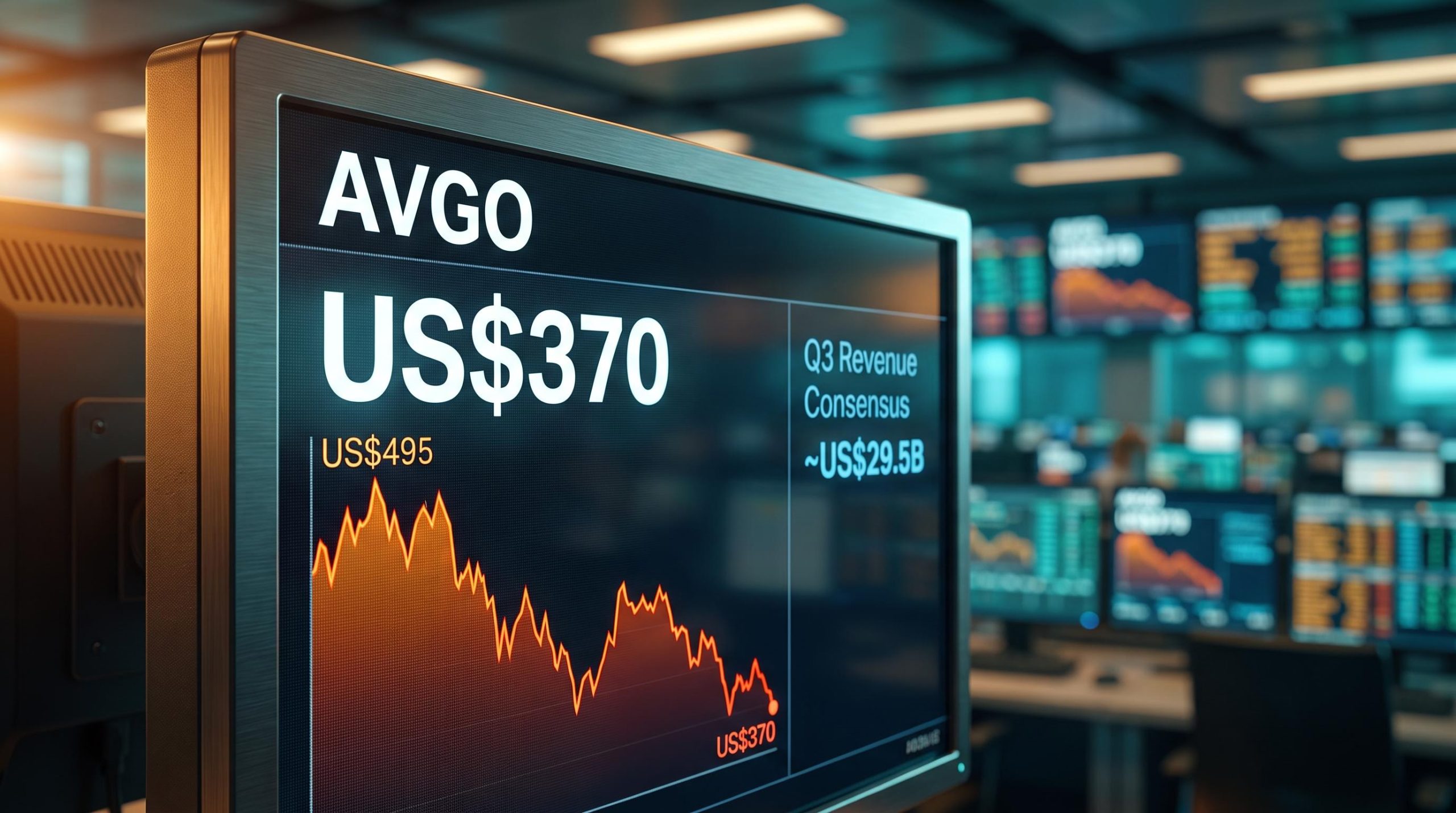
AI-exposed companies are printing some of the strongest earnings in years. Marvell’s revenue climbed 37 percent year over year. Workday beat consensus. Amazon earned a price-target upgrade tied specifically to agentic AI. The demand across the hardware and software stack is no longer speculative; it is showing up in quarterly results with real numbers behind it.
And yet, in the same week those results landed, Nvidia surrendered 4.5 percent of its market capitalisation, a $60 billion acquisition triggered a platform-access war that has no precedent at this scale, and AI-related convertible bond issuance started coinciding with upward pressure on long-term yields. The AI investment cycle is simultaneously delivering on its promise and introducing a new class of risks that most portfolios have not been stress-tested against.
Here is the cross-asset map for making sense of both realities at once. It covers what the earnings prints actually tell you about demand durability, where platform wars and debt structures are creating risks that traditional analysis misses, and how to evaluate your own AI exposure across equities, credit, and competitive positioning rather than defaulting to either a boom or a bubble narrative.
Strong earnings, volatile stocks: what the AI results season is actually telling you
Start with the numbers, because they are genuinely strong. Marvell reported Q2 revenue of $2.74 billion, clearing the $2.72 billion consensus estimate by a narrow margin, with year-over-year growth of 37 percent. The data centre segment, most directly tied to AI infrastructure spending, reached a record $2.17 billion, reflecting 46 percent annual growth. For guidance, the company set its fiscal year 2028 revenue target at $18 billion, stepping up from the prior $16.5 billion forecast, while also raising the fiscal year 2027 outlook to around $12 billion.
Workday delivered adjusted earnings per share of $2.75 on $2.65 billion in revenue, beating consensus on both lines. The stock rose 5.7 percent. At the application layer, Evercore ISI’s Mark Mahaney lifted his price target on Amazon to $355 from $315, citing survey data indicating that agentic AI is delivering additive value for Amazon’s retail operations. The stock added roughly 4 percent on the session.
Three different companies. Three different layers of the AI stack: infrastructure silicon, enterprise software, and commerce operations. All posting results that confirm demand is structurally real across the full technology supply chain, not concentrated in a single GPU vendor.
Marvell’s fiscal year 2028 revenue guidance: $18 billion, raised from $16.5 billion, representing one of the largest multi-year guidance upgrades in the semiconductor sector this cycle.
Then there is what happened to the stocks.
| Company | Key metric | Result vs. estimate | Stock reaction |
|---|---|---|---|
| Marvell | Q2 revenue | $2.74B vs. $2.72B consensus | Declined (guidance upgrade not fast enough) |
| Workday | Adjusted EPS | $2.75 beat, $2.65B revenue beat | Up 5.7% |
| Amazon | Analyst re-rating | PT raised $315 → $355 (Evercore ISI) | Up approx. 4% |
| Nvidia | Market cap change | N/A (prior rally context) | Down 4.5% after prior ~9% rally |
Nvidia dropped 4.5 percent across a single trading session, unwinding part of a roughly 9 percent advance from days prior that had added $442 billion to its market capitalisation. The absolute results were not the issue. The issue was the slope. Investors wanted acceleration on a specific partnership timeline, and the growth trajectory, while strong, was not steep enough to justify the multiple the stock was already carrying.
When the bar is perfection, a beat is not enough
“Priced for perfection” is a phrase that gets used loosely. What it means in practice, and what Nvidia illustrates with unusual clarity, is that the market prices in a particular rate of growth, not just a level of revenue. When the slope of that growth decelerates, even slightly, the stock reprices, regardless of whether the company is still growing at rates that would be exceptional in any other sector.
Nvidia also occupies a unique position in that it functions simultaneously as an earnings powerhouse, a trading vehicle for broad AI risk exposure, and a hub for crowded institutional and retail positioning and options activity. Conflating those three roles, treating its share price as a pure signal about AI fundamentals, distorts risk assessment.
The pattern across these earnings prints tells you that AI demand is structurally real. But strong fundamentals and rewarding stock performance are increasingly decoupled for the highest-visibility names. That distinction matters enormously for position sizing and entry timing. The question is not whether a company is growing. It is whether the market has already priced in a growth slope that even good results cannot satisfy.
AI stock valuation risk is compounded by a distributional problem that index-level calm conceals: large opposing moves by individual winners and losers cancel each other out at the benchmark level, leaving investors exposed to single-stock slope risk they believe they have diversified away.
When big ASX news breaks, our subscribers know first
The $60 billion acquisition that turned an API into a weapon
SpaceX acquired Anysphere, the company behind the Cursor AI coding assistant, in an all-stock transaction valued at approximately $60 billion, with the exchange ratio set using a short volume-weighted average price (VWAP) window. Multiple outlets describe it as the largest venture-backed startup acquisition on record.
That was the headline. The reframing came days later.
Following SpaceX’s takeover of Anysphere, OpenAI indicated it would withdraw Cursor’s access to its models, with 12 November 2026 set as the cutoff date. Rather than framing the decision as a commercial matter, OpenAI grounded it in terms-of-service compliance and governance concerns arising from the new ownership structure. In practical terms, a platform owner decided to revoke API access to a competitor’s most critical operational input, with less than three months’ notice, using a terms-of-service rationale that is difficult to contest in any conventional legal or commercial framework.
12 November 2026: OpenAI’s proposed termination date for Cursor’s model access, turning a compliance dispute into a countdown for one of the most widely used AI developer tools.
This is not a story about one startup. It is the first large-scale, high-visibility test case for a category of business risk that does not appear on traditional balance sheets: platform-access risk. Companies dependent on third-party model access without viable alternatives are exposed to a form of operational disruption that standard credit and equity analysis frameworks do not capture.
The chokepoints exist at every layer of the AI stack:
- Foundation models: proprietary large language models and the access terms governing them
- Cloud and inference infrastructure: hyperscalers controlling compute and deployment
- Developer tooling: coding copilots and agent frameworks operating at the developer interface
- Agentic orchestration: autonomous software agents as a new layer of value capture
For any company in your portfolio that depends on third-party model access as a core operational input, this situation is a live demonstration that platform owners can treat API access as a competitive weapon with short notice and a compliance rationale that is difficult to contest. The risk is material, and it is not adequately reflected in traditional analysis.
Why AI companies are borrowing like it is 2021, and what that does to yields
Nebius Group is issuing $4.5 billion in convertible bonds across 2030 and 2034 maturities, with the proceeds earmarked specifically for AI data centre and cloud expansion. It is one of the largest single convertible issuances in the AI infrastructure buildout, and it is structurally typical of the broader wave.
The structural features of current AI convertibles are what make this cycle distinctive. New deals are being priced with coupons that have fallen close to zero, while the average equity delta on these instruments sits at around 64 percent, the highest level seen since 2021. Pimco’s Marc Seidner has commented on these dynamics, noting that investors are accepting weaker downside protection in exchange for equity-like upside participation. In practical terms, these instruments behave far more like equity than traditional debt.
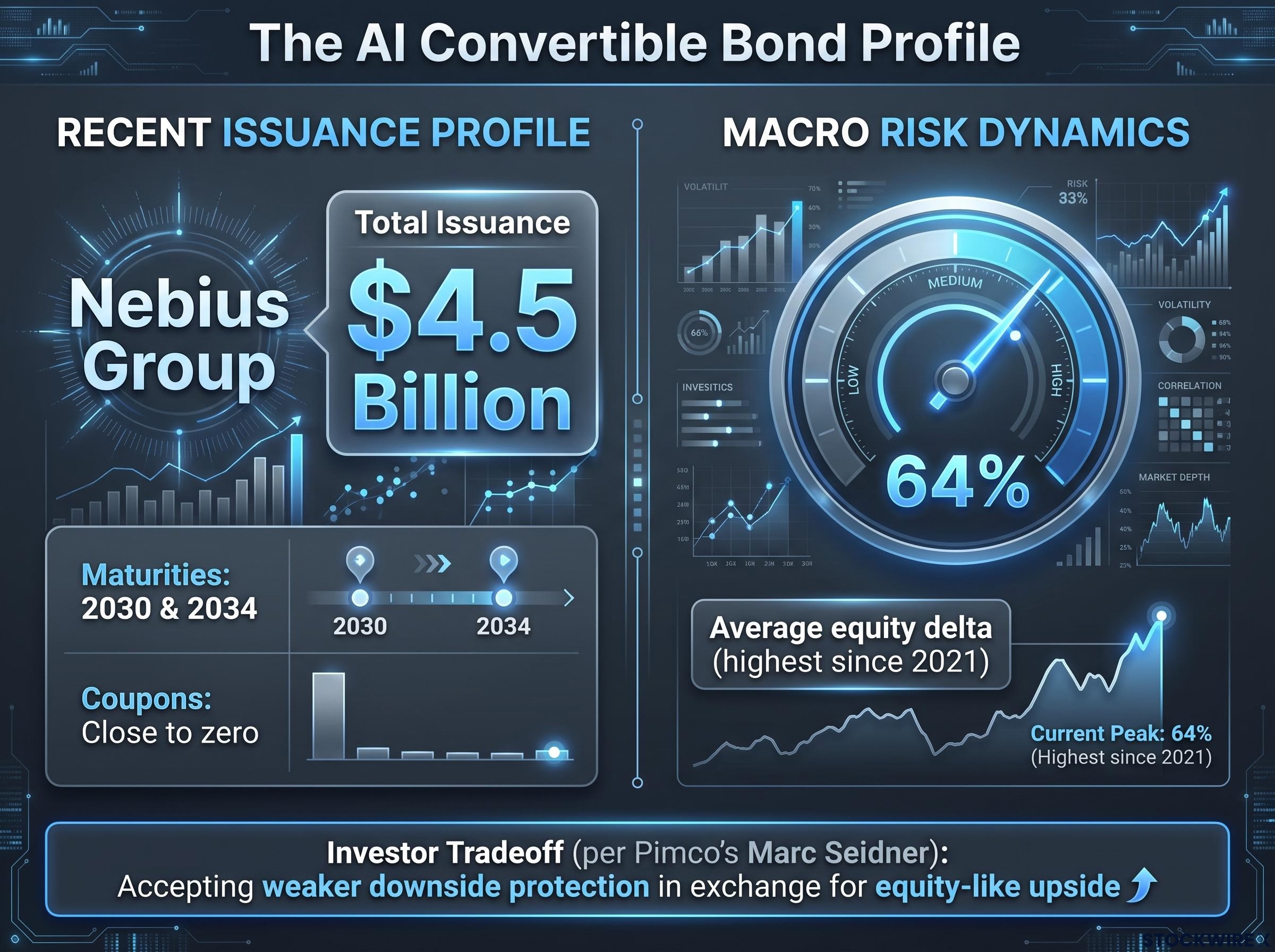
64 percent equity delta: the average for AI-related convertibles, meaning these instruments carry roughly two-thirds of the underlying stock’s price risk. They are equity-like sleeves in bond form, not fixed-income diversifiers.
These conditions are consistent with those last seen in the 2021 convertible cycle. The difference is that the issuers are now concentrated in a single sector with correlated risk exposures.
A feedback loop investors have not fully priced
The feedback loop runs like this: AI companies need capital for infrastructure buildout. They tap the convertible market on terms that are unusually equity-like. That issuance is contributing to and coinciding with upward pressure on ten-year yields. And the same high-multiple companies whose valuations depend on lower long-term rates are the ones issuing the debt.
AI bond market issuance is reshaping credit signals well beyond the convertible sleeve: Goldman Sachs estimates close to $500 billion in AI-related debt in 2026 alone, and by mid-July hyperscaler bond issuance had already surpassed twice the full-year 2025 total, concentrating passive bond fund exposure automatically.
At the instrument level, AI convertibles change the risk/return profile for investors in those deals: near-zero coupons, high equity sensitivity, and weaker downside protection. At the macro level, cumulative issuance is one contributing factor among many for long-term rates; the convertible market remains modest relative to overall Treasury supply, and current yield movements primarily reflect broader growth, inflation, and fiscal dynamics.
If you hold AI-exposed equities and you also hold AI-related convertibles in the same portfolio, you may be taking on correlated equity risk in both sleeves without realising it. Three variables to monitor in AI convertible positions:
- Coupon versus equity delta: the true equity risk being taken
- Issuer quality and balance sheet leverage: the credit buffer if sentiment turns
- Dilution implications: what happens to the equity if conversions occur at scale
Reading the AI stack as a competitive map
The earnings prints, the Cursor situation, and the convertible issuance wave are all individual data points. The structural question underneath all of them is: which companies in the AI ecosystem hold durable competitive positions, and which are exposed at access-dependent chokepoints?
The AI competitive landscape maps most clearly as a four-layer stack. Each layer represents a potential chokepoint where value accrues to the company that controls access:
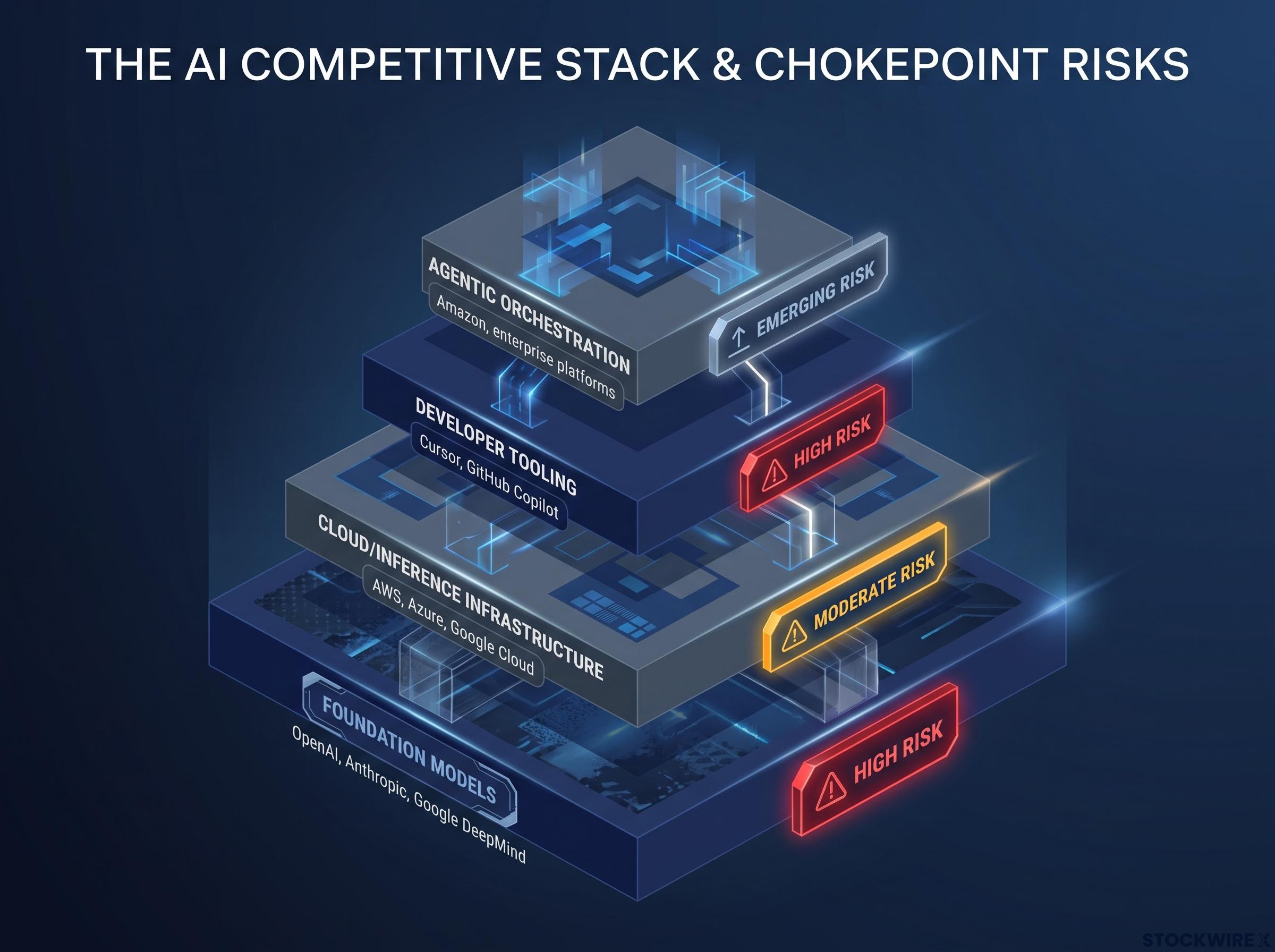
- Foundation models: the proprietary large language models and the terms governing who can use them
- Cloud and inference infrastructure: the hyperscalers (AWS, Azure, Google Cloud) controlling compute and deployment
- Developer tooling: the coding copilots, agent frameworks, and interfaces where developers build
- Agentic orchestration: autonomous software agents that are becoming a new value-capture layer in commerce and operations
| Stack layer | What it controls | Example companies/roles | Chokepoint risk |
|---|---|---|---|
| Foundation models | Model access and licensing terms | OpenAI, Anthropic, Google DeepMind | High (access revocable) |
| Cloud/inference infrastructure | Compute, deployment, scaling | AWS, Azure, Google Cloud | Moderate (multi-cloud mitigates) |
| Developer tooling | Build interfaces, coding copilots | Cursor, GitHub Copilot | High (model-dependent) |
| Agentic orchestration | Autonomous task execution | Amazon (retail ops), enterprise platforms | Emerging (early stage) |
Companies controlling or influencing multiple chokepoints accrue compounding competitive advantage. Amazon’s re-rating by Evercore ISI, with the price target lifted to $355, is a concrete early data point on agentic AI driving value capture at the orchestration layer for a company that already controls infrastructure through AWS.
The SpaceX-OpenAI dispute is instructive because it is not a pricing dispute. It is a governance and ecosystem-control dispute, which signals that platform owners will use access control strategically, not merely commercially. Open-source AI ecosystems exert some pricing pressure on proprietary models and reduce switching costs for developers, but they have not yet eliminated the chokepoint risk at the foundation-model layer.
When you evaluate an AI-exposed company for portfolio inclusion, the question is not just whether their product is good. It is whether they own or defensibly influence at least one chokepoint in the stack, or whether their entire business depends on access that another company can revoke.
Volatility, debt, and platform wars: is this sector risk or systemic risk?
Four distinct risk signals have emerged across this analysis: earnings-to-sentiment decoupling, platform-access weaponisation, AI convertible issuance coinciding with yield pressure, and single-stock volatility driving flows across the broader complex. The question is whether these signals add up to something confined to the technology sector or something that threatens broader financial stability.
The distinction matters for your portfolio response: sector risk and systemic risk demand different actions. Over-hedging against a systemic crisis that is actually a sector rotation wastes capital. Under-hedging against genuine contagion destroys it.
At current scale, these are sector-level risks, not systemic ones. Systemic stress would require broader leverage deterioration or credit contagion beyond the AI and technology complex. The convertible market remains modest relative to overall Treasury supply. The platform disputes, while commercially significant, are restructuring competitive positioning within a sector, not threatening financial infrastructure.
The cross-asset feedback loops are real and worth monitoring:
Crowded AI positioning creates a structural asymmetry that the BofA June 2026 fund manager survey captured precisely: 80% of respondents named long global semiconductors as the most crowded trade in the survey’s 12-year history, placing institutional capital directly on top of the model-convergence dynamic that amplifies correlated exits.
- Earnings-to-sentiment: Nvidia-type volatility in a single AI barometer stock triggers flow effects across institutional and retail positioning in the entire sector
- Convertibles-to-yields: cumulative AI convertible issuance is one contributing factor, among many, to upward pressure on long-term rates
- Platform consolidation-to-competitive positioning: access-control disputes shift the competitive map across multiple sectors that depend on AI infrastructure
- Single-stock volatility-to-flows: crowded positioning in AI names creates amplified moves that spill into correlated assets
But these are cross-asset pricing effects, not indicators of systemic financial instability at current scale. For your portfolio, overreacting to sector volatility as if it were systemic risk leads to over-hedging or de-risking at exactly the moment when fundamentally strong AI companies may offer attractive entry points. The correct posture is monitoring the feedback loops, not panic-hedging against contagion that the data does not support.
Four questions to bring to every AI position in your portfolio
Everything in this analysis, the earnings decoupling, the platform wars, the convertible debt dynamics, and the stack competition, distils into four questions you can apply to every AI-exposed holding:
- Is AI-driven revenue growth contracted and multi-year, or sentiment-dependent? Marvell’s guidance upgrade to $18 billion for fiscal year 2028 is meaningful because it reflects multi-year hyperscaler commitments. Compare that with names where guidance rests on analyst projections rather than contracted spend.
- Is the stock priced on near-term growth slope, or does it have valuation buffer? If the market has already priced in a specific rate of acceleration, even a strong beat can trigger selling. Position sizing should reflect how much slope risk you are carrying.
- Does the company’s debt structure create a feedback loop between yield movements and its own valuation? If a company is issuing near-zero-coupon convertibles with 64 percent equity deltas while its equity valuation depends on lower long-term rates, the circular risk is real and underappreciated.
- Does the company control at least one defensible chokepoint in the AI stack, or is it dependent on access it does not control? The Cursor situation is the worked example: a $60 billion company that could lose its foundational model access with a compliance rationale and a three-month deadline.
These four questions are not a checklist for eliminating AI exposure. They are a filter for distinguishing positions with structural durability from positions that are essentially leveraged bets on AI sentiment remaining elevated.
Durable AI moat businesses like network-effect platforms generate recurring revenue that does not depend on platform access granted by a competitor, which is precisely the structural quality the four portfolio questions in this analysis are designed to identify.
What durable AI exposure actually looks like in practice
Three portfolio construction implications follow directly from this analysis. First, prioritise companies with multi-year revenue visibility backed by contracted hyperscaler spend, not just analyst upgrades. Second, pair high-volatility AI sentiment names with profitable application-layer firms generating recurring revenue, so your AI exposure is not single-factor. Third, treat AI convertibles as equity-like sleeves in your portfolio construction, not as fixed-income diversifiers.
Holding multiple truths simultaneously, that AI demand is structurally real and that the investment cycle is introducing underpriced risks, is not a hedge against conviction. It is the correct analytical stance for the 2026 AI environment.
This article is for informational purposes only and should not be considered financial advice. Investors should conduct their own research and consult with financial professionals before making investment decisions. Past performance does not guarantee future results. Financial projections are subject to market conditions and various risk factors.