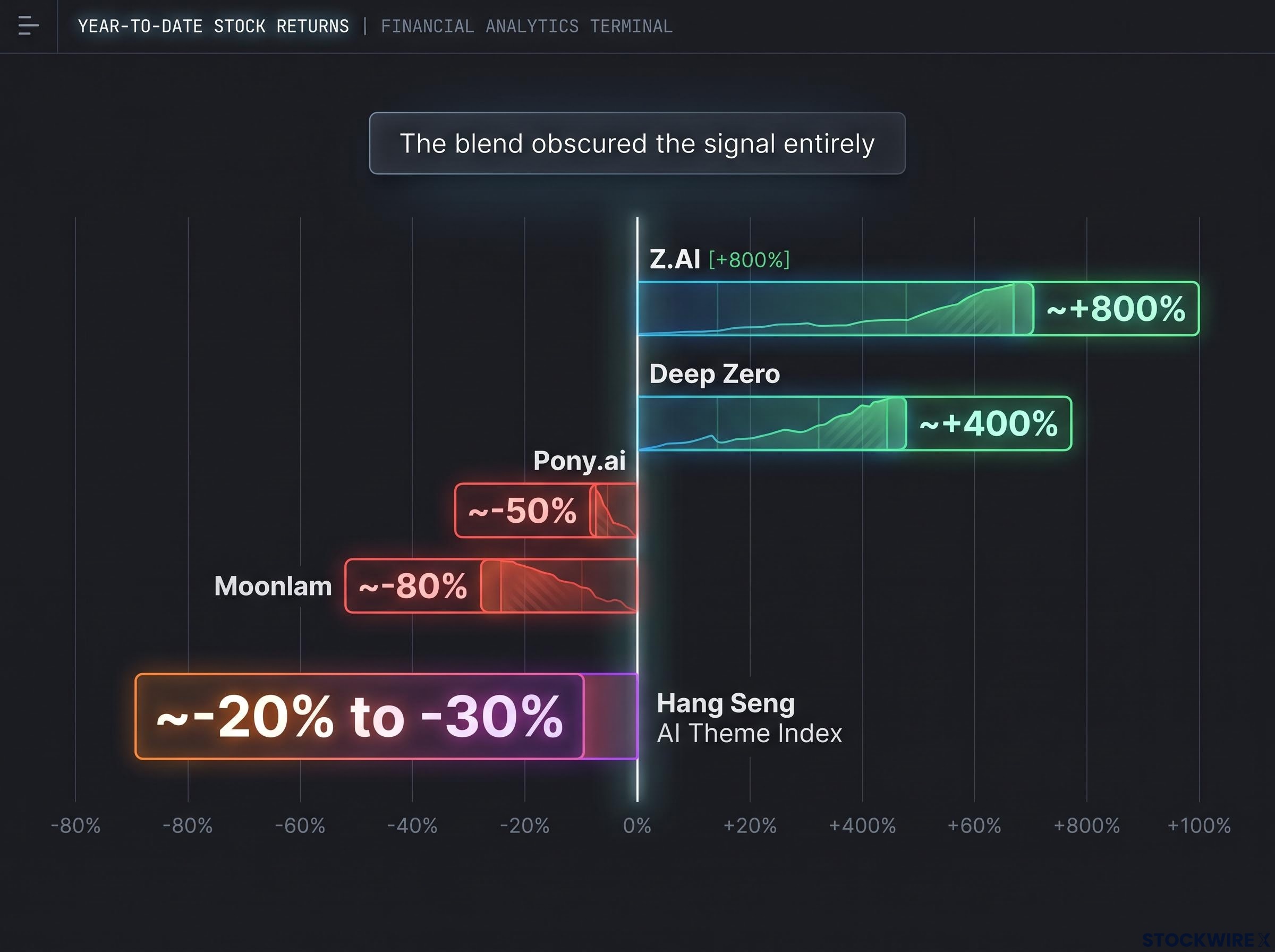
Z.AI listed on 8 January 2026 and climbed approximately 800% by mid-year. Moonlam, operating in the same AI theme on the same exchange, lost roughly 80% over the same period. The gap between those two numbers is not noise. It is the single most important signal in Hong Kong’s AI market right now.
That divergence is not about company quality in the abstract. It is about where each company sits in the AI value chain. Foundation-model platforms and domestic chip plays attracted policy support, institutional capital, and procurement certainty. Downstream application software and autonomous-driving names faced a different test entirely: prove profitability or get repriced. The market sorted them accordingly.
Here is the map of where the returns actually came from across five layers of Hong Kong’s AI ecosystem, where the gains clustered, and the allocation questions that determine whether you capture the opportunity or average it away.
Hong Kong’s AI market is not one trade, and the numbers prove it
Start with the raw dispersion. Z.AI (2513.HK), a foundation-model platform that listed on 8 January 2026, reached a peak near HK$2,980 and delivered approximately 800% year-to-date returns at the point of reporting; measured from its IPO price, peak gains exceeded 2,000% before moderating. MiniMax (0100.HK), listed one day later on 9 January, posted multi-hundred-percent gains at peak. Deep Zero, the domestic hardware independence play, surged approximately 400% year-to-date.
Now the other side. Pony.ai (2026.HK), an autonomous-driving name in the same Hang Seng AI Theme Index, fell roughly 50% year-to-date. Moonlam dropped approximately 80%.
These are not outlier results on either end. They are representative of two distinct performance clusters that have persisted across months, not days.
The index that contains both clusters tells the story most clearly.
The Hang Seng AI Theme Index posted returns of approximately -20% to -30% over recent multi-month measurement periods, despite holding several of the year’s largest individual winners. The blend obscured the signal entirely.
| Company | Ticker | Segment | Approx. YTD Return | Notes |
|---|---|---|---|---|
| Z.AI | 2513.HK | AI Platform / LLM | ~+800% | Peak gains from IPO exceeded 2,000% |
| MiniMax | 0100.HK | AI Platform / LLM | Multi-hundred % | Listed 9 January 2026 |
| Deep Zero | — | AI Hardware | ~+400% | Domestic hardware independence play |
| Pony.ai | 2026.HK / PONY-W | Autonomous Driving | ~-50% | ~9-10% single-day drop on HK debut |
| Moonlam | — | Downstream / Application | ~-80% | Heaviest drawdown in AI theme |
The spread between the best and worst performers in the same thematic index tells you that your entry point into this theme, not your decision to enter at all, is the variable that determines whether you make or lose money.
When big ASX news breaks, our subscribers know first
Why hardware and foundation models captured the gains
Two structural tailwinds converged on the same value-chain layers. The first is policy. China’s industrial strategy has explicitly prioritised semiconductor self-reliance and computing-power sovereignty, channelling procurement contracts, regulatory support, and capital formation toward domestic chip makers and AI infrastructure firms. The second is competitive position. Foundation-model leaders have built advantages that downstream players cannot easily replicate.
China’s high-tech manufacturing cycle is running well above the headline industrial output rate, with semiconductor integrated circuit production expanding 20.7% year-on-year in July 2026 and industrial robot output up 30.2%, confirming that the policy tailwinds driving hardware and foundation-model valuations on HKEX are backed by real production acceleration, not just narrative.
The moat characteristics of leading foundation-model firms cluster around four axes:
- Deep relationships with state-linked and enterprise customers who need reliable domestic AI infrastructure
- Scale advantages in training data, parameter counts, and model iteration speed
- Narrative linkage to national AI competitiveness, which pulls both retail and institutional capital
- Substantial capital access: Z.AI and MiniMax raised hundreds of millions of USD through their January 2026 HKEX offerings
The capital formation evidence reinforces the structural case. Multiple hardware names, including Biren Technology, Iluvatar CoreX, and GigaDevice Semiconductor, completed substantial Hong Kong listings in the same period. Informed capital was concentrating at these layers, not distributing across the theme broadly.
The IPO pipeline as a policy signal
The concentration of AI IPOs in December 2025 to January 2026 was itself a signal. The exchange pipeline reflected industrial strategy priorities, not just investor appetite. When policymakers, exchange operators, and institutional allocators all point capital at the same value-chain layers simultaneously, that alignment becomes its own form of structural advantage for the companies sitting at those layers.
For you, this means the hardware and foundation-model premium is not priced on hope alone. It reflects a structural position in China’s industrial strategy that makes these segments the path of least regulatory resistance and greatest procurement certainty.
The Z.AI case study: when even the winner tests your conviction
Z.AI listed on 8 January 2026, touched a high of roughly HK$2,980 in May before pulling back to around HK$1,000 by the time of reporting. That is a drawdown exceeding 60% from peak in a stock still up approximately 800% year-to-date.
On numerous occasions, the share price moved by more than 20% within a single session. At this scale, volatility is a position-sizing parameter, not a performance highlight.
The counterintuitive moments are where conviction gets tested hardest. When Z.AI unveiled its Ox Alpha general language model, the newest addition to its GLM product series, the share price declined by around 6%. The market was already pricing in model progress and pivoting to the next question: what does the R&D cost to stay competitive? Projected research and development expenditure of approximately HK$1.88 billion gave that question a specific number.
This is the foundation-model paradox. The companies winning the AI race are spending at a pace that keeps profitability as a secondary concern while model development remains the primary competitive axis. That trade-off is rational at the industry level and nerve-testing at the portfolio level.
The foundation-model paradox, where leading companies spend aggressively on R&D while deferring profitability, sits inside a broader structural question about binding constraints on AI deployment; the companies that control physical bottlenecks in power, cooling, and compute capacity have historically built more durable compounding franchises than the headline technology providers above them in the stack.
The likely catalysts for future price movement in Z.AI and similar foundation-model names fall into four categories:
- Model quality updates and benchmark performance
- Forward guidance on revenue and customer acquisition
- R&D cost disclosures and spending trajectory
- State and enterprise contract announcements
A 60%-plus drawdown from peak in a stock still up 800% year-to-date tells you that correct subsector selection and correct position sizing are two separate decisions. Confusing them is where the actual losses occur.
What is dragging down autonomous driving and downstream applications
The market is applying a categorically different valuation test to these segments. Downstream software and autonomous-driving companies are judged on profitability and commercialisation proof, not on policy narrative or model-development promise. That distinction is not temporary sentiment; it is a structural sorting mechanism.
Pony.ai fell roughly 50% year-to-date. Moonlam dropped approximately 80%. WeRide (0800.HK) experienced an approximately 9-10% single-day drop on its November 2025 Hong Kong debut and has continued to face volatility tied to regulatory and macroeconomic news.
Autonomous-driving names face compounding burdens beyond those of ordinary application-layer companies:
- Heavy capital expenditure requirements with no near-term payback
- Regulatory uncertainty with no clear resolution timeline
- Long lead times to scale from pilot to commercial operations
- Acute sensitivity to macro data (rate expectations, funding conditions) that punishes capital-intensive, cash-burning businesses disproportionately
Even on days when the pattern briefly reverses and application-layer names outperform hardware, the trigger is the same: actual profit or commercialisation milestones. Sentiment alone no longer moves these names sustainably.
Profitability has become the sorting mechanism
The market in 2026 is actively distinguishing durable AI businesses from concept stories. MiniMax can rise while Z.AI falls in the same session as the market discriminates between growth narrative and earnings progress. Application-layer names sit at the most exposed point of this sorting process because they lack both the policy shield of hardware and the scale moat of foundation models.
The takeaway is not to avoid these segments permanently but to recognise that the catalyst required for a re-rating is a confirmed commercialisation milestone, not a thematic sentiment wave. Size and time positions accordingly.
A value-chain map for allocation decisions: five layers, five risk profiles
The evidence above sorts into a five-layer framework. Each layer has distinct drivers, a different current market pattern, and a different volatility assumption.
The five-layer framework used here maps directly onto a broader six-segment structure that Morgan Stanley uses to track AI investment cycles, and the AI value chain layers each carry different S-curve positions and time horizons that a single thematic index position cannot separate.
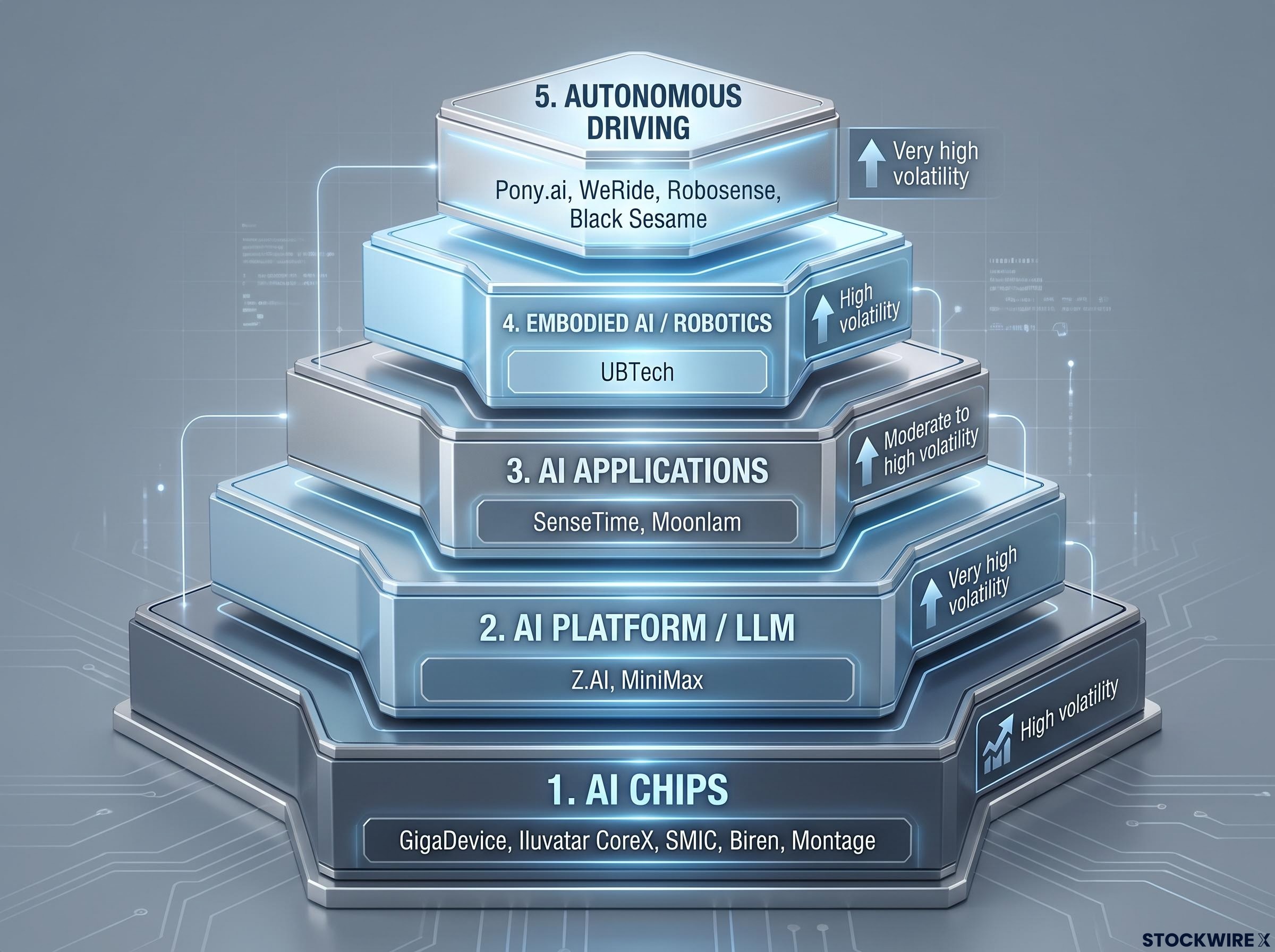
| Layer | Typical HK Names | Key Drivers | Current Market Pattern | Volatility Assumption |
|---|---|---|---|---|
| AI Chips | GigaDevice, Iluvatar CoreX, SMIC, Biren, Montage | Policy support, capex cycles, export controls | Strong multi-month rallies; high beta to policy news | High; policy-event driven |
| AI Platform / LLM | Z.AI (2513.HK), MiniMax (0100.HK) | Model quality, ecosystem adoption, enterprise contracts | Extreme upside with extreme drawdowns | Very high; 20%+ intraday swings |
| AI Applications | SenseTime, Moonlam | Profitability, niche dominance, sales execution | Mixed; rewarded only on profit milestones | Moderate to high; earnings-event driven |
| Embodied AI / Robotics | UBTech | Hardware cost curves, use-case maturity, regulation | Select rallies; early-stage and sentiment-driven | High; thematic and speculative |
| Autonomous Driving | Pony.ai (2026.HK), WeRide (0800.HK), Robosense, Black Sesame | Regulation, funding, AV adoption, sensor cost | Volatile; commercialisation still questioned | Very high; macro and regulatory sensitivity |
Broad thematic ETFs face two failure modes in this environment. The first is dilution: the Hang Seng AI Theme Index blends triple-digit risers with -80% sinkers, producing negative index returns despite containing some of the year’s largest winners. The second is methodology lag: the broader Hang Seng Tech Index remains dominated by incumbent internet and EV platforms and excludes the January 2026 AI listing cohort that generated most of the gains.
The Hang Seng AI Theme Index posted approximately -20% to -30% returns over multi-month periods while containing several of the year’s biggest individual winners. Broad thematic exposure traded the theme at the cost of the dispersion advantage.
Broad ETFs retain value for investors who cannot manage stock-level information flow. But they represent a bet on the theme, not on the dispersion. Before entering any position, resolve these four allocation questions in order:
- Which layer risk do you actually want? Policy-levered hardware, speculative but central foundation models, or execution-driven downstream applications each carry different information requirements.
- How do you treat policy sensitivity and information asymmetry? Names tightly linked to domestic industrial strategy carry risks that standard financial analysis does not fully capture.
- Can you absorb 20%-plus single-day moves? Z.AI recorded multiple intraday swings exceeding 20% during its run. This is a feature of leading foundation-model names, not an anomaly.
- Does your information flow justify stock-level selection? If not, a broad product may be the more honest allocation, even at the cost of dilution.
Subsector clarity is the edge: what changes from here
Three structural realities have emerged from the evidence. Hardware and foundation models carry policy and moat advantages that are unlikely to dissolve quickly. Downstream names face a profitability fulcrum that is now the re-rating catalyst, not sentiment. And broad thematic exposure trades the theme at the cost of the dispersion advantage.
The two variables most likely to shift this framework are worth monitoring specifically:
- Whether application-layer companies begin showing credible profitability or commercialisation milestones, which would narrow the gap with foundation-model names
- Whether regulatory clarity on autonomous driving arrives in a form that changes the AV funding calculus
- Shorter-term rotation days, where hardware weakens and applications strengthen, occur periodically and should not be misread as structural trend reversals
- Sentiment-only re-ratings without an earnings basis have not held for downstream names in 2026
The ongoing IPO pipeline, concentrated initially in December 2025 to January 2026 with further listings expected, will continue adding new names to evaluate. For foundation-model leaders like Z.AI, the forward catalysts remain model quality updates, forward guidance releases, R&D cost disclosures, and state or enterprise contract announcements.
The Hong Kong IPO pipeline for foundation-model companies continues to expand beyond the January 2026 cohort, with Moonshot AI targeting a late 2026 to early 2027 listing at a valuation above $30 billion, adding another data point on how public markets are pricing monetisation against model-development spending.
The market is mid-sort. It is actively distinguishing durable AI businesses from concept stories, and that sorting process creates both risk and opportunity on a rolling basis. The subsector selection discipline described here is not a one-time portfolio decision; it is an ongoing monitoring posture. The framework holds. The names within each layer will continue to shift on earnings, commercialisation, and policy news.
This article is for informational purposes only and should not be considered financial advice. Investors should conduct their own research and consult with financial professionals before making investment decisions. Past performance does not guarantee future results. Financial projections are subject to market conditions and various risk factors.
—