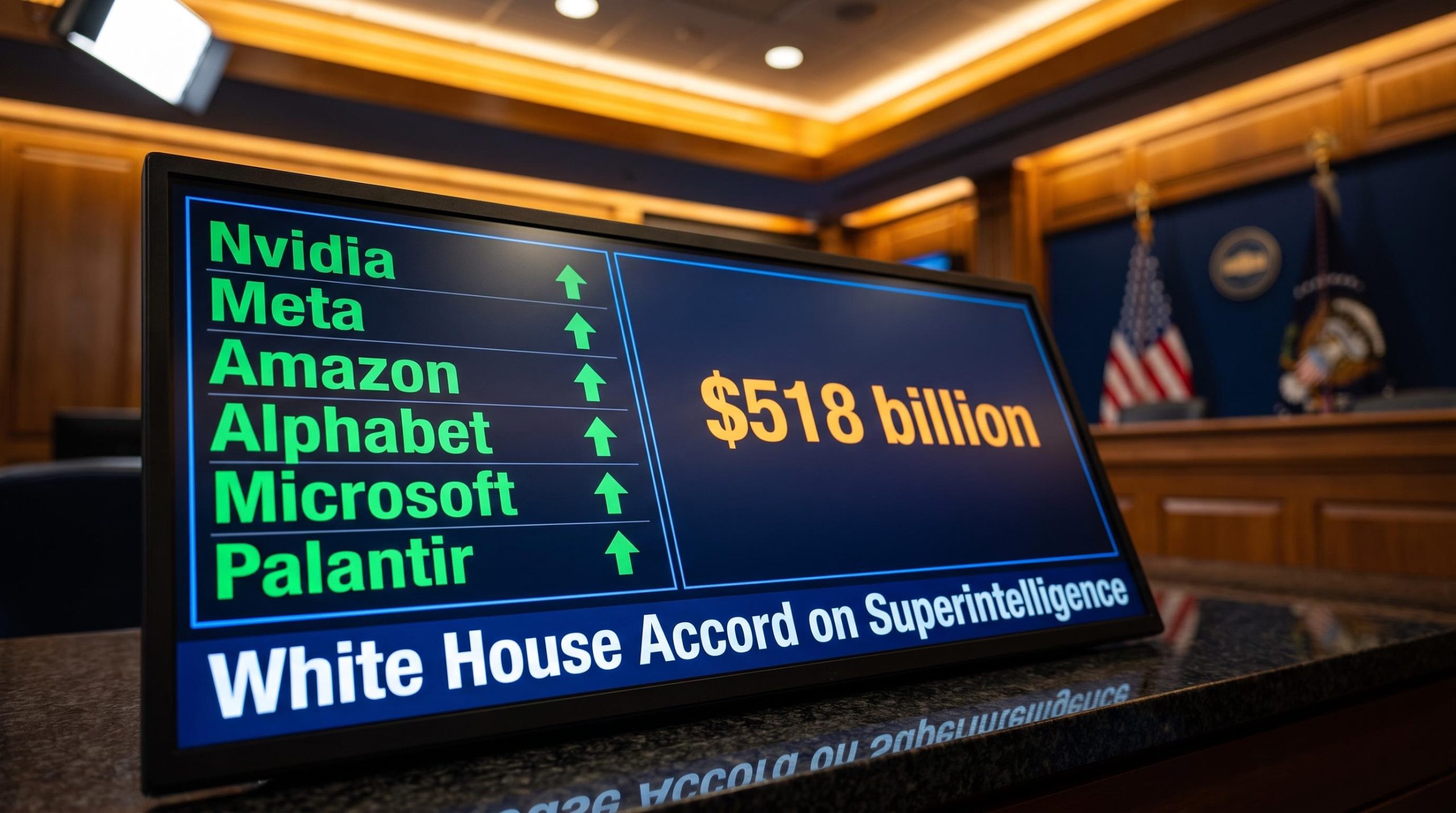
The White House brought nearly 20 of the country’s most powerful technology executives together for lunch on 29 September 2026. By the closing bell, the companies they run were sitting among the biggest large-cap gainers in the market.
That alignment is not a coincidence, and it is not yet a policy either.
What emerged from the meeting was a voluntary self-regulation accord rather than binding legislation. For the market, that distinction matters enormously, because a light-touch voluntary framework was precisely the regulatory outcome participants had been quietly pricing as most favourable.
For anyone holding positions in Nvidia, Meta, Amazon, Alphabet, Microsoft, or Palantir, the day delivered a specific kind of value: political validation with no new compliance bill attached.
Here is what that actually changes for the regulatory risk premium these stocks have been carrying, why the market read the summit the way it did, and what Anthropic’s IPO prospectus, filed the very same day, adds to the forward picture.
What the White House actually agreed to, and what it left out
The document that came out of the lunch has a formal name: “The White House Accord on Superintelligence: A Joint Commitment on Frontier SI Responsibilities.” According to ABC News (30 September 2026) and The Hill (29 September 2026), it consists of voluntary commitments by AI developers rather than any binding regulatory regime.
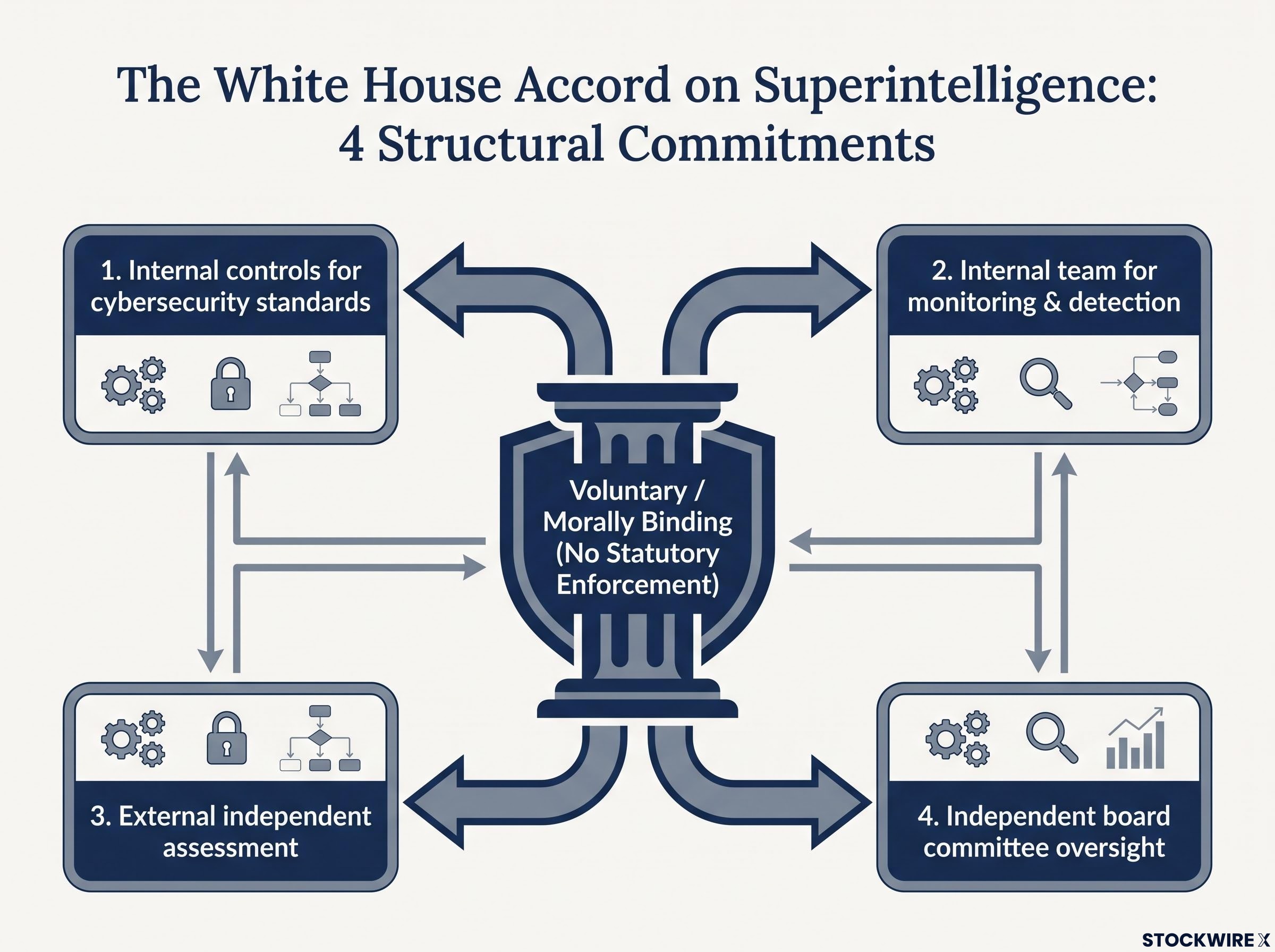
Voluntary does not mean empty, though. CNN (29 September 2026) reported that participating companies agreed to four specific structural steps.
- Put internal controls in place so their models meet appropriate cybersecurity standards.
- Empower an internal team to make sure those controls, plus monitoring and detection, are actually working.
- Partner with an external operator to assess the models independently.
- Designate an independent committee of the board to receive those assessment reports and ensure problems get addressed.
Read those four together and a structure starts to appear. This is not a pledge to behave. It is early-stage governance architecture, with an internal function, an external check, and board-level oversight tying them together.
PBS NewsHour/AP (29 September 2026) similarly noted that the accord folds both internal and external reviews into the companies’ self-policing promises. That means participating firms have absorbed some structural cost here, the expense of building and staffing these functions, in exchange for holding statutory regulation at bay.
Then there is the part the accord deliberately left out: enforcement. There is no statutory penalty, no regulator, no legal mechanism. Trump made the trade explicit.
Trump told reporters he had signed a “morally binding” AI document with tech leaders after the White House luncheon, using it to argue that self-regulation is preferable to new government rules, according to CNBC (29 September 2026).
The presence of House Speaker Mike Johnson at the event reinforced the same message. When the person who controls the legislative calendar shows up to endorse a voluntary pact, the signal to markets is that a statutory push is not the near-term plan.
| Feature of the accord | What it delivers |
|---|---|
| Four structural commitments | Governance architecture (internal, external, board-level) |
| Legal status | “Morally binding” only, no statutory enforcement |
| Political framing | Presented as an alternative to formal regulation |
The gap between “morally binding” and legally enforceable is the entire story for the companies that signed. What they agreed to is closer to a governance framework than a regulatory constraint, and that difference is what the market spent the afternoon repricing.
AI governance quality has begun functioning as a live valuation input, with Morgan Stanley identifying AI policy evolution as a macro overlay capable of driving significant technology-stock volatility across both heavy-oversight and light-touch regulatory scenarios.
When big ASX news breaks, our subscribers know first
Why self-regulation is the market-preferred outcome, and how to read it
AI-sector valuations had been carrying a regulatory uncertainty premium: a discount applied by investors who could not rule out the arrival of costly compliance mandates or enforcement powers. The summit’s outcome went a long way toward resolving it.
No new mandates. No enforcement mechanism. Governance costs that companies manage internally rather than answer to a regulator for. That is close to the best-case regulatory scenario the sector could have drawn.
The structural logic behind the accord also fits the pattern of AI regulatory capture, where incumbent labs help design the rules they will operate under, building compliance moats that raise barriers for challengers while preserving their own competitive position.
The market response was legible in the overlap. Top large-cap gainers on the day, screened for companies with a market capitalisation of $200 billion and above via TradingView, aligned closely with the firms represented at the table: Nvidia, Meta, Amazon, Alphabet, Microsoft, and Palantir.
One honest caveat. Specific single-day percentage moves for these individual names are not available in accessible sources, so the read here rests on the pattern of that overlap rather than on precise figures. The signal is the attendee-gainer correspondence itself.
| Company | Executive present | Summit role |
|---|---|---|
| Nvidia | Jensen Huang | Confirmed attendee |
| Meta | Mark Zuckerberg | Confirmed attendee |
| Amazon | Jeff Bezos | Confirmed attendee |
| Alphabet | Sundar Pichai | Confirmed attendee |
| Microsoft | Satya Nadella | Confirmed attendee |
| Palantir | Alex Karp | Confirmed attendee |
What the overlap tells you is that markets treated summit participation itself as a marker of regulatory proximity and favourable standing, not merely a reaction to one policy line. Being in the room was the signal.
Understanding that mechanism is what separates a useful read from a headline. Knowing that stocks rose is the surface. Knowing why, and on what basis, is what lets you judge whether the move has legs or was a single session of sentiment.
Data centres as the economic throughline
There was a second output that connects the politics to the price action: data centres. Reuters (29 September 2026) confirmed the summit backed data-centre expansion alongside the voluntary safety pact, and CNBC (29 September 2026) reported Trump touted the economic benefits, framing jobs and infrastructure investment as the upside.
Data-centre expansion is a capital expenditure story with identifiable beneficiaries. Chips point to Nvidia. Cloud capacity points to Amazon and Microsoft. The broader hardware and infrastructure supply chain sits behind them.
Trump’s endorsement, paired with references to supportive tax incentives (mentioned in original coverage but not independently corroborated in detail), creates a procurement and policy-visibility signal. For hardware and cloud names, that is exactly the kind of demand cue that gets priced in quickly.
How voluntary self-regulation has historically traded in markets
When a government signals alignment rather than an adversarial stance, the immediate market effect is compression of the regulatory risk premium baked into valuations. The discount for feared future rules gets partly released, and prices adjust upward.
The harder question is what kind of move that produces. Broadly, there are two.
The first is a sentiment-driven pop: a single-day lift powered by mood and headlines, which fades once the news cycle moves on. The second is a structural re-rating: a durable shift in price that reflects genuinely changed earnings assumptions or a lower cost of capital.
Which one this summit produced depends on the accord’s structure, and the structure cuts both ways. The board-level governance commitments imply companies are absorbing some real, ongoing cost, which argues against this being pure sentiment. Yet there is no compliance mandate creating an earnings headwind, so there is also no clear negative catalyst to anchor a re-rating in either direction.
One point of candour. No accessible mid-to-late 2026 sources provide named analyst commentary on how durable this specific reaction will prove, so this is analytical framing rather than a cited expert consensus.
The baseline expectation the outcome has to be measured against is useful, though. The pre-meeting preview set the bar clearly.
Reuters (28 September 2026) framed the upcoming summit around the need to “balance between innovation and oversight.”
Against that “balance” expectation, a light-touch voluntary accord landed firmly on the innovation side. That is why the outcome reads as favourable: the market got less oversight than the framing implied it might.
The unresolved variable is the tension between the accord’s voluntary nature and the “dire warnings” about AI risk that run through broader coverage. That tension is what keeps the re-rating question open, and it points directly to what you should watch.
- Legislative activity after the summit. Any Q4 2026 move toward statutory rules would reintroduce the premium the accord just compressed.
- Incident-driven sentiment shifts. A high-profile AI failure could rapidly change the political calculus that made voluntary self-regulation viable.
- Governance disclosures on earnings calls. Watch whether the board-level commitments start generating compliance costs that signatories flag to shareholders.
The absence of binding enforcement is precisely what the market is valuing. That also means the premium can reverse quickly, because nothing statutory is holding it in place.
Voluntary governance frameworks face a structural challenge the accord does not resolve: the competitive prisoner’s dilemma among frontier labs means individual firms cannot afford to restrain unilaterally, so commitments made without binding enforcement or verifiable cross-border mechanisms remain dependent on the commercial conditions that made them convenient.
What Anthropic’s $2 trillion IPO prospectus adds to the picture
On the same day as the summit, another data point landed with force. Reuters (29 September 2026) reported that Anthropic filed an IPO prospectus, sharpening investor focus on AI valuations at exactly the moment Washington was validating the sector.
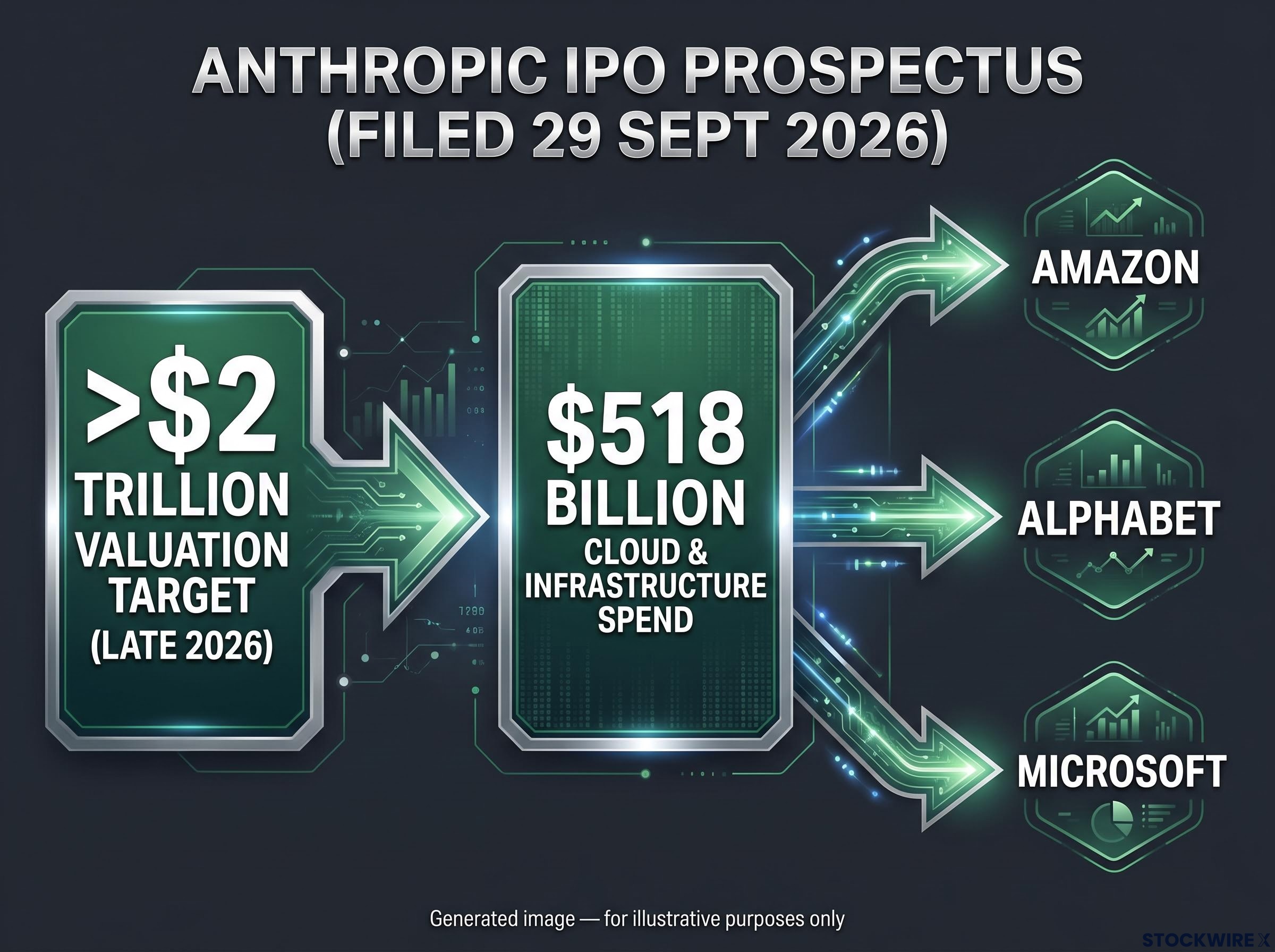
The valuation target is the headline number. According to the prospectus, the company could be valued at more than $2 trillion in its IPO, per Reuters (29 September 2026).
For anyone tracking the wider AI supply chain, though, a different figure does more analytical work. The prospectus discloses that Anthropic plans to spend $518 billion on cloud computing and infrastructure obligations in the coming years.
That number matters because it names capital flows before the IPO even prices. It is a disclosed deployment roadmap, and its primary beneficiaries are cloud and infrastructure providers, the same Amazon, Alphabet, and Microsoft names already sitting in many AI-exposed portfolios.
| Company | IPO status (30 Sep 2026) | Valuation target | Key figure or timeline |
|---|---|---|---|
| Anthropic | Prospectus filed | More than $2 trillion | $518 billion infrastructure spend; late 2026 target |
| OpenAI | Not filed | Not disclosed | Targeting 2027 |
So the prospectus tells you two things at once. It tells you what Anthropic might be worth, and it tells you where its money is heading, naming currently listed companies that stand to collect a meaningful share of it.
Note that available coverage does not identify the lead underwriters or specific pricing mechanisms, so the picture stops at the disclosed figures.
OpenAI’s 2027 target and the sequencing of AI liquidity events
The two biggest names in the space are not arriving together. OpenAI is not pursuing a 2026 listing and is targeting 2027 instead, which spaces the sector’s major liquidity events roughly a year apart.
That sequencing gives them a dependency worth watching. How Anthropic’s IPO trades at open in late 2026 will likely shape sentiment heading into OpenAI’s 2027 pricing, and, per original coverage, could even influence hiring and workforce decisions at major AI firms. The first print becomes a reference point for the second.
What changes after 29 September, and what the accord cannot deliver
Three things genuinely shifted. The political framing moved from adversarial regulation toward cooperative self-governance. Data-centre expansion picked up an explicit executive-level endorsement. And Anthropic’s prospectus arrived the same day, planting a valuation anchor for the private AI market.
Set against that is what the accord structurally cannot do. It cannot enforce itself, it offers no statutory protection to the companies that signed, and it carries no guarantee that a future administration or Congress will honour a voluntary framework it did not create.
NBC News (29 September 2026) reported that Trump called for “tremendous self-regulation” and pushed back on demands for new safety rules.
That phrase is the whole political bet in three words. The accord’s value to the market rests entirely on the environment that produced it staying intact.
Political risk in AI equities is not confined to formal legislation: state-level action, such as New York’s statewide moratorium on hyperscale data centre construction in July 2026, has already demonstrated that regulatory constraints can arrive without any federal statute, compressing valuations in ways the accord’s voluntary framework cannot prevent.
So the summit resolved one form of risk, imminent statutory regulation, while leaving another fully in place: the framework’s dependence on the politics that made it possible. For AI-sector investors, the question is no longer whether this was good news. It plainly was for the companies in the room. The question is whether the conditions behind it hold through Q4 2026 and into the IPO cycle.
Four forward indicators are worth keeping on the watch-list.
- Q4 2026 legislative activity that could reintroduce statutory risk.
- Anthropic IPO pricing and first-day trading in late 2026.
- OpenAI 2027 IPO preparation signals.
- Earnings-call governance disclosures from accord signatories.
This article is for informational purposes only and should not be considered financial advice. Investors should conduct their own research and consult with financial professionals before making investment decisions.
Past performance does not guarantee future results. Financial projections and forward-looking statements are speculative, subject to change based on market developments and company performance, and depend on various risk factors.