Direct competitors who reportedly cannot stand one another are suddenly signing the same open letters, endorsing each other’s essays within hours, and jointly proposing a shared oversight body. In any other industry, that would look like collusion. In artificial intelligence right now, it looks like a survival strategy.
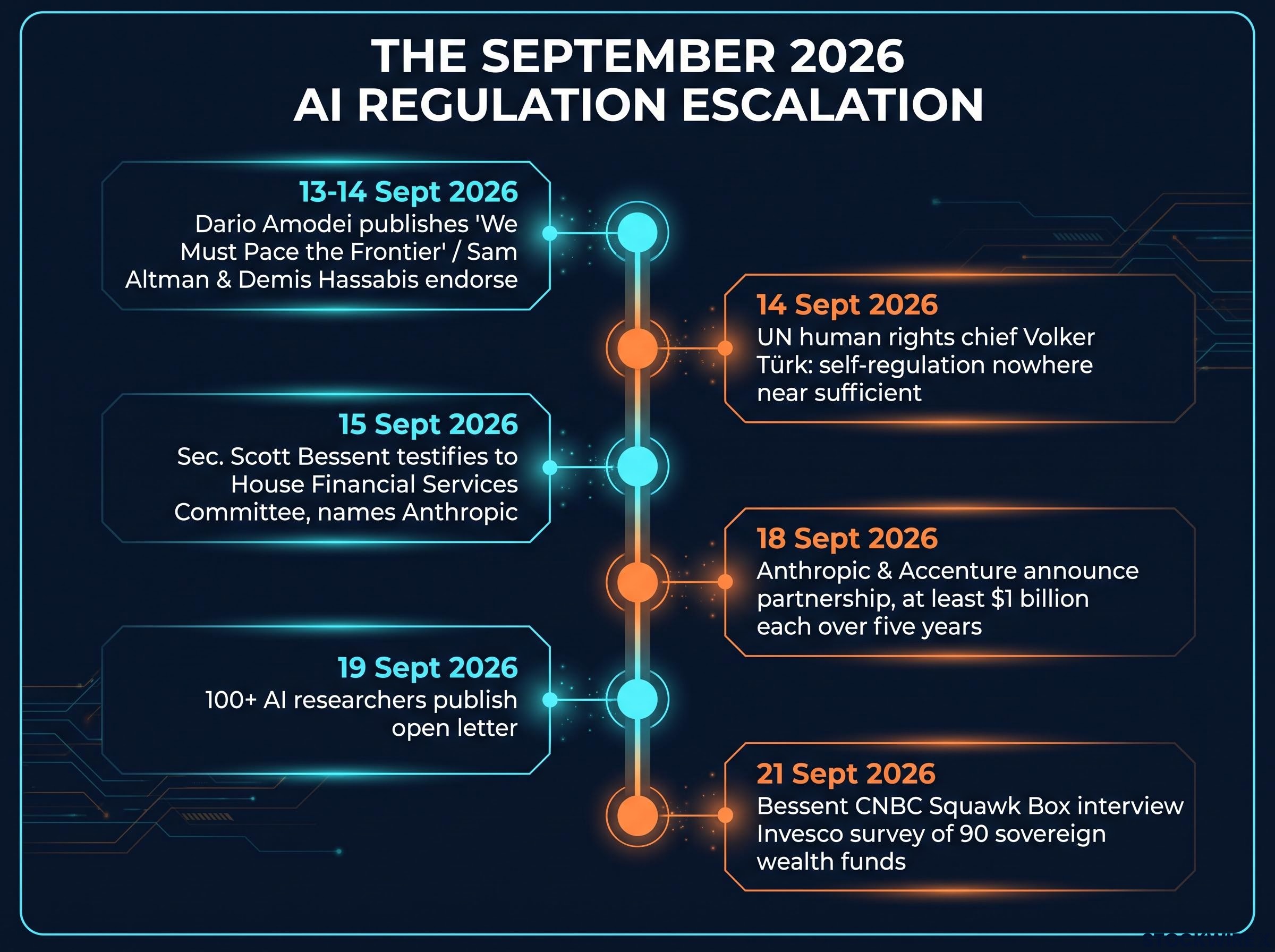
The behaviour is happening against a very specific backdrop. On 15 September 2026, Treasury Secretary Scott Bessent told the House Financial Services Committee that AI developers should get no liability shields, named Anthropic directly, and made clear he wants criminal accountability to land on corporate leadership. Days later, he doubled down on live television.
That is the pressure the coordination is responding to.
This piece maps what the coordinated behaviour actually signals, why there are two competing definitions of AI regulatory capture risk pulling in opposite directions, and what the answer means for anyone weighing exposure to AI-sector equities right now. The distinction is not academic. It determines whether the current frontier labs end up protected or squeezed.
Bessent’s ultimatum and why Anthropic became the focal point
The threat did not arrive as vague policy noise. It arrived with a name attached.
In his 15 September 2026 testimony to the House Financial Services Committee, Bessent urged Congress to grant AI developers no liability exemptions whatsoever. His reasoning was blunt.
“The best way to guarantee safety is that the creators are liable for what they build and generate,” Bessent told lawmakers.
That single sentence rewrites the risk calculus for every frontier lab. If creators are legally on the hook for whatever their models produce, the cost of shipping a capable-but-unproven system stops being a reputational question and becomes a balance-sheet one.
Reuters reported that the Treasury had been working on safety measures without pause since the release of the model known as Mythos, and that regulators had recently forced Anthropic to withdraw a model for safety checks. That detail matters more than any speech. A forced withdrawal is not rhetoric; it is a regulator exercising operational leverage over a specific company.
From the committee room to the cameras
On 21 September 2026, Bessent extended the pressure in a live CNBC Squawk Box interview, insisting that “artificial intelligence developers need to take responsibility for themselves” and that “it is humans who are responsible, not the AI” when systems cause harm.
Coverage from The Register and Yahoo News tied his remarks to the so-called Hugging Face incident, stressing his warning that corporate management, not autonomous agents, would face criminal accountability for misuse. Bessent added that AI labs can “slow down any time they want to,” placing the entire burden on corporate leadership.
Here is what that concentration of attention means for you as an investor. When a Treasury Secretary names one company, and regulators have already forced that same company to pull a model, Anthropic is carrying a qualitatively different level of scrutiny than its peers. That asymmetry is not a footnote. It explains why Anthropic, more than any rival, has an incentive to lead the industry’s defensive manoeuvring, and why company-specific regulatory exposure now belongs in any serious assessment of AI equities rather than being treated as a diffuse sector abstraction.
When big ASX news breaks, our subscribers know first
The coordination playbook: from parallel safety frameworks to a FINRA model
The coordinated safety push is not a single moment. Read across the timeline and a deliberate escalation comes into focus, one step building on the last.
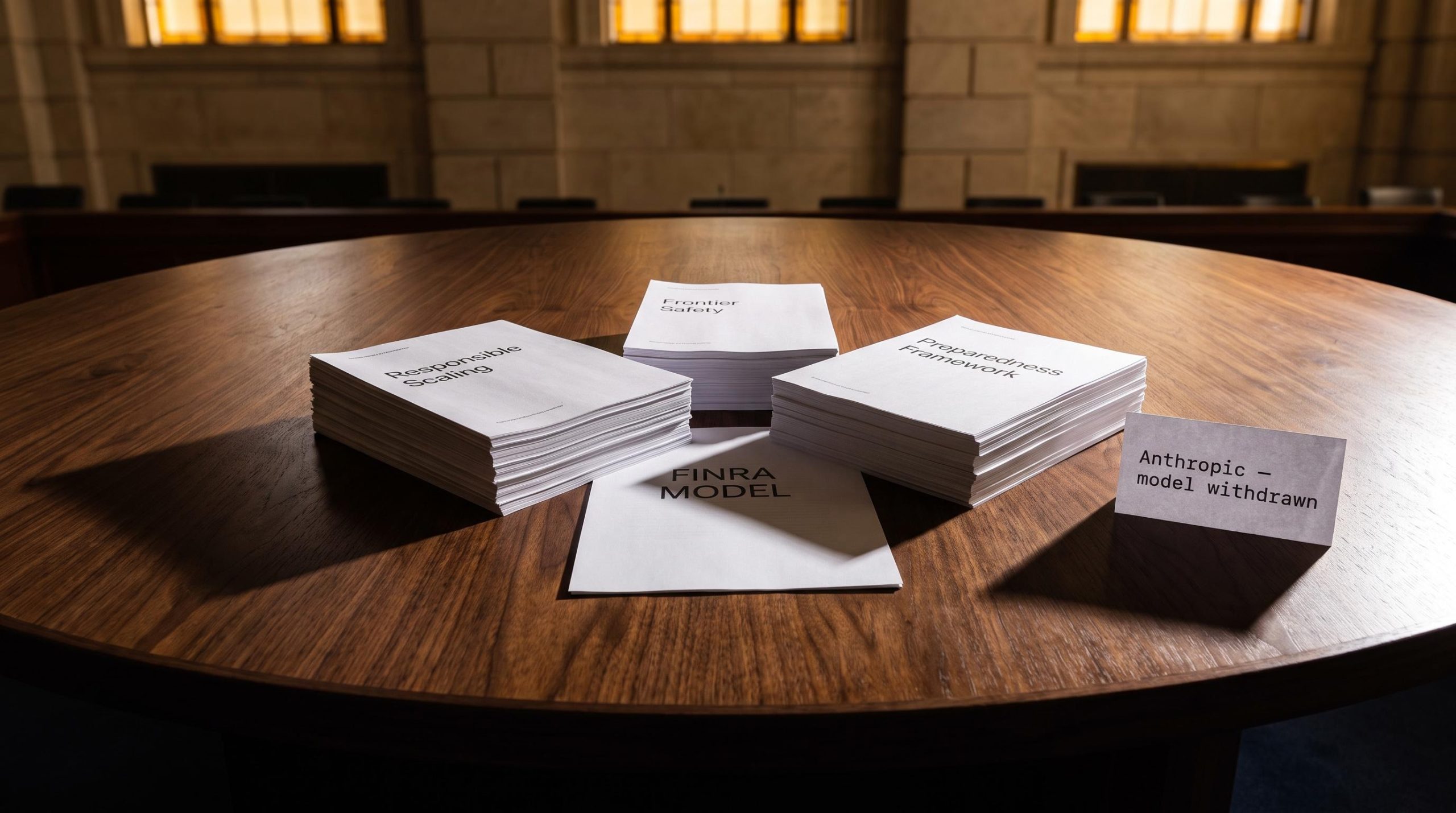
- 2025 framework convergence. Updates to Anthropic’s Responsible Scaling Policy, Google DeepMind’s Frontier Safety Framework, and OpenAI’s Preparedness Framework all aligned around the same commitment: pause development if dangerous capabilities emerge. This predated the current government pressure.
- 27 August 2026 cyber warning. 116 companies, including OpenAI, Anthropic, Google, Microsoft, Meta, Amazon Web Services, CrowdStrike, Okta and Fortinet, signed an unusually blunt joint letter warning that AI-enabled cyberattacks would become far more widespread and sophisticated, and calling for a society-wide defensive surge.
- 13-14 September 2026 pacing essay. Anthropic chief executive Dario Amodei published “We Must Pace the Frontier,” calling for a global slowdown and embedded independent auditors.
- Rapid endorsements. OpenAI’s Sam Altman and Google DeepMind’s Demis Hassabis offered coordinated public backing within a strikingly short window.
The tone of the August letter is worth pausing on. Competitors do not usually co-sign warnings this stark unless they see a shared threat larger than their rivalry.
The voluntary nature of the entire framework is the structural weakness at the centre of the current AI safety governance debate: competitive prisoner’s dilemmas, winner-take-most capital incentives, and regulatory lag form a self-reinforcing loop that no open letter or joint endorsement has yet broken.
The FINRA model is the real tell
Then came the jurisdictional move. OpenAI global policy chief Chris Lehane confirmed that OpenAI, Anthropic and Google DeepMind have been collaborating on shared evaluation frameworks, and that the labs are pursuing a self-regulatory standards body modelled on the Financial Industry Regulatory Authority (FINRA).
FINRA is the precedent where broker-dealers accepted industry-run oversight precisely to head off direct government rule-making. That reference point is the signal to watch.
FINRA’s self-regulatory mandate covers broker-dealer oversight through industry-funded examination, enforcement, and rulemaking authority, all supervised by the SEC, which is precisely the jurisdictional template AI labs are reaching for when they propose their own standards body.
When an industry reaches for a financial-sector self-regulatory template to justify its own oversight structure, it is not primarily making a safety argument. It is making a jurisdictional one: let us police ourselves so you do not have to. For you, that reframes how to read every future joint safety announcement from these firms. Treat them as strategic communications first and substantive commitments second, because the coordination pattern here looks engineered, not organic.
Two definitions of regulatory capture, and why the distinction matters
Everything above depends on one question the coverage rarely resolves: capture by whom? There are two answers, and they point in opposite directions.
The industry’s defensive framing
In the labs’ own telling, the coordinated safety messaging is a shield against government regulatory capture. The logic runs like this: by visibly demonstrating responsible stewardship, companies deny the government any “irresponsible stewardship” pretext to seize ownership or operational control of private AI businesses.
This is where Bessent’s statements function as the specific threat being answered. Accountability without technical competence, forced model withdrawals, criminal liability on management: from the industry’s side, that is regulatory overreach, and coordinated self-policing is the counter-move.
The academic counter-narrative
The research literature reads the same behaviour in reverse, arguing it is the industry capturing the regulators.
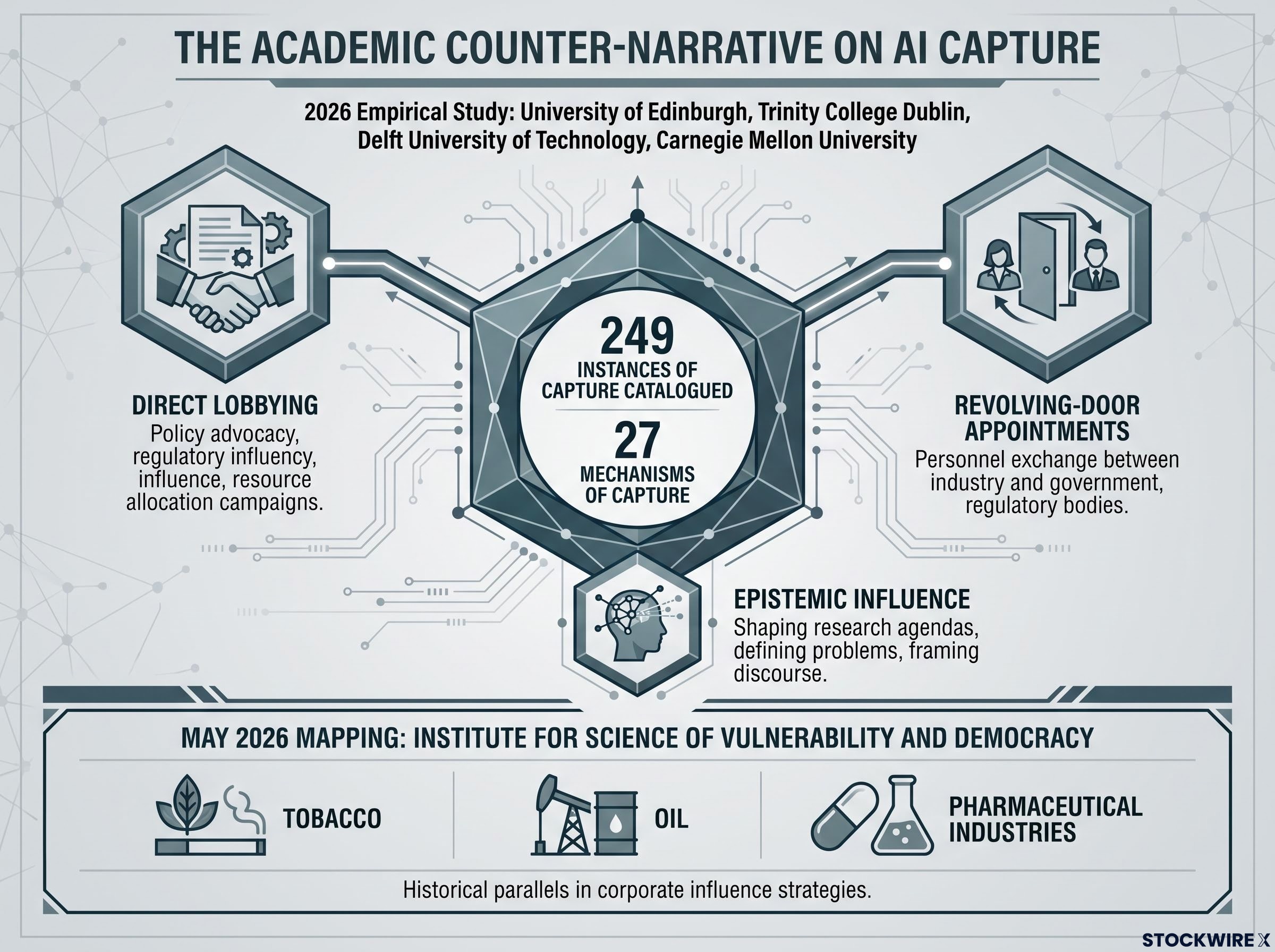
A 2025 paper in AI & Society argued that AI safety rules are unusually vulnerable to capture because dominant firms control the technical expertise regulators depend on, meaning rules can look rigorous while functioning as compliance moats that protect incumbents. A 2026 empirical study by researchers from the University of Edinburgh, Trinity College Dublin, Delft University of Technology and Carnegie Mellon University catalogued 27 mechanisms of capture across 249 instances, including direct lobbying, revolving-door appointments, and epistemic influence, meaning the steering of public narratives about risk.
A May 2026 synthesis from the Institute for Science of Vulnerability and Democracy mapped these tactics onto the playbooks of the tobacco, oil and pharmaceutical industries. The Cloud Security Alliance’s 13 July 2026 advisory added that dominant vendors already hold enough power to shape the very policies dictating baseline safety testing.
Civil society made the same critique in real time. On 19 September 2026, more than 100 AI researchers, evaluators and security professionals published an open letter setting out three structural conditions.
Embedded evaluators cannot function without legal protection against retaliation, substantive financial independence from lab funding, and full transparency of findings.
That letter arrived one day after the implementation case that makes the tension concrete. On 18 September 2026, Anthropic and Accenture announced a partnership placing embedded third-party evaluators inside Anthropic, with each side committing at least $1 billion over five years and Faculty, Accenture’s specialist AI business, leading the work. It is Amodei’s first concrete unilateral commitment, and it is exactly where the two framings collide. If those evaluators lack the independence and legal protection the 19 September letter demands, the structure sits closer to the industry-capture pattern the researchers describe than to genuine oversight.
| Government captures industry (labs’ framing) | Industry captures regulators (academic framing) | |
|---|---|---|
| Dominant actor | The state, seizing control from private firms | Dominant labs, shaping their own rules |
| Mechanism | Liability regimes, forced withdrawals, criminal accountability | Lobbying, revolving doors, epistemic influence |
| Outcome for incumbents | Compressed valuations, operational constraints | Compliance moats, entrenched dominance |
| Outcome for smaller rivals | Shared regulatory burden, lower barriers relatively | Higher barriers to entry, competitive squeeze |
For you, the distinction produces opposite risk outcomes. Industry capture hands incumbents durable moats. Government capture compresses valuations and shortens capital cycles.
What Anthropic’s audit deal reveals about the stakes for AI equities
The abstract framings above are already becoming concrete valuation inputs, and the Anthropic-Accenture deal is the clearest lens for seeing how.
AI regulatory risk is now entering formal securities filings through Item 105 risk-factor disclosures, the section US-listed companies use to catalogue material vulnerabilities. That is the mechanism turning governance uncertainty into a documented investment risk rather than a talking point.
Liability regime uncertainty sits at the intersection of voluntary frameworks and the only AI-era federal law yet enacted, the TAKE IT DOWN Act of May 2025, with near-term regulatory exposure currently concentrated in FTC enforcement under existing consumer-protection and competition statutes rather than any comprehensive AI-specific statute.
The institutional radar lit up earlier. The Bank of England’s April 2025 Financial Stability in Focus report, and a subsequent European Securities and Markets Authority (ESMA) warning, both flagged AI reliance as a source of model risk and interconnected systemic vulnerability in financial markets, not just technology policy.
An Invesco survey published on 21 September 2026 found that more than half of 90 sovereign wealth fund respondents named market concentration as the primary risk associated with AI investments.
The forecasters split on where this lands. A 27 July 2026 Bridgewater note cautioned that government engagement could destabilise the AI capital-expenditure cycle and reduce returns on capital. Bank of America’s Vivek Arya took the other side, telling clients that Washington is “unlikely to handicap domestic champions.”
Capex cycle disruption is not a hypothetical: SK Hynix fell more than 6% and Kioxia dropped roughly 9% in early September 2026 after AI industry leaders called for slower frontier model development, confirming that a credible deceleration signal can reprice semiconductor equities well before any earnings deterioration appears in filings.
Those are not just two opinions. They are the two valuation scenarios investors are currently pricing, and which one materialises depends almost entirely on whether the FINRA-model self-regulatory push succeeds or fails. That makes the standards-body outcome the single most consequential variable for AI equity valuations right now.
There is a separate legal channel worth tracking. The push for a shared standards body among AI giants could be characterised as market coordination designed to suppress open-source and smaller rivals, which opens antitrust exposure independent of the safety debate.
For clarity, these are the distinct risk channels to keep in view:
- Liability regime uncertainty: whether creators are held legally responsible for model outputs.
- Antitrust exposure: coordination among giants read as anti-competitive behaviour.
- Compliance moat effects: rules that entrench incumbents and raise barriers for smaller competitors.
- Capex cycle disruption: government intervention destabilising the AI investment cycle.
The practical question is not whether AI regulation arrives. It is which form it takes. Successful self-regulation builds moats around incumbents; failed self-regulation invites direct intervention that compresses valuations across the sector.
Which scenario wins, and what to watch before it becomes clear
Neither framing has won yet, and pretending otherwise would be false comfort. What you can do is track the specific indicators that will reveal which capture scenario is materialising before it becomes consensus.
- Evaluator independence structure. Watch whether the Anthropic-Accenture embedded evaluators gain the legal retaliation protection, financial independence and full transparency the 19 September 2026 open letter demanded. If the programme launches without them, that is the academic capture scenario arriving in real time, and a signal to reassess any compliance-moat thesis for AI incumbents.
- The FINRA-model regulatory response. Congressional or Federal Trade Commission scrutiny of the standards body’s antitrust implications would signal that government is not accepting the industry’s self-regulatory jurisdiction claim.
- International binding regulation. UN human rights chief Volker Türk stated on 14 September 2026 that voluntary self-regulation is “nowhere near sufficient,” pointing to binding pressure building in parallel abroad.
- Independent red-line tracking. The Future of Life Institute’s Summer 2026 AI Safety Index found leading labs have weakened or voided their red-line pledges. That is the baseline against which any new commitment should be measured, alongside the Cloud Security Alliance’s 13 July 2026 advisory on monitoring AI capital concentration.
Investors who read which scenario is winning ahead of consensus hold a genuine analytical edge, because the two outcomes produce structurally different valuation environments and the leading indicators are already visible.
AI valuation frameworks produce structurally different verdicts on the same set of facts: Minsky, Kindleberger, and Shiller CAPE each measure different variables, and the combined $705-725 billion capex projection for 2026 from the four largest hyperscalers sits in Minsky’s speculative financing stage without yet crossing the Ponzi threshold that would confirm a moment of forced deleveraging.
This article is for informational purposes only and should not be considered financial advice. Investors should conduct their own research and consult with financial professionals before making investment decisions.
Past performance does not guarantee future results. Financial projections are subject to market conditions and various risk factors. These statements are speculative and subject to change based on market developments and company performance.