Most investors treat the artificial intelligence hardware race as a single contest: whoever builds the fastest graphics processing unit wins, and everyone else fights over scraps. That framing is wrong, and it leads to poor portfolio decisions.
The mid-2026 numbers tell a different story. Nvidia, AMD, and Broadcom all reported extraordinary revenue growth in their most recent quarters, yet each is capturing AI infrastructure spending through a fundamentally different business model. They are not simply three companies selling the same chip.
Comparing Nvidia vs AMD vs Broadcom properly means understanding those distinct models, their competitive moats, and where each one carries valuation risk. What follows here gives you a structured financial and strategic framework to evaluate all three as separate plays rather than as interchangeable bets on the same trend.
Mapping the AI hardware landscape and competing business models
Start with the structural reality most coverage skips. The AI accelerator market is not one lane with three cars in it. It is three separate lanes, and each of these companies runs in a different one.
Nvidia sells general-purpose merchant GPUs: chips that any customer can buy and program for a wide range of AI workloads. AMD does the same, positioned as the credible second source. Broadcom does something else entirely.
Broadcom designs custom application-specific integrated circuits (ASICs), which are chips built for one buyer to run one specific set of tasks as efficiently as possible. It does not sell an off-the-shelf GPU at all.
This distinction matters the moment you look at market share, because the numbers depend entirely on what you measure. Estimates from SiliconAnalysts and Kaisoresearch put Nvidia at roughly 80-90% of the AI accelerator market by revenue, with AMD capturing approximately 5-7% (an estimated $7-8 billion in 2025) and hyperscaler ASICs absorbing much of the rest.
Widen the lens, though, and the picture shifts. Mordor Intelligence reports that GPUs across all vendors held just 59.2% of accelerator revenue in 2025, which implies that non-GPU chips like ASICs and FPGAs already command close to 40% of the market.
That divergence is the point. Tracking GPU revenue alone misses the growing footprint of custom internal silicon, which means your portfolio analysis has to account for bespoke chips sitting alongside the retail GPU market, not just the headline vendor rankings.
AI semiconductor divergence across end markets is already measurable: Nvidia’s processor segment accelerated growth for three consecutive quarters through mid-2026 while Qualcomm contracted 3.5% in the same period, confirming that sector labels are no substitute for end-market analysis when sizing positions across the AI hardware landscape.
Here is how the three models compare at a glance.
| Company | Primary AI hardware model | Core software / ecosystem moat | Target customer profile |
|---|---|---|---|
| Nvidia | General-purpose merchant GPUs | CUDA software stack and developer libraries | Broad market: AI labs, hyperscalers, enterprises |
| AMD | Merchant GPUs plus EPYC data centre CPUs | ROCm platform (maturing, still behind CUDA) | Hyperscalers seeking a second supplier |
| Broadcom | Custom ASIC design and networking hardware | Design partnership plus VMware enterprise software | Hyperscalers building proprietary chips |
Once you see the three lanes clearly, the false equivalence dissolves. You cannot value a pure GPU seller the same way you value a custom design partner, and that sets up everything that follows.
When big ASX news breaks, our subscribers know first
Nvidia and the economics of software lock-in
Nvidia is not just the market leader. It operates at a scale that reframes what leadership even looks like in this sector.
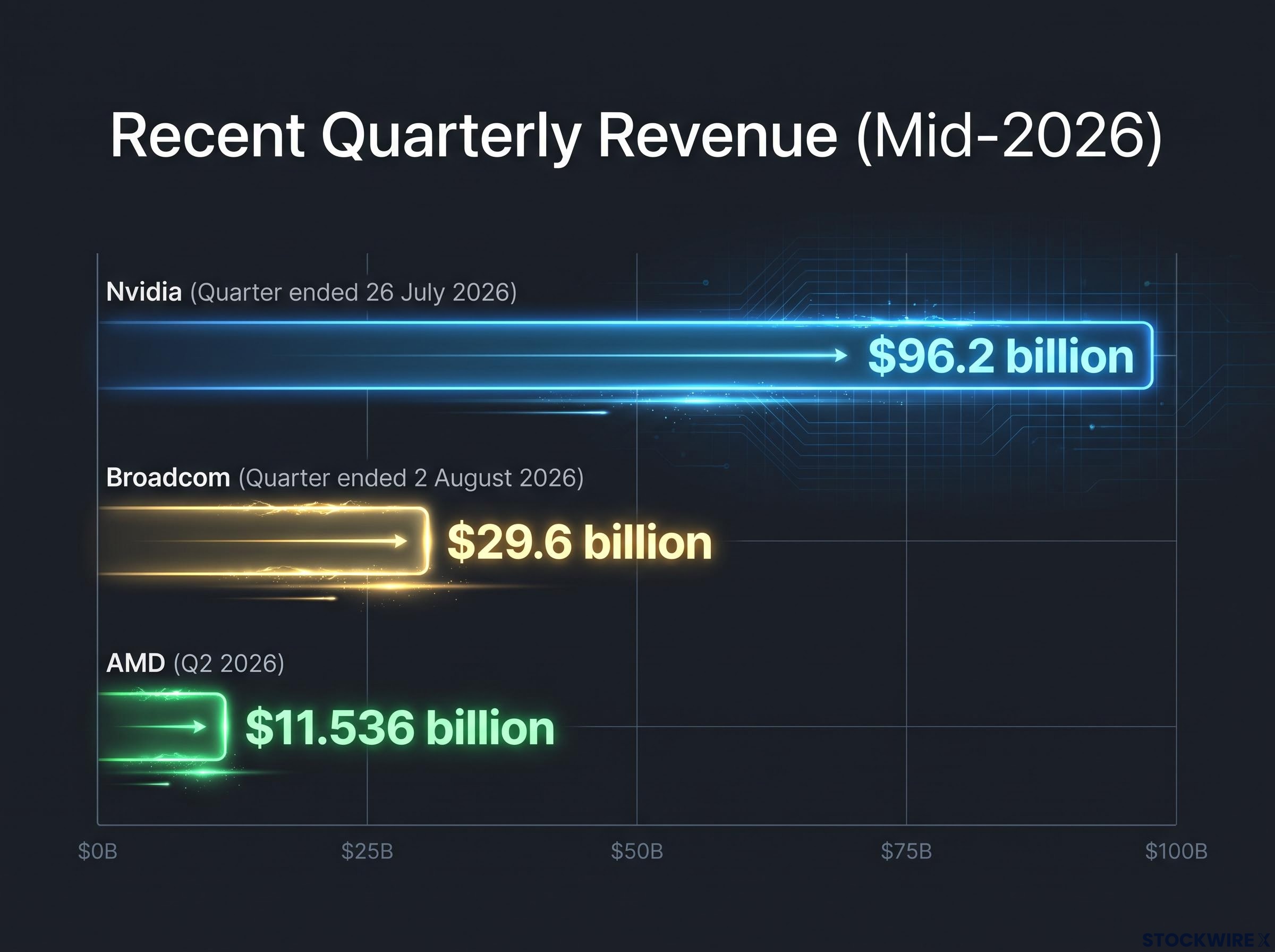
For the quarter ended 26 July 2026, Nvidia reported total revenue of approximately $96.2 billion, up 106% year-over-year. Data centre revenue alone reached roughly $89 billion, split between about $49 billion from hyperscale customers and $40 billion from its enterprise infrastructure segment.
Gross margins held at approximately 75%, with operating margins near 66%. Those are software-company margins earned on physical hardware, and that combination is what makes Nvidia unusual.
Forward guidance and the next demand wave Nvidia guided next-quarter revenue to approximately $108 billion (plus or minus 2%). The next phase of demand centres on AI agents: software capable of completing multi-step tasks autonomously, which requires far more computing power per task than a standard chatbot query and could drive a substantial new layer of infrastructure spending.
The interpretive point matters here. Margins that high, sustained at this scale, are not a function of chip speed alone. They are protected by something harder to replicate.
The CUDA ecosystem advantage
Nvidia’s roughly 80-90% revenue share rests on CUDA, its software platform, and the libraries built around it such as cuDNN and TensorRT. Companies have spent years writing AI applications specifically for this stack.
Moving to a rival architecture is not a matter of buying cheaper chips. The friction includes overhauling software compatibility, retuning performance, committing significant engineering time, and untangling existing infrastructure dependencies.
Those switching costs are why alternative platforms remain significantly harder to adopt at scale for broad, general-purpose workloads. For the reader, the takeaway is direct: Nvidia’s dominance is guarded by developer habits, not just silicon performance, so you should weigh software lock-in as heavily as raw speed when judging its forward valuation. The price already assumes continued hyper-growth, which makes the durability of that moat the central question.
AMD and the hyperscaler mandate for a secondary supplier
AMD’s story is often told as a challenger closing the gap on Nvidia. The more accurate frame is that AMD is the release valve the entire industry needs.
The company has moved well beyond its gaming and laptop-chip roots. For Q2 2026, AMD reported total revenue of $11.536 billion, up roughly 50% year-over-year, and recently crossed a $1 trillion market capitalisation.
Data centre revenue reached $6.718 billion, up 107% year-over-year, now representing approximately 58% of total company revenue. AMD pairs its MI300 and MI350 GPUs with EPYC CPUs, which handle the data centre management tasks that scale up alongside every GPU deployment.
The strategic driver is not that AMD builds a better chip than Nvidia. It is that large technology firms refuse to depend on a single supplier. That reluctance creates structural demand for a credible second option, regardless of the performance gap.
The following cloud and AI customers are deploying AMD hardware as a secondary capacity source:
- OpenAI, under a multi-tier agreement allowing up to 6 gigawatts of AMD GPU deployment
- Meta, under a similar multi-tier arrangement of up to 6 gigawatts
- Cloud providers adopting MI350 GPUs and EPYC CPUs to optimise price and performance on specific services rather than replacing CUDA infrastructure wholesale
Here is the caution. Those OpenAI and Meta agreements are tied to deployment milestones and do not represent guaranteed revenue. AMD also has to fund heavy investment in its ROCm software platform while protecting margins, and its valuation already prices in significant market-share gains.
The ROCm software ecosystem is the single most binary variable in AMD’s forward case: until it reaches mainstream enterprise accessibility, AMD’s accelerator revenue stays structurally tethered to hyperscaler procurement decisions rather than the broader enterprise market that would unlock a genuine share-gain story.
For you, that means AMD’s growth is best read as a structural necessity for the industry rather than a bet on it dethroning Nvidia. The metric to watch is how much of that milestone-based contract value actually converts into booked revenue.
Broadcom and the hidden infrastructure of custom silicon
Shift the lens away from off-the-shelf chips entirely, and a second, highly profitable AI business comes into view. Broadcom does not sell a merchant GPU. It designs the custom chips that hyperscalers build for themselves, and it supplies the networking that ties those chips together.
The economic logic behind custom AI chips is straightforward: lower per-inference costs, better power efficiency, and reduced dependence on a single external supplier, and that logic explains why hyperscaler ASIC programmes have grown from a margin story into a structural feature of the semiconductor landscape.
The financials are formidable. For the quarter ended 2 August 2026, Broadcom reported revenue of $29.6 billion, up 86% year-over-year, with AI semiconductor sales reaching $16.7 billion, up 221% year-over-year and comprising more than half of total revenue.
Free cash flow came in at approximately $13.7 billion, equal to roughly 46% of total revenue. That level of cash conversion is what makes this a genuinely defensive way to capture AI capital expenditure.
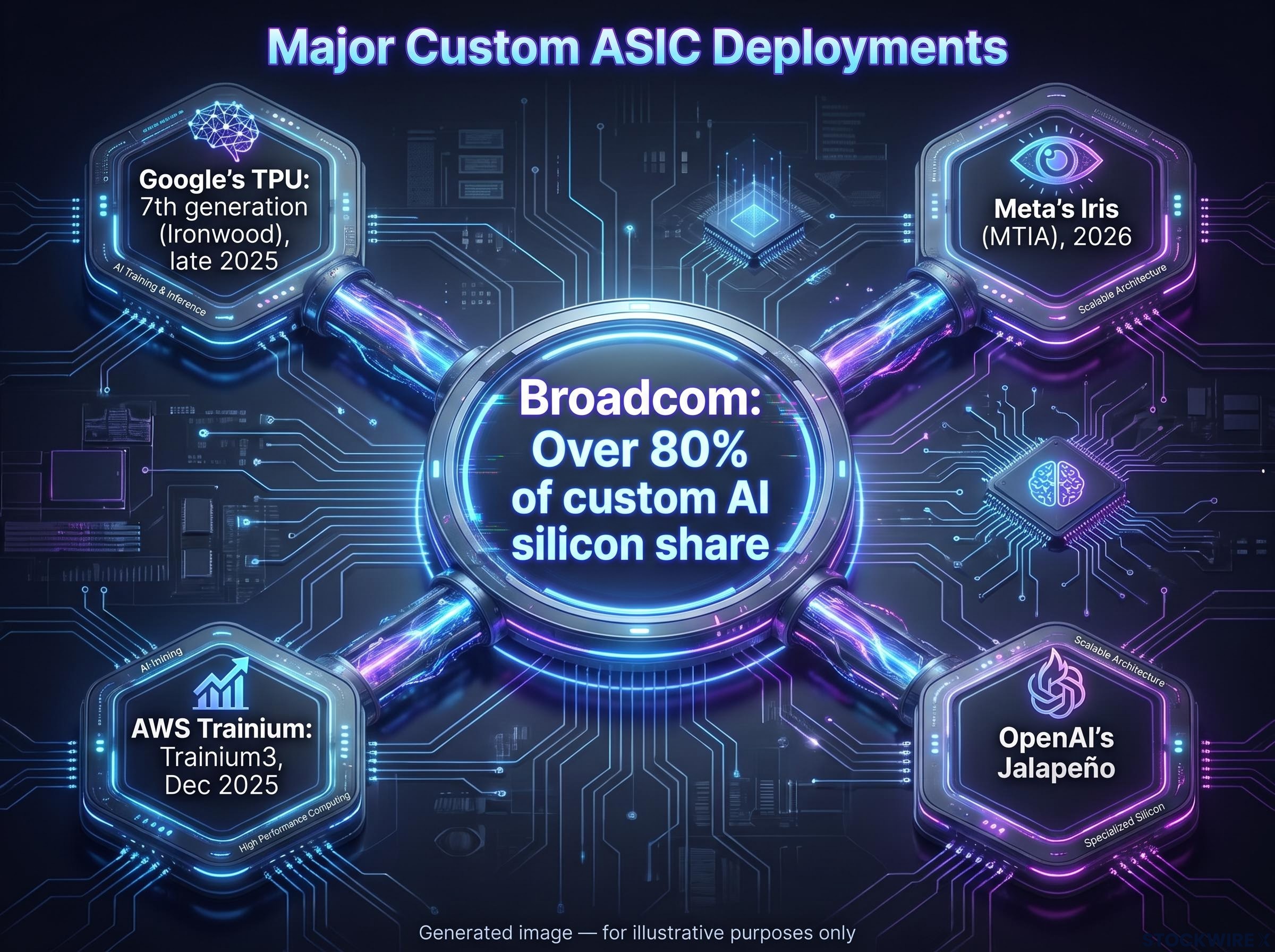
Broadcom and a small group of partners design over 80% of the custom AI silicon used by hyperscalers, manufactured on advanced TSMC processes. Real-world deployments include:
- Google’s TPU, now in its 7th generation (“Ironwood”), released in late 2025 for internal search, ads, and language-model serving
- Meta’s Iris (MTIA) accelerator, which passed testing in 2026, used for recommendation and ranking tasks
- AWS Trainium, the second-largest hyperscaler ASIC by production scale, with Trainium3 reaching general availability in December 2025
- OpenAI’s Jalapeño, among the custom programmes Broadcom supports
Hyperscalers pursue these chips for lower cost per compute, better power efficiency, workload-specific performance, and supply assurance that reduces their dependence on Nvidia.
The networking interconnect premium
Designing the chip is only half of Broadcom’s role. As AI clusters scale to thousands of chips, the networking and interconnect hardware that links them becomes proportionally more important to overall system performance, and Broadcom supplies that high-margin layer.
Its ownership of VMware adds a substantial enterprise infrastructure software business, giving the company a steadier revenue baseline underneath the AI hardware surge.
The risk sits in concentration. Broadcom leans heavily on a handful of hyperscaler ASIC programmes, so a strategic shift by any one of them could dent future revenue, and sustaining high-70s gross margins may become harder as custom design attracts more competition. For you, Broadcom offers a way to own AI infrastructure spending without competing in the headline GPU war at all.
Shared vulnerabilities in the artificial intelligence capital expenditure cycle
For all their differences, these three companies share the same foundation, and that foundation has cracks worth studying before you commit capital.
The first is overbuild. If hyperscalers and enterprises install more computing capacity than their monetisable workloads actually need, the sector could enter a digestion phase of slower growth or outright order declines.
The second is margin compression. As competition intensifies across AMD’s GPUs, Broadcom-designed ASICs, and hyperscalers’ own internal chips, buyer bargaining power will grow, and the current exceptional margins will become harder to hold.
The third, and most acute, is concentration. The entire AI compute boom rests on spending from a small group of buyers, and custom silicon designed with Broadcom actively caps Nvidia’s long-term upside in certain high-volume infrastructure layers.
| Risk factor | Primary vulnerability | Trigger metric to monitor |
|---|---|---|
| AI capex overbuild | All three; Nvidia most exposed by revenue scale | Hyperscaler capital expenditure guidance |
| Margin compression | Nvidia and Broadcom (highest margins to defend) | Quarterly gross margin trend |
| Customer concentration | Broadcom (handful of ASIC programmes) | Single-customer revenue share |
| In-sourcing / custom chips | Nvidia (upside capped in volume layers) | Hyperscaler internal chip deployment |
The practical read is straightforward. Spending among Amazon, Google, Meta, Microsoft, and the major AI labs dictates the fortunes of all three suppliers, so you should watch cloud-provider capex guidance closely. A budget cut from a single major buyer would trigger immediate repricing across every one of these stocks at once.
Calibrating semiconductor exposure for the next phase of AI hardware
The clearest way to hold these three is by the role each plays. Nvidia is the general-purpose frontier leader, protected by CUDA. AMD is the strategic release valve that hyperscalers need for supply diversity. Broadcom is the custom-silicon and networking backbone capturing spend that never touches a merchant GPU.
The next test for all three is the shift from model training toward large-scale agentic inference, which changes both the volume and the type of compute in demand. Nvidia’s ecosystem, AMD’s second-source position, and Broadcom’s custom-design footprint will each be pressured differently by that transition.
The action for you is to audit your current semiconductor weightings against these three distinct models rather than treating the sector as one monolithic AI trade.
For investors wanting to stress-test the valuation side of this comparison in more depth, our dedicated guide to Nvidia and Broadcom valuation multiples examines how contract-backed ASIC revenue certainty justifies Broadcom’s premium forward P/E relative to Nvidia’s multiple compression despite accelerating revenue.
This article is for informational purposes only and should not be considered financial advice. Investors should conduct their own research and consult with financial professionals before making investment decisions. Past performance does not guarantee future results, and financial projections are subject to market conditions and various risk factors.