Markets are pricing a 56.5% probability that the Federal Reserve raises rates again in October, while the Bank of Japan just lifted its own policy rate to 1.25% and promptly watched the yen slide toward 157 per dollar. The hike strengthened the dollar. The hike weakened the yen. Two central banks tightening, two opposite outcomes.
That paradox sits at the heart of one of the most significant structural forces in currency markets right now, the USD Yen policy divergence that has defined this pair for the better part of a year.
The USD/JPY pair has spent months pinned in the mid-150s, absorbing record intervention spending by Japanese authorities, five separate BoJ rate hikes, and persistent Fed hawkishness, and it has barely shifted off its elevated range.
Understanding why requires looking past the rate decisions themselves to the gap between them. What follows unpacks the mechanics driving this divergence, where the major institutional forecasters disagree, and what the risks on both sides of this trade look like, so you can assess this currency pair with the same framework professional strategists use.
Why two rate hikes produced opposite currency outcomes
Here is the contradiction worth sitting with for a moment. On 16 September 2026, the Fed delivered a 25-basis-point increase, its first in roughly three years, lifting the federal funds target range to 3.75%-4.00% effective 17 September. Around the same window, the BoJ raised its own rate by 25 basis points to 1.25%, the highest in 31 years. Both moves were tightening. Yet the yen weakened, not strengthened.
The resolution lives in a single number: the gap between the two rates.
Currency markets do not price the absolute level of any one central bank’s rate. They price the difference between two of them. When both banks hiked, the differential did not narrow. It stayed wide, at roughly 250-275 basis points in the dollar’s favour.
The EUR/USD collapse below parity in 2022 is the clearest modern precedent for how central bank divergence reshapes a currency pair: the Fed’s September 2022 dot plot revision repriced the dollar upward before a single additional basis point was delivered, confirming that markets trade the expected rate path, not the current level.
That gap actively rewards holding dollars over yen. An investor parking capital in dollar assets earns materially more than one holding yen, and no amount of BoJ tightening changes that arithmetic until the gap itself closes. This is the key insight for anyone watching the pair: the BoJ’s hike was structurally irrelevant to the USD/JPY trend, because it did nothing to shrink the differential.
Here is how the two decisions stacked up.
- Fed, 16-17 September 2026: 25bp hike to 3.75%-4.00%, dollar firmed
- BoJ, September 2026: 25bp hike to 1.25%, yen weakened toward 156.9 by 18 September 2026
The comparison sharpens when the differential sits alongside the two rates directly.
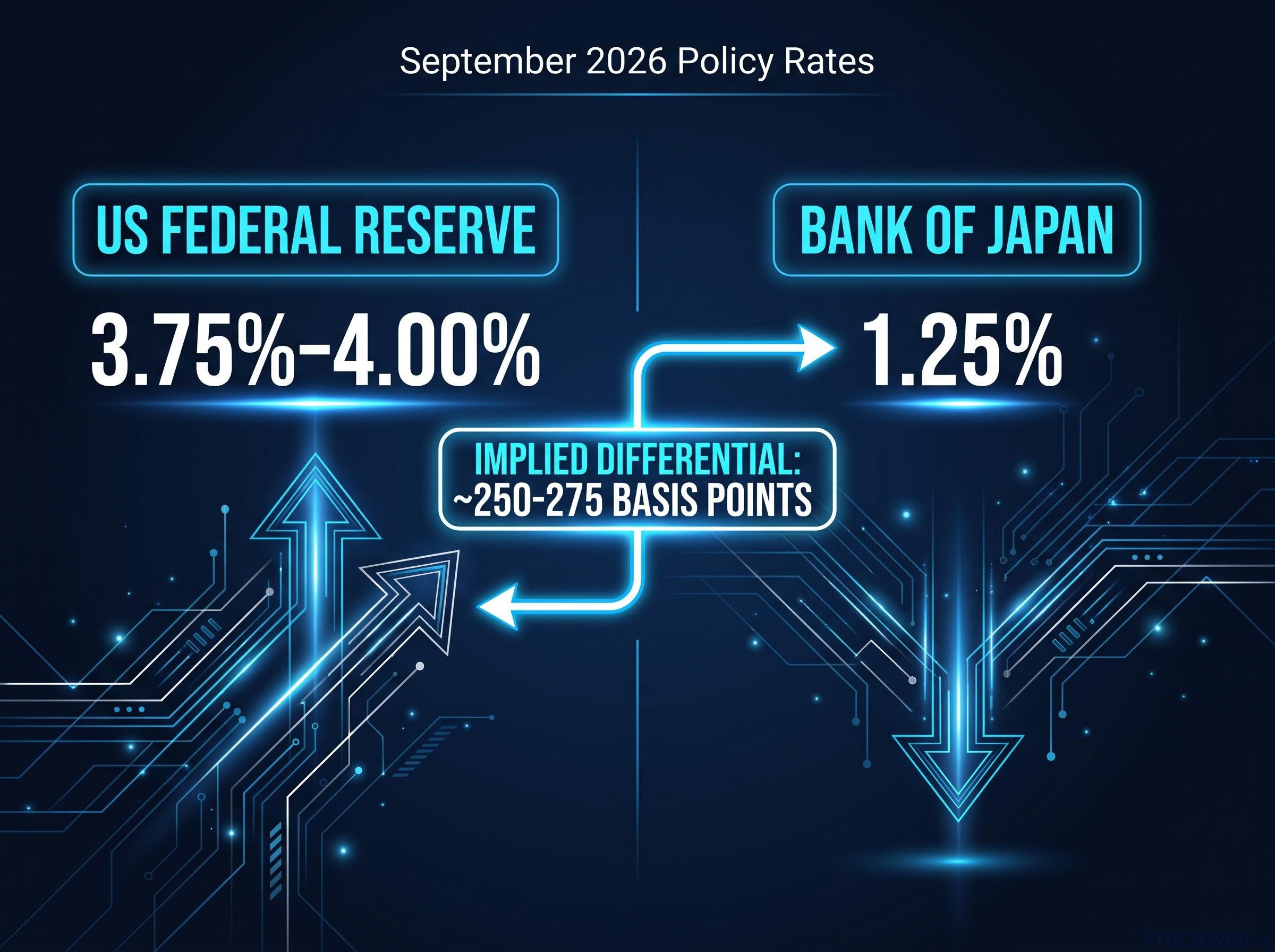
| Central Bank | Policy Rate | Implied Differential |
|---|---|---|
| US Federal Reserve | 3.75%-4.00% | ~250-275 basis points |
| Bank of Japan | 1.25% |
Scotiabank analysts flagged the yen as the single most significant mover in overnight trading following the decision. The number tells the story: when the gap is this wide, the direction of the pair is already decided.
When the decision and the message pull in different directions
The rate decision was only part of what moved the yen. Governor Kazuo Ueda’s post-meeting press conference delivered ambiguous and mixed signals, and that communication amplified the selling beyond what the hike alone would have caused.
Clarity matters as much as the decision itself. When a central banker hikes but sounds hesitant about the pace ahead, traders hear caution and sell accordingly.
The vote reinforced that reading. The decision passed 7-2, with two members dissenting. Those two dissents point to genuine internal division at the BoJ over how quickly normalisation should proceed, which is exactly the uncertainty that keeps yen bears confident.
When big ASX news breaks, our subscribers know first
The carry trade engine: how policy divergence becomes currency price action
So how does a rate gap on paper turn into relentless downward pressure on the yen? The answer is the carry trade, and once you follow the logic, the persistence of the trend stops looking mysterious and starts looking inevitable.
The mechanics run as a simple chain:
- Borrow money in the low-yield currency, the yen, where funding costs are minimal
- Convert those borrowed yen into dollars
- Invest the dollars in higher-yielding US assets
- Pocket the interest rate differential between the two
- Manage or carry the currency risk, and repeat the process at scale
At a differential of 250-275 basis points, that spread is not a rounding error. It is a structural incentive that draws capital toward the dollar every day the gap stays open. The same dynamic shows up in bond markets.
Tokyo strategist Masayuki Yamamoto points to a roughly 200 basis-point gap on 10-year bond yields as a fundamental driver of ongoing yen weakness.
That yield gap is the foundation beneath the entire trade. Every BoJ hike that falls short of the Fed’s pace leaves the differential intact, which means the flow of capital keeps running in the same direction regardless of how many times Tokyo tightens.
The DXY tells the same story from the dollar side, recovering to the 100.22-100.30 range as of 18 September 2026 after two sessions of declines, on the back of expectations for continued Fed tightening.
Why record intervention has not broken the trend
This is where the carry trade reveals its stubbornness. Japanese authorities have spent enormous sums trying to slow the yen’s fall, and the trend keeps reasserting itself.
In April and May 2026, the Ministry of Finance deployed a record ¥11.73 trillion, around $73 billion, in FX intervention. A late-July joint US-Japan operation followed, functioning as a containment exercise that capped the pair below the 155-160 zone but left the underlying rate-driven trend untouched.
The pattern is not new. Between September and October 2022, Japan intervened to buy yen for the first time in decades, and those operations forced sharp corrections of 5-10 yen. Yet without a shift in the interest rate differential, USD/JPY climbed back toward its prior highs within months.
The 2024 carry trade unwind, described at peak fear as the largest in history, resolved within weeks without a cascading structural breakdown, and the same dynamic played out again when Japan’s 2026 intervention exceeded $70 billion yet still failed to reverse yen weakness, because unilateral action buys time rather than resetting the underlying rate-driven flow.
The read for you is straightforward: Japanese authorities can slow the yen’s descent, but they cannot reverse it while the yield gap stays open. That reframes every intervention headline as temporary noise rather than a structural turning point. The capital flow re-establishes the trend after each spike, because the profit motive behind it never went away.
Where the forecasters divide: yen collapse or yen recovery?
Ask ten strategists where USD/JPY lands by the end of 2026 and you will get answers spanning nearly 40 yen. That spread is not noise. It reflects a genuine debate that turns on one question: does the BoJ’s normalisation pace converge with the Fed fast enough to close the differential before structural yen selling becomes entrenched?
The forecasters split into two camps, and knowing where each sits gives you a map of the debate rather than a single number to accept or reject.
On one side, the persistence camp expects the yen to stay weak. Maybank forecasts USD/JPY at 157 by end-2026 and 156 in early 2027, viewing the structural pull toward US rates as too strong to break. ING sees a similar picture, with a base case of 158 by end-2026 and 152 by end-2027.
What makes ING’s view striking is the internal tension it carries.
ING strategists note the yen is roughly 20% undervalued by fair-value models, yet their base case still sees USD/JPY at 158 by end-2026.
That is the crux of the persistence argument: valuation says the yen is cheap, but momentum and the rate gap say cheap can stay cheap for a long time.
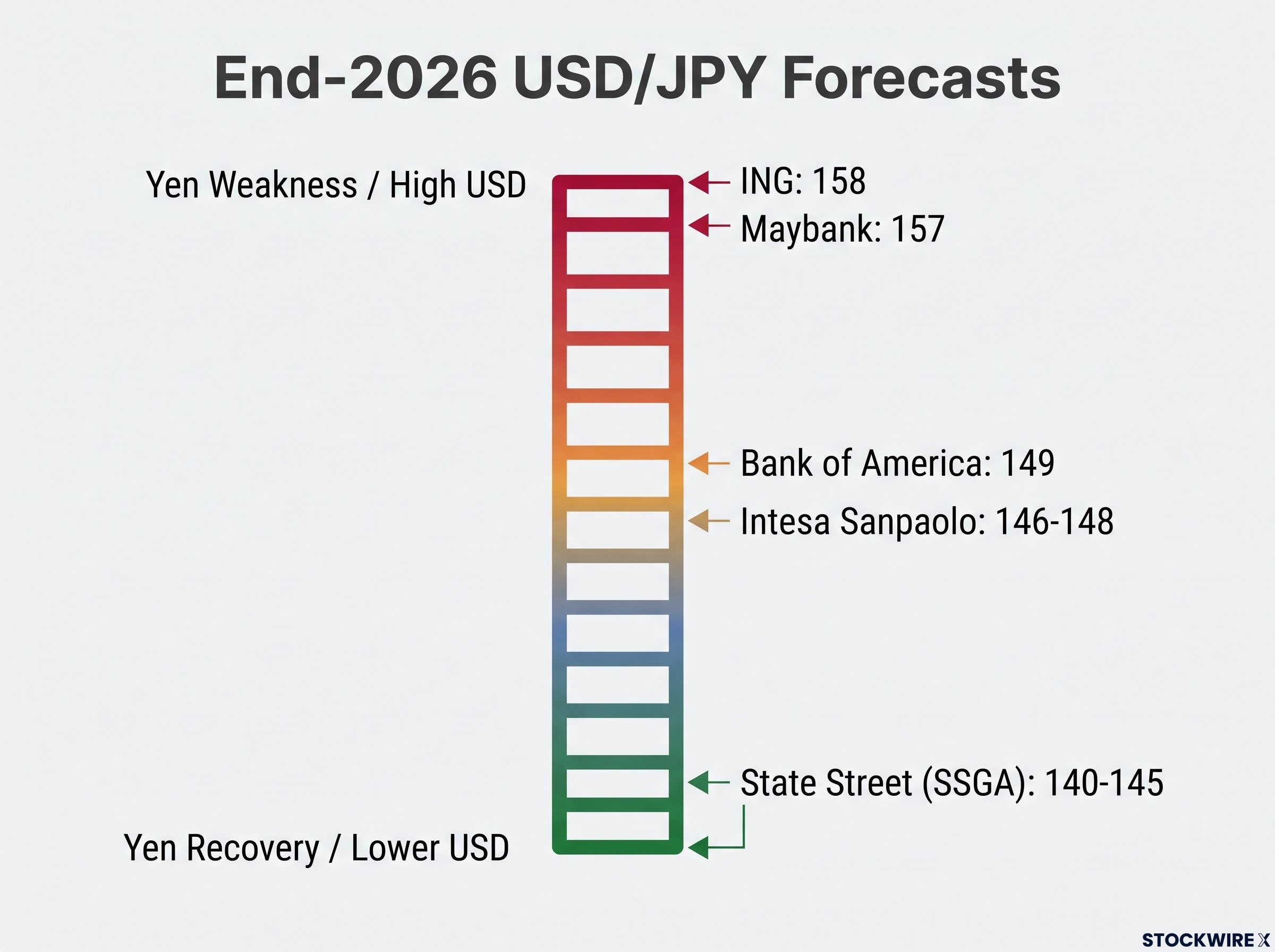
Here is how the full spread of institutional forecasts lines up.
| Institution | End-2026 Target | End-2027 / Longer-Term Target | Primary Rationale |
|---|---|---|---|
| Maybank | 157 | 156 (early 2027) | Structural pull toward US rates |
| ING | 158 | 152 | Yen undervalued but momentum dominates |
| Fitch Ratings | ~6% appreciation | Not specified | Largest gain among Fitch-20 currencies |
| Intesa Sanpaolo | 146-148 | Not specified | Gradual yield convergence |
| Bank of America | 149 | Not specified | Peaking US rate cycle |
| State Street (SSGA) | 140-145 | 120-130 (3-5 yrs) | BoJ normalisation, valuation reversion |
| Eurizon / Nordea | Not specified | ~125 fair value | PPP and Big Mac Index undervaluation |
The gap between ING’s 158 and SSGA’s 120-130 longer-term view is the whole argument in two numbers. It reflects a real disagreement about whether the Fed or the BoJ blinks first, and your own read on that question should shape how you interpret this pair’s next move.
The recovery scenario: what would need to go right for the yen
The recovery camp is not betting on luck. They cite three specific conditions, and each is worth watching for.
- Accelerated BoJ normalisation that starts to close the yield gap
- A Fed pause or pivot that stops the differential from widening further
- Sustained intervention from Japanese authorities whenever USD/JPY approaches 160
The problem for this camp is the Fed’s own guidance. According to the September 2026 Summary of Economic Projections, the median path sits at 4.1% for 2026, and officials do not expect rates to begin falling until 2028.
That timeline matters for you. It means any yen recovery thesis is a slow-burn play requiring patience and clear catalysts, not a quick trade on BoJ hawkishness alone.
Tail risks that could break the trend in either direction
The short-yen trade has become crowded, and crowded trades carry their own danger. When too many participants sit on the same side, the exit gets narrow, and a reversal can turn violent. Three distinct risks sit beneath the surface here.
Funding currency alternatives to the yen have gained traction in 2026, with TD Securities formally assessing the Canadian dollar’s carry-to-volatility ratio as now on par with yen, marking the first time CAD has been positioned as a global funding currency replacement and signalling how crowded the short-yen trade has become.
- Intervention risk: Japanese authorities have flagged 160 per dollar as an informal “danger zone”, and the Ministry of Finance has shown both the will and the firepower to defend it, having deployed ¥11.73 trillion earlier in 2026
- Carry unwind risk: a violently crowded short-yen position means any rapid reversal, from intervention or a global risk-off event, could trigger liquidity strains among Japanese banks and nonbanks with large US-dollar exposures
- Imported inflation and credibility risk: persistent yen weakness is eroding Japanese household real income and complicating the BoJ’s price stability mandate, with the IMF warning that lagging normalisation could damage the central bank’s credibility
The inflation dimension is where the abstract becomes concrete.
FSM Global’s analysis of July 2026 showed yen-based import prices up 29.1% year-on-year, against just 17.7% on a contract-currency basis.
That 11.4 percentage-point gap is a direct measure of how much the weak yen is costing Japanese households. It tells you the BoJ faces political pressure as much as technical pressure to speed up normalisation, because voters feel currency weakness at the checkout.
What a rapid yen reversal would cost corporate Japan
The other side of the coin is corporate earnings, and this is the less-visible risk that makes yen weakness a systemic issue rather than just a macro-positioning story.
According to Daiwa Securities’ Kenji Abe, every 1-yen gain against the dollar reduces the total pretax profit of listed Japanese companies by roughly 0.3%. At the individual level, major automakers estimate that a 1-yen appreciation cuts annual operating profit by around ¥50 billion.
That is the bind facing Japanese policymakers. Exporters benefit from a weak yen, but households and importers bear the cost, and a sharp reversal would slam corporate earnings just as it relieved the inflation squeeze.
For you, the risks cut both ways. An intervention spike or risk-off unwind could produce a rapid 5-10 yen correction that punishes leveraged carry positions, while a failure to defend the 160 line would signal that authorities have lost control of the narrative, with knock-on effects for BoJ credibility and Japanese asset prices.
What the differential needs to do before this trade changes character
Enough about where this pair has been. The more useful question is which variables would actually shift its trajectory, so you can filter the noise around every data release and focus on the readings that matter.
Start with the Fed’s October meeting and its updated dot plot. This is the single most important near-term catalyst. A second consecutive hike widens the differential further and reinforces the short-yen trade. A pause begins the convergence narrative that the recovery camp is waiting for. Markets currently assign a 56.5% probability to that October hike, up from 42.5% just one week prior.
The BoJ’s pace of normalisation is the second variable. Five hikes since the March 2024 exit from ultra-loose policy have lifted the rate to 1.25%, but that is a long way behind the Fed’s more aggressive cycle. The gap shows how much ground the BoJ needs to recover before convergence becomes real.
Against that backdrop, the Fed’s own projections are the anchor to keep in mind.
The September 2026 Summary of Economic Projections puts the median rate at 4.1% for 2026, 3.9% for 2027, and 3.6% for 2028, with the long-run neutral rate nudged up from 3.1% to 3.2%, and no cuts expected until 2028.
Here are the four questions worth tracking from here.
- Will the Fed hike again in October, or signal a pause?
- Will the BoJ accelerate normalisation beyond its current cautious pace?
- Will USD/JPY breach 160 and trigger fresh intervention?
- Is Japanese import inflation building enough political pressure to force faster rate rises?
Use the recovery benchmarks as your yardstick: SSGA’s 140-145 by end-2026 and Intesa Sanpaolo’s 146-148 tell you whether incoming data is supporting or undermining the convergence story.
For investors who want to model how much yen appreciation each 100 basis point shift in the differential produces, our full explainer on USD/JPY convergence dynamics walks through the week-by-week mechanics of how simultaneous Fed and BoJ hikes interact with bond market signals and US inflation prints to set near-term price direction.
Reading the differential, not just the decision
Return to the paradox that opened this piece. Two central banks hiked, and the yen still fell, because the gap between their rates grew wider rather than narrower. That is the whole lesson in one sentence.
In a carry-trade-driven currency pair, the direction of the differential matters more than the direction of any single rate decision. Five BoJ hikes since March 2024 have not meaningfully closed a differential still sitting near 250-275 basis points, which is exactly why the trend has held.
The monitoring framework comes down to three things: Fed forward guidance, the BoJ’s normalisation pace, and intervention triggers near 160. Institutional forecasts spanning from ING’s 158 to SSGA’s longer-term 120-130 reflect genuine uncertainty about when, and whether, that gap finally closes.
Watch the differential, not the decision, and you will read every future Fed and BoJ announcement more clearly than someone tracking the headlines in isolation.
This article is for informational purposes only and should not be considered financial advice. Investors should conduct their own research and consult with financial professionals before making investment decisions. Past performance does not guarantee future results, and financial projections are subject to market conditions and various risk factors.