For nearly two decades, the Japanese yen was the currency the world borrowed to fund almost everything else. Ultra-low rates and deep markets made it the funding liability of choice for professional traders chasing yield elsewhere.
That role has grown unstable. Following the July 2026 intervention episodes around the yen, a gap has opened at the centre of global funding markets, and traders have been searching for the next cheap liability to borrow.
In September 2026, TD Securities put a name to the successor. Its strategists argue the Canadian dollar now sits on par with the yen from a carry-to-volatility standpoint, positioning CAD as the emerging funding currency of the moment.
Understanding this shift matters because it reshapes how currency opportunities line up for the rest of the year. Here is how the Canadian Dollar carry trade actually works, why Washington’s trade policy is doing the heavy lifting, why the Swiss franc is a trap rather than an alternative, and the specific triggers that could break the setup before 2027.
Decoding the carry trade engine and the perfect funding currency
The signal that gets professional attention is not a high interest rate. It is a low carry-to-volatility ratio, and it is doing something unusual for the Canadian dollar right now.
Start with the mechanism itself. A currency carry trade means borrowing in a low-interest-rate currency (the funding currency) and using the proceeds to buy higher-yielding assets in another currency (the target currency). You pocket the interest rate difference and carry the exchange-rate risk.
The framing shift matters here. You need to view certain currencies not as assets to buy, but as cheap liabilities you can borrow to finance higher-yielding bets elsewhere in your portfolio.
Rates are only half the story, though. The other half is volatility, which is where the carry-to-volatility ratio comes in.
The carry-to-volatility ratio This is the interest rate differential divided by the currency’s implied volatility. It measures how much yield you collect for each unit of exchange-rate risk you take on. A wide rate gap and calm currency movements produce an attractive ratio; a narrow gap or a jumpy currency ruins it.
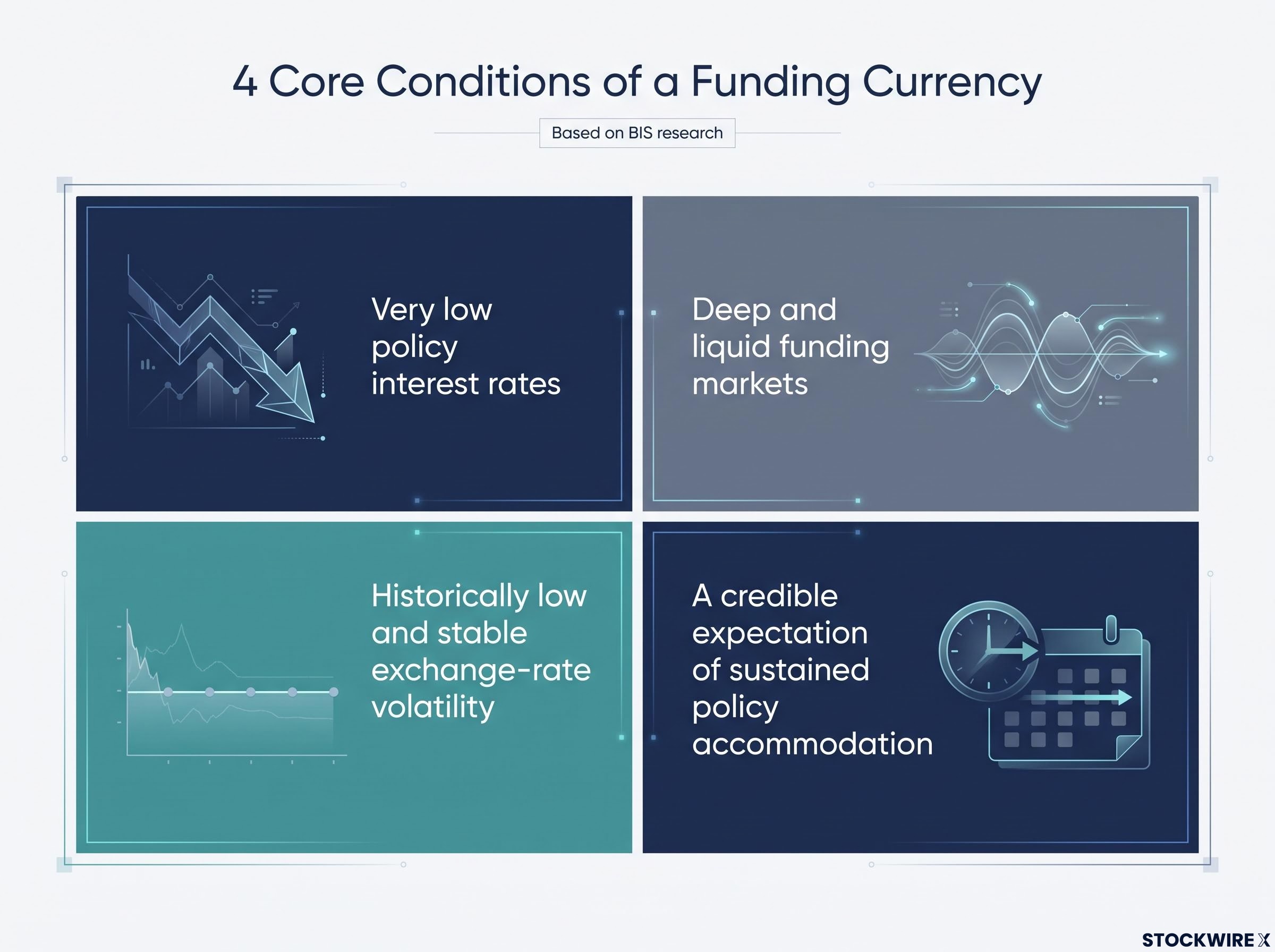
Research from the Bank for International Settlements (BIS) and market practitioners points to four core conditions that make a currency ideal for funding. Any candidate for the yen’s old job needs all of them at once:
- Very low policy interest rates, which keep your borrowing cost cheap
- Deep and liquid funding markets, which let large, leveraged positions trade at scale
- Historically low and stable exchange-rate volatility, which reduces the risk of holding the position
- A credible expectation of sustained policy accommodation, meaning the central bank looks committed to keeping rates low for a long stretch
The yen and the Swiss franc ticked all four boxes for years, which is exactly why they dominated. According to BIS research, the yen’s low yields, deep liquidity, and subdued volatility made it the funding currency of choice, with large speculative short positions stacking up across multiple cycles.
The yen carry trade accumulated speculative short positions across multiple cycles precisely because Japan offered the full combination of near-zero rates, deep liquidity, and subdued volatility, a benchmark the Canadian dollar is now being measured against for the first time.
This foundational knowledge is what lets you read any currency pair through the lens of institutional capital flows rather than retail speculation.
The risk-adjusted return metric
Here is why volatility carries so much weight. A single sharp move in your funding currency can erase months of patiently collected interest in a matter of days.
That is why predictable, gentle depreciation is prized far more highly by institutional traders than a headline-grabbing yield. A currency that drifts slowly weaker while you hold your short position is close to ideal. A currency that lurches upward without warning is the fastest way to lose money on an otherwise sound trade.
When big ASX news breaks, our subscribers know first
Why U.S. tariffs and a sidelined central bank make Canada the prime candidate
Theory only gets you so far. What makes the Canadian dollar interesting right now is a live geopolitical catalyst that is effectively engineering a ceiling on the currency.
TD Securities frames it bluntly: from a carry-to-volatility perspective, CAD is now on par with the yen as a global funding currency. The bank argues that escalating trade tension between the United States and Canada creates asymmetric upside risk in USD/CAD and reinforces the loonie’s role as a funding liability.
Two forces are working together. First, the Bank of Canada held its policy rate at 2.25% in its 2 September 2026 decision, with the Bank Rate at 2.50% and the deposit rate at 2.20%. Second, Washington has piled on tariff pressure.
The tariff picture is severe. The U.S. President signed proclamations under Section 338 of the Tariff Act of 1930, imposing an additional 50% ad valorem duty on targeted Canadian goods including dairy, alcoholic beverages, and motor vehicles, effective 22 August 2026. Canada responded with counter-tariffs of up to 50% on specified U.S. goods, effective 8 September 2026.
Section 338 tariffs on Canadian goods, covering dairy, alcoholic beverages, cement, and motor vehicles, bypassed USMCA protections entirely, meaning Canada’s free-trade backstop offered no buffer against the shock that now underpins the loonie’s structural weakness.
The market read is visible in the price. USD/CAD was trading near 1.38 to 1.39 in early September 2026, testing the 1.39 level that matches TD Securities’ year-end target for the pair.
A structurally capped currency tells you something specific. The downside risk of your funding liability suddenly appreciating, the very thing that wrecks a carry trade, is heavily muted by immediate geopolitical headwinds pressing the currency lower.
Here is how the Canadian dollar’s current profile stacks up against the historical yen benchmark.
| Metric | Canadian Dollar Profile | Historical Yen Profile |
|---|---|---|
| Policy rate | 2.25%, held through end-2026 per TD Securities | Near-zero for close to two decades |
| Carry-to-volatility standing | On par with JPY, per TD Securities | Historically the benchmark funder |
| Downward pressure source | U.S. Section 338 tariffs, trade tension | Sustained ultra-loose monetary policy |
| Funding market depth | Deep domestic, less globally entrenched | Deep global, large offshore liquidity |
This is the bridge between macro policy and market mechanics, and it explains why institutional money is leaning toward CAD shorts right now.
The Section 338 ceiling effect
The tariff shock does more than dent trade figures. As the economic drag registers in Canadian domestic data, it weakens the case for the Bank of Canada to tighten.
TD Securities expects markets to drift away from any hawkish read on the September meeting as tariff effects filter through. A slowing economy pins the central bank in place, which keeps rates low and the funding thesis intact. In effect, the tariffs build the ceiling and the central bank’s forced patience holds it there.
The Swiss franc trap and its structural limits as a funding alternative
If the yen’s replacement had to be picked on interest rates alone, the Swiss franc looks like the obvious answer. After the July yen interventions, plenty of FX participants gravitated toward exactly that view.
The appeal is easy to see. The Swiss National Bank holds its policy rate at 0.00%, the cheapest borrowing cost in the developed world. On the surface, that is a funder’s dream.
The SNB’s zero rate policy, held since June 2025 and projected to remain there through 2028, creates exactly the kind of persistent carry-trade selling pressure that makes economic data prints almost irrelevant to franc direction, a structural feature that coexists uncomfortably with the franc’s safe-haven reflex.
The problem starts with the neighbour. The Eurozone policy rate sits near 2.25%, which creates a differential of roughly 2.25 percentage points in favour of the euro. Going long EUR/CHF earns positive carry, but shorting the franc against the euro, holding CHF as your liability, means paying negative carry rather than collecting it.
Then there is the deeper danger, which has nothing to do with rates.
The gold correlation danger
The Swiss franc behaves like a gold proxy, and that is what makes shorting it so treacherous. Capital that flows into gold tends to bid up Swiss assets at the same time, pushing the franc higher.
The relationship is well documented. A Goldman Sachs FX report noted that the franc had come to mirror gold’s moves, particularly during risk-off episodes, and academic co-integration work finds a long-run link between London gold prices and Swiss franc futures. Historical estimates suggest roughly 0.3% to 0.4% franc appreciation for every 1% advance in gold, though this figure is not independently confirmed.
You must recognise what this means in practice. Shorting a safe-haven currency during a gold bull market exposes you to violent, unpredictable squeezes that can wipe out your collected yield in a single session.
History has already shown the pattern. During the August 2007 quant meltdown, safe-haven flows rapidly unwound franc short positions, according to BIS Bulletin No. 124, and the SNB’s 2015 abandonment of its euro floor delivered another brutal reminder.
This is the trap that catches traders who look only at absolute interest rates and ignore the commodity correlation sitting underneath. TD Securities views continued gold strength and the stable Euro-Swiss rate gap as reasons the franc cannot sustain a prolonged decline the way the yen once did.
Commodity exposure and the triggers that could break the Canadian carry trade
None of this makes the Canadian dollar a safe short. The setup is genuinely fragile, and the biggest weakness is one the yen never had to worry about.
The yen enjoyed structural insulation from commodity cycles. The loonie does not. A Bank of Canada staff analytical note identifies crude oil prices, alongside USD fluctuations and cross-country rate differences, as a key systematic factor driving the currency.
That commodity link cuts directly against the trade. A sharp rise in oil can strengthen the Canadian dollar enough to inflict losses on carry shorts, precisely the kind of sudden appreciation that carry strategies fear.
The tariff premium is a second vulnerability. TD Securities treats the Section 338 negotiations as a binary risk, warning that a breakdown is underpriced while a tentative deal would ease the pressure. A trade breakthrough could strip the geopolitical discount out of the loonie almost overnight, forcing a rapid unwind.
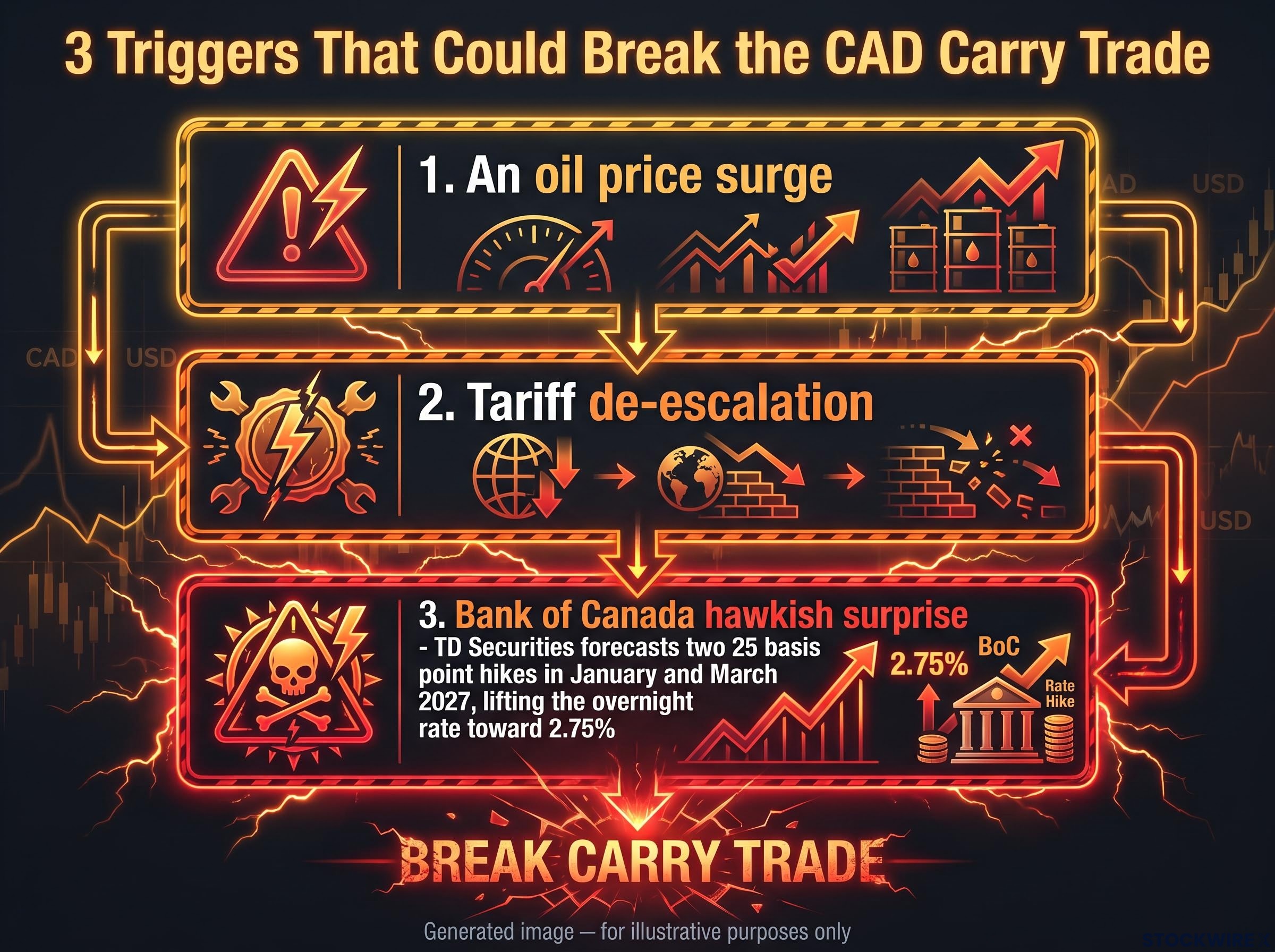
If you are tracking or executing this strategy, sudden crude spikes and positive trade headlines are immediate red flags that demand tight risk management. Here are the three distinct triggers that could reverse the trade, ranked by how quickly they could bite:
- An oil price surge, which can lift CAD sharply regardless of the tariff backdrop
- Tariff de-escalation, a trade breakthrough that removes the geopolitical discount from the currency
- A Bank of Canada hawkish surprise, where TD Securities forecasts two 25 basis point hikes in January and March 2027, lifting the overnight rate toward 2.75%
Those hikes matter most because they carry their own timestamp. They mark the point where the cheap, sidelined-central-bank rationale starts to expire.
Navigating the funding currency transition into 2027
The core argument holds for now. The Canadian dollar offers a rare combination of low, stable rates and geopolitical headwinds that suppress its upside, a blend that TD Securities judges superior to both the yen, which faces potential Bank of Japan catalysts, and the franc, trapped by its gold correlation and negative carry.
Funding currency dominance is path-dependent, though, and this one comes with an expiry date already on the calendar. The setup rests on a sidelined Bank of Canada, and TD Securities’ projected rate hikes for Q1 2027 are the natural point where that logic breaks. Monitoring oil, the tariff talks, and the central bank’s tone is not optional; it is the trade.
Investors exploring which currency pairs sit on the other side of the CAD funding trade will find our deep-dive into the AUD carry trade, which examines how the RBA’s November hike repricing, compressed cross-asset volatility, and Australia’s commodity-exporting profile are combining to create the target-currency counterpart to the current CAD short thesis.
This article is for informational purposes only and should not be considered financial advice. Investors should conduct their own research and consult with financial professionals before making investment decisions. Past performance does not guarantee future results, and forward-looking projections are subject to market conditions and various risk factors.