The Federal Reserve Chair is about to speak at Jackson Hole, and the most important word he might say has nothing to do with rate cuts or hikes. It is “2%.”
TD Securities analysts have flagged the US dollar as facing modestly asymmetric downside risk heading into the Jackson Hole symposium on 22 August 2026. Their reasoning is not the typical Fed-speech playbook of parsing forward guidance for rate-path clues. The dollar’s near-term trajectory, in their framing, hinges almost entirely on whether Fed Chair Kevin Warsh convincingly reaffirms the Fed’s inflation-targeting mandate. Rate expectations are already anchored. What is not anchored is market confidence that the 2% target remains operationally non-negotiable under the current Fed leadership.
Here is the actual risk structure around this event: why credibility matters more than guidance, what the two scenarios look like in practice, and how to approach USD positioning when the trade is about volatility rather than direction.
Why this Jackson Hole is different from the ones traders are used to
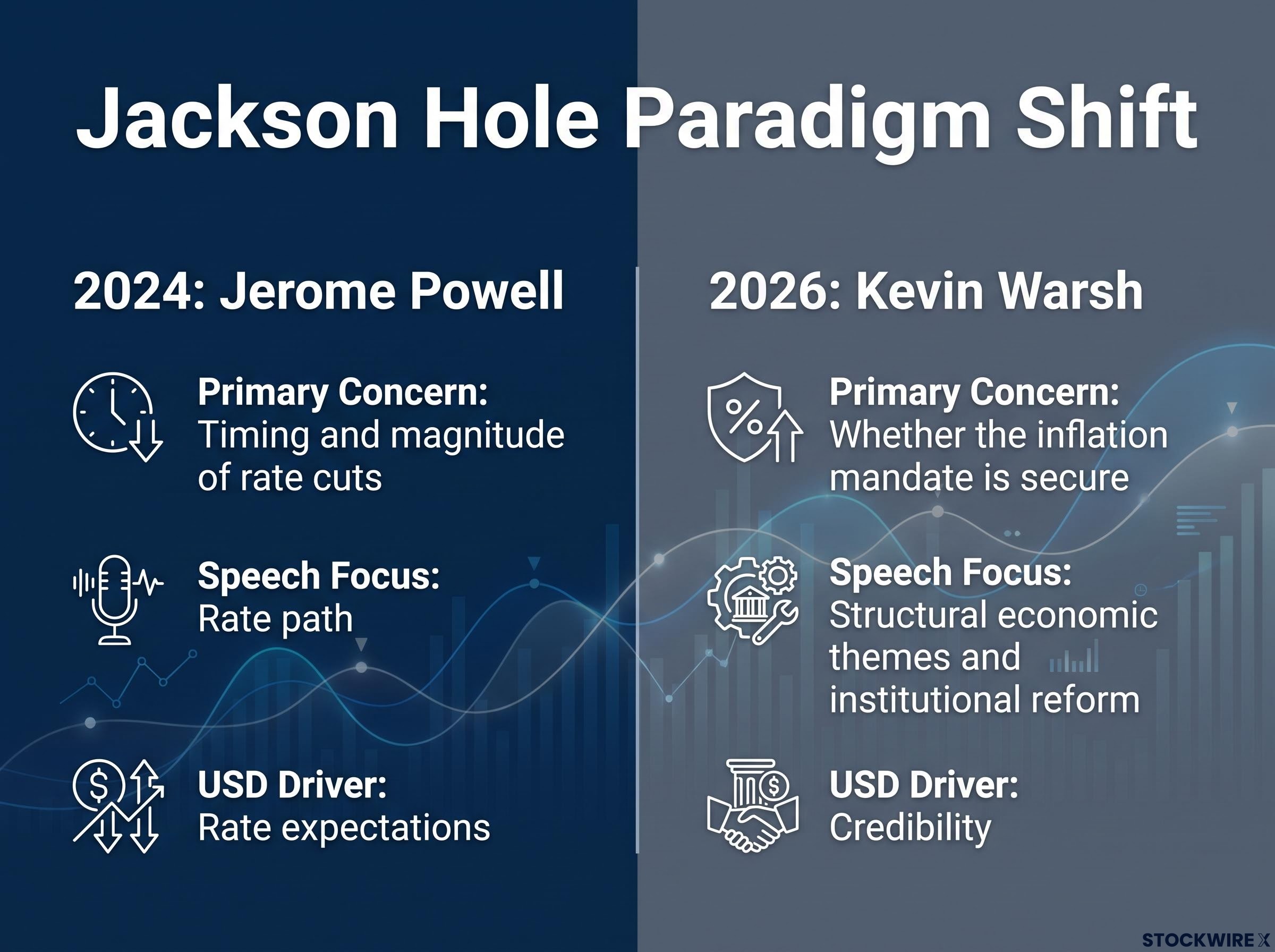
When Jerome Powell addressed Jackson Hole in 2024, markets treated it as a rate-signal event. The speech validated imminent rate cuts once inflation was deemed on a sustainable path back to target, and the dollar moved accordingly. Traders positioned around the rate path. The analytical framework was familiar: parse the forward guidance, adjust the dot plot expectations, trade the direction.
That framework does not apply today. TD Securities expects Warsh’s speech to cover broad structural territory, touching on areas such as productivity, AI-driven growth, supply-side dynamics, and longer-term Fed institutional reform, rather than near-term rate signals. With markets entering the symposium in a state where the rate outlook is broadly settled, there is little room for a durable directional USD move driven by guidance alone.
The shift from rate-signalling to framework-signalling means the tools traders used for previous Jackson Hole events will give them the wrong read this time. Positioning around this speech requires a different lens.
Warsh’s confirmation environment shapes the stakes at Jackson Hole: he inherited headline CPI at 3.8% and regional Fed presidents publicly calling for rate hikes by Q3 2026, conditions that make any perceived softening of the 2% target far more market-moving than it would be in a benign inflation setting.
- Primary market concern: Powell 2024 was about the timing and magnitude of rate cuts. Warsh 2026 is about whether the inflation mandate itself is secure.
- Speech content focus: Powell spoke to the rate path. Warsh is expected to address structural economic themes and institutional reform.
- USD sensitivity driver: In 2024, the dollar moved on rate expectations. Today, it moves on credibility.
When big ASX news breaks, our subscribers know first
Warsh has said all the right things on inflation, so why is credibility still in question?
The rhetoric has been hawkish. In Congressional testimony, Warsh stressed that the Fed is “committed to the 2% inflation goal” and has “no tolerance for persistently elevated inflation.” He framed the mandate in terms that left little room for ambiguity.
Congress tasked the Fed with ensuring price stability “without excuse or equivocation.”
He has explicitly rejected raising the inflation target, stating the Fed “will not be comfortable with inflation above 2%.” He has described a “regime change” in Fed policy to eliminate the “inflation tax.” On paper, this is as hawkish as public communication gets.
So what is the market actually worried about?
Fed independence under Warsh has been a live market variable since his confirmation by a narrow 54-45 Senate vote in May 2026, with Trump’s documented pressure campaign on Powell providing the concrete historical baseline against which every Warsh policy signal is now assessed.
The gap is between verbal commitment and perceived operational rigidity. Markets remain unsure whether the Fed’s reaction function, meaning how it actually behaves when inflation and growth pull in opposite directions, will match the rhetoric. External market commentary, including from KPMG’s Economic Compass (note: this source has not been independently verified), has urged Warsh to “reaffirm the 2% target,” “not move the goalposts,” and clearly explain the reaction function at Jackson Hole. That those calls are being made at all tells you the credibility question is not settled.
Three specific credibility gaps markets are watching:
- Operational reaction function clarity: Will the Fed hold the line on 2% even if it means accepting weaker growth?
- Inflation-versus-growth trade-off: How does the Fed prioritise when the dual mandate pulls in opposing directions?
- Reform framing: Does institutional reform language reinforce or quietly soften the inflation target?
Even a speech full of hawkish language may not move markets if it does not also address how the Fed will behave when the hard choices arrive. Buying the dollar on headline quotes without waiting for the bond market’s reaction is where the mistake lives.
The mechanism: how credibility affects the dollar even when the rate path does not move
The rate path is largely unchanged heading into Jackson Hole regardless of what Warsh says. TD Securities projects rate expectations to remain relatively stable following the speech. That isolation is what makes the credibility variable so visible: if the rate path does not move, any dollar move is almost entirely about perceived mandate durability.
How credibility supports the dollar
When investors trust the Fed will keep inflation near 2% over the medium term, they demand a lower risk premium for holding dollar assets. That trust supports the USD’s expected real value even if nominal rates drift lower. Credibility is a structural floor.
How credibility uncertainty weakens it
When credibility is in question, markets price in a higher probability that future inflation will overshoot, or that the target itself could be softened. That raises discount rates on USD assets, a measure of how much future returns are marked down to reflect risk, and can weaken the dollar even when the next policy rate move is fully priced and unchanged.
Structural dollar weakness adds a second layer to the Jackson Hole risk setup: fiscal-driven term premium, declining foreign capital demand, and coordinated US-Japan intervention have already placed a ceiling on USD strength, meaning the credibility premium the dollar needs from Warsh’s speech is doing heavier lifting than it would in a normal rate environment.
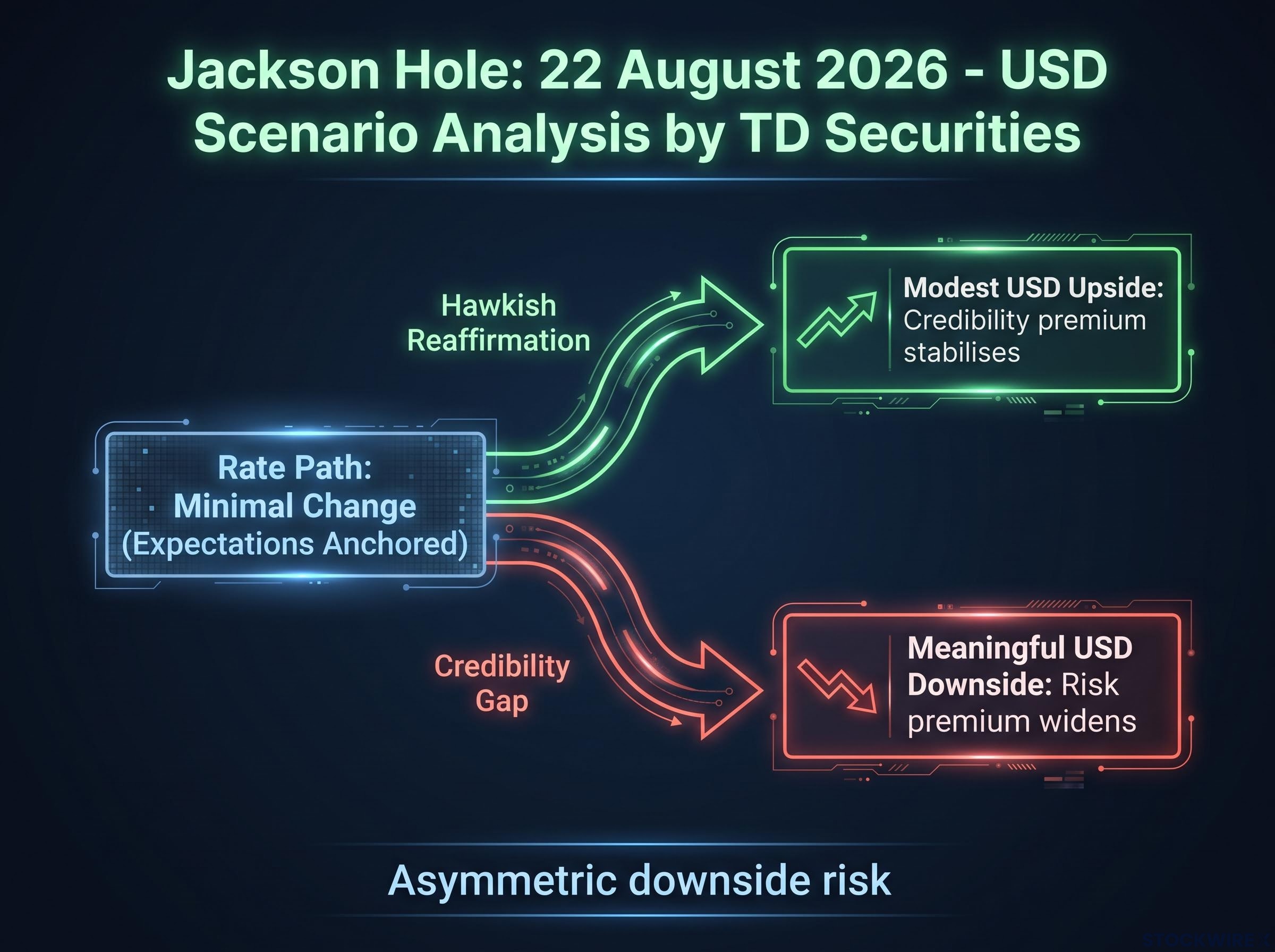
| Scenario | Rate path effect | USD effect |
|---|---|---|
| Hawkish reaffirmation | Minimal change; expectations already anchored | Modest upside; credibility premium stabilises |
| Credibility gap | Minimal change; guidance unchanged | More meaningful downside; risk premium widens |
The asymmetry is the signal. According to TD Securities, a hawkish reaffirmation on inflation credibility is likely to produce only limited USD gains, whereas a failure to put credibility concerns to rest could weigh on the dollar considerably more. The dollar’s fate at Jackson Hole is not about what the Fed will do next quarter. It is about whether markets trust the Fed to hold the line on inflation over the next several years.
Why reform language at Jackson Hole carries its own market weight
TD Securities expects Warsh to address longer-term institutional reform themes, making this speech distinct from a standard policy update. Warsh’s own “regime change” rhetoric provides the context: markets will parse reform language for directional signals on the mandate itself.
The distinction that matters is precise. Reform framed as reinforcing independence, clarity of mandate, and accountability for price stability supports credibility and stabilises the dollar. Reform framed in ways that appear to place structural or political considerations ahead of the inflation target undermines credibility, even without changing immediate policy.
Two categories of reform framing signals to watch:
- Mandate-reinforcing indicators: Language emphasising operational independence, accountability structures, and transparency around the reaction function.
- Dilution-risk indicators: Language that subordinates the inflation target to broader structural goals, references political considerations in policy design, or leaves the impression that the 2% target could be revisited.
Even sections of the speech that sound abstract or procedural, about Fed governance or structural priorities, will be market-moving if they signal which way the mandate’s rigidity is being adjusted. Skipping past the institutional reform portions as policy-neutral is where the positioning risk sits for traders and investors watching this event.
How to trade around an event designed to generate volatility, not direction
TD Securities frames Jackson Hole 2026 as more likely to generate short-term price volatility than establish a sustained directional trend for the dollar. That framing should shape how you position.
The core principle: this is a reaction trade, not a prediction trade. The two-sided outcome distribution, modestly skewed to USD downside but genuinely uncertain, makes large pre-event directional bets unattractive on an expected-value basis. The highest-probability approach is a process trade: read the bond market reaction, then position after the speech rather than before it.
Three post-speech confirmation steps:
- Wait for bond market reaction. The first USD move is often driven by headline algorithms and can reverse as rates markets digest the full speech. The initial spike is not necessarily the signal.
- Read real yield and breakeven direction. Watch 5-10 year Treasury yields and breakeven inflation levels for the credibility read. Rising real yields or falling breakevens after a hawkish reaffirmation would suggest markets are accepting the message. The opposite hints at lingering doubt.
- Size into the confirmed move with adjusted parameters. Once the bond market has spoken, commit to the trade with position sizing that accounts for elevated volatility.
Operational risk adjustments for the session:
- Smaller position sizes relative to usual intraday risk
- Wider stops to account for spread blowouts and whipsaws, while keeping total capital at risk constrained
- Major pairs only: EUR/USD, USD/JPY, GBP/USD, where liquidity is deepest and slippage least severe during event spikes
The discipline here is patience. Waiting for the bond market filter before sizing in is the operational edge when the event is designed to generate volatility, not a clean directional signal.
For investors wanting to track DXY technicals and the specific data hierarchy shaping the dollar into the keynote, our full explainer on the dollar’s Jackson Hole setup covers the 98.50 support level, Friday PMI sequencing, and the RSI conditions that would amplify a hawkish surprise.
What the market will actually be scoring when Warsh speaks
Three variables will determine the USD read in real time, and you can watch for each of them as the speech unfolds:
- Explicit reaffirmation of the 2% target as operationally binding. Not the words “2%” in isolation, but whether Warsh commits to a reaction function that treats the target as non-negotiable even under growth pressure.
- Clarity on the inflation-versus-growth trade-off. Markets need to hear how the Fed will behave when the dual mandate creates tension, not just that both sides matter.
- Framing of institutional reform. Reform that fortifies mandate independence supports credibility. Reform that subordinates it to structural or political priorities does not.
TD Securities’ view: the dollar carries a modest downside skew, with short-term volatility the most probable outcome rather than any clear trend emerging from the event.
The asymmetric risk structure holds across all three criteria. Hawkish reaffirmation across all three offers modest USD support. A credibility gap on any one of them opens the door to more meaningful downside. Because the rate path is anchored, the speech’s lasting impact will run through medium-term USD sentiment and inflation expectations, not the next Federal Open Market Committee (FOMC) decision.
That scorecard gives you a framework for assessing the speech in real time, independently of the headline reactions that may not capture the credibility-specific dynamics at the centre of this event. The question walking out of Jackson Hole is not what Warsh said about rates. It is whether markets believe the 2% target still means what it used to.
This article is for informational purposes only and should not be considered financial advice. Investors should conduct their own research and consult with financial professionals before making investment decisions. These statements are speculative and subject to change based on market developments and Federal Reserve policy decisions.