On 16 September 2026, the Federal Reserve raised interest rates for the first time since July 2023, and the reflexive instinct across trading desks was to reach for the sell button. UBS, publishing its response the following morning, handed clients a different instruction entirely.
The tension between tighter policy and a still-running bull market is not an academic debate. With the federal funds rate now sitting at 3.75% to 4.00%, the live question is whether corporate earnings growth is strong enough to absorb higher discount rates, or whether the rate cycle is about to reprice the entire market. UBS’s 17 September 2026 investor note argues firmly for the former, backed by specific data on retail sales, S&P 500 earnings trajectories, and artificial intelligence capital expenditure. Most major institutions largely agree, though the caveats about where the vulnerabilities sit are worth reading closely.
This unpacks the data behind the UBS investment strategy, stress-tests the constructive call against its counterarguments, and translates the bank’s positioning guidance into concrete decisions you can evaluate against your own portfolio today.
What the Fed just did, and why UBS called it a manageable headwind
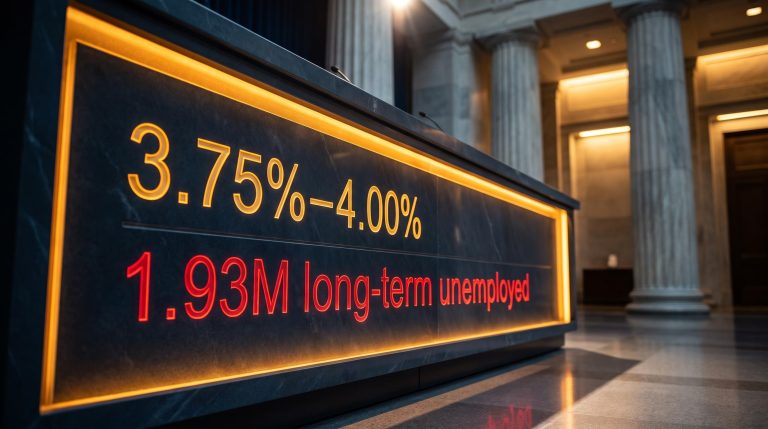
The mechanics were straightforward. The Federal Open Market Committee (FOMC) lifted the target range for the federal funds rate by 25 basis points, from 3.50% to 3.75% up to 3.75% to 4.00%. The vote was unanimous at 12-0, and it marked the first increase since July 2023.
The official framing left little ambiguity about intent.
Inflation composition is the variable that determines whether a given hike does mechanical damage to equities or passes largely without incident; August 2026 core CPI held at 2.4% and was still decelerating, which materially changes what the September decision actually targets.
FOMC statement, 16 September 2026 “Inflation remains elevated.” “Today’s policy action will support a timelier return to the Committee’s 2 percent goal.”
Here is where it gets analytically interesting. The market had spent months pricing in roughly four rate increases across the full tightening cycle. UBS’s own house forecast called for only two. That gap matters, because it means the September decision delivered considerably less shock than defensive positioning had implied it would.
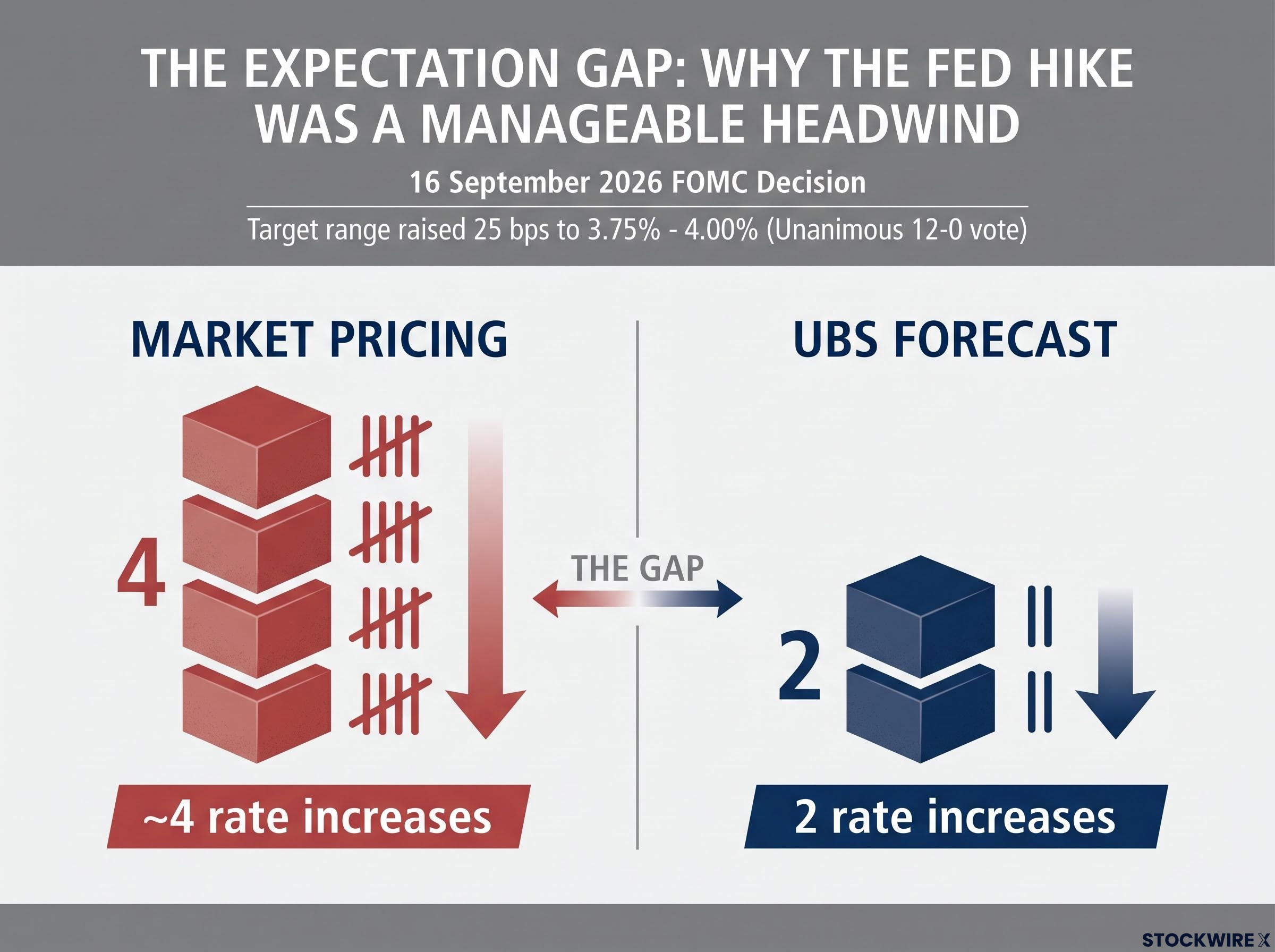
That is the core of what UBS labelled a “manageable headwind.” It does not rest on any claim that rates are low or that inflation is beaten. It rests on the argument that a substantial share of the tightening was already absorbed into asset prices before the announcement landed.
UBS’s framing leans on three supports:
- A meaningful portion of tightening was pre-priced into valuations before the decision, limiting incremental downside.
- The Federal Reserve revised its economic growth outlook upward alongside the hike, which reduces the risk that higher rates choke off corporate profits.
- Strong and broadening earnings growth provides a buffer against the multiple compression that higher rates mechanically produce.
For you, the read is specific. If tightening expectations were already embedded in valuations, and if the residual risk is two hikes rather than four, then investors who positioned defensively for a more aggressive cycle may have over-hedged. UBS is telling clients the leftover rate shock is smaller than the market’s own pricing implied, which reframes the decision from a fresh catalyst for selling into a headwind that earnings can plausibly outrun.
When big ASX news breaks, our subscribers know first
How rate hikes and equity markets actually interact (and why this cycle may be different)
To evaluate that claim rather than simply accept it, you need the transmission mechanism in front of you.
Higher interest rates raise the discount rate, which is the return investors demand to hold a stock rather than a risk-free asset. When that rate rises, the present value of a company’s future earnings falls. This compresses valuation multiples, and it hits long-duration growth stocks hardest, because so much of their value sits in profits expected years out.
That is the standard logic, and on its own it argues for lower equity prices when the Fed tightens. But there is a counterforce, and it is the whole basis of the bull case.
The pace of Fed hikes carries more analytical weight than the direction, with the mildest modern tightening cycle delivering S&P 500 gains of roughly 18% over four months while the most aggressive produced losses near 6%, a 24-percentage-point spread from the same directional rate move.
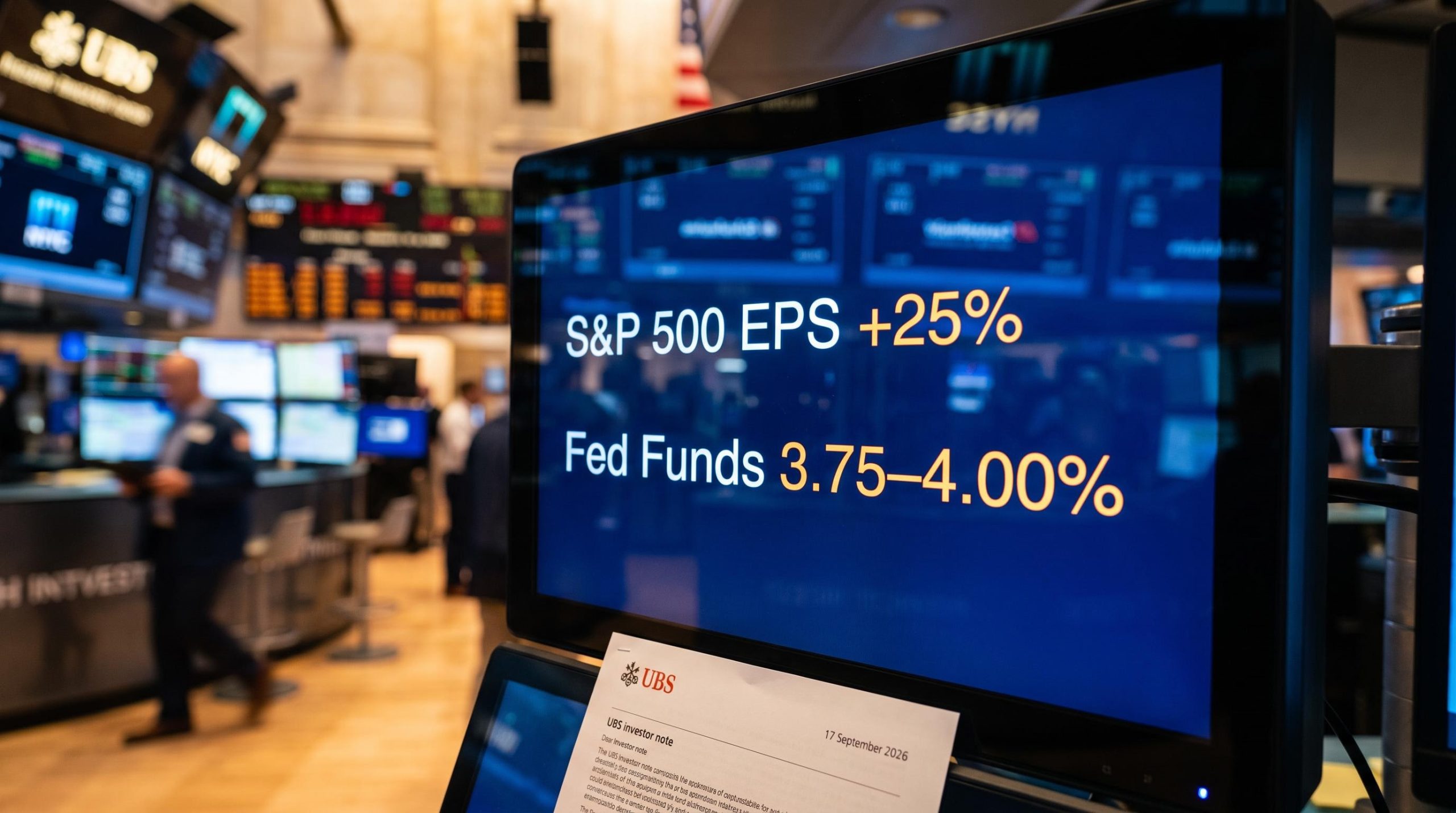
Equity price is a function of two moving parts: the discount rate, which rises with Fed hikes, and the earnings trajectory, which can rise faster. When nominal earnings growth is large enough, it offsets the multiple compression. The price-to-earnings ratio (a measure of how much investors pay for each dollar of profit) can shrink while earnings per share climb quickly enough to keep price levels flat or growing. UBS projects S&P 500 earnings growth of 25% in 2026 and 14% in 2027, which is precisely the kind of trajectory capable of running ahead of higher discount rates.
The 2022 comparison: what is different this time
The obvious objection is 2022. That tightening cycle produced S&P 500 drawdowns, so why should this one behave differently?
The answer is the earnings environment the hikes arrived into. In 2022, rates rose while corporate earnings were decelerating and margins were under pressure, so multiple compression and weakening profits pulled in the same direction. The 2026 cycle arrives alongside a consensus earnings acceleration, not a slowdown, which flips the risk calculus.
UBS points to three features that distinguish this cycle from prior tightening episodes:
- Earnings are accelerating rather than decelerating, projected above 25% growth for 2026 with broadening sector participation.
- The AI capital expenditure cycle provides a structural growth driver that simply did not exist in 2022.
- A large share of the hikes was pre-priced, limiting the valuation shock the decision itself can deliver.
If you hold a growth-heavy portfolio, this framework clarifies the single question that actually matters. It is not whether rates are rising. It is whether your holdings’ earnings are growing fast enough to outrun the multiple compression those rising rates produce. That is a durable mental model, and it applies to the next rate decision as much as this one.
The two pillars UBS cites: earnings forecasts and AI capital expenditure
The first pillar is earnings, and the strength of the UBS case lies less in its own forecast than in the company it keeps.
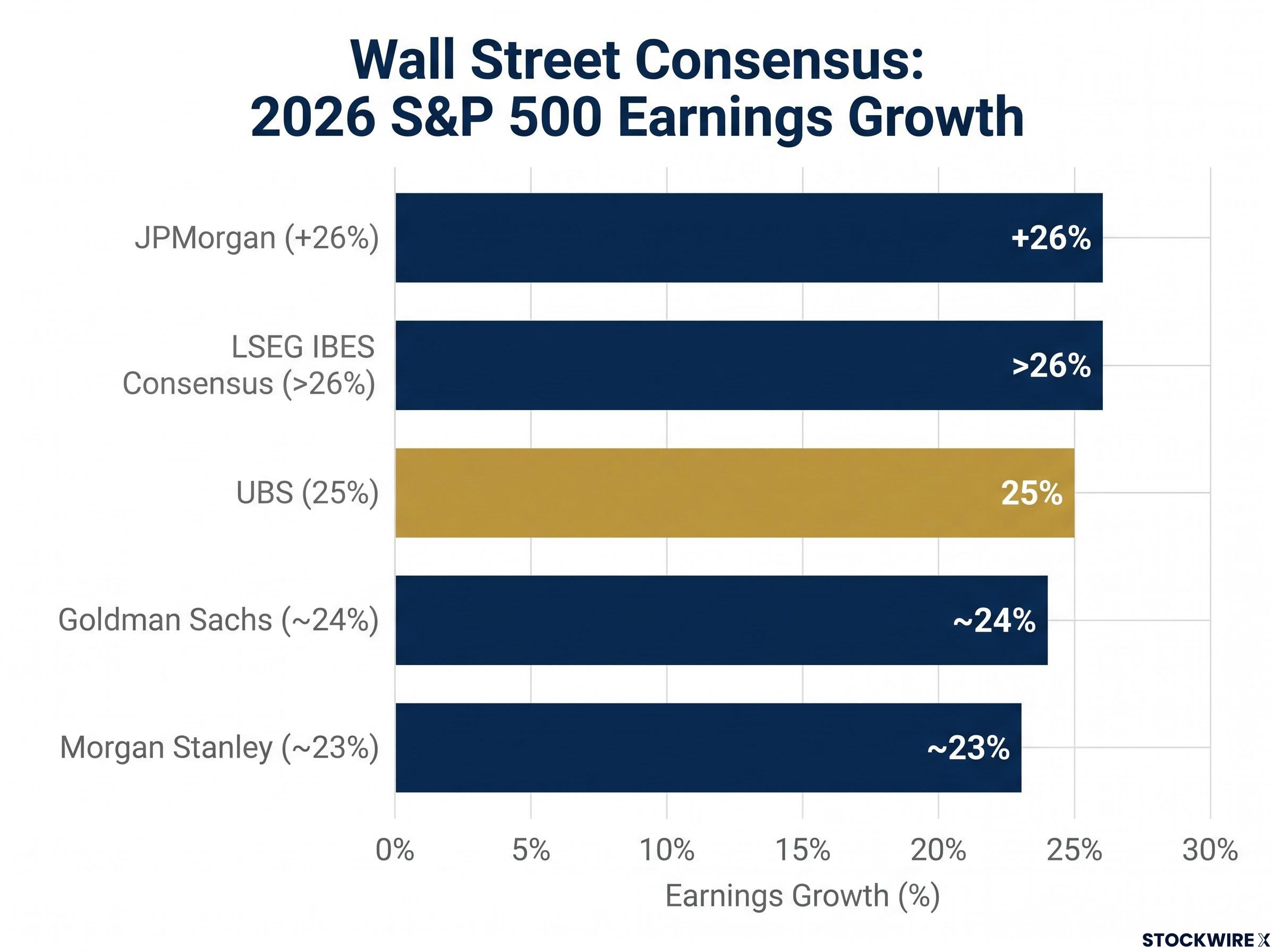
UBS projects 25% S&P 500 earnings growth in 2026 and 14% in 2027. On their own, those are just one bank’s numbers. Placed alongside the rest of Wall Street, they stop looking like optimism and start looking like consensus.
| Institution | 2026 EPS growth | 2027 EPS growth | Source date |
|---|---|---|---|
| UBS | 25% | 14% | 17 September 2026 |
| Goldman Sachs | ~24% (EPS $340) | ~13% (EPS $385) | 28 May 2026 |
| JPMorgan | +26% | +22% | 11 August 2026 |
| Morgan Stanley | ~23% (EPS $339) | EPS $380 | 13 May 2026 |
| LSEG IBES consensus | >26% | Not stated | 30 June 2026 |
When Goldman, JPMorgan, Morgan Stanley and UBS all land near 25% growth from different methodologies, you should treat that convergence as meaningful evidence rather than a single house talking its book. It significantly reduces the risk of being blindsided by one institution’s bias.
The S&P 500 earnings trajectory heading into September was already under scrutiny before the rate decision landed; analysts raised Q2 2026 EPS estimates by 3.4% during the quarter itself, the opposite of the historical 2.7% downward revision pattern, meaning the 23.6% Q2 result represented a genuinely harder hurdle rather than a lowered bar engineered for easy beats.
Supporting the earnings base is the consumer. UBS explicitly cited August 2026 retail sales, which rose 1.2% month-over-month and 6.0% year-over-year to $773.9 billion, as evidence that household spending remains healthy enough to sustain corporate revenue.
The second pillar is AI capital expenditure, and this is the structural argument that operates independently of rate policy.
UBS AI capex projection Global AI-related spending rising from approximately $900 billion in 2026 to $1.2 trillion in 2027, a roughly 33% increase.
UBS argues this spending flows through semiconductors, cloud infrastructure, data centres and power equipment, feeding index-level earnings directly. Goldman Sachs quantifies the effect, estimating AI productivity adds 0.4 percentage points to S&P 500 earnings growth in 2026, rising to 1.5 percentage points in 2027. Reuters reports that five major companies, including Microsoft, Alphabet and Amazon, forecast combined capex near $730 billion in 2026.
S&P Global Ratings AI infrastructure projections place hyperscaler and enterprise AI spending above $1.3 trillion by 2027, an independent credit-ratings perspective that reinforces the structural scale of the growth driver the UBS bull case depends on.
The dissent is worth holding onto. Allianz Research warns that elevated AI spending raises the bar for demonstrable revenue and cash-flow visibility, and that the benefits remain concentrated in a narrow set of names, which amplifies index-level concentration risk. The earnings pillar is real, but it leans heavily on a small group of companies delivering on very large expectations.
What UBS recommends investors do now, and where the risks concentrate
The analysis converts into a decision, and UBS’s guidance is specific enough to test against your own holdings.
The bank’s core positioning recommendations:
- Maintain diversified exposure across the AI value chain, spanning semiconductors, cloud, data centres and power or utilities, rather than concentrated bets on a handful of AI leaders.
- Reduce exposure to rate-sensitive and heavily leveraged concentrations.
- Keep overall equity exposure constructive rather than retreating to cash.
The exposures UBS and cross-institutional research flag for scrutiny sit at the opposite end:
- Overvalued long-duration growth stocks without clear cash-flow visibility.
- Heavily indebted companies reliant on cheap financing.
- Concentrated positions in a few mega-cap AI or tech names, given their outsized sensitivity to both rates and sentiment.
- Small-cap stocks with weaker balance sheets, which Goldman Sachs specifically flags as more vulnerable to tightening than large-caps because of their higher sensitivity to financing costs.
On implementation, cross-institutional research favours diversified vehicles such as sector ETFs and thematic funds over concentrated single-stock positions, which is the practical route for retail investors to hold the AI theme without carrying single-name risk.
For investors ready to act on the diversification and concentration-reduction guidance UBS outlines, our comprehensive walkthrough of portfolio rebalancing after an equity rally covers the specific execution sequence across tax-advantaged accounts, contribution redirections, and taxable sales that minimises friction when shifting out of rate-sensitive concentrations.
The conditions that would change the call
The invalidating conditions matter as much as the bull case, because they turn a passive view into an active watch list.
Inflation is the first trigger: if it re-accelerates and forces hikes beyond the two UBS projects, the discount-rate pressure escalates. Earnings are the second: if growth undershoots the 25%-plus consensus, the primary buffer thins. AI capex is the third: if spending is cut or fails to translate into proportional revenue and profit, the structural pillar weakens. Concentration is the fourth: a sharp correction in mega-cap AI names or credit stress among leveraged firms would drag the indices disproportionately.
Treat these as a monitoring checklist, not a prediction. The investor who knows exactly what would break the thesis can adjust as the evidence moves, rather than holding the view passively until it has already turned against them.
A constructive stance that demands active calibration
The through-line is clean. The September rate hike is a genuine headwind, the institutional consensus on earnings is the primary counterweight, and UBS’s positioning guidance is the translation of that thesis into portfolio action.
The evidence for the constructive view is unusually well-cross-validated. UBS at 25%, Goldman at ~24%, JPMorgan at +26% and Morgan Stanley at ~23% on 2026 earnings growth converge from independent methodologies, August 2026 retail sales of +1.2% support the consumer base underneath those numbers, and the two-hike versus four-hike pricing gap explains why near-term rate shock risk looks contained.
The distinction to carry away is between constructive and passive. Diversifying across the AI value chain and reducing rate-sensitive concentrations are active decisions, not a default to holding everything and hoping. The bull case has defined conditions under which it holds and defined conditions under which it breaks, and the informed approach is to track the second set as closely as the first.
This article is for informational purposes only and should not be considered financial advice. Investors should conduct their own research and consult with financial professionals before making investment decisions. Past performance does not guarantee future results, and financial projections are subject to market conditions and various risk factors.