
One radiopharmaceutical carries almost the entire company. Illuccix generated US$305 million across the first two quarters of 2025 alone, and that single prostate cancer imaging agent still accounts for roughly 75-81% of Telix Pharmaceuticals’ group quarterly revenue.
The question few investors are asking loudly enough is what happens to the investment case if Illuccix plateaus before its therapeutic successor arrives.
Telix is a company mid-transition. It is moving from a single-product diagnostic cash-flow machine toward a multi-cancer radiopharmaceutical portfolio, with a projected 2029 launch of its lead therapeutic candidate, TLX591, as the destination and a run of regulatory and clinical milestones as the path. The Pixclara approval, while a genuine achievement, is not the variable that decides the long game.
This Telix Pharmaceuticals analysis gives you a structured view of each pipeline stage, the revenue risks protecting or threatening that transition, and the specific data points worth tracking to build your own conviction. The aim is to hand you the lens to evaluate Telix as a multi-year holding, not a single-event trade on the next regulatory headline.
What Illuccix actually earns, and why that number is under pressure
Start with the scale, because it explains everything that follows. In Q1 2025, Telix reported group revenue of US$186 million, of which US$151 million came from global Illuccix sales. That is roughly 81% of the entire company running through one product.
Q2 2025 told the same story with slightly different arithmetic. Group revenue reached US$204 million, with Illuccix contributing US$154 million, or about 75% of the total.
Zoom out and the growth is undeniable. Full-year FY 2025 group revenue came in at US$803.794 million, up 56% on the prior year, and H1 2026 revenue reached US$477.35 million, up 22% year-on-year, with the Precision Medicine segment alone contributing US$388.6 million.
| Quarter | Group Revenue | Illuccix Revenue | Illuccix % of Group |
|---|---|---|---|
| Q1 2025 | US$186M | US$151M | ~81% |
| Q2 2025 | US$204M | US$154M | ~75% |
For an investor weighing Telix as a long-term holding, this is the foundation. Illuccix is the engine funding every pipeline bet, so understanding where its pricing power is firm and where it is fragile is the starting point of any credible thesis.
The Pixclara approval, which made Telix the first company to win FDA clearance for a brain cancer imaging radiopharmaceutical, adds a third commercial product to the diagnostics franchise and lends regulatory credibility to the broader pipeline, even if it does not materially shift the revenue concentration problem in the near term.
The pass-through expiry question investors should be asking
Here is where the headline reimbursement number can mislead you. Transitional pass-through payments are temporary Medicare supplements that give newly approved products enhanced reimbursement for a limited window. When that window closes, the product reverts to standard payment mechanics, which typically compresses the effective net price.
Illuccix’s pass-through status expired in 2025, and Morningstar’s Brian Han flagged this as a source of downward pressure on average selling prices.
Morningstar analyst Brian Han reported that Illuccix average selling prices face downward pressure following the expiration of transitional pass-through payment status in 2025, with clinicians facing minimal barriers to switching to competing PSMA diagnostic products, which limits Telix’s pricing leverage.
The Medicare list rate itself actually rose. CMS data shows the payment for HCPCS code A9596 climbing from US$1,177.85 per millicurie in 2025 to US$1,236.67+ from 1 January 2026.
That gap between a rising list rate and a warning about net ASP pressure is the whole point. The published Medicare number is not the price Telix banks after distributor margins and product mix, and the net impact of the pass-through expiry at that level is not documented in public sources. Do not read the CMS rate alone and conclude Illuccix pricing is stable; that is a known unknown worth flagging in your own due diligence.
When big ASX news breaks, our subscribers know first
Zircaix and the manufacturing lesson from the FDA’s Complete Response Letter
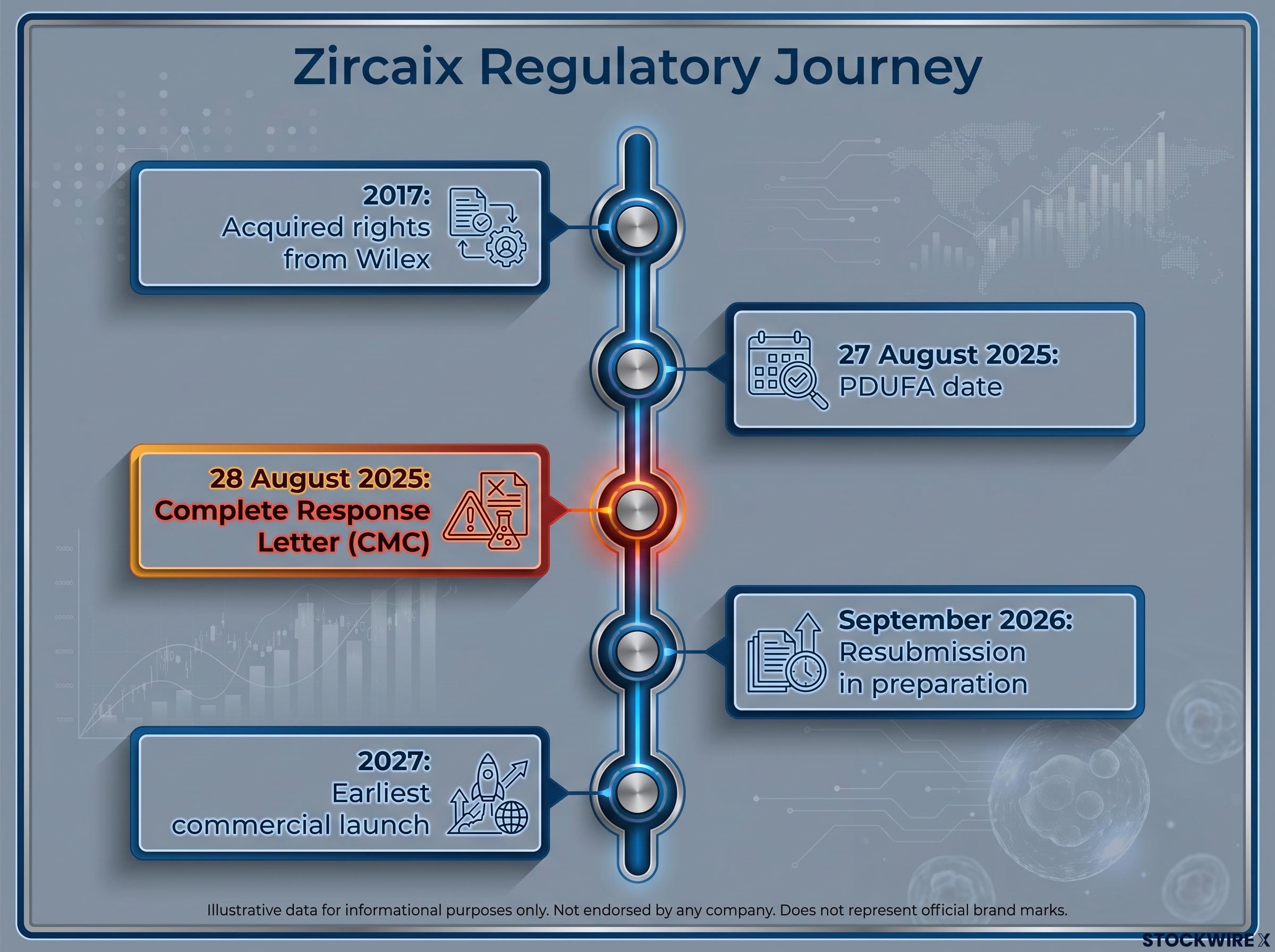
The FDA delivered its verdict on Zircaix one day after the deadline. Following a Priority Review with a Prescription Drug User Fee Act (PDUFA) date of 27 August 2025, Telix received a Complete Response Letter (CRL) on approximately 28 August 2025, a regulatory notice that the application cannot be approved in its current form.
The grounds matter more than the timing. The CRL cited deficiencies in the chemistry, manufacturing and controls (CMC) package, specifically a lack of demonstrated comparability between the product used in the ZIRCON Phase 3 trial and the scaled-up commercial manufacturing process.
That distinction tells you something. A CRL issued the day after review completion, on CMC grounds, signals the FDA worked through the file thoroughly and found a substantive technical gap rather than a procedural one. For radiopharmaceuticals, comparability between trial-scale and commercial-scale batches is a recurring sector-wide challenge, not a Telix-specific stumble, but it is Telix carrying the cost of the delay.
The FDA CMC considerations for radiopharmaceuticals specifically identify comparability between trial-scale and commercial-scale batches as a recurring challenge, driven by the short half-lives and rapid manufacturing cycles that make scale-up documentation materially harder to standardise than in conventional biologics.
In terms of its biology, Zircaix binds to a cell-surface antigen that is expressed in clear cell renal cell carcinoma while remaining undetectable in normal kidney tissue, and Telix has held exclusive worldwide licensing rights from Wilex since acquiring them in 2017. Its regulatory journey has run as follows:
- BLA submitted to and accepted by the FDA with Priority Review designation
- PDUFA date set for 27 August 2025
- Complete Response Letter received approximately 28 August 2025 on CMC comparability grounds
- Corrected CRL issued, followed by a granted extension of the BLA resubmission deadline
- Resubmission still in preparation as of September 2026, with no confirmed filing date or new PDUFA date
What a successful resubmission would change for the investment case
A cleared resubmission would give Telix its second commercial-stage product and its first meaningful step into kidney cancer, directly reducing the single-product concentration that defines the company today.
That is the upside. The timing is the catch.
With the resubmission unfiled and no new PDUFA date confirmed, any commercial launch realistically sits in 2027 at the earliest. For an investor, Zircaix represents the clearest near-term route to revenue diversification, and its delay extends the period during which Illuccix carries the entire commercial weight of the company.
TLX591, what a 25% success probability actually means for investors
Lead with the number that sets the odds. Morningstar assigns a 25% probability to the successful commercialisation of TLX591, Telix’s most advanced therapeutic candidate for metastatic prostate cancer.
Brian Han, Director of Equity Research at Morningstar Australasia Pty Ltd, assigns a 25% probability to the successful commercialisation of TLX591.
Sit with what that implies. Three out of four modelled scenarios see Telix’s most important therapeutic candidate failing to reach commercial scale. This is not a base case; it is a discounted bet, and the market treats it accordingly.
The bull and bear cases pull in opposite directions:
- Bull case: an interim Phase 3 readout anticipated in 2026 as the near-term inflection point, a projected commercial launch in 2029, and Telix’s estimate that TLX591 costs roughly one-fifth of Novartis’ Pluvicto to manufacture, attributed to reduced radiation waste and lower Lutetium-177 requirements.
- Bear case: the 25% base probability, a lengthy runway stretching to 2029, dependence on Lutetium-177 supply, and the absence of independent verification of that manufacturing cost advantage.
Pluvicto is the benchmark to beat. Novartis received regulatory approval for it in March 2022 as the first PSMA-targeted radioligand therapy for metastatic prostate cancer, which makes TLX591 the challenger thesis. That thesis depends on two things holding at once: the clinical data succeeding and the manufacturing cost edge surviving independent scrutiny it has not yet faced in public sources.
The theranostic platform economics underpinning Telix’s transition explain why Novartis, Eli Lilly, and Bristol-Myers Squibb collectively deployed over USD 6.5 billion in radiopharmaceutical M&A between 2023 and 2025: a single biological target can generate two commercial revenue streams, compressing development risk while expanding the addressable patient pool.
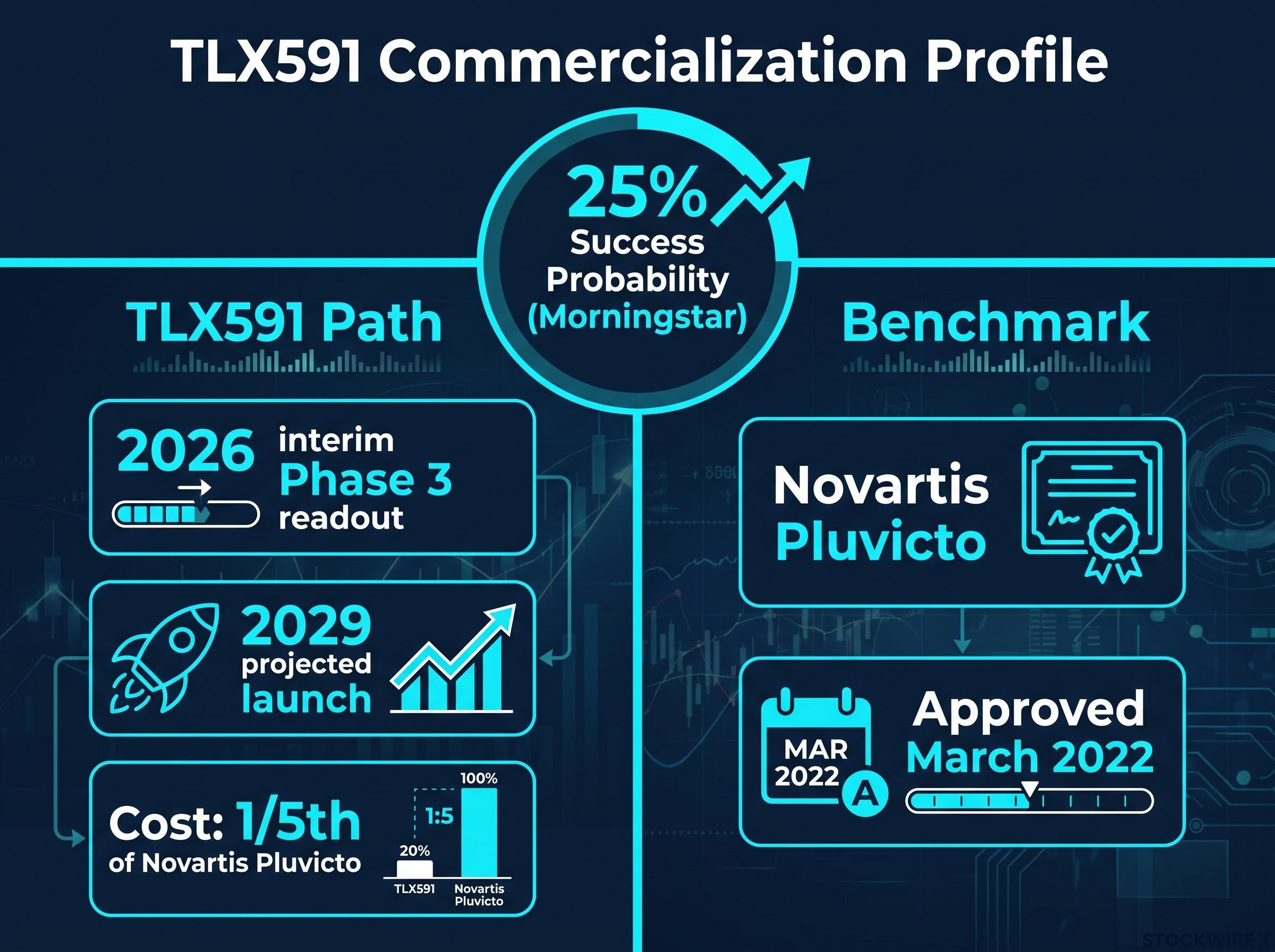
Because the expected value is already discounted so steeply, the 2026 interim readout becomes a high-impact binary event. A clean result is a de-risking moment that could re-rate the stock upward; a weak one cuts hard the other way. An investor who cannot articulate how they would weight that interim data cannot honestly claim a 2029 position on Telix, because TLX591 is the single largest variable in the long-duration case.
The four risks that could stall the 2029 roadmap
Think of this less as a disclaimer and more as a triage. Each risk threatens the roadmap differently, and they do not deserve equal weight in your attention.
Revenue concentration sits at the top because it is structural and immediate. With Illuccix at 75-81% of quarterly revenue, everything else is funded by one diagnostic product, and any wobble in its trajectory hits the whole machine at once.
Pipeline execution is the second-order concern, and it runs in two parts. Zircaix must clear its CMC resubmission with no confirmed filing date or PDUFA as of September 2026, and TLX591 must convert a 25% probability into an approval by 2029, with the 2026 interim readout as the pivot.
| Risk Category | Specific Trigger | Severity Signal | Investor Monitoring Point |
|---|---|---|---|
| Revenue concentration | Illuccix plateau or pricing erosion | 75-81% of quarterly revenue | Quarterly Illuccix ASP vs CMS rate |
| Pipeline execution | Zircaix CMC and TLX591 trial outcomes | No PDUFA date; 25% TLX591 probability | Resubmission filing; 2026 interim readout |
| CMS reimbursement | Fee-schedule and coding changes | Multiple A9596 / A9513 adjustments | Annual CMS rate revisions |
| Manufacturing / supply | CMC scale-up and Lutetium-177 supply | Zircaix CRL as live example | Manufacturing capex disclosures |
The read for an investor is blunt. You are underwriting a roughly three-year execution runway funded almost entirely by one diagnostic product, and each of these categories is a different way that runway could shorten without warning.
Sector-wide pressures Telix cannot control
The third and fourth risks sit outside the company’s hands. CMS reimbursement policy is a persistent sector-wide pressure, evidenced by the documented pattern of multiple rate adjustments through 2025-2026 for radiopharmaceutical codes including Illuccix (A9596) and Lutathera (A9513). Fee-schedule calibration can move diagnostic economics regardless of how well Telix executes.
Lutetium-177 supply is the fourth risk, and it feeds directly into the TLX591 thesis. Telix’s cost-advantage claim rests partly on needing less of the isotope than Pluvicto, so any tightening in Lutetium-177 supply threatens the very economics the bull case leans on.
The honest limitation here is data. Granular analyses benchmarking Telix’s specific Lutetium-177 exposure against peers are not publicly available, which is itself an analytical gap to note. Telix’s FY 2025 and H1 2026 communications flag substantial investment in supply chain and manufacturing infrastructure, an implicit acknowledgment that these pressures are real, with the US$388.6 million H1 2026 Precision Medicine segment providing the cash-flow base to fund that build-out.
Whether the 2029 investment case holds up under scrutiny
The roadmap is coherent, but it is a chain of dependencies, and a chain is only as strong as its weakest link. Illuccix has to hold its margins through pricing pressure. Zircaix has to clear its CMC resubmission and win real commercial uptake. TLX591 has to deliver a positive 2026 interim readout and then reach approval by 2029.
The manufacturing cost claim is the swing factor for TLX591. If the one-fifth-of-Pluvicto estimate holds, the competitive economics are compelling; if independent scrutiny narrows it, the commercial case shrinks with it. That estimate remains a Telix figure without public independent verification.
The cash-flow base is genuine. FY 2025 revenue of US$803.794 million and H1 2026 revenue of US$477.35 million fund the pipeline. But Morningstar’s 25% probability on TLX591 anchors the long bet, and an investor who can stomach the binary risk of the 2026 readout and the Zircaix resubmission is underwriting a fundamentally different profile than one pricing Telix on current Illuccix cash flows alone.
Beyond the pipeline variables, a US$600 million convertible bond overhang and dual-listing arbitrage pressure between the ASX and Nasdaq sit as structural headwinds that analyst consensus targets of A$23.34 to A$24.22 acknowledge but do not resolve on their own.
Over the next 12-18 months, three data points will tell you which way the case is breaking:
- The Zircaix resubmission filing date and any new PDUFA date
- The TLX591 Phase 3 interim readout outcome
- Illuccix’s quarterly ASP trajectory relative to CMS rate movement
This article is for informational purposes only and should not be considered financial advice. Investors should conduct their own research and consult with financial professionals before making investment decisions. Past performance does not guarantee future results, and financial projections are subject to market conditions and various risk factors.