SpaceX and Tesla have each formed special committees of independent directors to study a possible combination, Elon Musk confirmed on SpaceX’s third-quarter earnings call on 20 October 2026. Musk said he cannot sit in on those discussions because, as he put it, he is “a conflicted party” with large stakes on both sides.
The disclosure turns years of speculation about a SpaceX Tesla merger into a formal process. It is still a process, not a deal. No terms, exchange ratio or shareholder vote have been announced, and Musk warned that talks are early and a transaction is not certain.
If you hold Tesla or SpaceX, the parts that matter most are the approval threshold, the analyst scenarios being circulated, and the governance risks. Together, they show how far this sits from a done deal.
Why the 50% vote of all Tesla shares is the real test
Musk raised the toughest obstacle himself. He told the call that Tesla’s approval requirement was “quite a high hurdle,” according to Business Insider.
Elon Musk, CEO of SpaceX and Tesla “We will need a 50% vote of all shares, not just those who vote, but of all shareholders.”
That distinction is the whole story. A majority of votes cast only counts shareholders who actually vote. A majority of outstanding shares counts every share, so any share that sits idle on deal day effectively counts as a no.
The reference point is Tesla’s 2024 vote to move its incorporation from Delaware to Texas. That proposal drew about 63% of outstanding shares, according to the Delaware Court of Chancery record. The threshold can be cleared, but only with heavy turnout and strong support.
Tesla’s SEC filing confirms the company’s certificate of formation and bylaws are now governed by Texas law, the legal framework that will shape any shareholder approval process for a combination with SpaceX.
For you as a Tesla holder, the message is simple. Not voting is not a neutral act, and the outcome may hinge on turnout as much as on whether the terms look attractive.
The process carries its own credibility burden. Musk called the recusal arrangement “an odd kabuki dance,” with the two companies’ representatives free to talk while he stays out of the room. That puts the independent directors, their advisers and the paper trail at the centre of any eventual verdict.
As of 20 October, the companies had not disclosed:
- Committee members
- Financial or legal advisers
- Deal terms
- An exchange ratio
- A formal vote notice
When big ASX news breaks, our subscribers know first
What analysts think a combined company would look like
With no proposal on the table, analysts have filled the gap with their own numbers. Their views range from near-certainty to a five-year wait.
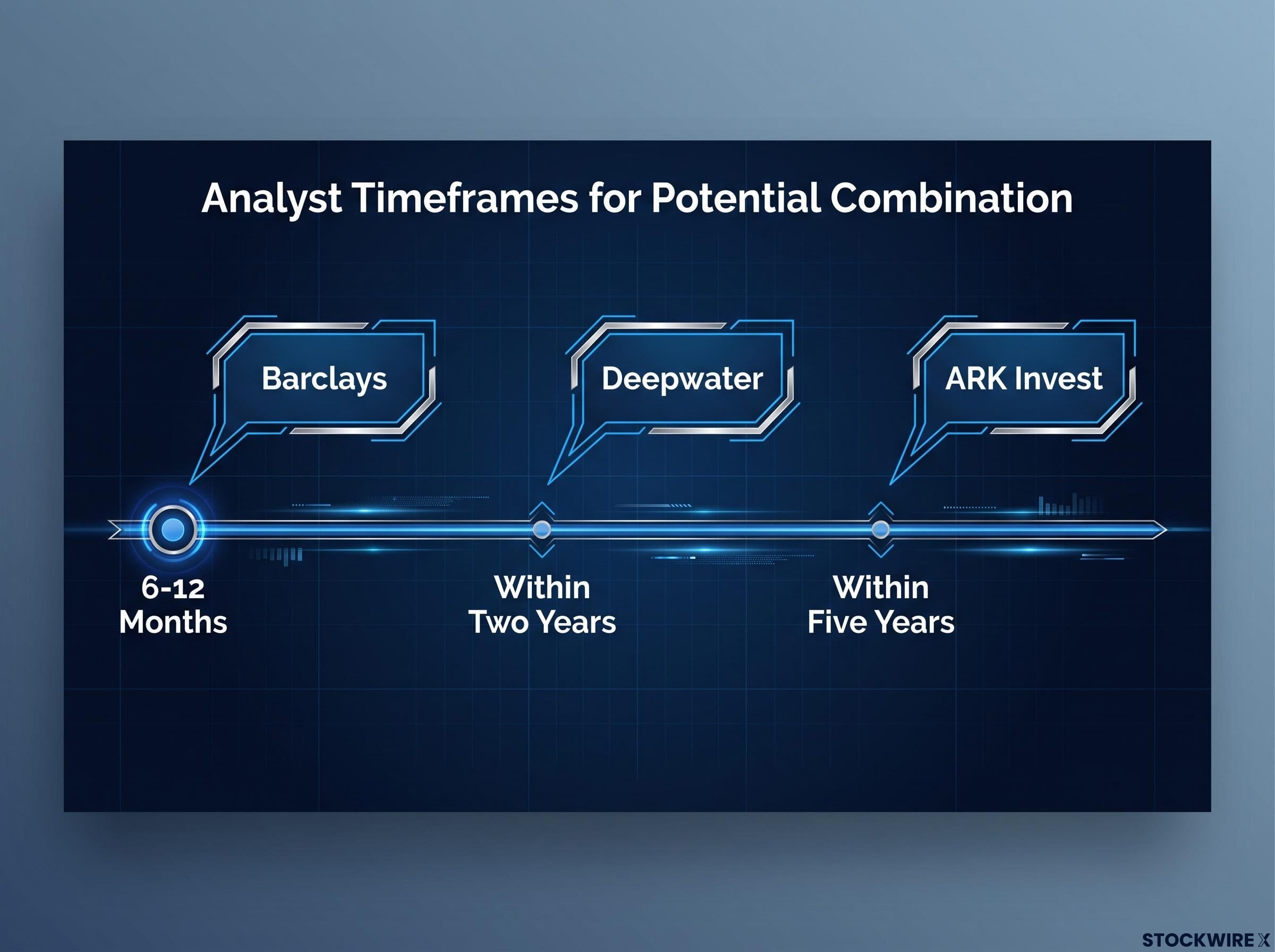
Barclays analyst Dan Levy sketched an all-stock deal with SpaceX as the buyer, according to secondary coverage of his client note. Using illustrative values of about $2.1 trillion for SpaceX and $1.5 trillion for Tesla, he arrived at roughly 0.7 SpaceX shares per Tesla share before any premium. A premium is the extra amount a buyer pays above a target’s market value to win approval.
| Source | View | Timing | Key figure |
|---|---|---|---|
| Barclays (Dan Levy) | SpaceX buys Tesla in an all-stock deal | Deal within 6-12 months | ~0.7 SpaceX shares per Tesla share |
| Deepwater (Gene Munster) | Combination highly likely | Within two years | ~95% probability |
| Future Fund (Gary Black) | “Inevitable,” with dilution risk | Not specified | Heavy dilution possible for Tesla holders |
| ARK Invest | Possible, but models Tesla standalone | Within five years | Not specified |
| RBC Capital Markets | SpaceX acquires Tesla | Not specified | ~$480 per Tesla share; ~$3.74T combined |
Levy also suggested an announcement could come before Tesla’s annual meeting. Gary Black, by contrast, warned that a stock-for-stock swap could heavily dilute existing Tesla holders, meaning their slice of the combined company could shrink.
None of these are company proposals. The gap between 6-12 months and five years shows that even bullish analysts are guessing on timing, so you should read each figure as a scenario rather than a forecast.
Wolfe Research has described the merger as a mainstream institutional investment thesis rather than retail speculation, and it lists dilution, capital intensity, conflicts and regulatory exposure as the four main obstacles to any deal.
The control question
In the Barclays scenario, Musk would own about 37% of combined equity but control about 56% of votes. That gap would come from shares carrying different voting weights, so he could hold majority control without majority ownership.
That figure comes from secondary coverage of an analyst note, not from any disclosed structure.
The strategic case, and the strong quarter behind it
Musk framed a merger as having “a lot of merit.” He pointed to six areas where the companies overlap:
- Superintelligence software
- Chip design
- Terafab, the custom semiconductor manufacturing effort
- Robotics
- Orbital mass transport
- Connectivity
Those overlaps are expensive. Starship, satellites, AI infrastructure and chips all consume capital, and a larger combined public balance sheet could help fund them.
The quarter Musk reported alongside the committee news strengthens SpaceX’s side of that argument.
| Revenue | Growth | Net income | Consensus (LSEG) |
|---|---|---|---|
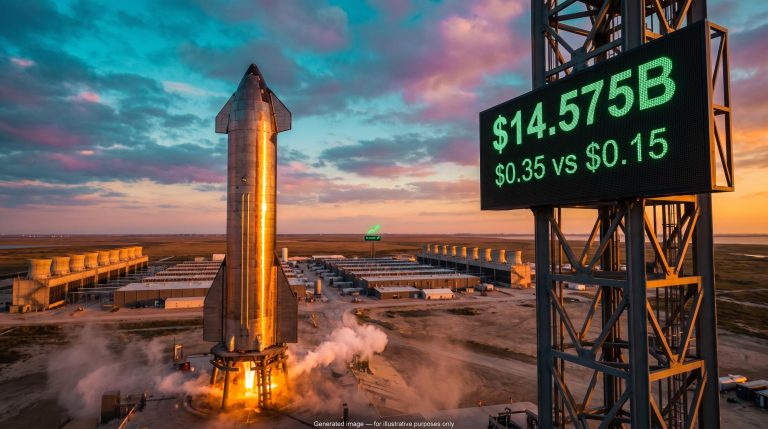
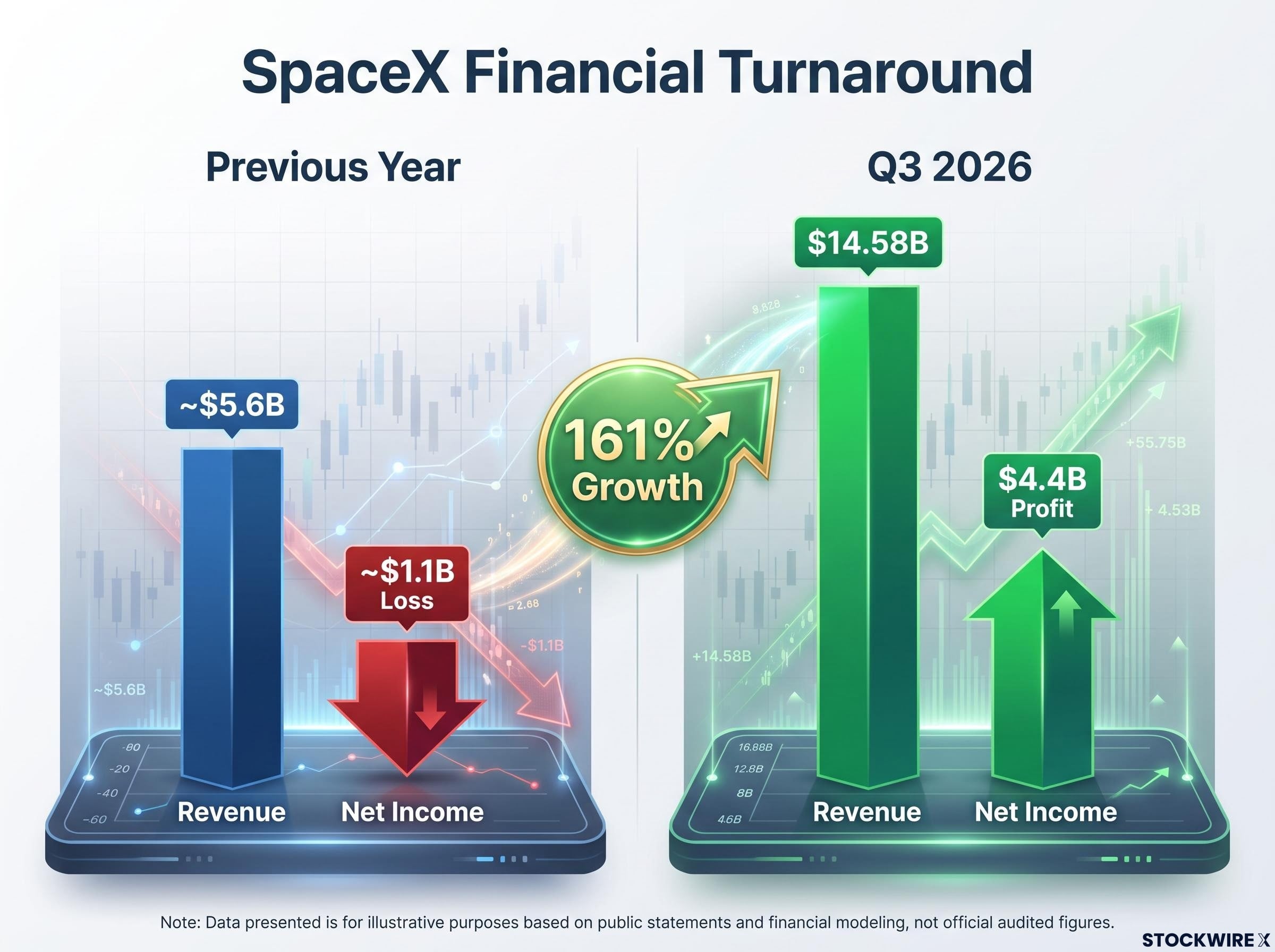
| $14.58B | 161% from ~$5.6B | $4.4B vs ~$1.1B loss a year earlier | $12.72B |
Revenue cleared the $12.72 billion LSEG consensus cited by Reuters and CNBC. It also beat the higher $12.87 billion estimate Investing.com used. The swing from a loss to $4.4 billion in profit came less than a year after SpaceX acquired xAI in February 2026 and listed publicly in July 2026.
SpaceX’s four revenue segments (launch, Starlink broadband, Direct-to-Cell and AI compute) sit at different maturity stages, which is why a profit swing of this size needs to be read segment by segment.
Markets responded cautiously. SpaceX shares rose roughly 4%-5% after hours, while Tesla gained around 1% in reported trading, though snapshots taken at different times varied.
For Tesla holders, the context matters. SpaceX would come to any negotiation with a strong hand, and that strength affects what Tesla shareholders might receive in exchange.
What could derail it: conflicts, dilution and the SolarCity shadow
Tesla investors have seen a related deal before. In 2016, Tesla bought SolarCity while Musk was Tesla’s CEO and chair and also a major SolarCity shareholder. Critics called it a conflicted rescue, and the deal led to years of shareholder litigation.
The lesson still applies. A strong strategic story does not settle concerns about whether directors fulfilled their duties to all shareholders, and shareholders can challenge a deal even after it is approved.
The risks this time are familiar:
- Musk’s conflict of interest as CEO and major shareholder on both sides
- Dilution of minority Tesla holders in a stock-for-stock swap
- Uncertainty over the exchange ratio and any premium
- Voting control concentrated in Musk’s hands
- Regulatory complexity
On that last point, combining an automaker with a space and defence contractor, a satellite provider and AI businesses could draw scrutiny across antitrust, national security, telecoms, defence contracting and auto regulation, according to reported concerns. The SpaceX-xAI deal shows Musk is willing to consolidate his companies. It does not prove Tesla will follow.
Musk’s caution Musk said that no terms had been agreed, a deal is not certain, and talks are at an early stage.
The main risk is not whether the deal makes strategic sense. It is whether the process holds up under scrutiny, so committee disclosures will tell you more than daily price moves. The signals to watch are:
- Committee members named
- Independent advisers appointed
- Terms or an exchange ratio disclosed
- A formal vote notice filed
What to watch before treating this as a deal
The committees are real, and SpaceX brings a record quarter to the table. Even so, the hardest questions are still open: whether the vote can clear its threshold, how much Tesla holders might be diluted, and how the conflict of interest will be managed.
The next milestones are concrete. Look for the names of committee members, the advisers they appoint, any disclosed exchange ratio, and eventually a vote notice that sets the turnout challenge in motion. Until those arrive, analyst probabilities are informed guesses rather than terms.
Investors exploring how to weigh these analyst cases will find our dedicated guide to scenario-based stock valuation shows how to assign probabilities and test entry prices.
This article is for informational purposes only and should not be considered financial advice. Investors should conduct their own research and consult with financial professionals before making investment decisions. Past performance does not guarantee future results. Financial projections are subject to market conditions and various risk factors, and forward-looking statements are speculative and subject to change.