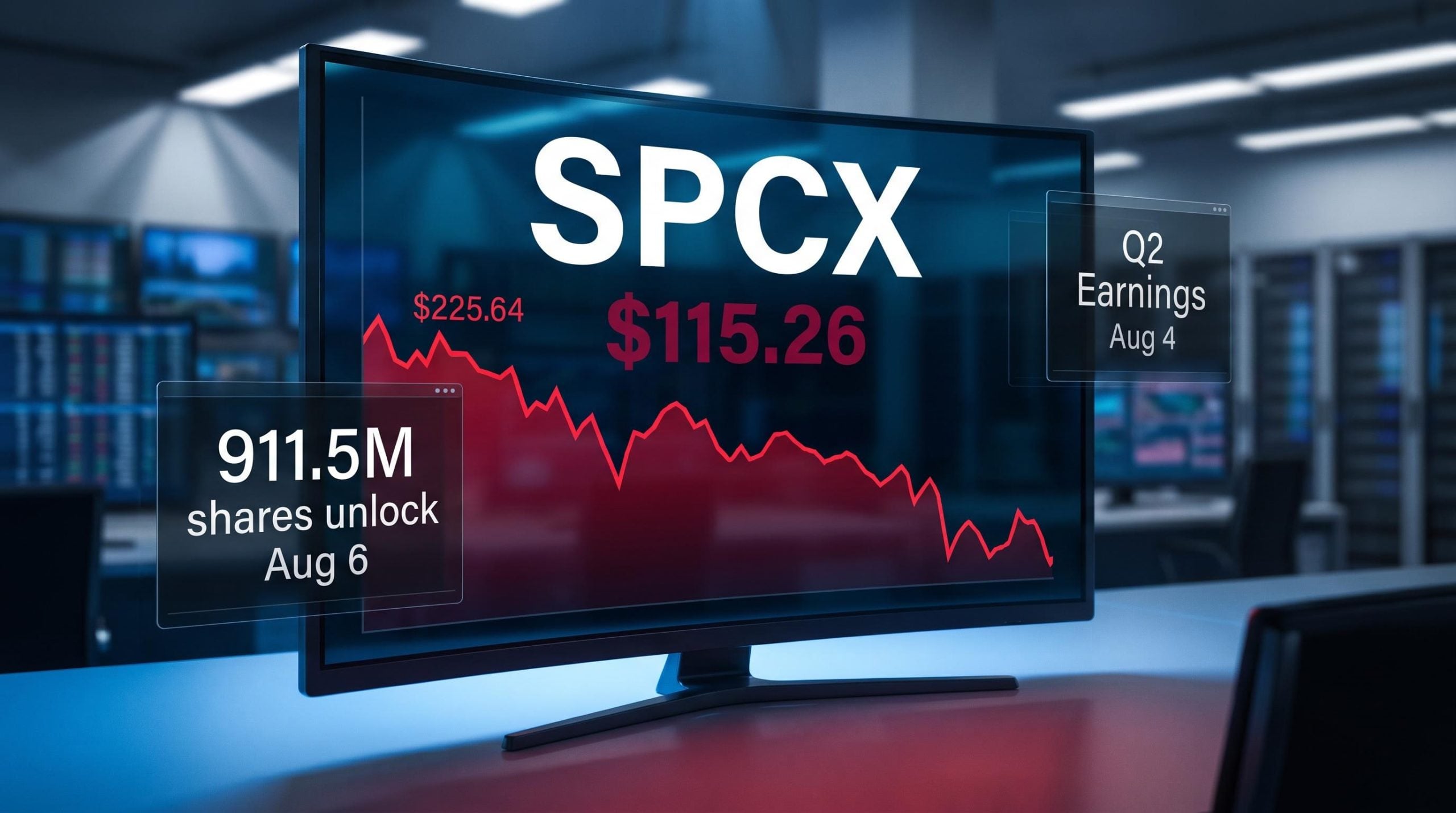
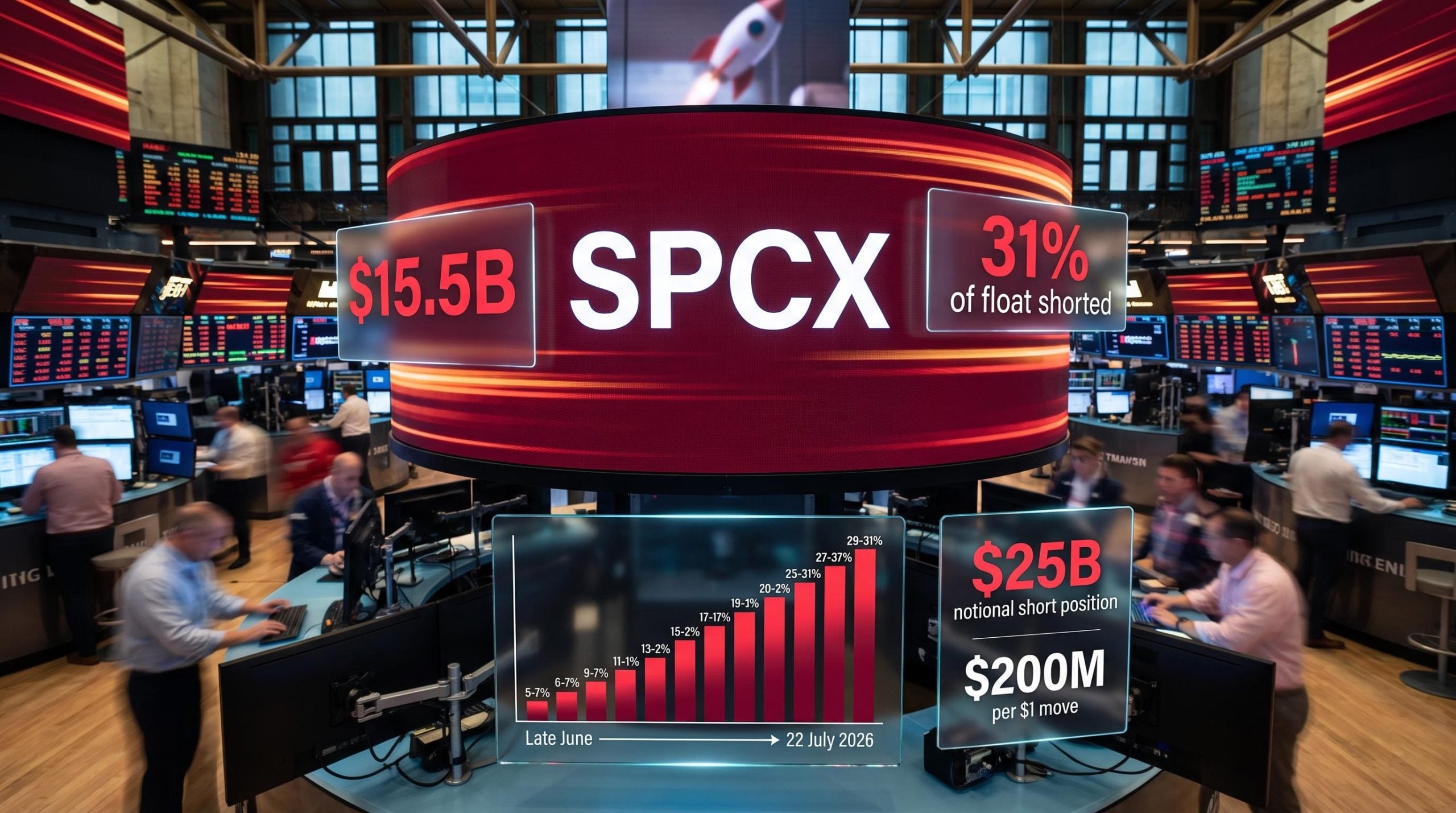
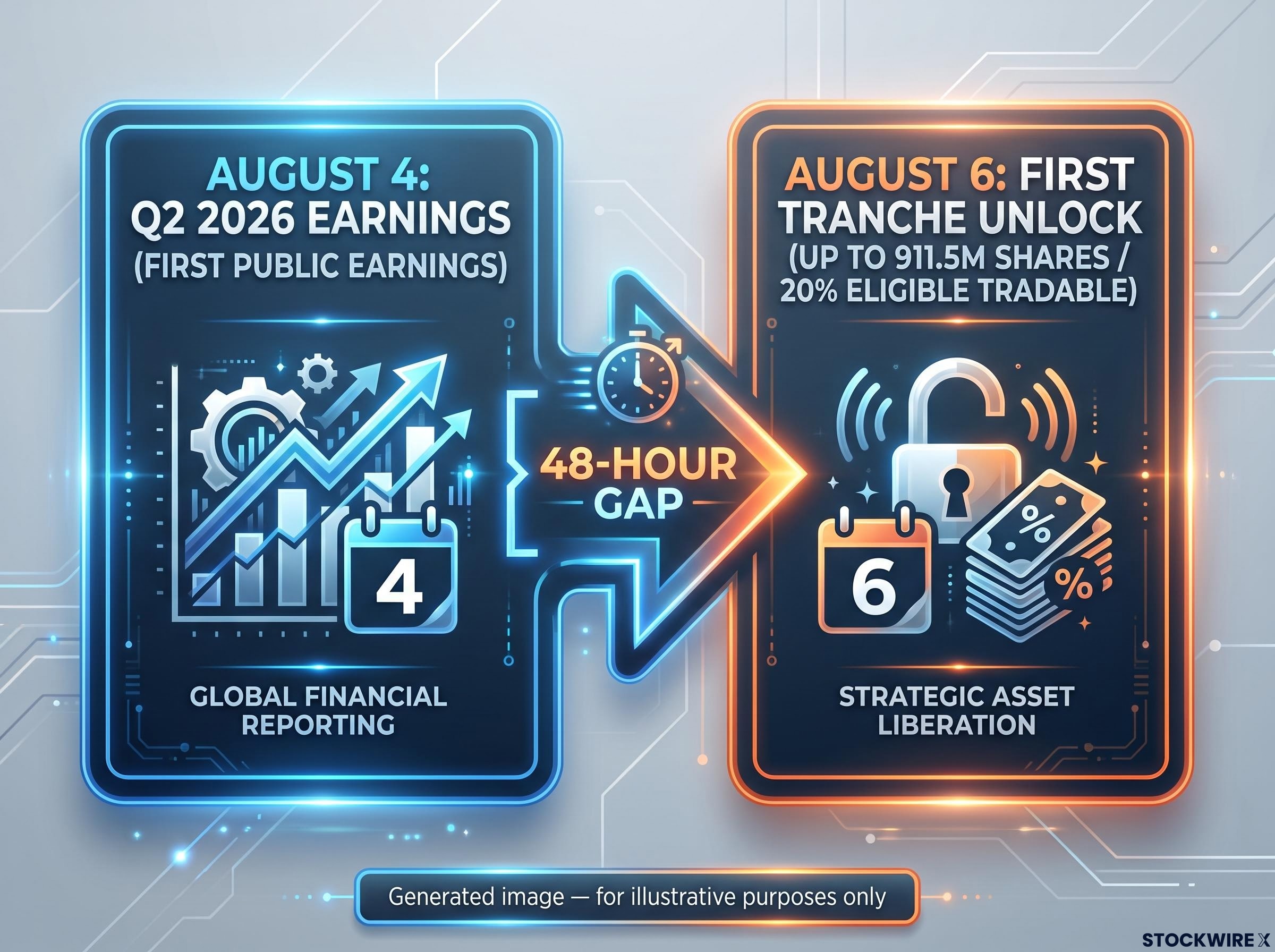
SpaceX reports its first-ever public earnings on August 4. Two days later, on August 6, up to 911.5 million insider shares become tradable. The timing of these two events is by design, not coincidence; the S-1 lock-up provisions directly link the first tranche release to the earnings report date. And heading into both, SPCX is already trading roughly 15% below its IPO price.
That combination makes this the most structurally loaded week any newly public stock has faced in years. Most companies deal with a first earnings print or a major lock-up expiration. SpaceX faces both within 48 hours, with each event directly amplifying the other’s impact. The stock has already fallen from an intraday high of $225.64 to $115.26 as of 22 July 2026, which means investors are pricing in disappointment before either catalyst has actually landed.
Here is a framework for reading both events together, not in isolation: what each one does independently, how they interact when stacked two days apart, and what that means for how you think about position sizing and timing around this window.
A stock already repriced before the real test begins
SPCX opened to the market on 11 June 2026 with an IPO price of $135 per share. Within five days it had climbed to an intraday peak of $225.64, before turning sharply lower. The 22 July close came in at $115.26, representing a decline of 6.70% on that single session.
The key price data points heading into August:
- IPO price: $135 (11 June 2026)
- Intraday high: $225.64 (16 June 2026)
- 22 July close: $115.26
- Single-day decline on 22 July: 6.70%
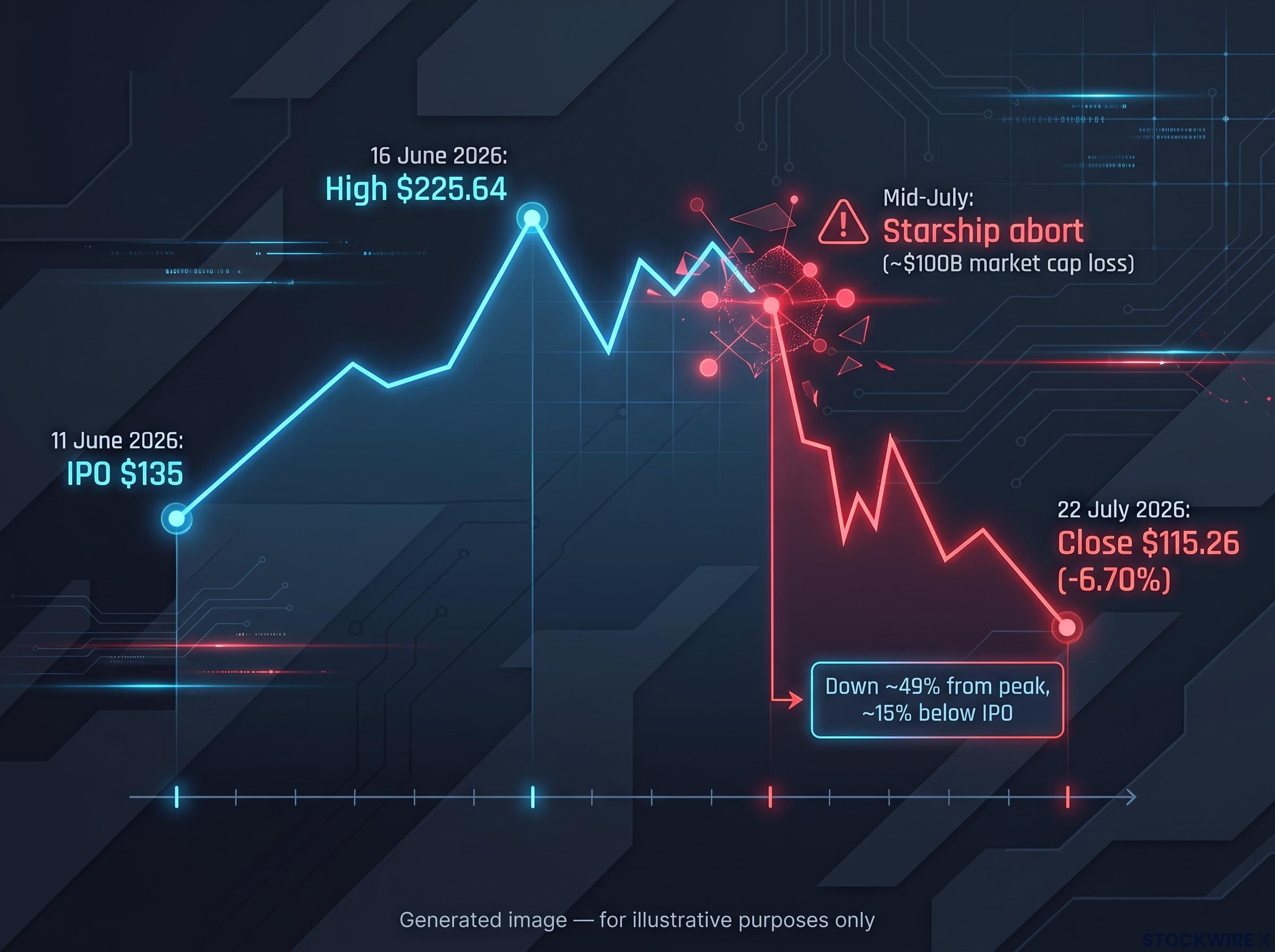
The sell-off has been driven by two distinct pressures. Broader market unease around debt-funded AI capital spending weighed on technology valuations generally. More specifically, a Starship launch abort in mid-July dealt a direct blow to near-term confidence in the company’s operational momentum.
The Starship abort impact extended well beyond a single session, with the stock closing at $131.11 on 16 July, the first close below the $135 IPO price, and wiping an estimated $800 billion in market capitalisation from the mid-June peak that had briefly exceeded $2.6 trillion.
According to Reuters, citing Ortex data, the Starship abort wiped out approximately $100 billion in market capitalisation.
The cumulative effect is a stock sitting roughly 49% off its intraday peak and around 15% beneath where it priced at IPO. A stock at this level is not neutral. It is both more vulnerable to further selling if earnings disappoint and more capable of a sharp relief rally if the numbers come in better than feared. That asymmetry shapes everything about how the August catalysts will land, and it should inform how much risk you are willing to carry into the week.
When big ASX news breaks, our subscribers know first
What the August 4 earnings will actually reveal
August 4 is the day SpaceX stops being a narrative stock and starts being a numbers stock.
The company will report Q2 2026 results after market close, followed by a management webcast. It is the first time public investors will see audited, line-item financials rather than secondary-market valuations or management commentary. Until now, SPCX has traded on the weight of the Starlink scale thesis, Starship ambition, and Elon Musk’s execution track record. This report replaces all of that with actual figures.
The three financial dimensions the market is watching:
- Starlink revenue growth and margins: the single largest driver of near-term valuation
- Launch services unit economics: whether the core business is scaling profitably
- Capital expenditure profile: the scale of spending across Starship and related infrastructure
How the two scenario branches play out
If margins and revenue come in stronger than the market’s implicit expectations, the report could attract enough institutional buying to begin absorbing the supply wave arriving two days later. A strong print reframes SPCX as a growth stock with real economics behind it, not just ambition.
If revenue or guidance misses, it reinforces every concern that has driven the stock down 49% from its peak. At current levels, a miss exposes the stock to further de-rating at precisely the moment when 911.5 million new shares are about to become tradable.
This is not a typical quarterly print. It is the first genuine price discovery moment for SpaceX’s fundamentals as a public company, which means the magnitude of the market’s reaction is likely to be larger than what you would expect from a routine earnings release.
The valuation mathematics embedded in SPCX’s current price already demand historically extraordinary growth rates across Starlink and launch services, which means even a technically solid Q2 print can still disappoint if it does not confirm the trajectory the market has already priced for multiple years forward.
The lock-up mechanics: what 911.5 million shares actually means
A lock-up expiration is the date when insiders and early employees, who received shares before the IPO, become legally allowed to sell those shares on the open market. In SpaceX’s case, the lock-up is not a single event. It is a staged system that releases shares in tranches over several months.
According to CNBC, up to 911.5 million shares become eligible for sale in the first tranche on 6 August 2026.
The core mechanic is straightforward: the S-1 provisions allow 20% of eligible insider and employee shares to begin trading on the second day following the Q2 earnings release, per CNBC. That places the first unlock on 6 August. An additional 10% can unlock if SPCX trades at least 30% above the IPO price (above approximately $175) for five of the ten trading days around the earnings release. At $115.26 as of 22 July, that threshold is not realistically in range.
But August 6 is only the beginning. The schedule extends through the rest of the year.
The full complexity of the lock-up schedule extends well beyond the August 6 first tranche, with roughly a dozen distinct unlock events running through December 2026 and a performance trigger that can accelerate an additional 10% of eligible shares before Q2 earnings data is even absorbed.
| Unlock Date | Tranche | Shares / Percentage Eligible | Condition |
|---|---|---|---|
| 6 August 2026 | First tranche | 20% of eligible shares (up to 911.5 million) | Two trading days after Q2 earnings |
| 6 August 2026 | Conditional tranche | Additional 10% | SPCX above ~$175 for 5 of 10 trading days |
| 31 Aug, 10 Sep, 25 Sep, 10 Oct, 25 Oct* | Employee tranches | 7% each | Calendar-based* |
| After Q3 earnings* | Post-Q3 tranche | 28%* | Tied to Q3 report* |
| December 2026* | Full employee unlock | Remaining employee shares* | Calendar-based* |
Dates and percentages for post-August-6 tranches are based on analyst reporting and have not been independently verified against the S-1 filing.
According to one strategist quoted by Yahoo Finance, insiders may be able to sell up to approximately 44% of the company by early autumn, expanding the float by roughly 900% from initial levels (this estimate has not been independently verified).
The scale of this unlock relative to the initial float means that buyers in August are not simply weighing whether SpaceX is a good business. They are weighing whether it is a good business at a price that also accounts for a structural multiplication of available supply. That is a meaningfully different calculation.
Why the 48-hour gap between earnings and the unlock is the actual risk mechanism
Rather than fixing an independent calendar date, the lock-up structure is built around the earnings release itself: per CNBC, the S-1 provisions specify that the first 20% of eligible shares becomes tradable on the second trading day after the Q2 report. That means every eligible insider will make their first sell-or-hold decision using the same earnings data the public just received.
How the scheduling design creates a feedback loop
This is where the two events stop being separate catalysts and start amplifying each other. The gap between them creates a direct feedback loop between new information and insider incentives.
- If earnings disappoint and SPCX sells off on 4-5 August:
- Insiders with newly liquid shares may choose to accelerate diversification into a falling price, adding real supply to a weak market.
- Public investors, anticipating this behaviour, may begin discounting the stock before any insider actually files a sale.
- The anticipation of selling can become self-reinforcing, amplifying the post-earnings move downward.
- If earnings beat expectations and SPCX rallies into 6 August:
- Some insiders may take partial profits at elevated prices, even if they remain long-term believers in the business.
- That incremental supply creates a ceiling on the relief rally, limiting how far the stock can run before new shares need to be absorbed.
- The rally’s magnitude gets capped by the very event that a strong print was supposed to help the market digest.
The relevant question is not whether insiders will sell. It is how the market prices the option value of their ability to sell, which is a different and earlier problem than watching post-6 August filings. Markets often discount lock-up supply before it actually hits the tape, not only after.
The empirical lock-up expiration findings from Field and Hanka show that markets frequently begin discounting the anticipated supply before insiders actually file sales, meaning the informational event and the price impact are often decoupled by days or weeks.
Reading insider selling: what the filings will and will not tell you
Lock-up expiration allows insiders to sell. It does not require them to. And not every sale carries the same informational weight.
When the first post-6 August insider filings appear, three variables actually matter:
- Aggregate volume: How much of the 911.5 million eligible shares is sold in the first two to four weeks? The total figure is the outer bound of potential supply, not the expected supply.
- Seniority of sellers: Are senior executives and board members selling, or mostly rank-and-file employees? Executive-level sales carry a higher informational signal about the company’s internal confidence.
- Plan type: Are sales structured as pre-planned Rule 10b5-1 transactions, or are they discretionary?
Rule 10b5-1 plans are automated trading arrangements set up in advance. They allow insiders to sell shares on a predetermined schedule for diversification or tax purposes, independent of any short-term view on the stock. A sale executed under a 10b5-1 plan carries far less informational weight than a discretionary sell.
Long-tenure employees whose net worth is heavily concentrated in SpaceX stock have a legitimate diversification motive that says nothing about their confidence in the business. When the filings start appearing, you should be looking at who is selling and how much relative to their total holdings, not simply whether any selling is happening at all.
Insider selling patterns across the broader 2026 IPO cohort provide a useful reference frame: US corporate insiders sold roughly $11 of stock for every $1 they bought in H1 2026, with the 2026 IPO cohort returning less than half the S&P 500’s advance through mid-July, suggesting the structural incentive to sell into early liquidity windows is not specific to SpaceX.
What this convergence means for how you size and time a position
The August window is not a normal earnings week. The standard logic of acting on a good or bad print is operating inside a much more complex supply-and-demand dynamic that can invert expected price responses.
When the distribution of outcomes is this wide, the size of a position matters more than the direction of the bet.
A relief rally from oversold levels competes directly against a sustained de-rating on a massive float expansion. Both outcomes are plausible. Both are supported by the structural setup. That makes position sizing the primary risk management lever, not conviction in one direction.
Before acting around this window, three practical questions are worth applying to your own situation:
- How much capital can you hold through high volatility across a two-week period where both information and supply are shifting simultaneously?
- What is your time horizon relative to the multi-month unlock schedule stretching through December 2026?
- Are you reacting to the earnings print, the supply dynamic, or both, and have you sized accordingly for each?
Some strategists have identified late August, after the first large unlock and post-earnings volatility clears, as a potentially more rational entry window than the current artificially scarce float environment. This framing is analyst commentary, not a directional recommendation, and has not been independently verified.
August is the first chapter, not the verdict
4 August and 6 August are the first real test of how SPCX behaves under the structural forces that govern every large public stock: information releases, liquidity events, and insider behaviour. They will not resolve the long-term investment question.
The market still needs to see the evidence across multiple quarters: true Starlink unit economics, the Starship commercialisation trajectory, and whether SpaceX can sustain high growth without compressing returns on capital. Those answers take time. August provides the baseline reading, the data point against which all future quarters will be measured.
The honest framing is not to predict what happens on 6 August. It is to be equipped to interpret it as it unfolds, and to position accordingly for the longer arc of SpaceX becoming a conventionally analysed public company, one earnings cycle at a time.
This article is for informational purposes only and should not be considered financial advice. Investors should conduct their own research and consult with financial professionals before making investment decisions. Forward-looking statements regarding SpaceX’s financial performance, lock-up mechanics, and share price are speculative and subject to change based on market developments and company performance.