A confidential S-1 registration statement filed with the SEC on 1 April 2026 set in motion what could become the largest public offering in financial history. SpaceX is targeting a Nasdaq debut on 12 June 2026 at a rumoured valuation of US$1.75 trillion, and as of 19 May 2026, the public S-1 is expected imminently. For Australian investors, the window between filing and first-day trading is narrowing. What follows is a breakdown of the IPO timeline, an interrogation of the valuation arithmetic, an explanation of what SpaceX’s three divisions actually do, and a practical guide to the specific access pathways available, including the newly launched BetaShares Space Industry ETF (ASX: RCKT).
The IPO clock is ticking: what we know about the timeline and structure
SpaceX submitted its confidential draft S-1 to the SEC on or around 1 April 2026, according to reporting from Barron’s, Reuters, and CNBC. Because the filing was lodged confidentially, it does not appear on the SEC’s EDGAR public database. Its absence reflects the confidential filing mechanism, not a lack of regulatory action.
Forbes reported on 18 May 2026 that the public S-1 was expected “this week,” with SpaceX targeting a Nasdaq listing on 12 June 2026 and seeking to raise up to US$75 billion. That timeline, however, remains conditional on regulatory review, market conditions, and the company’s internal decisions.
Confirmed versus pending: the IPO milestone checklist
What has been confirmed:
- Confidential S-1 filed with the SEC (on or around 1 April 2026)
- Target exchange: Nasdaq
- Target listing date: 12 June 2026
- Rumoured fundraising target: up to US$75 billion
What remains pending:
- Public S-1 publication on EDGAR
- Retail allocation details (no programme confirmed for Australian or international retail investors)
- SEC effective date and final pricing
The gap between “imminent filing” and “first day of trading” could be as short as three weeks. Australian investors researching this opportunity now are operating in that compressed window.
When big ASX news breaks, our subscribers know first
Inside the US$1.75 trillion valuation: ambition or arithmetic?
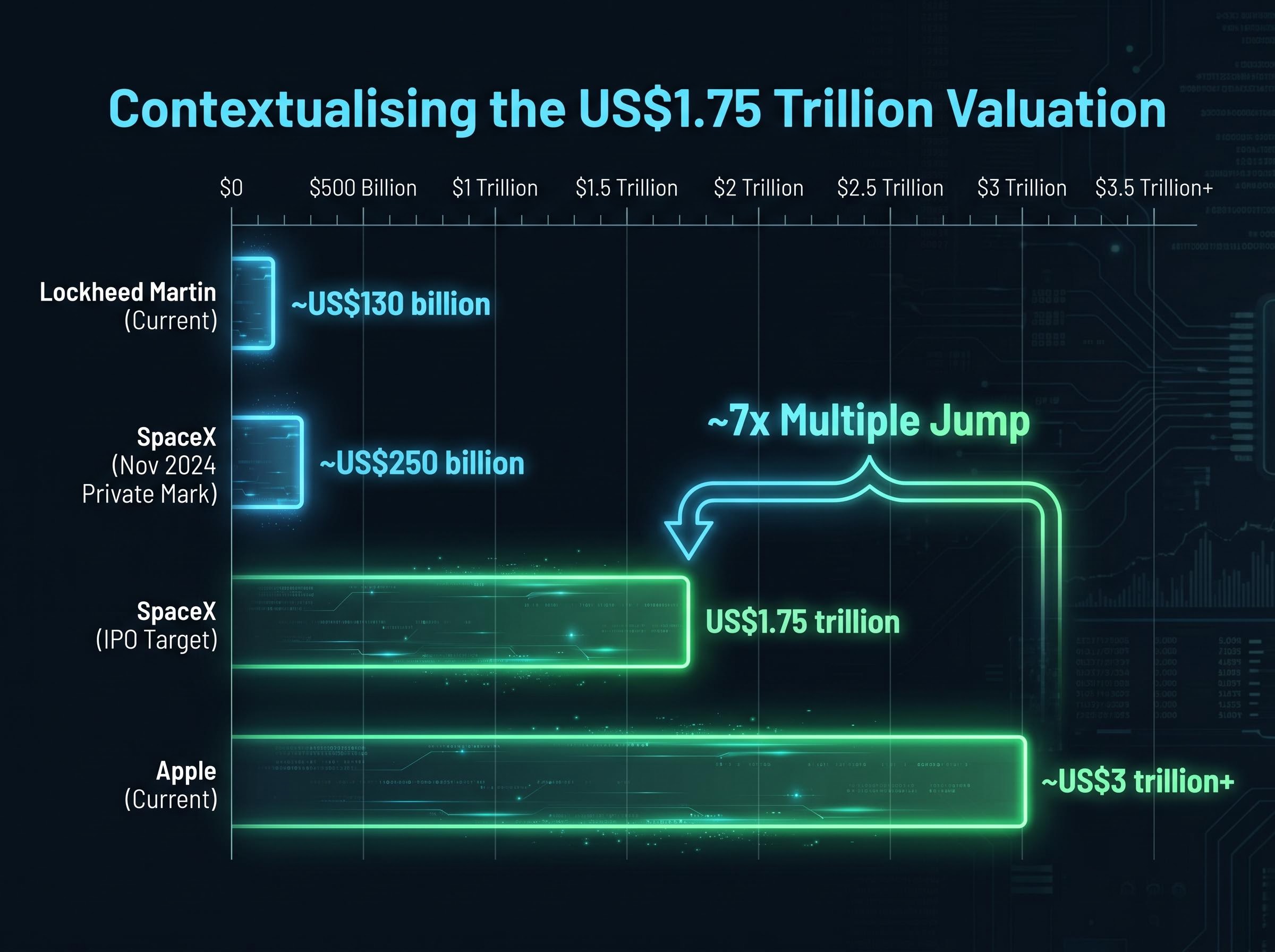
The most recent verified private-market benchmark is the November 2024 tender offer, reported by Reuters, which valued SpaceX at more than US$250 billion (approximately US$135 per share). That figure represented the highest private-market mark for any company at the time.
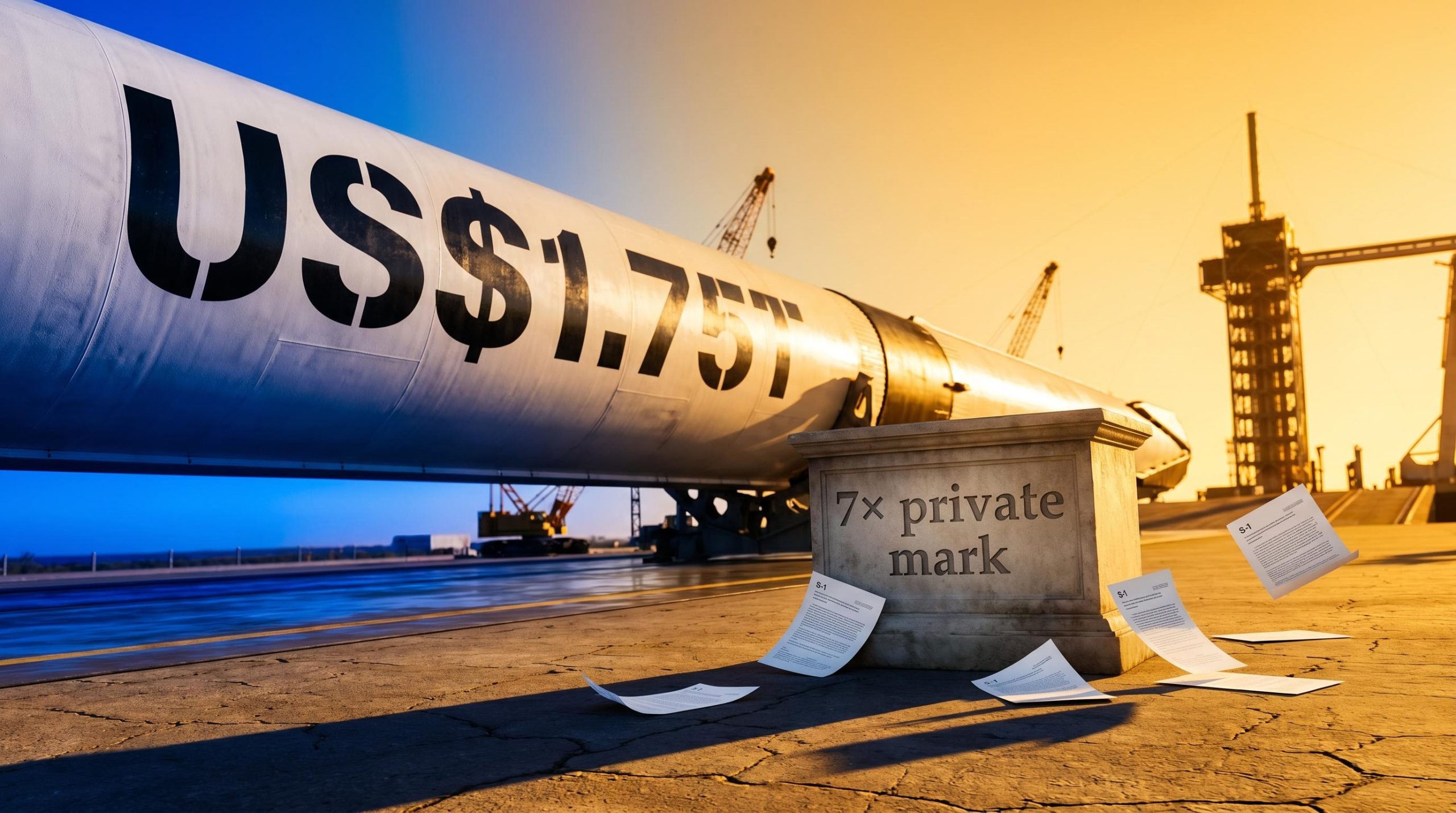
The US$1.75 trillion IPO target represents approximately a 7x multiple over that benchmark. That gap is the central analytical question for any prospective investor.
| Company / Benchmark | Valuation | Context |
|---|---|---|
| SpaceX (Nov 2024 private mark) | ~US$250 billion | Last verified secondary-market tender offer |
| SpaceX (IPO target) | US$1.75 trillion | Rumoured IPO valuation, ~7x private mark |
| Apple (current market cap) | ~US$3 trillion+ | Largest listed company globally |
| Lockheed Martin (current market cap) | ~US$130 billion | Largest listed aerospace and defence name |
At US$1.75 trillion, SpaceX would surpass every listed aerospace and defence company and sit among the top handful of global mega-caps by market capitalisation. The bull case that supports this figure rests on treating Starlink as a global telecom and technology platform with high terminal margins, a long-run scenario rather than a near-term fair value assessment.
The IPO valuation arithmetic becomes more challenging when expressed in earnings multiples rather than absolute dollar terms: at a reported $2 trillion, SpaceX is priced at approximately 250x EBITDA, a figure that implies decades of uninterrupted growth and requires Starlink to achieve global telecom scale before the multiple can compress to levels typical of established infrastructure businesses.
Forbes (18 May 2026) reported analyst warnings that SpaceX could face a “Musk effect,” with reputational and political risks associated with Elon Musk’s public profile representing a specific concern at this valuation level.
What SpaceX actually does: the three divisions powering the valuation case
Most retail investors associate SpaceX with rockets and Elon Musk’s space ambitions. The business, however, operates across three distinct areas:
- Launch and rocketry (Falcon 9, Starship): The original business, providing commercial and government launch services, including NASA crewed missions and satellite deployment.
- Starlink satellite internet: A low-Earth-orbit broadband constellation providing subscription-based internet access to consumers, enterprises, and governments globally.
- AI and related capabilities (xAI): An emerging segment encompassing artificial intelligence activities linked to Musk’s broader technology ecosystem.
Understanding where the valuation weight actually sits reframes the investment question entirely.
Why Starlink carries the valuation thesis
Starlink is the revenue engine. Media estimates based on leaked internal data suggest SpaceX generated high single-digit to low double-digit billions of US dollars in full-year 2024 revenue, with Starlink contributing the majority of revenue growth and likely over half of total company revenue. The subscriber base exceeded 2 million as of late 2023-2024 and has continued to grow, though no officially sourced current figure is available.
The bull case treats Starlink as a global telecom challenger: a subscription revenue model with an addressable market spanning billions of underserved broadband users, margin potential that improves at scale as satellite infrastructure costs are amortised, and a competitive moat built on constellation density and launch cost advantages.
This scenario is long-term and conditional. SpaceX has not published audited financial statements, and all revenue and subscriber figures available to investors are estimates derived from leaks or investor-pitch materials. That financial opacity is itself a material consideration.
How Australian investors can gain exposure before and after listing
Retail allocation into the IPO book itself is unlikely for most Australian investors. No broker-specific retail allocation programme for the SpaceX IPO had been publicised as of mid-May 2026. The realistic primary pathway is purchasing shares on Nasdaq once trading begins, via an Australian broker with US market access.
International ETF flows into the Australian market reached $6.9 billion in Q1 2026 alone, the first quarter on record in which international funds overtook domestic funds as the most purchased ETF category on major retail platforms, a structural shift that contextualises why access pathways to a Nasdaq-listed mega-cap carry heightened interest among Australian retail investors in 2026.
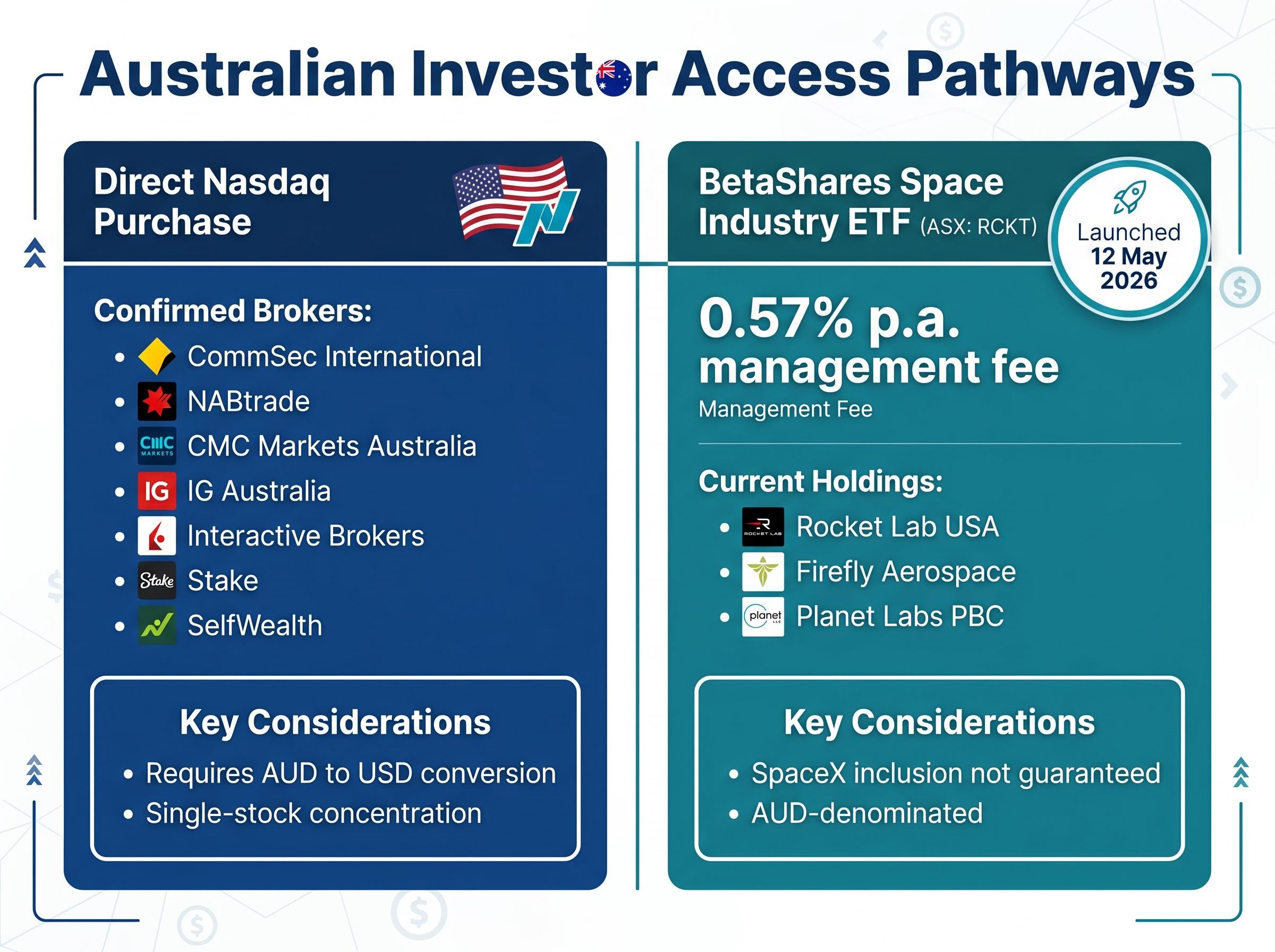
Confirmed platforms offering US exchange access include:
- CommSec International
- NABtrade
- CMC Markets Australia
- IG Australia
- Interactive Brokers (Australian entity)
- Stake
- SelfWealth
AUD to USD currency conversion costs and foreign exchange spreads apply to all direct purchases.
The RCKT ETF: what it holds now and the SpaceX inclusion question
The BetaShares Space Industry ETF (ASX: RCKT), launched on 12 May 2026 with a management fee of 0.57% per annum, offers the alternative pathway. Current holdings include names such as Rocket Lab USA, Firefly Aerospace, and Planet Labs PBC.
RCKT does not currently hold SpaceX. Inclusion post-IPO would require SpaceX to meet the underlying index’s eligibility criteria: listing on an eligible exchange, revenue classification within space-industry activities, and market capitalisation and liquidity thresholds. Commentary characterises inclusion as probable given SpaceX‘s core business focus and projected mega-cap status, but it is not guaranteed.
| Pathway | Exchange | SpaceX Exposure | Currency Risk | Notes |
|---|---|---|---|---|
| Direct broker purchase | Nasdaq (US) | Full, direct | AUD/USD conversion required | Available post-listing only; concentrated single-stock exposure |
| BetaShares RCKT ETF | ASX | Indirect; inclusion not guaranteed | Embedded in fund (AUD-denominated) | Diversified space-sector exposure; 0.57% p.a. management fee |
The trade-off is straightforward. Direct purchase delivers full SpaceX-specific exposure with currency risk and single-stock concentration. RCKT offers diversified space-sector exposure through the ASX, without guaranteed SpaceX inclusion.
For Australian investors considering RCKT as their primary route into the space sector, our dedicated guide to the RCKT ETF examines the fund’s concentration risk in detail, including Rocket Lab and AST SpaceMobile together accounting for 23.3% of holdings, the 40% maximum drawdown recorded by the underlying index, UBS Australia’s recommendation to limit exposure to less than 5% of a portfolio, and the unhedged currency risk embedded in a fund with 74.3% of assets in US-denominated equities.
The risks prospective investors need to price in
At US$1.75 trillion, the valuation requires a specific set of assumptions to hold. If any of them fail, the investment case weakens materially.
- Valuation gap risk: The approximately 7x jump from the November 2024 private-market benchmark demands that Starlink achieve global scale, sustained competitive advantage in satellite broadband, and high terminal margins. None of these are yet verified by audited accounts.
- Financial transparency risk: SpaceX has not published audited financial statements as of 19 May 2026. This level of opacity is atypical for an offering at this scale and limits investors’ ability to conduct independent due diligence.
- “Musk effect” risk: Reputational and political risks associated with Elon Musk’s public profile represent a named risk factor for post-IPO price performance.
- Concentration risk: The bull case rests almost entirely on Starlink execution. Launch services and AI activities, while strategically significant, contribute a smaller share of the revenue-driven valuation thesis.
- Capital intensity: Satellite constellation refresh cycles require ongoing, substantial capital expenditure that could compress margins in the medium term.
- Regulatory and competition risk: Starlink operates across dozens of jurisdictions with varying broadband regulatory frameworks, and competition from other satellite and terrestrial providers is increasing.
Forbes (18 May 2026) noted analyst warnings that SpaceX could face a “Musk effect” with associated risks at this valuation level, a factor investors should weigh alongside the financial and operational considerations.
Verdict before the S-1 drops: what the IPO actually asks investors to believe
The analytical tension is clear. SpaceX is a genuinely transformative business, operating the world’s most active launch vehicle, building the largest satellite constellation in history, and generating billions in recurring subscription revenue. It is being offered at a valuation that requires a specific and ambitious long-run scenario to hold, without the audited financial transparency typical of a public offering at this scale.
The public S-1, once filed, will be the single most important document for investors. It will contain audited figures, formal risk disclosures, and the valuation methodology underpinning the offering price. Its publication, expected in the coming days, should be treated as the trigger for substantive due diligence.
Reading the S-1 prospectus with analytical discipline requires understanding which line items carry the most weight at a valuation of this scale: revenue segmentation between Starlink and launch services, operating cash flow trends, capital expenditure commitments for satellite constellation refresh cycles, and the governance structure governing share classes and founder control.
For Australian investors, the practical step now is to identify a preferred access pathway: direct Nasdaq purchase through a broker with US market access, or diversified space-sector exposure via the BetaShares RCKT ETF (management fee 0.57% p.a.), with the understanding that RCKT does not guarantee SpaceX inclusion. The 12 June 2026 target date leaves limited time between S-1 publication and the first day of trading.
This article is for informational purposes only and should not be considered financial advice. Investors should conduct their own research and consult with financial professionals before making investment decisions. Past performance does not guarantee future results. Financial projections are subject to market conditions and various risk factors.