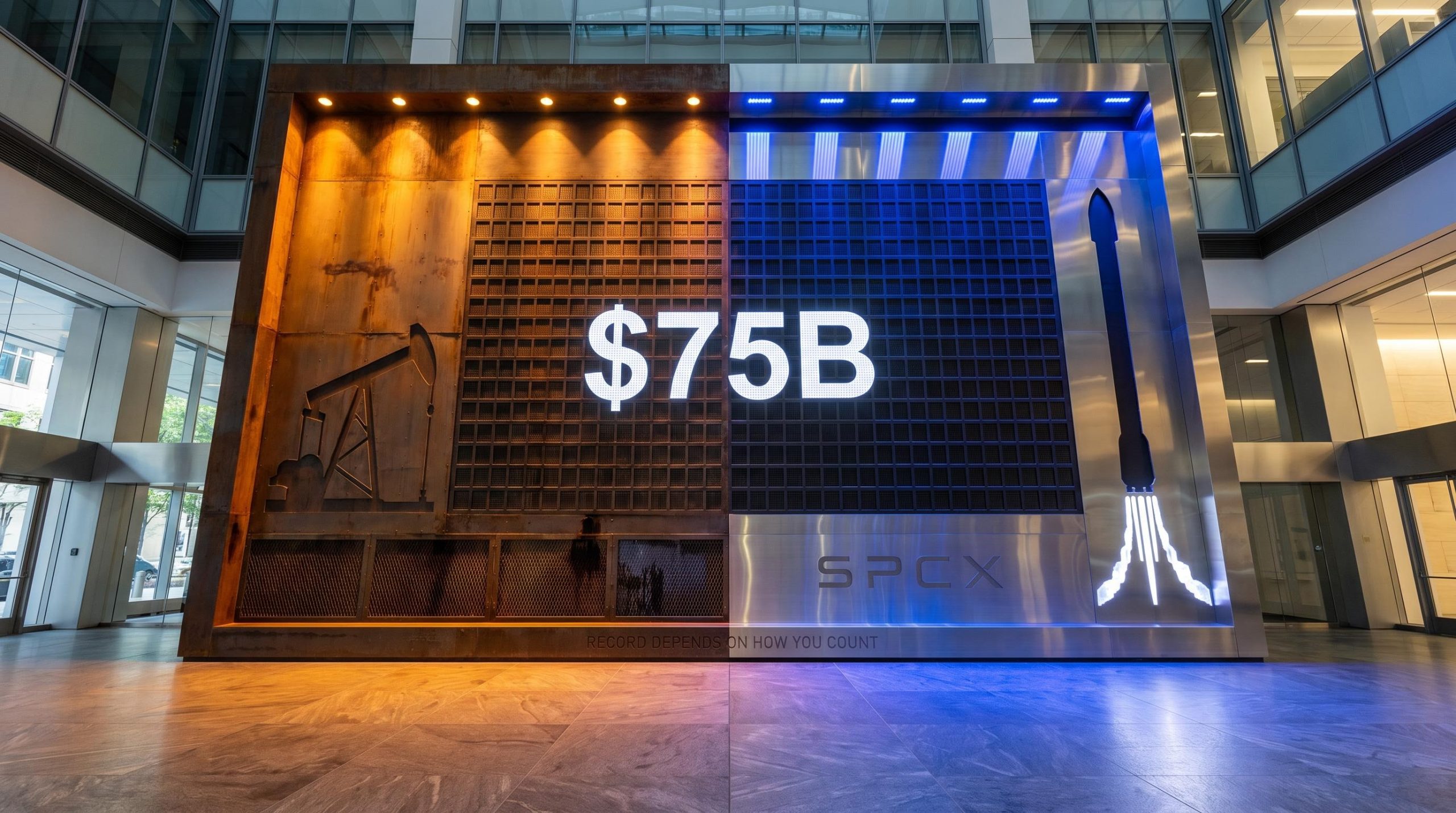
SpaceX priced its initial public offering at $135 per share on 11 June 2026, raising $75 billion at an implied valuation of $1.77 trillion. Every headline declared it the largest IPO in history. Almost none explained what that actually means.
The comparison is to Saudi Aramco’s December 2019 listing, which generated $25.6 billion in proceeds at a $1.71 trillion implied valuation. On nominal figures, SpaceX wins on both measures. But once inflation enters the picture, Aramco’s valuation in today’s dollars comes to roughly $2.2 trillion, meaningfully above SpaceX’s $1.77 trillion. The record, it turns out, depends entirely on how you choose to count.
What follows is a breakdown of exactly how IPO records are set and measured, why the SpaceX-Aramco comparison is more complicated than the headlines suggest, and what the $1.77 trillion figure says about how public markets are pricing space infrastructure in 2026.
What “largest IPO in history” actually measures
The phrase “largest IPO ever” collapses three distinct measurements into one. Each tells a different story, and in the case of SpaceX, each produces a different answer.
- Capital raised (proceeds): The dollar amount of new equity sold to investors. This is the most common shorthand for IPO size.
- Implied market capitalisation at listing: The total equity value of the company at the offering price, regardless of how much equity was actually sold.
- Free float percentage: The share of total equity placed with public investors. This is the mechanism that connects the two figures above: a company can be worth trillions while raising comparatively little, if it sells only a small slice of itself.
These three figures can diverge sharply because how much equity a company sells is a separate decision from how markets value the whole company. Aramco floated only a small percentage of its total equity in 2019, which capped its proceeds at $25.6 billion even though the underlying company was valued at $1.71 trillion. SpaceX’s offering involved a materially larger free float, which is why its capital raised so substantially exceeds Aramco’s even though their implied enterprise values at listing are broadly comparable in nominal terms.
The gap between implied valuation and capital raised traces back to IPO mechanics and retail access structures that determine who captures the offering price and who buys into the secondary market at a premium, a distinction that shapes return outcomes independently of whether the underlying business performs.
The result: “largest IPO ever” can simultaneously be true on one measure and false on another. That is exactly the situation with SpaceX.
| Metric | Aramco (Dec 2019) | SpaceX (Jun 2026) |
|---|---|---|
| Capital raised | ~$25.6B (initial); ~$29.4B with greenshoe | ~$75B |
| Implied valuation at listing | ~$1.71 trillion | ~$1.77 trillion |
| Free float structure | Small percentage of total equity floated | Materially larger free float |
When big ASX news breaks, our subscribers know first
The inflation adjustment that changes the story
SpaceX holds the nominal record on both measures. That much is straightforward. The picture shifts once purchasing power enters the calculation.
Aramco’s $1.7 trillion valuation at listing was confirmed across contemporaneous financial reporting, with the offering widely described as raising approximately $26 billion before the greenshoe exercise, establishing the nominal benchmarks against which SpaceX’s 2026 figures are now being measured.
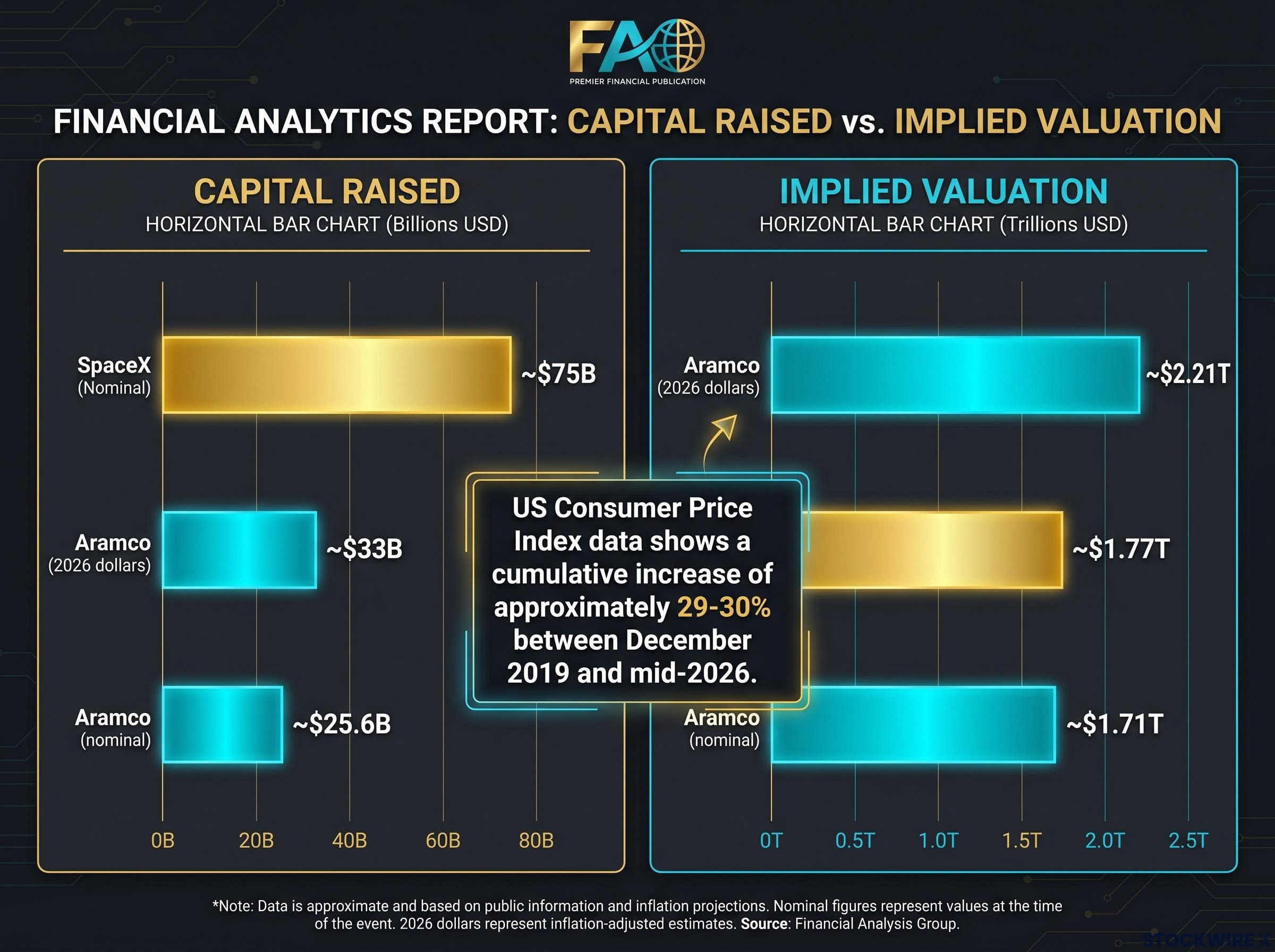
US Consumer Price Index data shows a cumulative increase of approximately 29-30% between December 2019 and mid-2026. Applied to Aramco’s figures, the adjustment produces the following:
- Aramco’s $1.71 trillion implied valuation converts to roughly $2.21 trillion in 2026 dollars.
- Aramco’s $25.6 billion in proceeds converts to roughly $33 billion in 2026 dollars.
SpaceX’s $1.77 trillion implied valuation sits below Aramco’s inflation-adjusted $2.21 trillion. On implied enterprise value in real purchasing-power terms, Aramco’s record has not been surpassed.
The reverse holds on capital raised. SpaceX’s $75 billion exceeds Aramco’s inflation-adjusted $33 billion by more than double. That fundraise is a genuine record on any real-terms basis, and it is not close.
| Metric | Aramco (nominal) | Aramco (2026 dollars) | SpaceX (nominal) |
|---|---|---|---|
| Capital raised | ~$25.6B | ~$33B | ~$75B |
| Implied valuation | ~$1.71T | ~$2.21T | ~$1.77T |
SpaceX’s $1.77 trillion implied valuation is below Aramco’s inflation-adjusted $2.21 trillion. But its $75 billion capital raise exceeds Aramco’s adjusted $33 billion by more than double. The record depends on which metric you use and whether you adjust for inflation.
The exact inflation figure varies marginally by index choice (US CPI is the standard for dollar-denominated comparisons), but the directional conclusion holds on any reasonable measure. Headline financial journalism typically omits both qualifications.
Why SpaceX commands a $1.77 trillion valuation without the earnings to match
A company posting net losses attracting a $1.77 trillion market capitalisation invites an obvious question. The answer sits at the intersection of two analytically coherent but divergent investor frameworks, neither of which can be dismissed as irrational given the genuine uncertainty in the inputs.
The earnings-anchored view
A discounted cash flow model built on SpaceX’s current financials, a standard discount rate, and modest Starlink penetration assumptions does not obviously support a $1.7 trillion valuation.
- SpaceX, founded in 2002, has reinvested heavily into research and development and infrastructure throughout its history.
- Pre-IPO reporting suggests strong revenue growth and heavy reinvestment, with profitability varying by business segment and period.
- On conventional earnings multiples, the valuation appears stretched relative to disclosed financials.
The optionality view
An aggressive DCF incorporating high Starlink subscriber penetration, strong average revenue per user, continued launch dominance, and new orbital services (in-space manufacturing, data relay, space logistics) can produce very large present values.
- Starlink contributes the majority of SpaceX’s total revenue as of the IPO date, creating a recurring subscription revenue base.
- The global addressable market for broadband connectivity alone runs into the hundreds of billions of dollars annually; space-based infrastructure extends that further.
- Adjacent markets in orbital services, government contracts, and space logistics add optionality that is difficult to value precisely but directionally positive.
The sensitivity point matters: small changes in long-run assumptions around subscriber count, average revenue per user, or discount rate can shift fair-value estimates by hundreds of billions of dollars. This is a feature of any long-duration growth asset rather than evidence of market irrationality. Both frameworks can be modelled rigorously within a DCF structure; the disagreement is about which scenario distribution an investor assigns to Starlink’s future penetration and SpaceX’s ability to execute on adjacent markets.
The gap between SpaceX’s current fundamental value and its listing price represents priced-in optionality that analysts estimate at roughly $1.8 trillion above near-term DCF estimates, a spread that makes the sensitivity of long-run subscriber and revenue assumptions the single most consequential variable in any valuation model.
Key risk factors remain material: technological execution risk (Starship development timelines, next-generation constellation deployment), regulatory risk (spectrum licensing, orbital debris policy), and competitive risk (other satellite broadband providers, terrestrial wireless expansion into underserved markets).
Starlink and the launch monopoly that make the case concrete
The optionality framework does not live in abstraction. Its credibility rests on a specific set of operational facts that, taken together, describe a competitive position no previous satellite connectivity provider has held.
Starlink’s scale as of the IPO date:
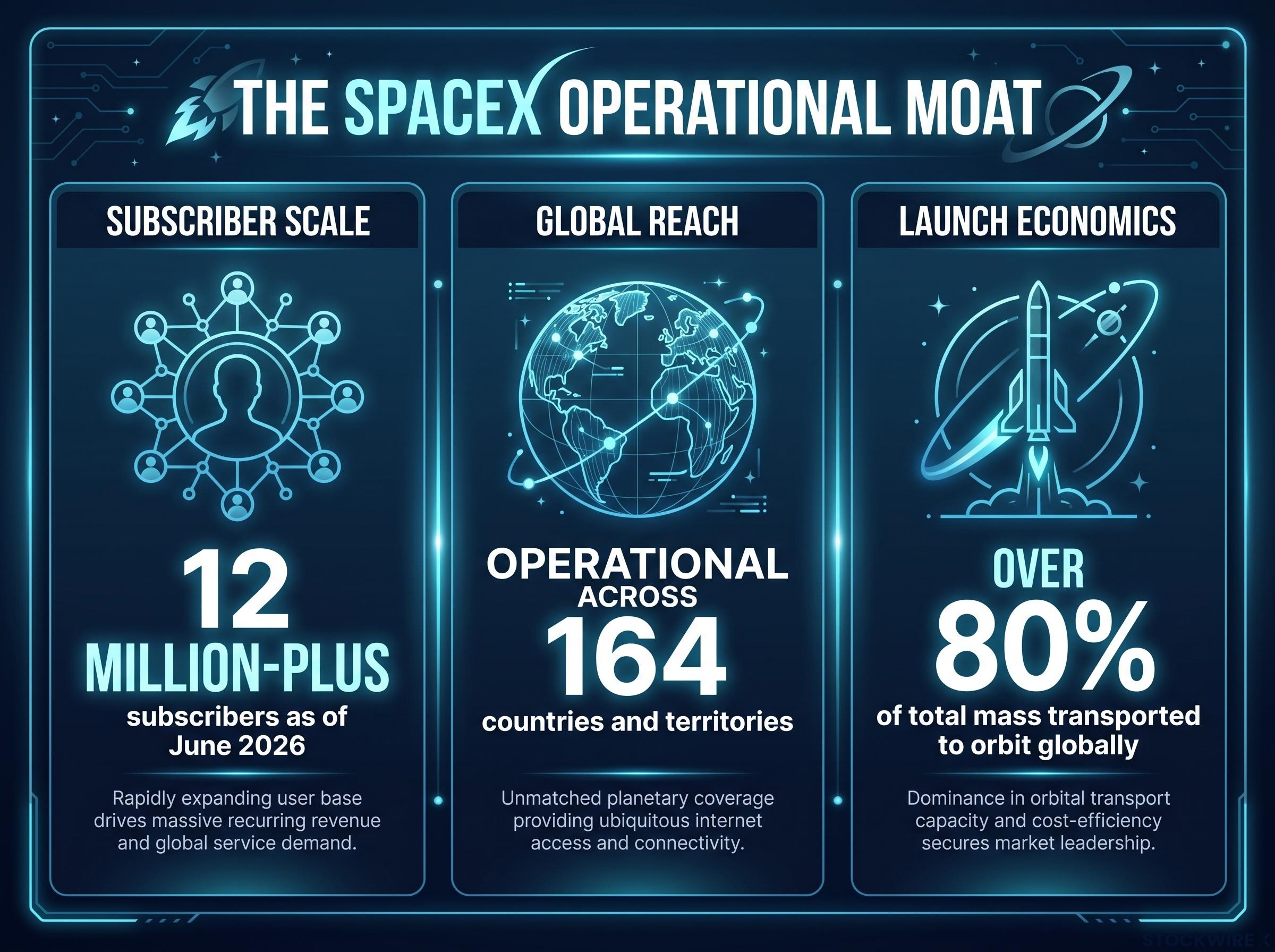
- 12 million-plus subscribers as of June 2026, per company updates and industry reports.
- Operational across 164 countries and territories, per company statements.
- A recurring subscription revenue model with structural cost advantages that improve at scale.
- The majority of SpaceX’s total revenue, making it the commercial engine of the $1.77 trillion valuation.
The structural moat sits in SpaceX’s internal launch capacity. Competitors purchasing third-party launch services face higher deployment costs for every satellite they place in orbit. SpaceX can replenish and expand its constellation at a cost no external competitor can match, creating a durable economic advantage that compounds with every launch.
In the three years preceding its IPO, SpaceX’s launch operations accounted for over 80% of total mass transported to orbit globally, per company data. Independent industry estimates are broadly consistent, typically placing SpaceX’s share in the 70-90% range depending on methodology and time period.
That combination of subscriber scale, recurring revenue, and unmatched launch economics is what separates Starlink from any previous satellite connectivity attempt. It does not guarantee the $1.77 trillion valuation proves correct in hindsight. It does explain why the valuation is at least internally coherent.
What Aramco and SpaceX tell us about how capital markets think now
Seven years separate the two listings. The shift they represent is not coincidental.
Aramco’s December 2019 IPO was the capstone of the hydrocarbon era’s dominance of global capital markets. The world’s most profitable company, grounded in proven reserves and decades of demonstrated cash flow, achieved a trillion-dollar listing at the height of that era’s confidence. Its valuation was built on existing assets and proven production: a backward-looking calculation of what had already been extracted and what remained in the ground.
SpaceX’s June 2026 IPO is the first time public markets have assigned trillion-dollar status to a company whose core value proposition is space-based infrastructure and connectivity rather than terrestrial resource extraction. Its valuation is built on expected future cash flows from a still-expanding platform: a forward-looking calculation of what has not yet been built.
The Aramco-to-SpaceX comparison tracks directly onto two structural shifts institutional investors follow closely. The first is capital moving away from fossil-fuel infrastructure toward technology-enabled alternatives. The second is orbital connectivity being re-rated as foundational infrastructure, not merely a niche technology product.
The roughly seven-year gap between the two listings is itself analytically relevant as a measure of how quickly the capital market’s centre of gravity shifted. For investors thinking about long-duration portfolio positioning, the comparison offers a concrete, data-anchored case study in structural regime change.
IPO cohort underperformance is a pattern documented across more than four decades of listings: newly listed companies have trailed comparably sized established peers by an average of 3.3% per year over their first five years, a drag that compounds even when the underlying business delivers on its growth targets because the listing valuation already embedded those expectations.
The largest IPO ever was once a monument to oil. Now it belongs to orbital infrastructure.
The record is real, but read the fine print
SpaceX raised $75 billion on Nasdaq under the ticker SPCX, implying a $1.77 trillion valuation at listing. Aramco raised $25.6 billion in December 2019 at a nominal implied valuation of $1.71 trillion, which converts to roughly $2.21 trillion in 2026 dollars. In real purchasing-power terms, Aramco’s enterprise value at listing has not been surpassed.
Three takeaways:
- SpaceX holds the nominal record on both capital raised and implied valuation at listing. On the fundraise, the record is genuine by any measure, nominal or real.
- Aramco holds the real-terms record on implied valuation once US CPI adjustment is applied. The headline claim of “largest IPO ever” is accurate on one reading and incomplete on another.
- The transition from Aramco to SpaceX as the benchmark signals a structural reorientation in how institutional capital values infrastructure, from proven reserves to orbital connectivity.
As more long-duration, optionality-heavy companies reach public markets, the tools used to evaluate record IPOs will need to match the structure of the assets being listed, not just the precedents of the hydrocarbon era. The discipline of reading the fine print, which metric, which adjustment, which framework, is itself the most useful skill a finance-educated reader can carry forward.
For investors wanting to translate the valuation framework into a practical entry strategy, our full explainer on IPO timing and lock-up dynamics examines why waiting for lock-up expiries, initial earnings reports, and independent institutional research coverage has historically produced better entry points than buying at the moment of peak public excitement, with specific reference to comparable high-profile listings.
This article is for informational purposes only and should not be considered financial advice. Investors should conduct their own research and consult with financial professionals before making investment decisions. Financial projections and valuation frameworks discussed are subject to market conditions and various risk factors. Past performance does not guarantee future results.