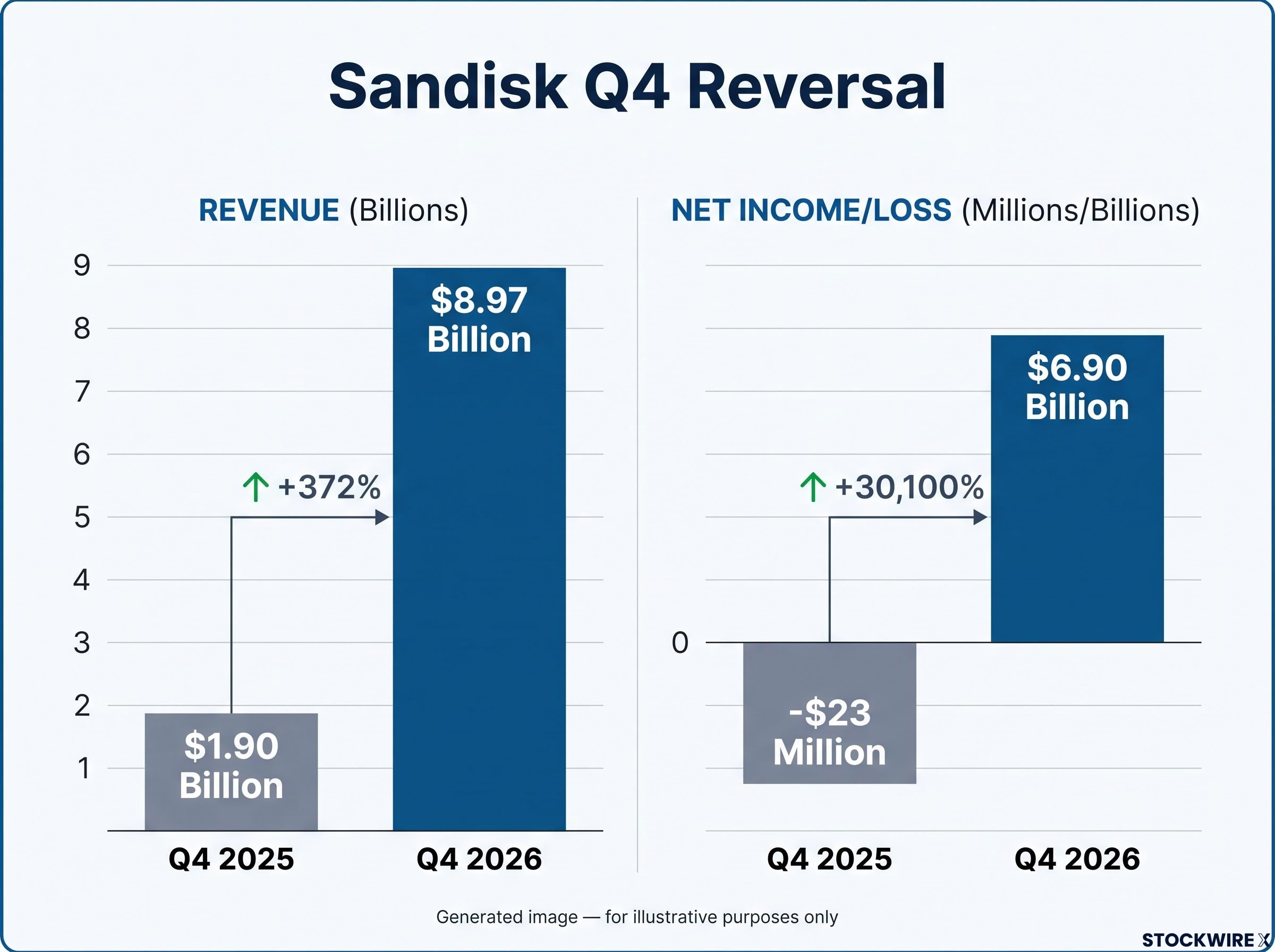
Sandisk swung from a $23 million net loss to $6.90 billion in net income in a single year. The fiscal fourth-quarter results, announced on 5 August 2026, represent one of the most dramatic earnings reversals the memory industry has produced.
Two forces converged to make it happen. NAND flash pricing recovered sharply after a prolonged downturn, and AI infrastructure buildout created a surge in data centre storage demand that lifted both volumes and average selling prices simultaneously. The combination drove record revenue, record margins, and a capital return programme that signals management expects the cash generation to continue.
Here is what the numbers actually tell you about whether this quarter reflects a durable shift in Sandisk’s earnings power or a cycle peak that the market is already questioning, and which specific metrics to watch when the next quarter lands.
A quarter that rewrote the record books
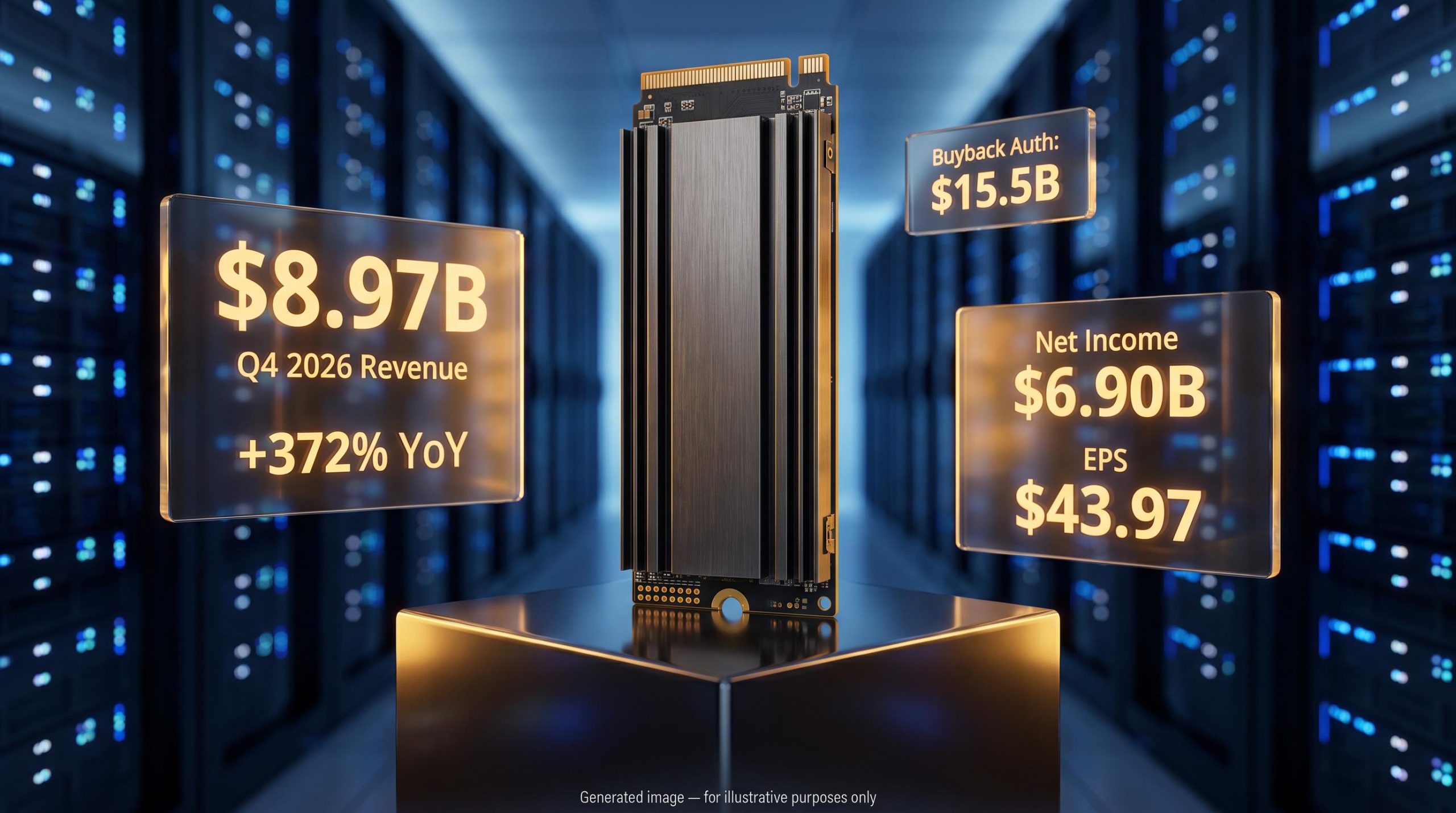
The scale starts with revenue. Sandisk generated $8.97 billion in fiscal Q4 2026, with sequential growth of 51% and year-over-year growth of 372%, both company records.
The profitability swing is where the magnitude hits hardest. On a GAAP basis, the company shifted from a net loss of $23 million (-$0.16 diluted EPS) in Q4 2025 to net income of $6.90 billion ($43.97 diluted EPS) in Q4 2026. That is a nearly $7 billion reversal in four quarters.
That margin trajectory was already drawing analyst attention before Q4: SanDisk’s 78.4% non-GAAP gross margin in Q3 2026 sparked a broader debate about memory sector repricing and whether the semiconductor storage industry had structurally shifted away from its commodity-cycle history.
| Metric | Q4 2025 | Q4 2026 | Change |
|---|---|---|---|
| Revenue | $1.90B | $8.97B | +372% YoY |
| GAAP Net Income | -$23M | $6.90B | ~$7B swing |
| Diluted EPS | -$0.16 | $43.97 | +$44.13 |
For the full fiscal year, Sandisk grew revenue by 175% to reach $20.25 billion in FY 2026, with full-year GAAP net income of $11.43 billion, or $73.76 diluted EPS. That full-year trajectory matters. It tells you this was not a one-quarter anomaly driven by a single pricing spike but a sustained transformation across four consecutive quarters, and that distinction shapes whether you treat the current earnings run rate as structural or temporary.
When big ASX news breaks, our subscribers know first
What actually drove the surge: pricing, volume, or something else?
According to management’s Q4 2026 earnings call commentary, pricing accounted for roughly two-thirds of sequential revenue growth, while volume improvements contributed the remaining third. That split is the single most important number in the entire report for assessing durability.
Key driver split (per management’s Q4 2026 earnings call): Approximately two-thirds of Q4 sequential revenue growth came from higher pricing. Approximately one-third came from higher shipment volumes.
Three factors combined to produce the result:
- Pricing gains: Tight NAND supply lifted average selling prices across product categories, with non-GAAP gross margin reaching 84.6% in Q4 2026
- Volume growth: Shipment volumes rose meaningfully, though they contributed roughly half as much as pricing to the sequential increase
- Mix shift: A deliberate repositioning toward data centre and edge customers amplified pricing power by concentrating sales in segments willing to pay premium for storage density and performance
That mix shift is not incidental. It explains why Sandisk captured outsized pricing gains relative to the broader NAND market. The company moved toward customers whose AI workloads make storage a mission-critical input, not a commodity purchase.
The risk embedded in this composition is straightforward. A meaningful portion of current earnings power depends on NAND market conditions staying favourable. If supply loosens or AI capital expenditure moderates, the pricing tailwind fades first, and it contributed twice as much as volume to the latest quarter’s growth.
Sandisk’s pricing gains reflect an industry-wide condition rather than company-specific outperformance: the memory chip shortage has driven simultaneous 900%-plus earnings surges across Samsung, SK Hynix, and Micron, with NAND flash prices projected to rise approximately 234% across 2026 as a whole.
Why data centres are now the engine of the business
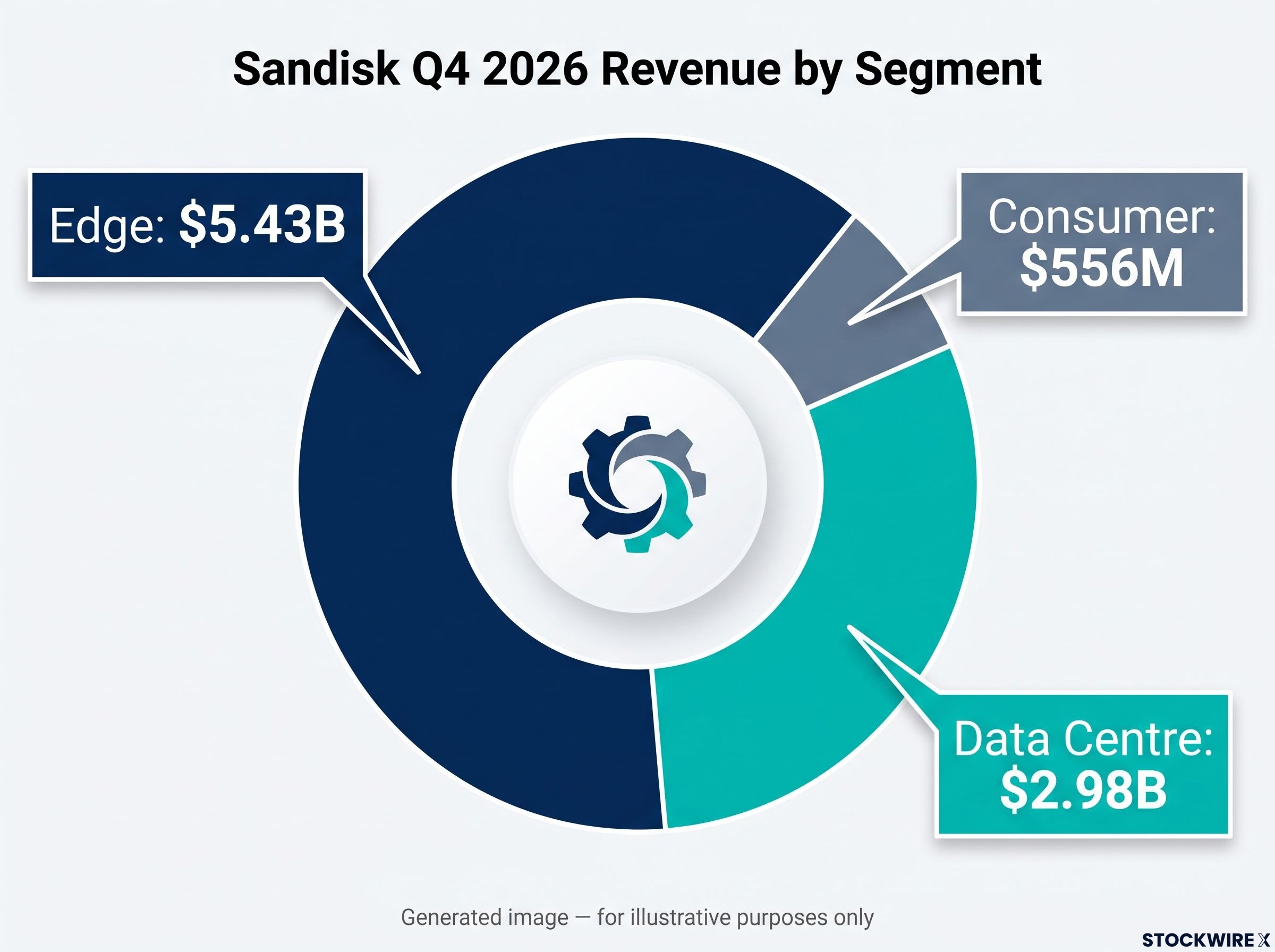
In Q4 2026, data centre revenue reached $2.98 billion, more than doubling compared with the prior quarter. The full-year figure is more telling: Sandisk generated $5.15 billion from data centre customers across FY 2026, representing year-over-year expansion of 437%. A segment that was a supporting player two years ago now generates enough revenue to move the company’s total financial profile.
| Segment | Q4 2026 Revenue | Q4 Sequential Growth | FY 2026 Revenue | FY YoY Growth |
|---|---|---|---|---|
| Data Centre | $2.98B | +103% | $5.15B | +437% |
| Edge | $5.43B | +48% | $12.16B | N/A |
| Consumer | $556M | -32% | N/A | N/A |
The edge segment remains the largest absolute contributor at $5.43 billion in Q4 and $12.16 billion for the full year. Consumer revenue came in at $556 million, falling by 32% quarter on quarter, is the deliberate low-priority tier, reflecting both softer discretionary demand and the company’s strategic choice to focus capacity on higher-value segments.
The 437% full-year data centre growth rate tells you that AI storage spending is not a future opportunity for Sandisk but a current revenue reality. AI training and inference workloads require massive, high-performance storage, and that demand is now large enough to materially reshape the company’s segment composition and margin profile in a single fiscal year.
The scale of that repositioning is underpinned by a structural shift in how AI workloads consume storage: Citi Research projects agentic AI inference alone will drive a NAND demand supercycle that takes data-centre SSD consumption from roughly 2.8% to 9.3% of total global NAND output, a trajectory that makes hyperscaler spending a durable rather than cyclical demand source.
What NAND flash memory is, and why its pricing cycle matters to investors
NAND flash memory is the storage technology inside the solid-state drives (SSDs) used in data centres, smartphones, and consumer devices. An SSD is a storage device with no moving parts that reads and writes data faster than traditional hard drives. Sandisk is one of the world’s primary NAND producers, which means its financial results are directly tied to the pricing and demand dynamics of this single product category.
Three factors drive NAND pricing at any given point:
- Supply capacity: The number of fabrication facilities producing NAND chips, and how much output they can deliver, sets the supply side of the equation
- AI data centre demand: Hyperscale cloud providers and enterprise buyers building AI infrastructure are currently the strongest source of incremental demand, pulling pricing upward
- Consumer electronics demand cycles: Smartphone and PC refresh cycles create periodic demand surges and lulls that amplify or dampen pricing swings
Why the memory cycle is the key variable for this stock
The current pricing environment reflects supply tightness. Manufacturers curtailed production during the prior downturn, and demand, particularly from AI workloads, rebounded faster than capacity could expand. That gap is what delivered 84.6% non-GAAP gross margins in Q4 2026.
The cycle can reverse. New fabrication capacity takes time to build, but it is coming. If AI capital expenditure moderates, or if consumer demand fails to recover, the same dynamic that lifted pricing can compress it. The NAND industry experienced exactly this in 2022-2023, when oversupply drove prices and margins sharply lower across the sector.
Understanding this cycle tells you that Sandisk’s current margins are not a permanent baseline. They are a cycle-dependent outcome, and evaluating the stock requires forming a view on where NAND pricing heads next, not just where it sits today.
Management’s forward guidance and the capital return signal
Q1 2027 guidance points to continued acceleration:
- Revenue: Guided range of $10.3 billion to $10.8 billion, implying mid-teens to approximately 20% sequential growth from Q4’s record level
- Non-GAAP diluted EPS: Guided range of $44.00 to $46.00
- Non-GAAP gross margin: Guided range of 83.0% to 85.0%
The guidance midpoint would represent another record quarter. Management is not projecting a plateau; they are projecting sequential growth on top of a result that was already the best in company history.
The capital return programme reinforces the message. Sandisk’s board approved a further $14 billion in share repurchase capacity alongside the Q4 results, which lifted total remaining buyback authorisation to $15.5 billion. The company repurchased approximately $4.5 billion of stock during Q4 alone, and approximately $4.52 billion across all of FY 2026.
Total remaining buyback capacity: $15.5 billion, following the $14 billion incremental authorisation approved on 5 August 2026.
A growing number of New Business Model agreements, with multiple additional agreements signed since April 2026, are designed to lock in longer-term commercial relationships with higher-value customers and improve revenue visibility. These agreements support the mix shift toward data centre and edge buyers that is underpinning margin expansion.
The combination of sequential revenue growth guidance and a $14 billion buyback authorisation tells you that management is not simply reporting a strong quarter. They are signalling confidence in the company’s ability to sustain elevated cash generation into the next fiscal year and beyond.
What the market’s cautious reaction tells investors about cycle risk
Despite record results and an earnings beat, some coverage indicates the stock pulled back following the 5 August announcement. The disconnect between historic earnings and a muted share price response is not irrational. It reflects a legitimate question the market is pricing: how much of the strength is already in the stock, and how sustainable is pricing-led growth?
Factors supporting continued momentum:
- Q1 2027 guidance midpoint implies another sequential revenue increase on top of a record quarter
- New Business Model agreements are locking in higher-value customer relationships
- AI infrastructure investment shows no sign of slowing, with hyperscale cloud providers continuing to expand storage capacity
Factors warranting caution:
- Pricing rather than volume drove the larger share of sequential revenue growth, making current earnings power vulnerable if NAND supply loosens
- Consumer segment revenue dropped sharply quarter on quarter, a reminder that not all demand categories are participating equally
- Valuation after a historic run may already reflect optimistic assumptions about cycle duration
The stock pullback on strong results is the market’s way of asking whether Sandisk’s earnings power is structural or cyclical. That is precisely the question you need to form your own view on before acting.
For investors wanting to quantify the downside scenario more precisely, our deep-dive into memory chip cycle reversal signals examines the late-stage warning indicators already visible across the sector, including SK Hynix’s $29 billion capacity expansion and the historical trough-to-peak earnings mechanics that define how sharply margins compress when supply returns.
This article is for informational purposes only and should not be considered financial advice. Investors should conduct their own research and consult with financial professionals before making investment decisions. Past performance does not guarantee future results. Financial projections are subject to market conditions and various risk factors.
What the record quarter changes, and what it leaves unresolved
Two things are now definitively established. Sandisk’s AI-era earnings power is real and substantial, with $11.43 billion in full-year net income proving the business can generate cash at scale. And the company’s capital return capacity is being deployed aggressively, with $15.5 billion in remaining buyback authorisation signalling where management expects free cash flow to land.
One variable remains genuinely unresolved: whether NAND pricing holds at current levels across future quarters, given that pricing gains contributed a disproportionately larger share of recent revenue growth than volume improvements did.
Three signals to watch when Q1 2027 results arrive:
- Data centre revenue trajectory: Whether the segment sustains triple-digit sequential growth or begins to normalise will indicate whether AI storage demand is still accelerating
- Gross margin realisation: A result within the guided 83.0% to 85.0% range confirms pricing power; a result below it suggests the cycle may be turning
- Pricing-versus-volume composition: If volume growth closes the gap on pricing as a growth contributor, the earnings story becomes more durable; if pricing remains dominant, cycle risk stays elevated
Those three data points will tell you whether Sandisk’s current earnings cycle is extending or beginning to plateau. That is the read worth coming back for.
—