
A single obligation arrives on a desk. It has its own announcement, its own regulator, its own commencement date, and its own reasonable-sounding compliance requirement. On its own, it is manageable.
Now stop treating each one as its own project. Add them all up instead.
Here is the problem. The cumulative regulatory load on Australian SME directors changed materially between 2023 and 2026, but it changed without any single moment large enough to force a board to stop and reassess. Six separate sources, uncoordinated timelines, and no consolidated guidance for anyone trying to hold the whole picture.
If you sit on the board of an Australian small or medium business, you have almost certainly absorbed each of these obligations one at a time. What you have probably never done is see them listed together.
What follows is the count nobody has done for you yet, and the argument it makes on its own. You will hold a complete tally of what is in force, what is legislated but not yet commenced, and what is proposed but not law. And you will understand why the way it arrived is the actual problem.
What landed, and when: the full tally
Take the obligations in the order that makes the weight legible, not the order they arrived. Each one carries a status tag before anything else, because the status is the point.
Wage theft is now a criminal offence. Under the Fair Work Legislation Amendment (Closing Loopholes) Act 2023 (Cth), which commenced on 1 January 2025, intentional underpayment can attract up to 10 years’ imprisonment. Exposure shifts to the individual director. For an individual the maximum financial penalty is the greater of three times the underpayment or $1,565,000; for a body corporate, the greater of three times the underpayment or $7,825,000.
The payroll gap is sharper than it first appears: most conventional payroll platforms were built to process and disburse pay, not to generate independent evidence that each run satisfied its legal obligation, which is exactly what wage theft director liability now demands of boards in personal terms.
A statutory tort for serious invasions of privacy commenced on 10 June 2025 under the Privacy and Other Legislation Amendment Act 2024. This gives individuals a direct right to sue, adding a litigation dimension on top of regulator-led enforcement.
The first tranche of broader Privacy Act reforms cleared Parliament in December 2024, with provisions progressively taking effect since.
The Anti-Money Laundering and Counter-Terrorism Financing regime expands from 1 July 2026 under the Anti-Money Laundering and Counter-Terrorism Financing Amendment Act 2024 (Cth). Real estate agents, lawyers, accountants, conveyancers, and trust and company service providers are captured for the first time. Because they lose their small business exemption on personal information handled in that work, a large category of professional firms enters Privacy Act coverage too.
Cybersecurity maturity has become a commercial gate. The Essential Eight framework, published by the Australian Cyber Security Centre (ACSC), now functions as the standard against which larger customers and cyber insurers assess vendors. Documented controls are a precondition of winning work and holding cover, independent of any statutory enforcement.
Notifiable data breach obligations remain live and carry the heaviest financial exposure of anything on this list.
The OAIC notifiable data breach scheme sets out when organisations must notify affected individuals and the regulator, with mandatory notification obligations sitting alongside the civil penalty exposure described above and applying independently of any state-level breach requirements.
For a serious or repeated interference with privacy, the maximum civil penalty for a body corporate is the greater of $50 million, three times the benefit obtained from the conduct, or 30% of adjusted turnover during the breach turnover period, according to the Office of the Australian Information Commissioner (OAIC). For an individual, the maximum is $2.5 million.
Two further measures are legislated but not yet live. Both commence on 10 December 2026: an automated decision-making disclosure obligation, and a Children’s Online Privacy Code.
Finally, one item is proposed but not law. The government has committed to removing the $3 million small business Privacy Act exemption, confirmed by the Attorney-General in February 2026 Senate estimates. A second tranche is being progressed, but no Bill has been introduced and no commencement date set.
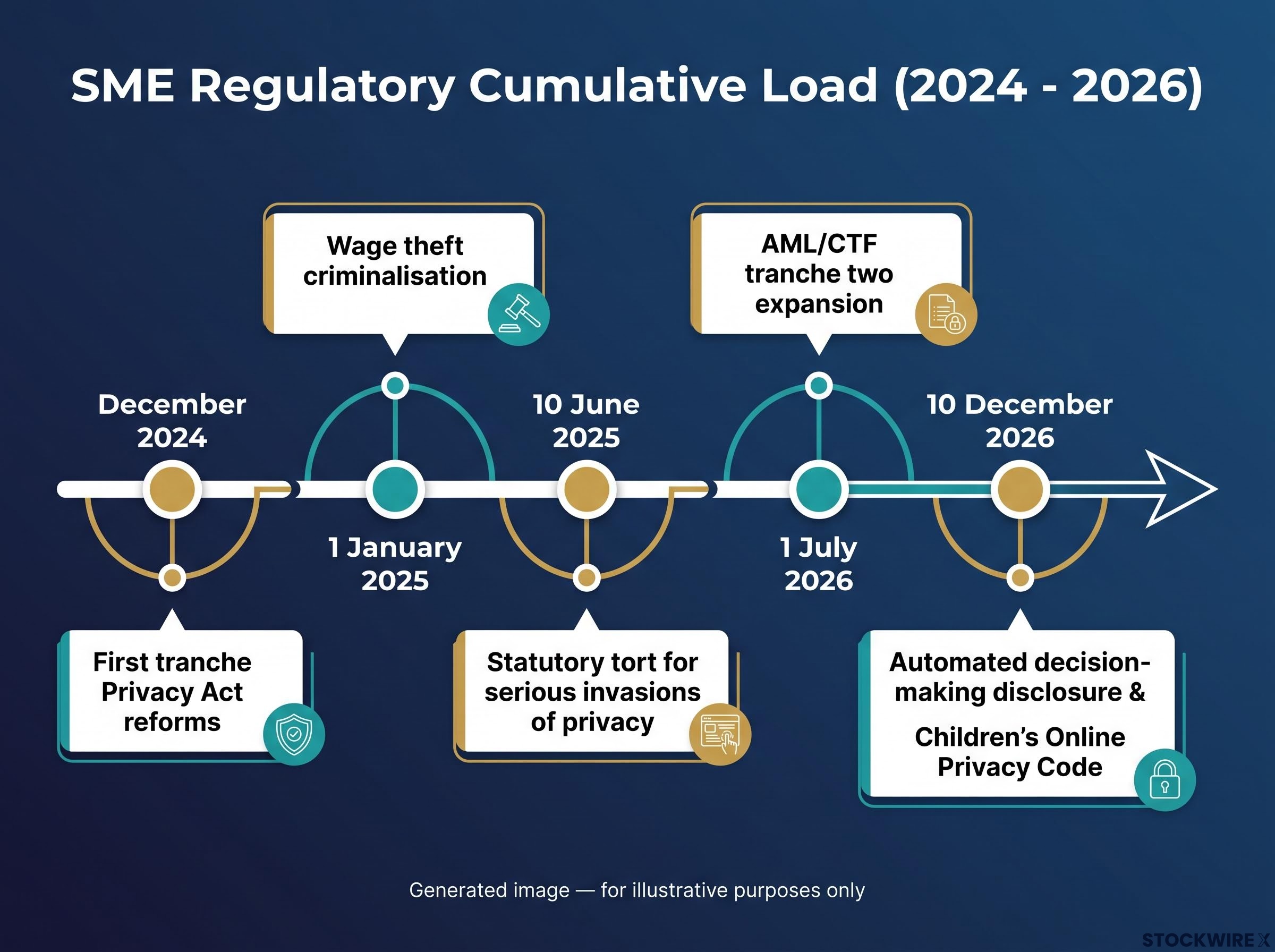
| Obligation | Source / Legislation | Commencement | Status |
|---|---|---|---|
| Wage theft criminalisation | Fair Work Legislation Amendment (Closing Loopholes) Act 2023 | 1 January 2025 | In force |
| Statutory tort for serious invasions of privacy | Privacy and Other Legislation Amendment Act 2024 | 10 June 2025 | In force |
| First tranche Privacy Act reforms | Privacy and Other Legislation Amendment Act 2024 | December 2024 (progressive) | In force |
| AML/CTF tranche two expansion | AML/CTF Amendment Act 2024 | 1 July 2026 | In force |
| Cybersecurity maturity as commercial gate | Essential Eight (ACSC) | Ongoing expectation | In force (commercial) |
| Notifiable data breach obligations | Privacy Act 1988 (Cth) | Operative | In force |
| Automated decision-making disclosure | Privacy and Other Legislation Amendment Act 2024 | 10 December 2026 | Legislated, not commenced |
| Children’s Online Privacy Code | Privacy and Other Legislation Amendment Act 2024 | 10 December 2026 | Legislated, not commenced |
| Removal of $3m small business exemption | Proposed second tranche | No date set | Proposed, not law |
The two December 2026 items deserve a closer look, because the table cannot carry the detail:
- The automated decision-making disclosure obligation requires organisations to state in their privacy policy where AI tools make decisions affecting individuals. Think credit assessment, candidate screening, and automated pricing.
- The Children’s Online Privacy Code introduces dedicated rules for handling children’s data.
The automated decision-making disclosure obligation arriving in December 2026 sits inside a broader problem: AI governance gaps at the SME level are already creating active security exposure as staff use ungoverned AI tools across organisations that have no data cleanliness baseline or cybersecurity maturity framework in place.
Now read the status column top to bottom. In force, in force, in force, in force, in force, in force, then legislated, legislated, and only one proposed. That column is the argument. Most of this load is not coming. It is already here.
When big ASX news breaks, our subscribers know first
Why nobody noticed: the structure of the problem
None of these obligations announced itself as part of a set. Each landed as its own project, and inside a typical SME, each one went to a different place.
Wage theft risk routes to finance and payroll. Cybersecurity lands with IT. Privacy falls to legal, or disappears into a gap where no function claims it. Director liability tends to reach the board only after the damage is done, once the individual pieces have already been dealt with separately.
The personal exposure embedded across this regulatory stack is not theoretical: Australian enforcement runs two simultaneous tracks over a single governance failure, meaning director liability persists after a company settles and long after the executive in question has departed.
That routing is the entire problem. A large enterprise absorbs this spread across a general counsel, a chief information officer, a dedicated risk function, and a compliance team. An SME relies on a single managing director or general manager, and the competencies these regimes demand do not scale down just because the business is smaller.
Consider where each obligation originates:
- The Fair Work regime
- The Privacy Act
- The AML/CTF regime
- The Australian Cyber Security Centre
- The insurance market
- Large-customer procurement practices
Six sources. No coordination between them. No shared commencement date. And no single document a director can open to see the combined position. Each regulator did its job in isolation, and the isolation is exactly what left the gap.
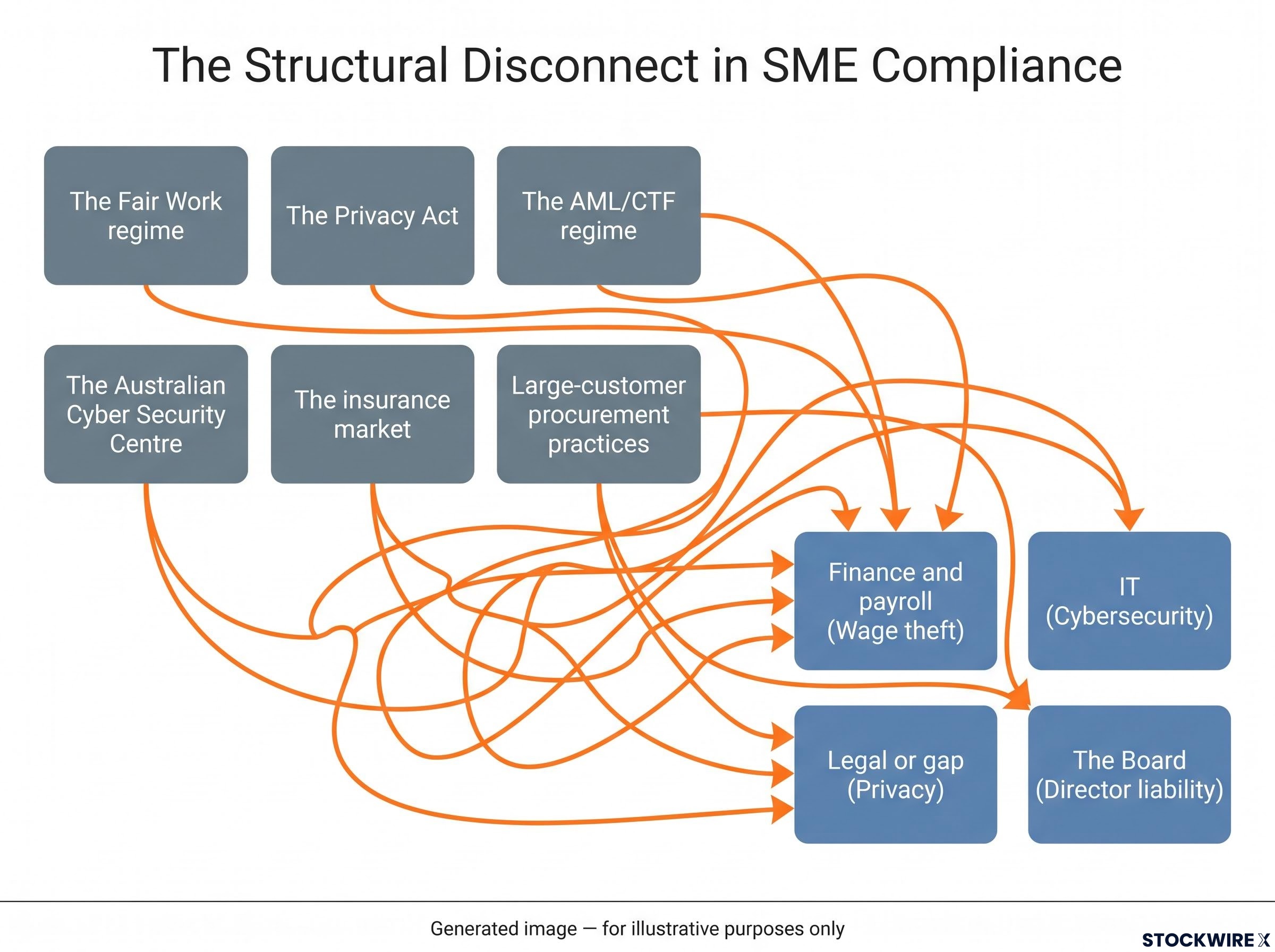
The gap between obligations
Here is the part that matters most for you. The failure mode for SMEs is rarely outright non-compliance with a single Act. It is incomplete integration between regimes.
Take a concrete example. A business updates its HR policies in response to wage-theft risk, which is sensible and diligent. But it never updates the access controls or audit logs on its payroll system, so it cannot demonstrate who changed payroll data and when. The compliance effort in one domain is quietly undermined by a gap in another.
This is why the distinction between an aggregation failure and a diligence failure is not academic. It is not that these directors are careless. It is that nobody in most SMEs is structurally positioned to hold the combined regulatory picture, because the obligations never arrive in one place. If you misdiagnose that as a diligence problem, you will buy the wrong solution.
What the count actually calls for
Once you see the failure as one of aggregation, the wrong response becomes obvious. Hiring a consultant per obligation replicates the exact fragmentation you are trying to fix. You end up with a stack of unconnected engagements, no continuity, and still nobody holding the combined view.
The pattern calls for something structural instead. Compare the two approaches directly:
- The tactical response. A separate specialist for wage theft, another for privacy, another for cyber, another for AML/CTF. Each solves its own problem and leaves the white space between them untouched.
- The standing accountability layer. A single function whose job is to hold the aggregate regulatory position of the business, track how the obligations interact, and know when to bring in specialist advice.
The value is in someone holding the aggregate view and knowing when to bring in specialist advice, not in one person covering all of it.
Fractional executive arrangements have grown into an established market category in Australia to fill precisely this role. A fractional CIO or fractional IT manager supplies senior-level technology leadership on a part-time basis, carrying a standing scope across the business rather than a per-engagement one. These roles are available from managed service providers, independent consultants, and advisory firms alike.
Hubify operates at this aggregation layer through its consolidated Hubify One model, which includes a fractional IT manager and CIO offering. The prior articles in this series covered Hubify One, the fractional CIO scope, and its April 2026 HubLab investment in detail, so the point here is narrower. Because Hubify already runs the underlying infrastructure for its clients, its governance assessments carry operational grounding rather than purely advisory standing. That starting position, not exclusivity, is its distinguishing feature; the model itself is widely available.
The commercial gate that ACSC cyber maturity now represents was set out in the June 2026 cyber maturity analysis. The director liability shift sits in the August 2026 wage theft piece. And the automated decision-making disclosure obligation, alongside the fractional CIO scope, was covered in the August 2026 AI governance piece. Read together, they map onto different corners of the same aggregation problem.
The limits of the argument
A standing governance layer is not a compliance guarantee, and pretending otherwise would weaken the case rather than strengthen it.
Someone in a fractional role, present for only a set number of days each month, cannot maintain comprehensive oversight of every shift across employment law, privacy, cybersecurity, and financial crime regulation. The model buys you coordination and senior judgment. It does not buy you omniscience.
The limits are worth stating plainly:
- Time and attention are finite; the SME still needs an internal champion to implement what the fractional role recommends.
- Accountability cannot be outsourced; directors remain legally responsible for compliance regardless of what governance arrangement sits underneath them.
- Fragmentation can return through the back door; engaging separate fractional roles for HR, privacy, cyber, and AML/CTF without coordination recreates the very silo problem it was meant to solve.
The criminal dimension of this regulatory stack includes triggers that operate without any notice or grace period: automatic disqualification under Section 206B takes effect immediately on bankruptcy, meaning a director can be prohibited from managing corporations before receiving any communication from ASIC.
There is genuine uncertainty on the proposed items too. Not everything in the second tranche will land in its current form. The removal of the $3 million small business exemption may look materially different once it reaches a Bill, and directors can reasonably monitor rather than actively prepare for items that are not yet law.
On proportionality, the Productivity Commission has historically argued for risk-based regulation that avoids disproportionate compliance costs for smaller businesses. That is its established approach rather than a specific published position on the current second tranche. The distinction matters if you are deciding which proposed obligations warrant action now: the live ones do, and several of the proposed ones can wait.
Two readings of the same count
For a director, the practical value of this tally is simply that it exists. Most directors will not have seen these obligations set out together, because the manner of their arrival actively discouraged anyone from aggregating them. Having the list in one place is itself a governance tool.
For an investor, the same count reads as a statement about a market. Demand for SME technology governance is not being generated by a technology upgrade cycle or discretionary spending appetite. It is being generated by an accumulation of statutory and commercial obligations that arrived independently and are highly unlikely to be unwound.
That is a structurally different demand driver from standard technology sector cycles, and a more durable one, because you cannot repeal an accumulation the way you can defer a discretionary purchase.
The central point holds under both readings. The obligations were never the problem individually. Each was manageable, reasonable, and self-contained. Most Australian SMEs simply have no one positioned to view these obligations as a whole picture rather than as separate, unrelated tasks.
This article is for informational purposes only and should not be considered financial advice. Investors should conduct their own research and consult with financial professionals before making investment decisions. These statements about proposed reforms are speculative and subject to change based on legislative developments.
What the list tells you that no single obligation could
Separate the live from the proposed one more time, by structure rather than by re-listing. The overwhelming majority of what you have just read carries a status of “in force.” The legislated items are dated and close. Only one line remains genuinely provisional.
That is the shape of the thing. Most of this load is already in place, and it did not require a crisis or a headline to get there. It simply accumulated, quietly, from six directions at once.
The three prior articles in this series traced the cyber maturity gate, the wage theft liability shift, and the AI governance obligations one regime at a time. This piece is the spine that connects them, and its conclusion is deliberately small. The list was always there. It has just never been put in one place until now.
So the single action worth taking is a question, not a purchase. Find out whether anyone in your organisation currently holds the combined regulatory picture. Then decide what it means if the answer is no.
—
—