Five companies control more than 90% of the global hearing aid market. Their dominance has almost nothing to do with building the best product.
For decades, that concentration held for a reason most people never questioned: the incumbents own the rooms where people are told they need help hearing. A hearing aid required a professional fitting, so whoever controlled the appointment controlled the sale. That structure stayed locked until two regulatory decisions, not a single competitor, began prising it open.
The first was the October 2022 US Food and Drug Administration (FDA) rule that let adults buy hearing aids without a prescription. The second was the FDA’s September 2024 authorisation of Apple’s Hearing Aid Feature, delivered as a software update to earbuds already in hundreds of millions of pockets.
This hearing aid industry analysis lays out why a regulated market stayed sealed for so long, what actually cracked it, and what it means for the companies that just inherited a hearing problem without inheriting the capability to solve it.
How five companies held 90% of a global market without making the best product
The concentration figure is the starting point, and it is stark. Estimates vary by source, but every major analysis lands in the same place: the five incumbents collectively control roughly 90% or more of the global market.
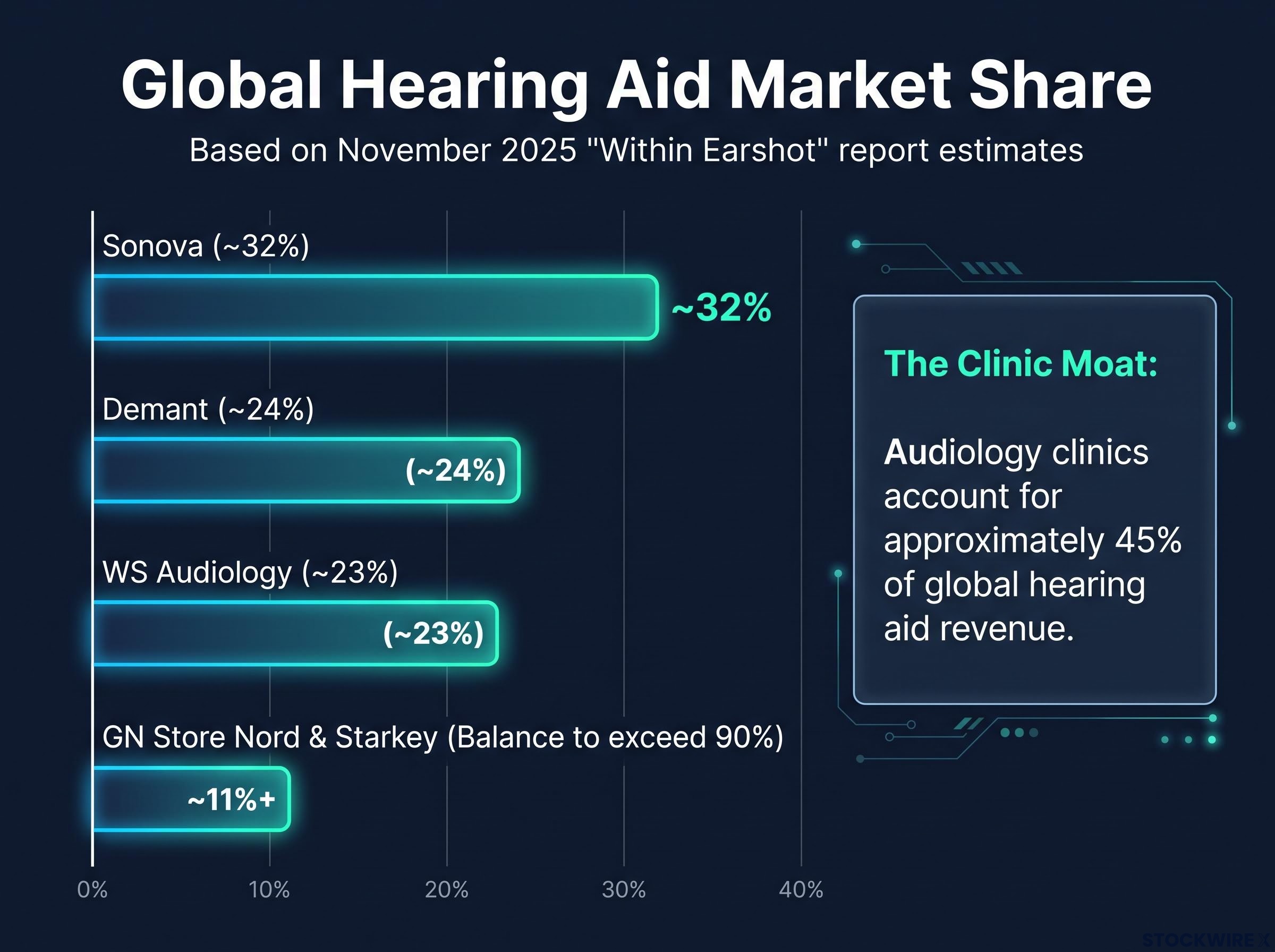
Sources disagree on the exact split. A September 2025 report from Global Market Insights put WS Audiology as the leader at 26.9% in 2024, with the top five holding 92.4% together. The American Economic Liberties Project’s November 2025 “Within Earshot” report gave a different breakdown, with Sonova at around 32%, Demant at 24%, and WS Audiology at 23%, still concluding the group controls close to 90% of the global product market.
| Company | Approx. global share (varies by source) | Primary clinic network | Core distribution mechanism |
|---|---|---|---|
| Sonova | ~24% to 32% | AudioNova | Owned audiological care clinics |
| Demant | ~19% to 24% | Hearing Care Alliance / Audika | Over 4,000 owned clinics worldwide |
| WS Audiology | ~18% to 27% | Signia / Widex retail | Branded clinical fitting channels |
| GN Store Nord | ~12% to 16% | JabraEnhance / GN Hearing | Hybrid clinical and remote counselling |
| Starkey | Balance to exceed 90% combined | Independent audiology partners | Professional fitting networks |
The obvious assumption is that this dominance came from superior engineering. It did not. It came from owning distribution.
Why the clinic was the product, not the channel
Audiology clinics account for approximately 45% of global hearing aid revenue, and the majors own those networks outright. Demant operated more than 4,000 clinics worldwide as reported in its FY2024 results, through its Hearing Care Alliance and Audika brands. Sonova runs its AudioNova chain on the same logic.
Here is why that matters more than any chip inside the device. A hearing aid had to be professionally fitted and calibrated, which made the clinic appointment mandatory rather than optional. The clinic was not a shop selling the product; it was part of the product itself.
That arrangement stayed stable for decades because regulation enforced it, not because consumers found it convenient. And that is exactly where the incumbents are exposed. Their moat sits at the clinic door, not the technology layer, which means the moment the need for an appointment disappears, so does the advantage.
When big ASX news breaks, our subscribers know first
What two FDA decisions changed, and why neither one reverses
Two regulatory actions redefined what a hearing device is allowed to be. They arrived two years apart, and the second carried far more weight than the first.
- October 2022, OTC framework. The FDA created an over-the-counter (OTC) hearing aid category, removing the prescription requirement for adults with perceived mild to moderate hearing loss. For the first time, retail and direct-to-consumer channels were legally open.
- 12 September 2024, Apple authorisation. The FDA cleared Apple’s Hearing Aid Feature through its De Novo pathway (a review route for genuinely new device types), making it the first over-the-counter hearing aid software the agency has approved. It reached users as a software update to AirPods Pro they already owned, with no appointment, no dedicated device, and no clinical fitting.
The asymmetry between those two moments is the point. The 2022 rule opened a door. Apple walked an installed base measured in hundreds of millions straight through it.
Apple did not compete with the clinic networks. It routed around them entirely. Bose and Eargo have since entered the OTC category, but the Apple action is categorically different in scale, because it activated hardware people already carried rather than asking them to buy something new.
The FDA’s De Novo authorisation of Apple’s Hearing Aid Feature established a new regulatory classification for hearing aid software, a determination that cannot be administratively unwound without congressional action and that permanently altered what consumer audio hardware is permitted to do.
The scale of unaddressed demand behind all this is enormous. The World Health Organization estimates approximately 1.5 billion people globally have some degree of hearing loss, with more than 430 million requiring rehabilitative services. The FDA puts roughly 30 million American adults in the mild to moderate range.
The early adoption data is more measured than the headlines suggest. The 2025 MarkeTrak 25 report found OTC introduction produced only a 4-percentage-point incremental increase in overall device adoption, while earbuds with hearing improvement features added an 8-percentage-point increase. Traditional prescription adoption held stable at roughly 39% over the past decade.
The incumbents have acknowledged the shift while defending their turf.
At its Capital Markets Day in March 2025, Demant’s management characterised OTC uptake as “limited,” arguing it increases technological access but does not replace professional, personalised care.
Growth figures for the OTC segment vary widely. Growth Market Reports (July 2025) estimated the global OTC market reached US$2.84 billion in 2024 with a projected compound annual growth rate of 7.8% through 2033. Research Nester (May 2025) put the 2024 figure far lower, at US$400.49 million, with a CAGR above 6.1%. An earlier claim of roughly 20% annual growth cannot be independently verified against these sources.
The takeaway is what neither figure can undo. A regulator redefining a medical device does not reverse, and Apple shipping hearing capability to hundreds of millions of existing devices does not reverse. For anyone making audio products, the competitive floor of this market has permanently moved.
The companies that just inherited a hearing problem (and the ones offering to solve it)
The interesting question is no longer what the incumbents are defending. It is what the new entrants suddenly need. Because the moment earbuds became legal hearing devices, an entire category of manufacturers acquired a hearing problem overnight, and almost none of them had the science to solve it.
Start with who is not the customer here. The five incumbents build their own technology at scale. Sonova’s Sphere Infinio platform, launched in August 2024 with real-time AI sound processing, is the clearest example, and Demant, WS Audiology and GN Store Nord are similarly self-sufficient in internal development. They will never license hearing algorithms from anyone.
The demand sits elsewhere. It sits with the companies now entering the OTC category with no clinical audiology expertise of their own:
- Consumer audio manufacturers adding hearing features to earbuds
- Television makers building speech clarity into their sets
- Headphone brands chasing the mild to moderate market
- OTC device builders assembling products from the ground up
These companies need hearing personalisation and speech enhancement that takes years of clinical expertise to build. That is where the licensing model enters. Instead of negotiating with every downstream manufacturer, an algorithm provider embeds its technology directly into semiconductor platforms, so every chip shipped already carries the capability.
The scale of that opportunity is concrete. Futuresource Consulting projects the market for hearing-assist audio at real volume.
A 2026 Futuresource Consulting whitepaper projects 61 million units of personal audio products with embedded hearing-assist features by 2026.
Several companies are competing to supply that layer, including Alango Technologies and Altitude Audio. What matters for the reader is timing: this licensing demand barely existed in commercial form before October 2022, which puts anyone who built the capability early at the very start of a demand curve.
AI hearing category valuations in private markets carry a useful calibration point: Fortell, a New York startup with minimal commercial revenue, attracted a US$740 million private valuation in July 2026, reflecting institutional conviction in speech enhancement technology that is broadly consistent with the structural demand this article describes.
Audeara’s position inside the shift
Audeara, a Brisbane-based audio technology company, is one company sitting inside this shift rather than the whole story of it. Its AUA Technology licensing division embeds algorithms directly into chip platforms, which is the semiconductor logic that removes the need to sign up manufacturers one by one.
The company reported record group revenue of approximately $4.45 million in FY26, of which AUA Technology licensing contributed roughly $1.68 million (all figures company-reported). North American revenue reached approximately $1.56 million.
Its OPTEK Microelectronics agreement advanced during FY26 from initial purchase orders of around A$31,000 to commercial production across two customer programs. A separate licensed manufacturing partnership with Taiwanese manufacturer Eastech opened access to the Chinese market with an initial order of 1,000 hearing aid licence keys, though no public evidence of follow-on volume exists yet.
The fee-per-chip licensing model that underpins this semiconductor strategy is capital-light by design: revenue scales with each unit shipped by the partner rather than requiring Audeara to carry manufacturing or distribution costs, which is structurally distinct from both the incumbent clinic model and the direct-to-consumer OTC approach.
Audeara also began a process in September 2026 to establish quotation on the US OTC market. The company has stated this involves no capital raise and no new securities, with the ASX remaining its primary listing. The application is subject to OTC Markets Group acceptance and is not guaranteed.
Its clinic footprint, reported at more than 3,000 locations globally and around 1,500 in Australia (company-reported and unverified), matters here as evidence of clinical credibility rather than as a distribution advantage. In a market where anyone can license a DSP algorithm, having operated inside audiology networks is a differentiator a pure software vendor cannot easily claim.
The scorecard, the counterweight, and what the open questions actually mean
Set against an earlier August analysis, four indicators tracked whether Audeara’s licensing intent was converting into a business. Two have moved. Two have not.
| Indicator | What was expected | Current status | Implication |
|---|---|---|---|
| Licensing revenue trajectory | Measurable division revenue | Moved (~$1.68M in FY26) | Intent has become recorded income |
| OPTEK deployment evidence | Progress beyond trial orders | Moved (A$31,000 to commercial production) | Chip-embedding model reached production |
| Eastech repeat orders | Follow-on volume in China | Not demonstrated publicly | Single order is not yet a pipeline |
| New partnership agreements | Fresh semiconductor or distribution deals | Not yet | Concentration risk remains |
A separate item fell outside the original framework. North American revenue of roughly $1.56 million arrived alongside a US OTCID quotation process built on no capital raise and no dilution, meaning commercial traction preceded the move toward investor access rather than the other way around, which is the sequence that carries more weight.
The US quotation process began in September 2026 with no capital raise and no new securities issued, meaning the commercial rationale rested entirely on the revenue trajectory already established, a sequencing that distinguishes it from the more common pattern of listing activity preceding commercial proof points.
What the two open indicators tell you is specific. Until licence volumes grow across multiple reporting periods and new partnerships are announced, this is a start rather than a track record. They are not red flags; they are the exact tests that separate a licensing business from a licensing aspiration.
Then there is the counterweight, and it is a real one. The same structural shift that opens demand for licensed hearing algorithms will attract other suppliers to the same opportunity. Companies that reach scale in this space will not do so unopposed. The competitive risks are structural:
- Larger audio technology licensors with deeper resources
- Semiconductor vendors with in-house DSP capability who can embed their own algorithms
- The incumbents themselves, should they decide to enter the licensing layer
Being early to the category, carrying clinical credibility that a pure software vendor cannot claim, and already sitting inside a semiconductor partner’s chip platform are genuine advantages, but none of them holds permanently. Each is a head start that competitors can close.
The line worth drawing is between what is settled and what is not. The market for embedded hearing personalisation exists; the FDA and Apple have confirmed that. Whether Audeara’s execution closes the open indicators over the next few reporting periods is a genuinely separate question.
Disclosure: StockWire X has a commercial relationship with Audeara.
This article is for informational purposes only and should not be considered financial advice. Investors should conduct their own research and consult with financial professionals before making investment decisions.
What the FDA settled, and what only execution can answer
The structural facts of this market are no longer in dispute. A regulator redefining a medical device does not reverse. Apple shipping hearing capability to hundreds of millions of existing devices, from 12 September 2024 onward, does not reverse either. These are settled conditions, not theses to be argued.
What remains open is company-level, and it is narrow enough to track precisely. Two variables will determine whether early positioning becomes a repeatable licensing business:
- Eastech follow-on volume across future reporting periods, beyond the initial 1,000 licence keys
- Whether materially new semiconductor or distribution agreements are announced
Both are forward-looking and carry genuine uncertainty. The US quotation process may not complete, and no projected revenue trajectory is guaranteed.
For anyone tracking companies at the intersection of hearing science and consumer audio, the frame has changed. The question is no longer whether a commercial market exists for embedded hearing personalisation. It is who builds the execution record to capture it, which makes Audeara’s next one or two reporting periods more informative than any single milestone announcement could be.
For investors wanting to understand how Audeara is extending its technology into adjacent markets beyond the OTC hearing aid category, our dedicated guide to Audeara’s Shokz distribution deal covers the bone conduction agreement targeting 600,000 Australian school-aged children through pre-funded government channels.
Past performance does not guarantee future results. Financial projections are subject to market conditions and various risk factors. Forward-looking statements are speculative and subject to change based on market developments and company performance.