
A sector rating upgrade from Neutral to ACCUMULATE, with target prices lifted materially across all three major Singapore banks, signals something more than routine analyst housekeeping. On 22 July 2026, Phillip Securities Research joined a broader street-wide reassessment of Singapore bank stocks, pointing to a convergence of forces that have not lined up this clearly in several years.
The upgrade lands as Singapore system loan growth runs well ahead of prior bank guidance, the SORA rate cycle shows early signs of bottoming, and non-interest income streams hold up despite a lower-rate environment. For investors who have been watching the sector from the sidelines while share prices pushed toward record highs, the question is no longer whether the fundamentals have improved but whether current valuations already price in that improvement.
This analysis walks through each driver behind the re-rating, sizes the conviction behind DBS, OCBC, and UOB individually, and surfaces the residual risks that determine whether the bullish thesis holds. Here is the framework for deciding where, and whether, this sector fits your portfolio right now.
What changed to trigger the upgrade right now
Phillip Securities Research upgraded its rating on the Singapore banking sector to ACCUMULATE from Neutral on 22 July 2026, raising target prices across all three major banks simultaneously.
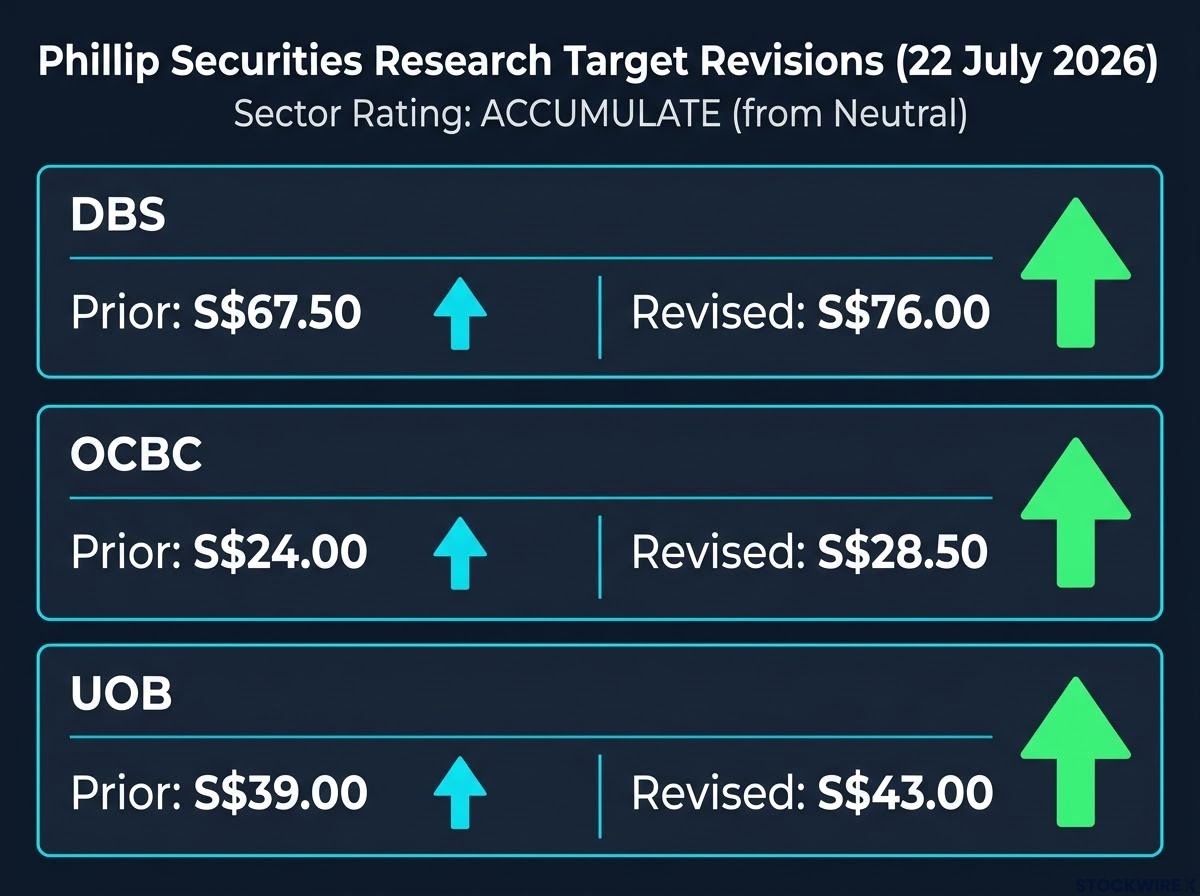
Sector rating change: ACCUMULATE from Neutral, effective 22 July 2026, covering DBS, OCBC, and UOB. The report was auto-generated using PhillipGPT based on Phillip Securities Research analyst research.
| Bank | Prior Target (S$) | Revised Target (S$) | Implied Upside Context |
|---|---|---|---|
| DBS | 67.50 | 76.00 | Wealth franchise strength, earnings visibility |
| OCBC | 24.00 | 28.50 | Excess capital optionality, wealth growth |
| UOB | 39.00 | 43.00 | Macro tailwind participation |
This is not one broker acting alone. Macquarie and Citi have also reportedly moved target prices higher and upgraded calls as part of a broader July 2026 re-rating wave, though these actions have not been independently confirmed. When multiple houses move in the same direction at the same time, the signal-to-noise ratio climbs meaningfully above what a lone upgrade typically carries. Three converging forces made this the inflection point: loan growth running ahead of guidance, rate stabilisation signals, and resilient fee income. For an investor evaluating whether to act, the street alignment here matters as much as any single price target.
The Singapore market rally has structural foundations that go beyond sentiment: a S$66 billion deposit surge into local banks in March 2026, approximately seven times the prior five-year monthly average, provided measurable capital backing for a move that sceptics have consistently underestimated.
When big ASX news breaks, our subscribers know first
How the SORA rate cycle is shaping bank earnings visibility
The rate narrative has dominated Singapore bank sentiment for two years. Where it sits now directly determines how much confidence investors can place in forward earnings estimates.
SORA, the Singapore Overnight Rate Average, is the benchmark interest rate that underpins most floating-rate loans in Singapore; when it moves, bank net interest margins (the difference between what banks earn on loans and what they pay on deposits) move with it. Three data points tell the current story:
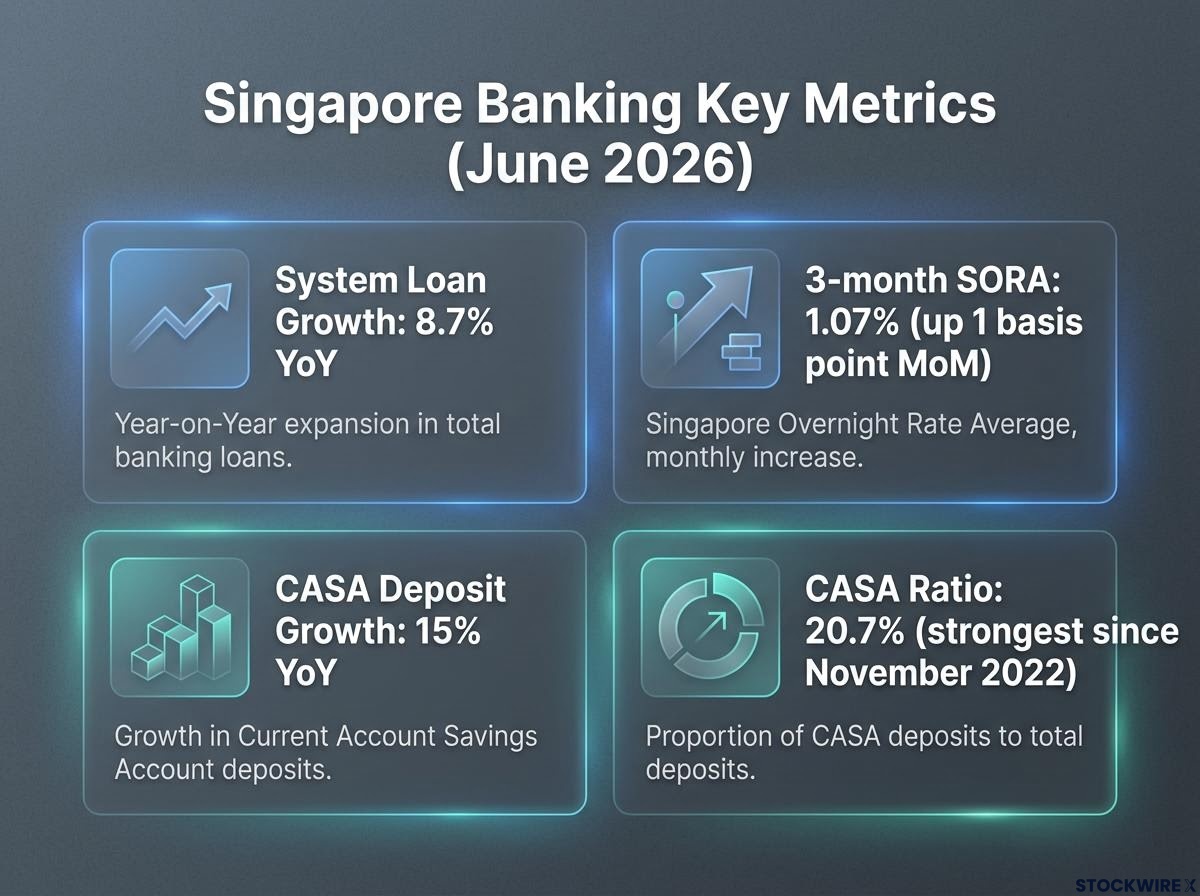
- In June 2026, the 3-month SORA moved up by 1 basis point on a month-on-month basis, settling at 1.07%
- At 109 basis points, the year-on-year decline was the most modest seen across the prior 15-month window, pointing toward a rate floor
- The rate has now posted back-to-back monthly gains, indicating a potential inflection in the rate cycle
The Fed connection
The Federal Reserve’s June 2026 projections turned more hawkish, with no rate cuts pencilled in for end-2026 in the base case. That matters directly for Singapore because SORA tracks global short-term rate trends. A Fed that stays higher for longer removes one of the largest overhangs on the sector.
The risk caveat is straightforward: if the Fed pivots back to dovish on growth concerns, or if local liquidity remains excessively abundant, SORA could resume drifting lower and revive margin compression worries. But for now, the direction of travel is constructive. Rate stabilisation does not mean margin expansion; it means the earnings floor is becoming visible, which is precisely what removes the overhang that had kept conviction low.
The SORA rate trajectory matters beyond the banking sector: Phillip Securities’ concurrent OVERWEIGHT call on S-REITs, issued in late June 2026, rests on the same 110 basis point decline in 3-month SORA that is now stabilising, with approximately 80% of SGD-funded trusts expected to see financing costs hold steady or fall in the second half of 2026.
Loan growth and deposit quality: the mechanics behind the earnings upgrade
System loan growth came in at 8.7% year-on-year as of June 2026, clearly above the low-to-mid single-digit guidance banks had previously communicated. This outperformance is being driven by:
- Stronger trade finance activity
- Regional corporate lending
- Continued infrastructure financing across ASEAN
8.7% year-on-year system loan growth against prior bank guidance of low-to-mid single digits. Revised sector assumptions now sit at approximately 6-7%, up from roughly 5% previously.
That gap between what banks guided and what actually materialised explains the scale of the target price revisions. When volume growth runs this far ahead of models, earnings estimates move with it.
Credit quality as the key validation point ahead
The deposit side reinforces the quality signal. CASA deposits (current account and savings account balances, which are the lowest-cost funding source for banks) expanded 15% year-on-year. The CASA deposit ratio climbed to 20.7% by June 2026, advancing from 20.5% recorded in April and marking its strongest reading since November 2022. A rising CASA ratio means more lending is funded with cheaper deposits, which cushions residual pressure on net interest margins.
The combination of loan growth running well above guidance and a CASA ratio at a multi-year high tells you the earnings upgrade has a structural quality dimension, not just a volume one. But the pace of expansion raises underwriting discipline questions that deserve equal weight. An 8.7% growth rate is well above trend, and the bullish case requires non-performing loan (NPL) ratios to hold when banks report upcoming quarterly results. This is not a reason to reject the thesis. It is a condition that needs monitoring.
MAS banking system statistics, published monthly through the Monetary Authority’s statistical bulletin, are the primary data source underlying the system-level loan growth and CASA deposit ratio figures that drove the revision in sector earnings assumptions for mid-2026.
Fee income and the wealth management engine powering non-interest earnings
The same geopolitical instability that investors might view purely as a macro risk is also generating revenue for Singapore banks. The collapse of the US-Iran ceasefire and the subsequent surge in oil prices have pushed market volatility sharply higher, and that volatility feeds directly into three income streams:
- Wealth management fees from increased client activity and portfolio rebalancing
- Capital markets income from higher trading volumes and deal flow
- Trading and hedging revenues as corporates and institutional clients increase their hedging activity
DBS and OCBC are specifically identified as the primary beneficiaries. Their wealth management franchises convert volatility into fee income in a way that UOB’s relatively less differentiated fee business does not replicate to the same degree.
Singapore’s structural wealth story as a durable earnings base
Beneath the cyclical volatility component sits a structural trend that does not depend on market swings to sustain growth. Singapore continues to attract family offices, private banking inflows, and assets under management growth as a regional wealth hub. For DBS and OCBC, this is both a current and forward earnings driver: the wealth management business generates fee income regardless of rate levels, providing an earnings buffer that partly explains the relative conviction gap between these two banks and UOB in current analyst coverage.
Fee income resilience is what prevented Singapore banks from experiencing the earnings deterioration many investors feared as rates fell. Understanding this mechanic is what makes forward consensus estimates credible rather than aspirational.
Dividends, buybacks, and the income-plus-growth case
The sector offers three distinct capital return levers, and they layer on top of each other:
- Regular dividends: The sector carries a dividend yield of approximately 4.1%, according to Phillip Securities (July 2026). A secondary reference from Perplexity cites a range of 4-5%, which is broadly consistent.
- Share buybacks: Active repurchase programmes across the sector improve return on equity mechanically and add EPS uplift over time, functioning as a structural earnings enhancer rather than a discretionary management gesture.
- Excess capital optionality: OCBC’s capital position stands out specifically, providing room for special dividends, acquisitions, or further buybacks that sit outside the baseline income case.
Dividend yield across the sector stands at roughly 4.1% per Phillip Securities (July 2026), supported by share repurchase programmes running concurrently at all three banks.
A 4.1% yield with active buybacks and excess capital optionality tells you this is not a sector where you are being asked to choose between income and growth. The structure currently offers both. OCBC’s excess capital adds genuine surprise potential that is absent from investments where the entire return story depends on rates. For investors seeking an income-plus-growth setup in regional banking, the capital return architecture here is one of the cleaner versions available in mid-2026.
Singapore income investing across both banks and REITs shares an analytical parallel: just as a headline dividend yield on bank stocks can obscure whether the payout is backed by durable earnings, PhillipCapital analysts have identified financial discipline and fundamental quality as more important than targeting the highest available yield when evaluating Singapore REIT income sustainability.
This article is for informational purposes only and should not be considered financial advice. Investors should conduct their own research and consult with financial professionals before making investment decisions.
Where the risks sit now that share prices are at record highs
The bullish case has been made. Here is where it breaks.
With share prices at or near record highs for all three banks (reports suggest DBS may have crossed S$70 and a $200 billion market capitalisation, though these figures have not been independently confirmed), the investor question shifts from survival risk to valuation risk. Improving fundamentals need to continue outpacing already elevated expectations, and that is a higher bar than simply improving from a trough.
The four risks, ranked by their current weight on the thesis:
- Valuation risk: Record prices require continued fundamental outperformance relative to expectations that have already been revised upward. This is the most immediate challenge.
- Rate path uncertainty: A Fed pivot back toward dovishness, driven by growth concerns, could cause SORA to resume drifting lower and revive the margin compression narrative.
- Credit quality under rapid loan growth: System loan expansion at 8.7% is well above trend. Underwriting discipline under that pace of growth is unproven until NPL data arrives.
- Geopolitical and macro shocks: The same volatility that currently supports trading revenue could, if it escalates materially, suppress trade flows, investment activity, and credit demand across the region.
Credit quality under rapid loan growth is the stress point US banks are also navigating: JPMorgan management has acknowledged a credit cycle is coming, late-stage auto delinquencies are rising, and savings buffers have eroded below pre-pandemic norms, providing a comparable risk framework for assessing whether Singapore’s 8.7% system loan expansion remains disciplined.
The first three risks are sector-wide. But UOB’s relatively lower fee income differentiation makes it more exposed to the rate and credit variables than DBS or OCBC, whose wealth franchises provide a partial buffer.
Monitoring points for the forward earnings cycle
Two upcoming data releases will test the thesis directly. Quarterly bank results, expected in the coming weeks, will provide the first hard NPL and asset quality validation of whether the 8.7% loan growth pace is being managed with appropriate underwriting discipline. Any shift in Fed policy signals, particularly following upcoming Federal Open Market Committee meetings, would alter the SORA trajectory and with it the margin outlook that underpins the entire re-rating.
What the upgrade signals and where the higher-conviction positions sit
The three drivers behind this re-rating reinforce each other in a way that makes the thesis stronger than any single component. Loan growth running ahead of guidance increases earnings volume. SORA approaching a floor gives those earnings visibility. Resilient fee income provides a buffer if either of the other two drivers softens. That convergence, not any individual data point, is what moved the street.
Within the sector, the conviction is not evenly distributed. DBS (target S$76.00) and OCBC (target S$28.50) carry the stronger cases: wealth franchise strength, earnings visibility, and in OCBC’s case, excess capital optionality that creates room for positive surprises. UOB (target S$43.00) participates in the same macro tailwind but attracts less differentiated enthusiasm from analysts.
The ACCUMULATE rating is not a maximum-conviction buy. It is a clear directional positive, backed by converging fundamentals and a sector dividend yield of approximately 4.1% that provides an income floor while the growth case plays out. The honest framing for the investor decision is this: the upgrade is well-supported, but entry at record prices requires accepting that continued fundamental outperformance relative to already elevated expectations is the bar the sector now has to clear.
Past performance does not guarantee future results. Financial projections are subject to market conditions and various risk factors.
—